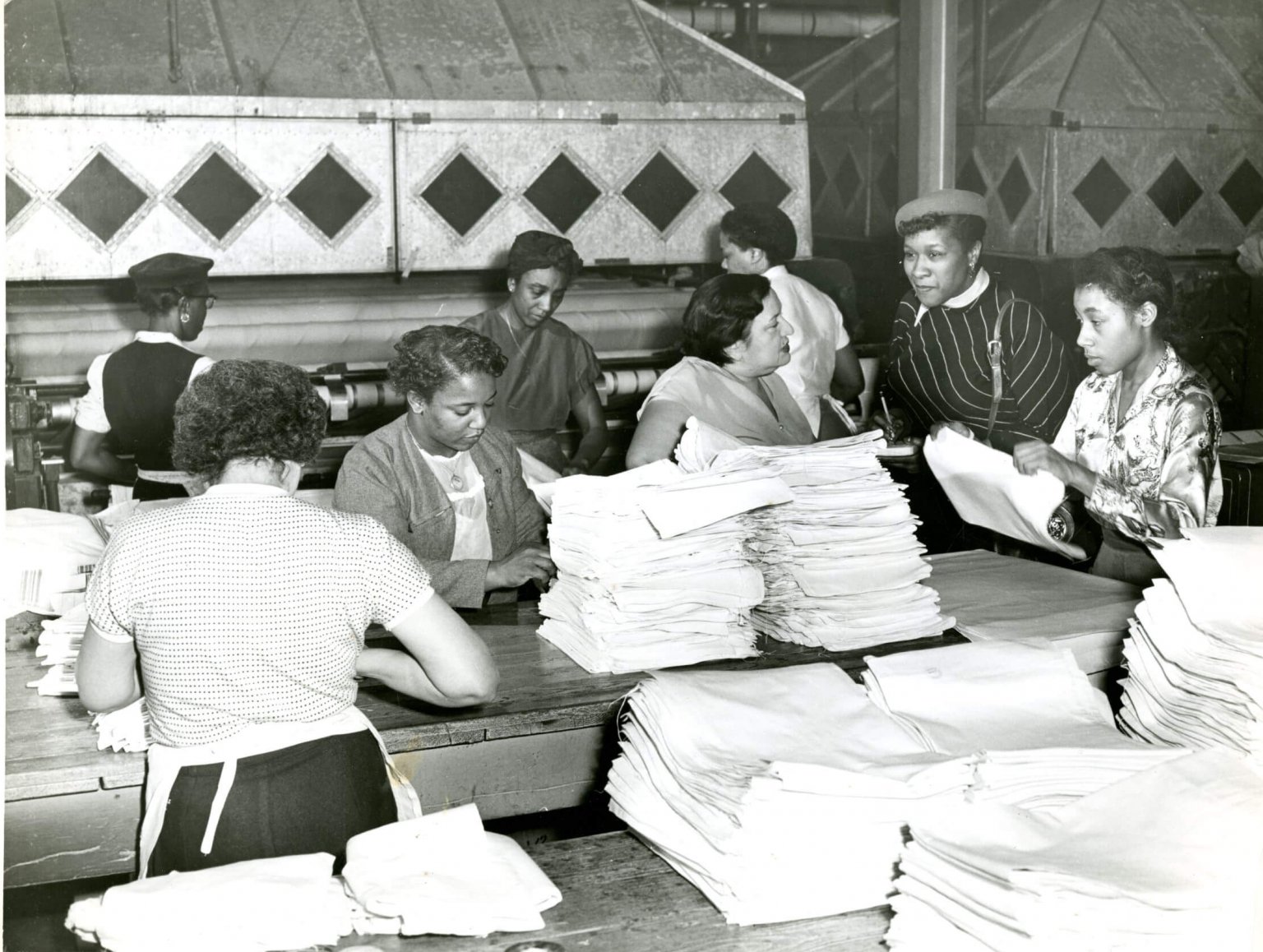
How the T.U.U.L.-affiliated Laundry Workers Industrial Union came to be.
‘Laundry Union Born in Fight on Racketeers’ from The Daily Worker. Vol. 10 No. 136. June 7, 1933.
Has Led Militant Fight Against Bosses
Racketeers can be smashed! The brief history of the Laundry Workers Industrial Union, now numbering 1,100 members, proves this. The 50 workers who formed the nucleus of the union in 1931 were directly drawn from the Greater New York Laundry Workers Union and Cooperative,” organized under a state charter by the notorious racketeer, Larry Fay.
This racket was instituted by Fay when he learned Laundry Union that 50,000 workers could be “organized” to pay him weekly dues of $2. By boasting of his political pull, which he claimed would win strikes and settle disputes, Fay bamboozled 500 laundry drivers into signing up. Later, he started a “strike” in the Lux Laundry, but failed to “deliver the goods” when the Seabury investigation interfered with his activities.
It was then that an opposition of militant workers was started in Fay’s organization and their efforts bore fruit by September, 1931. When 18 insurgent shop chairmen, representing practically the whole union, held a meeting in the home of a union member, Fay, in alarm, communicated immediately with the Laundry Owners Association. From the employers’ outfit he received $17,000. He then called a final meeting of his organization dissolving it. Fifty workers attending this meeting got together to lay the nucleus for the Laundry Workers Industrial Union.
Union Wages First Battle
When gangsters beat up the shop chairman at the Active Laundry, the union called its first strike. The strike, called in November, 1931, lasted six weeks. In its conclusion the union membership doubled to over 400 in February, 1932.

Since that time the union has conducted a number of strikes revolving around wage cuts, payment for over-time and against the firing of workers. In some cases the mere threat of a strike has won the demands of the shop committees. Such struggles were those at the Superfine Laundry in April, 1932, and the Jennings and Fairway Laundry strikes in October. All three started when one of the drivers was fired. And all three were victorious.
As a result of these successful battles, shop committees were recognized in six other laundries until at present, the union has organized drivers and inside workers who have won recognition in 20 shops.
Pretty Laundry Strike
The Pretty Laundry strike, lasting three months, has been the most bitter light yet conducted by the Laundry Workers Industrial Union. Despite daily battles with gangsters led by the bosses and the arrest of workers, mass picket lines were on the job every day. The strike was significant for it marked the first time that inside workers struck and over a proposed wage cut.
The Daily Worker began in 1924 and was published in New York City by the Communist Party US and its predecessor organizations. Among the most long-lasting and important left publications in US history, it had a circulation of 35,000 at its peak. The Daily Worker came from The Ohio Socialist, published by the Left Wing-dominated Socialist Party of Ohio in Cleveland from 1917 to November 1919, when it became became The Toiler, paper of the Communist Labor Party. In December 1921 the above-ground Workers Party of America merged the Toiler with the paper Workers Council to found The Worker, which became The Daily Worker beginning January 13, 1924. National and City (New York and environs) editions exist.
PDF of full issue: https://www.marxists.org/history/usa/pubs/dailyworker/1933/v010-n136-NY-jun-07-1933-DW-LOC.pdf
 Revolution's Newsstand