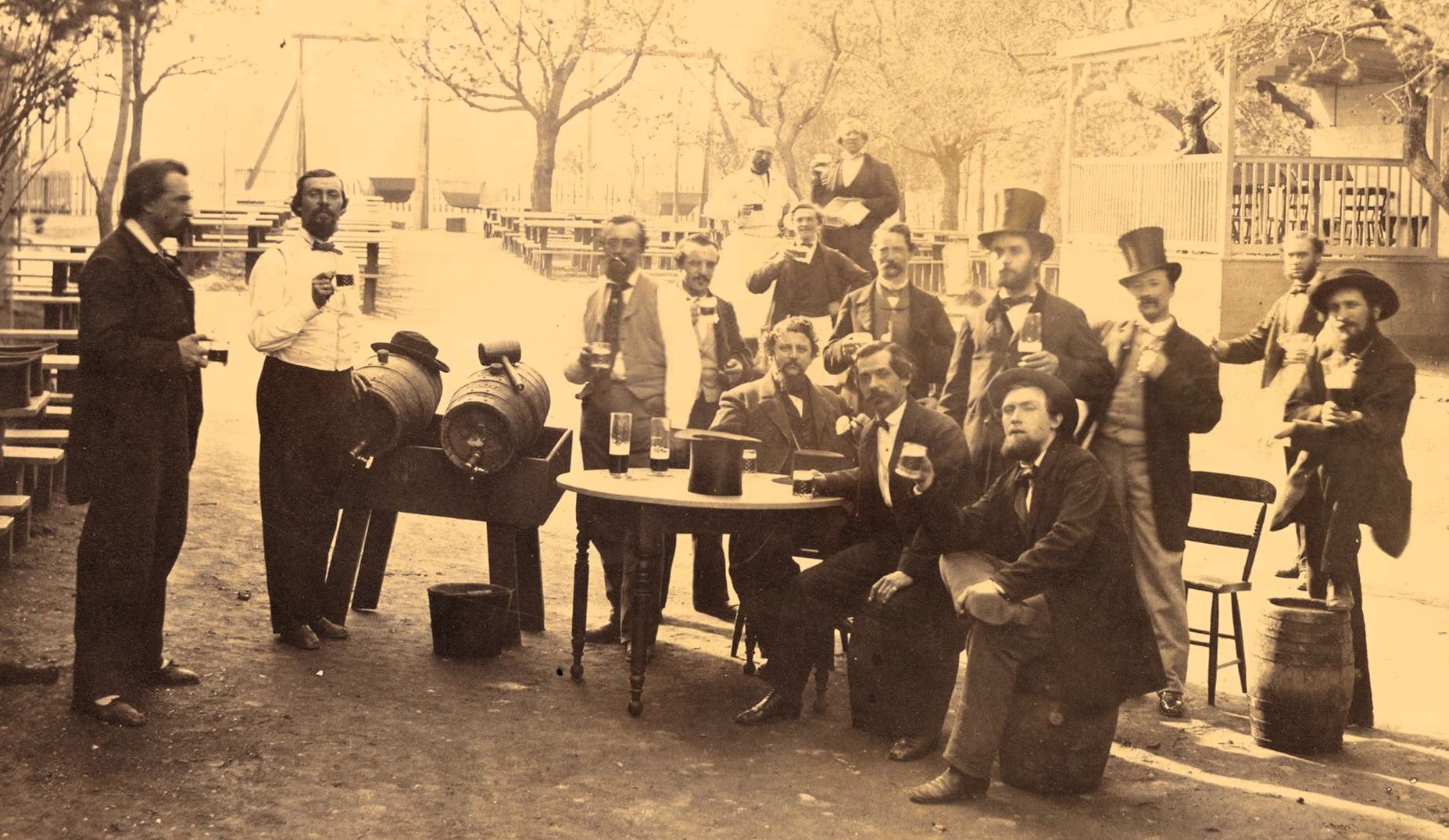
An absolutely fascinating social history of brewing in the U.S. looking at the period between the establishment of the United States and the Civil War; how the Founders made war on spirits, the role of German immigration, the coming of lager, and the birth of a national industry. Written by Engels’ correspondent, the Marxist historian and Brewery Workers’ leader Herman Schlüter, this is the third chapter of his large, invaluable, history of the industry and its unions in the United States
‘The Modem Beer-Brewing Industry’ by Hermann Schlüter from The Brewing Industry and the Brewery Workers’ Movement in America. International Union of United Brewery Workmen of America, Cincinnati. 1910.
1. THE BEGINNINGS.
THE American Revolution had put an end to commercial intercourse between England and her former colonies. The sea traffic with other countries was also interrupted by the English war ships, and the importation of goods from overseas was very small.
The very small quantity of beer which had heretofore been imported from England by the colonies was also cut off, and consequently the beer-breweries in this country began to revive somewhat, especially in Pennsylvania and in the state of New York a few small breweries started up again.
However, there was still but little demand for brewed beverages. Spirits was still the common drink, and the consumption of rum and similar liquors was still great in 1809, when it amounted annually to 18.08 quarts per capita of the population. Of fermented drinks — beer, ale and porter — there was consumed at that time 4.98 quarts per capita.
The enormous consumption of spirits aroused opposition among the people, and in the legislatures numerous propositions began to be advanced to stem the evil. More considerately than our present temperance advocates, they did not demand the complete prohibition of all alcoholic drinks, but sought to combat the harmful excessive consumption of spirits by promoting the production and use of beer.
This movement started in Philadelphia, and it was here that beer-brewing first began to revive, so that the breweries soon increased in number and the quantity of beer produced in Philadelphia surpassed that of all other ports in the United States. James Madison and Thomas Jefferson were decidedly in favor of the promotion of beer-brewing in order to diminish the consumption of spirits. In each session of Congress in the two decades after the adoption of the Constitution, measures were considered and adopted which were intended to promote beer-brewing and restrict the consumption of spirits. The legislatures of the various states also took this matter into consideration. In 1789 Massachusetts passed a law “for the promotion of the manufacture of beer,” according to which breweries which produced yearly more than 100 barrels of beer or ale for a period of five years were freed of all taxes. One of the reasons given for this law was that beer-brewing not only promoted agriculture, but that beer was the most suitable means for combating the injurious effects of spirituous liquors.
In New Hampshire also a similar law was enacted in 1792, which freed breweries from all taxes for ten years. In the preamble of this law it was expressly stated that the purpose was to discourage the use of distilled liquors in order to elevate the morals and health of the people through the consumption of beer.
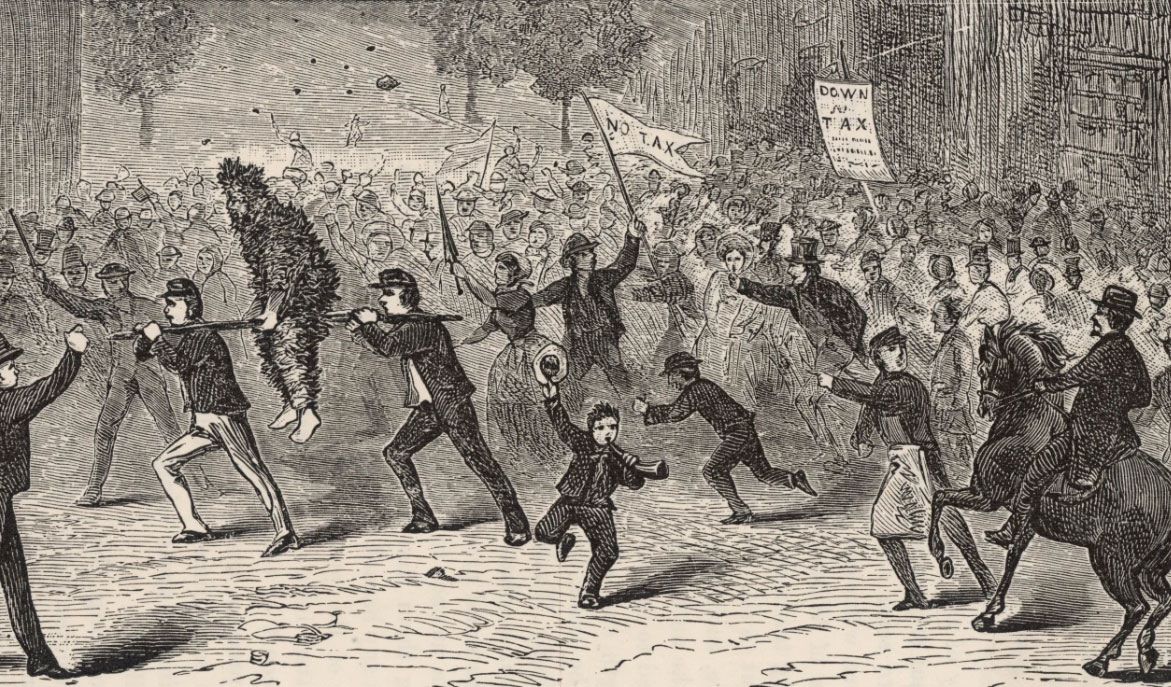
Hand in hand with the enactment of laws intended to promote beer-brewing came others which made more difficult the distilling of spirituous drinks. This was especially effected through heavy taxation of distilleries. Distilling, however, was still conducted with great profit and was so wide-spread that in certain parts of Pennsylvania each farmer was at the same time a distiller. The laws which were directed against distilling caused bitter opposition and their enactment resulted in open resistance in Western Pennsylvania, which is well known as the “Whiskey Rebellion.” Any farmer who expressed himself as willing to pay the whiskey tax was terrorized.
The movement against the payment of the tax in some parts assumed the character of an open insurrection against the government. The tax collectors were prevented from performing their duty by threats and violence. The tarring and feathering of such officials became a daily occurrence. Acts of violence were committed in which lives were lost and property ruined on a large scale. The movement took on such proportions that the government sent troops which were directed by George Washington himself. The leaders of the insurrection had gathered seven thousand armed men, but they all dispersed when the troops prepared for an onslaught.
The tax law which provoked the Whiskey Rebellion remained in force for several years, and it accomplished its purpose, for while it existed the number of whiskey distilleries was greatly decreased. When the law was repealed the distilleries again revived, and in the first decade of the nineteenth century the farmers in all the grain-raising states again took up distilling.
Nevertheless, the legislative measures had encouraged the revival of beer-brewing. In 1774 an ale-brewery was founded by Joseph Potts in Philadelphia, which developed vigorously during the Revolutionary War. In 1787 the breweries of Philadelphia consumed yearly 40,000 bushels of malt, and as a result of the general revival of business in the following year Philadelphia doubled its production of beer and porter. The price of Philadelphia beer at that time was thirty shillings per barrel. The porter of Philadelphia, especially, stood in very good repute. It was considered better than the famous London porter and was exported to China and the East Indies. A sample of Philadelphia beer was shipped to China and returned to Philadelphia, and it was found that it had not been affected in the slightest degree by the voyage.
Outside of Philadelphia also beer-brewing developed during the last decade of the eighteenth century, especially among the German population. Lancaster had a brewery as early as 1786. In Reading a brewery was erected by Joseph Hoch, in 1798. And even in the then distant Pittsburg we find traces of the manufacture of beer in 1795.
In the state of New York, also, there developed about this time the beginnings of beer-brewing, especially at Hudson, while the city of New York made little or no progress. In Hudson the first brewery of New York was re-established in 1786. Its owner was Benjamin Faulkins. In New York City Coulter’s brewery, also called the Old Brewery, was erected in 1792, at the place later called Five Points. In Troy brewing began in 1793. In Albany, which in former times had a very good reputation for its beer, the first brewery of modern times was established in 1796 by James Boyd. This first brewery in Albany was able to turn out 4,000 barrels a year. In Poughkeepsie, also, a brewery was started about this time. James Vassar, who had learned the art of brewing in England, came to Poughkeepsie in 1793 and began his brewing activities in 1797. At first the quantities produced were not large. He brewed about fifteen gallons a day, which was sold on the streets to neighbors and farmers. This was the beginning of a brewery which in 1848 produced on the average 20,000 barrels of ale, beer, and porter yearly.
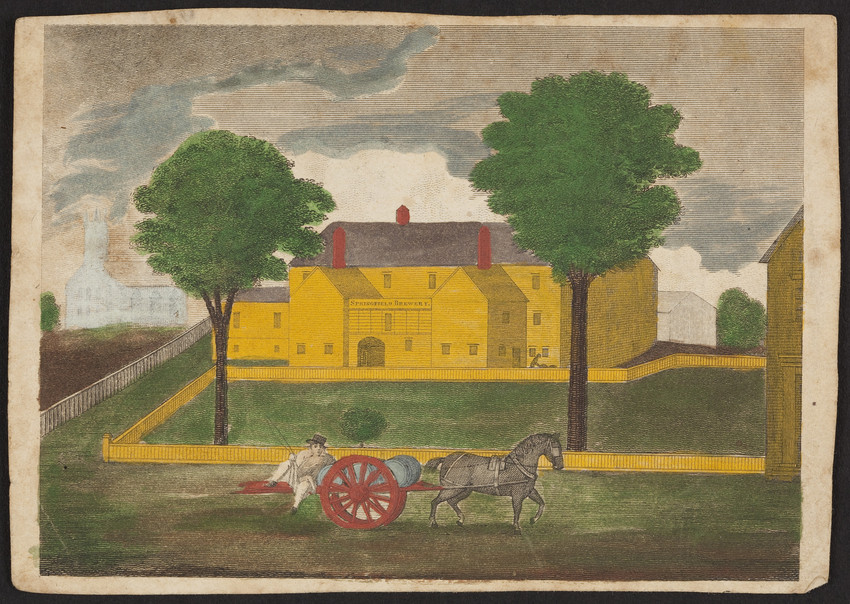
The first brewery in New Jersey was established at Newark in 1805. The founder was John N. Cunning. This is the establishment which later passed into the hands of the Ballantine family.
The progress of the industry was slow, but nevertheless there was progress. In 1810, we find in the United States one hundred and twenty-nine breweries, distributed through ten states. The farthest west of these states was Ohio. The total product of these breweries in beer.
ale, and porter amounted to 182,690 barrels, representing a money value of $955,761. Pennsylvania stood at the head, with forty-eight breweries, with a production of 71,263 barrels. Then followed New York, with forty-two breweries, producing 66,896 barrels. Massachusetts also deserves mention, producing 22,400 barrels. All the other states produced less than 10,000 barrels a year. New Jersey had at that time six breweries, Ohio thirteen, Maryland and Virginia each seven, Delaware two, Georgia one, and the District of Columbia three.
After the first decade of the nineteenth century the brewing industry began to develop more rapidly, especially in New York and Pennsylvania, where the immigration of beer-drinking people increased the beer consumption. In 1823 there were fourteen breweries in Philadelphia. In 1814 a German named Georg Michel Brobst erected a brewery in Reading, Pa. In Pittsburg, Joseph Wainwright started brewing on a larger scale in 1818. In 1831 another brewery was established in the same place by John N. Straub, who delivered beer to his customers with a pushcart. In the state of New York the brewing industry revived, especially in Albany. In 1820 there existed there already four breweries, among which was the one established by Fiddler & Taylor in 1822, which was the largest in the United States at that time. The capacity of this brewery was 250 barrels a day. Another of the Albany breweries was the one erected by Uri Burt in 1819. In 1851 the Burt brewery produced 50,000 barrels a year. In Oneida County, N. Y., we also find a brewery in operation as early as 1810.
In the city of New York the progress of brewing was slower than in other parts of the state. Here we do not find a new brewery until 1823, when the Croton brewery was established, owned by Miles & Bacon. In 1825 Abraham Nash established a small brewery in Troy, out of which later developed, in 1845, the brewery of Nash, Beadleston & Co., of New York City.
In Buffalo the first brewery was started in 1830, the owner of which was Jacob Roos. This was the beginning of the present Iroquois Brewing Company. In Utica, N. Y., also a brewery was established at about this time, which later became the Oneida Brewing Company. That was in 1832. Somewhat later another brewery was set up in the same place by Michael McQuade.
In the New England states the development of the brewing industry was slower than in Pennsylvania and Western New York, probably because of the fact that the immigration of beer-drinking peoples, especially Germans, was at that time not directed toward New England. Nevertheless, we find breweries in Massachusetts in the twenties of the nineteenth century. In Charlestown in the year 1821 the first brewery was established by John Cooper and Thomas Gould. This later developed into the Bunker Hill brewery. In South Boston the Boston Beer Company was founded in 1828. The first brewery in Providence, R. I., was erected by Otis Holmes in 1835.

In the meantime the white population pressed west-ward, and fertile farms and small villages blossomed in places heretofore trodden only by the red man. The political movements of the thirties drove a mass of people across the sea, especially of South Germans, and these helped to settle the northwestern part of the United States. This element remained true to its old habits of life, and as a result of this immigration, which in 1848 became a veritable stream^ we find breweries started up all over the West. The farther west the German immigration went the farther west extended the beer-brewing industry, which was a regular accompaniment of this immigration.
The names of the first breweries in the West show that foundations of this industry in that region were laid by Germans.
In Ohio German settlers had begun beer-brewing in 1817. These were religious communists, who had founded the colony of Zoar. This colony had a brewery in its settlement. It is said that in Cincinnati small breweries existed in 1809 and 1811, but historically this fact cannot be verified. In 1828 another brewery is said to have been established in this city, which later developed into the Walker Brewing Company. In 1836 the City Brewery was established there, which was owned by G. M. Herancourt. This brewery in its first year had a capacity of fourteen barrels a day, which was increased in the second year to forty-five barrels. A few years earlier, in 1832, two breweries had been established in Cincinnati, the Jackson Brewing Company and the brewery of Peter Jonte. With the arrival of German immigrants in Cincinnati the consumption of beer and the beer-brewing industry rose. In 1840 more than a quarter of the population consisted of Germans, and the number of breweries therefore was increased in that year to eight. In the other parts of Ohio brewing was developed early. In 1830 we find a brewery in Canton which was owned by T. C. Nighman. In the middle of the thirties L. Hoster and I. Silbernagel had already established breweries in Columbus. In 1837 Kroener & Rice established a brewery in Evansville. In 1838 John Vogelsang started a brewery in Toledo and in 1844 the first brewery was established in Baltimore, by Jacob Medtart.
In Indiana Jacob Salmon founded the first brewery in Madison in 1823. In 1841 this met with competition from the Scheik brewery. In Terre Haute the first brewery was founded in 1835 by George Hager. In Erie, Pa., the Diez brewery in 1830 was the first. It is said that in West Virginia there was a brewery in Wheeling as early as 1822, but it is certain that in 1845 George W. Smith erected a brewery in that city.
In the city of New York the year 1840 was of importance for the brewing industry, because it was then that the water of the Croton River was brought into the city, and with this one of the principal obstacles of the development of brewing was removed. In this year the brewery of George Gillig, a Bavarian, was started, at Fifth avenue and Fifty- third street. In 1842 two brothers started the Schaefer Brewery. In the same year the Johnson Brewery was started in Brooklyn. In 1846 Joseph Doelger erected his brewery in New York, and in 1848 another one was built by John Noller.
In the state of New York also, especially in the northern part, brewing began to develop about this time. In Rochester the first brewery was built in 1845 by Hathaway & Gordon. In Buffalo the second brewery was established in 1840 by J. F. Schanzlin & Hoffmann. Soon after this, in the same city, the breweries of J. Friedman and Gerhard Lang were started. On the whole, brewing developed in the state of New York to such a degree that in 1845 there existed 102 breweries.
Further west we find in the forties the foundation for the great brewing establishments which existed there later. In Chicago there was a small brewery in 1833, which was owned by William Lill, and in 1840 another brewery was established. But it was not until the middle of the forties that the Chicago breweries got a good start. In 1847 the brewery of A. Huck & John Schneider was started, which developed into a great enterprise. In Northern Illinois, in Galena, there existed two breweries in 1843. In Quincy, in the same state, Anton Delabar founded a brewery in 1840. In 1842 Alton already had a brewery which had been built by George Yackel.
The brewing industry of Milwaukee started in 1840, when Hermann Reidelshofer erected the first brewery. This later passed into the hands of Philip Best & Co. In the same year R. G. Owens started a second brewery, and a third was established in 1842 by Conrad Muntzenberger. In 1844 Jacob Best founded a small brewery, which later developed into the large Pabst establishment.
At the same time the foundations of the beer-brewing industry were laid in St. Louis. Distilling had been carried on in that city since 1811, and to such a degree that no less than 18,000 barrels of whiskey were produced in 1840. Up to this time beer-brewing was not practiced very much, but in 1840 there existed a brewery which belonged to one McHose. At the beginning of the forties Stiefel & Winkelmeyer founded the Union Brewery. Somewhat later the Washington Brewery was founded, and in 1845 there were already six breweries in St. Louis, of which the largest had a capacity of twenty-five barrels a day.
In Iowa beer-brewing was started in 1845, in which year Tschirgi put up the first brewing kettle in Dubuque. In St. Paul, Minn., the erection of the A. Yoerz’s establishment started the brewing industry in 1848, and two years later, in 1850, the first brewery was built in St. Paul’s sister city, Minneapolis, by John Orth.
In the four decades, from 1810 to 1850, the number of breweries in the United States had increased from 129 to 431, and the product from 5,754,737 gallons to 23,267,730 gallons. Still, the brewing industry, in the main, was concentrated in two states, Pennsylvania and New York. The breweries of these two states in the year 1850 produced 18,825,096 gallons; the breweries of all the other states, 4,442,634 gallons. Up to that time brewing as an industry had developed only in these two states.
2. LAGER BEER.
Until the early forties of the nineteenth century, all the beer brewed in America aside from the different kinds of small beer, was the sort known today as ale and porter. Lager beer, which had been brewed in Germany since the thirteenth century, was not known in America.
Lager beer requires slower fermentation, because it has to be brewed stronger in order to keep better. It also requires a lower temperature for its production than porter and ale. At a time, therefore, when artificial ice and cooling machines were not known and cooling places had to be provided by making cellars in the rock, the preparation of lager beer was more expensive than the other kind. In addition to this, yeast, which is necessary for the fermentation of lager beer, was not known in America; and as ships took such a long time in crossing the ocean, it was not practicable to import yeast, as it was thought that it would not keep so long. These are probably the reasons why lager beer was not introduced into America at an earlier date, although even at that time there were large numbers of German immigrants who had made their homes in America and who were acquainted with lager beer and would surely have preferred it to that brewed according to the English method.
The exact time when lager beer, brewed according to the German method, was introduced into America is not known, nor is it certain who was the first person to brew lager beer in this country.
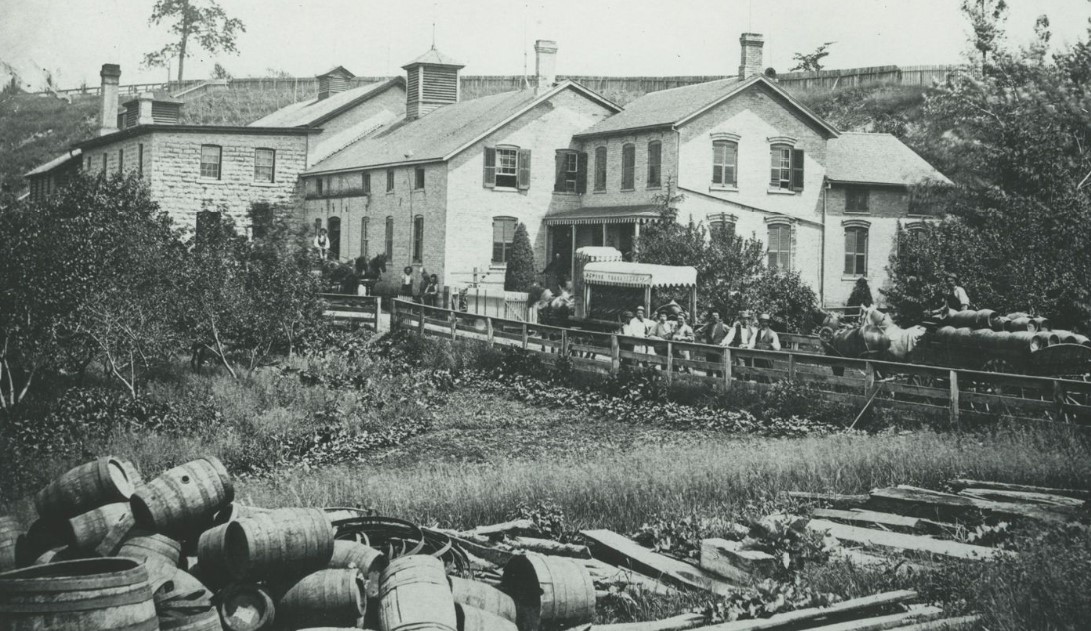
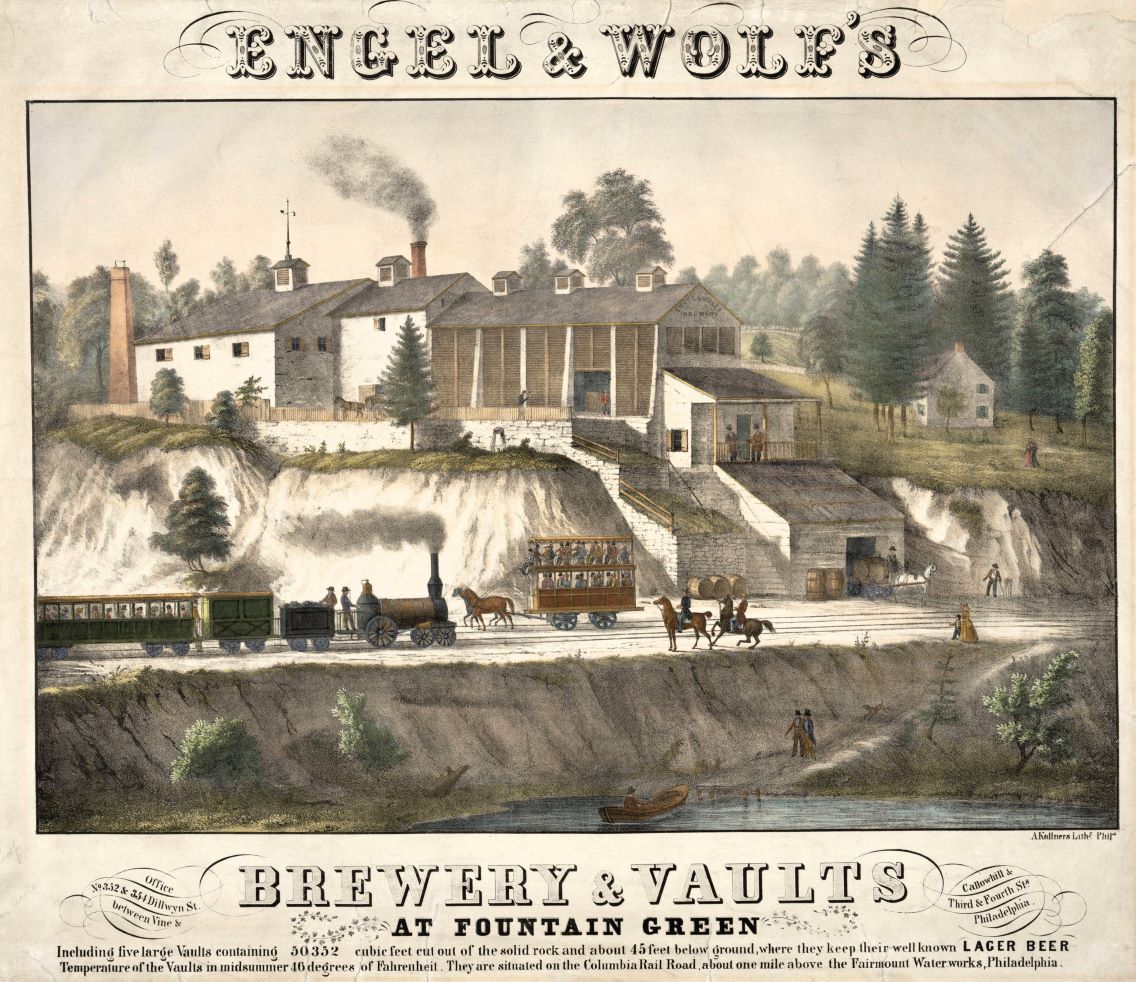
In Reading, Pa., there existed since 1826, a small brewery owned by a certain George Lauer, a Rhenish Bavarian, from whom it passed to his son Friedrich in 1835. This Friedrich Lauer began in 1844 or 1845 the brewing of lager beer; he explained, however, that he was not the first who introduced lager beer into America. He asserted that a certain Wagner, who had come to America in 1842, had shortly after his arrival started the brewing of lager beer in a small brewery in a suburb of Philadelphia. In the main this is substantiated by a member of the brewing firm of Engel & Wolf in Philadelphia. This gentleman says that in 1840 John Wagner brewed the first lager beer in America. This Wagner had a small brewery in John street, near Poplar, in Philadelphia. It was a very primitive establishment in which the first lager beer of America is said to have been produced. The brewing kettle was suspended from a beam over an open fire, and this kettle contained barely eight barrels. The yeast which it is said Wagner used for this lager beer, he had sent from a brewery in Bavaria where he had formerly been brewmaster.
The great value which was placed on this lager-beer yeast can be judged from the fact that a brother-in-law of Wagner’s is said to have stolen a pint of it. He was prosecuted for it and was sentenced to two years’ imprisonment.
At any rate, the brewing of lager beer was developed in Philadelphia, which had in some way come into the possession of lager-beer yeast. Among the breweries which took this up was that of Engel & Wolf, in Dillwin street, Philadelphia, which had for many years been a favorite resort of the Germans of that city who wanted to enjoy a cool drink. “More than once,” it is recorded, “they drank the brewery dry,” and a placard had to be put up announcing the next date when lager beer could be had.*
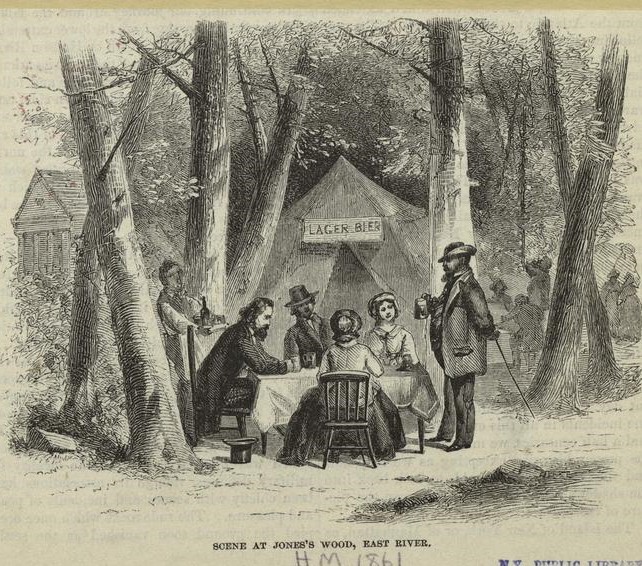
The brewing of lager beer now progressed rapidly, although in the first decade it had attained but little importance. In St. Louis a small lager-beer brewery was started as early as 1842 by Tobias Spenglar. In the city of New York the first lager beer was brewed in 1844 by George Gillig. (A German tavern-keeper by the name of Schwalbe, who kept a tavern in Chatham street, is said to have been the first to sell lager beer in New York. He had it sent from Philadelphia, and sold it at four cents a glass)
George Frey, who brewed the first lager beer in Erie, Pa., in 1847, had helped in the first brewing of “lager” in Buffalo in 1843. In 1848 a brewer in Pittsburg, John N. Straub, heard that lager beer was being brewed in Philadelphia. With great difficulty he got a quantity of lager-beer yeast from Philadelphia, which had to be brought by canal to Pittsburg, and which was used for the brewing of the first lager beer in Pittsburg.
In 1847 John A. Huck and John Schneider started the brewing of lager beer in Chicago. In 1849 the German beverage was first produced in Cincinnati, and in 1846 in Boston, by John Roessle, of Roxbury.
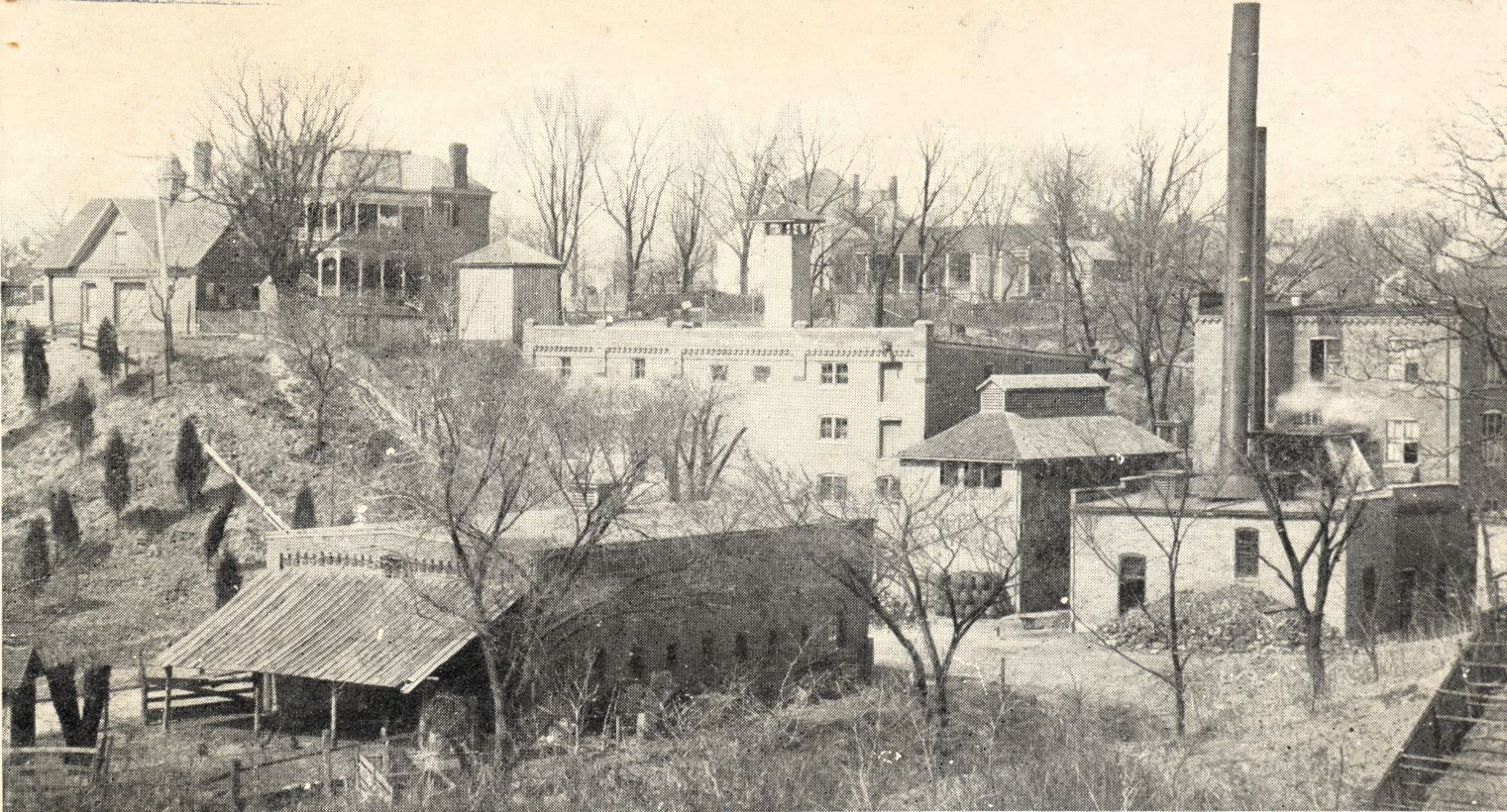
In Milwaukee the first lager beer was brewed in 1851 in the brewery of Jacob Best, out of which the Pabst establishment was later developed. Another Milwaukee brewer, a certain Wagner, it is said, had some yeast sent by his brother from Bavaria. He did not have much confidence, however, and was afraid the yeast might not be good any more. He therefore went to Best and offered him the yeast for what the transportation had cost him. Best accepted the offer. The yeast proved good, and so it came about that Jacob Best had the honor of brewing the first lager beer in Milwaukee. It is not unlikely that there is some connection between the Wagner of this story and the one who is reported to have started lager beer brewing in Philadelphia.
In the first decade after its introduction the brewing of lager beer made but slow progress in America. After this, however, with the general development of the industry,
the production and consumption of the new beverage grew, and it began to replace the heavy English beers. There were economic reasons for the slowness of its development at first. Heretofore, surface-fermented beers had been used, which could be kept on tap for weeks without getting stale and unusable. Such beers were more suited for the thinly settled regions, where beer was not consumed in large quantities, but sold in glasses here and there. With lager beer the situation was different, especially at a time when modem beer-drawing apparatus were not to be had, such as will prevent the entrance of air to the contents of the tapped barrel and thus partly prevent the carbonic acid of the beer from escaping. Lager beer is good only when freshly tapped. If it is open long it becomes stale and unusable, and therefore requires rapid consumption. A rapid consumption of the beverage, however, can take place only where many people congregate. This was not generally the case in the first decades of lager-beer brewing in America. Only on Sundays and holidays, when Germans got together to spend their free hours, was this the case. But later, with the industrial development, larger cities grew up, which attracted great masses of people and made a rapid consumption of lager beer possible; and even in smaller places the factories brought together large numbers of workingmen, where before there had been only small shops, and thus even in small places the use of lager beer became practicable. In short, the economic development prepared the ground for the increase of the lager-beer industry. In the second decade after its appearance, the growth of the lager-beer industry began which has lasted to our own time.
As early as 1860 far more than a quarter of the entire quantity of beer brewed in the United States was lager beer. That is, out of 3,235,545 barrels of beer, 855,803, which is far more than a quarter, were lager beer. The general economic development increased the demand for lager beer, and this increased demand naturally had an effect upon the growth and multiplication of lager-beer breweries. But the production of lager beer was limited to the winter season, because a particular temperature was necessary for manufacturing and storing it, and it was difficult to obtain this temperature without artificial means. Artificial ice and artificial or mechanical cooling apparatus did not exist. But now, as always happens when a certain need calls for a new invention, the increased demand for lager beer led to the invention of all kinds of cooling machines. The production of artificial ice, and in connection with it the building of complicated machines for manufacturing ice and producing a low temperature was greatly stimulated by the demand for lager beer. The ice industry really owes its existence to the lager-beer breweries. But the invention of cooling machines and the manufacture of artificial ice again had their effect upon the spread of the lager-beer breweries. The brewer who, up to that time, could manufacture his product only during certain times of the year, overcame this limitation through the use of artificial means. The natural ice, which had formerly been taken from lakes and ponds and stored in cellars, did not have to be stored underground any more, but could be kept on the ground floor or even higher, so that it had its effect from above instead of below. Natural ice was even at the beginning of the nineteenth century an article of trade between New England and New York. The natural product was shipped in great quantities from Boston to New York, where it was used for brewing purposes. The building of ice-houses began in the sixties. Improved ice-houses, where, through the addition of various salts the effect of the ice was increased, began to be built in 1880, the first one in Detroit. At the same time artificial ice began to come into general use. The first ice machine in a brewery was placed in the establishment of Glasgow & Thunder, in Bendigo, Victoria, Australia, in 1860. The first cooling machine which was used in America was introduced by the brewer, Georg Merz, in New Orleans, in 1869. He had imported it from France. In the spring of 1870, the S. Liebmann’s Sons’ Brewing Company in Brooklyn introduced the first cooling machine in New York or the vicinity, which was of an improved kind, but still did not meet all the requirements. The demand, however, stimulated the technicians to overcome all difficulties and to produce the perfect refrigeration machine with which today all the large breweries are equipped.
Only the development of the ice and cooling-machine industry enabled the lager-beer brewer to do away with the limits which nature had until now drawn. He did not have to brew his lager beer only at certain times of the year, but at any time when it suited him best. Human knowledge and technique had won a victory over nature.
3. FROM SMALL PRODUCTION TO GREAT INDUSTRY.
In the decade before the outbreak of the Civil War, the beer-brewing industry began to develop from the stage of small production to that of great industry, especially in the Eastern states, where alone anything of the nature of great industry could be said to exist. With the great increase of German population between 1850 to 1860 beer-brewing grew rapidly. While the population of the United States in this decade increased only from 23,000,000 to 31,000,000, the number of breweries grew from 431 to 1,269. While the manufactured product of the breweries in the year 1850 had a value of $5,728,568, it rose in 1860 to $21,310,933.
However, the main seats of the brewing industry still continued to be confined to two states, New York and Pennsylvania. Almost half of all the beer brewed in the Union in 1860 was produced in these two states. Of the total 1,269 breweries, 347 were in Pennsylvania and New York, and in capacity these were far ahead of the breweries in the other states. Of the 175 breweries in the state of New York, 46 were in New York City. And of the 172 breweries in Pennsylvania, 68 were in Philadelphia. In Baltimore there were then 12 breweries, and in Boston 6.
The value of the product of the New York breweries in 1860 was $6,320,724; that of the breweries in Pennsylvania, $3,151,069. According to this, out of the total value of the product manufactured in 1860, $21,310,933, these two states had $9,471,793. Of the other states, only Ohio, Illinois, New Jersey, Missouri, and California had a beer production exceeding in value $1,000,000 a year. In the same decade the settlement of the Western states brought the beer industry into that part of the country. About 1850, Mathias Frehm set up the first brewery in Davenport, Iowa. In 1849, the gold fever and the number of people drawn to California by it called forth the first brewery there, which was erected in San Francisco by a German, A. Schuppert. This was followed in 1852 by another, erected by the firm, Gundlach & Frauenholz. In the preceding year John Joseph Hartmann had established a “steam-beer” brewery in San Jose. In 1860 California already had 83 breweries.
The other Pacific states soon followed. In Walla Walla, in the later state of Washington, we find a brewery in 1855. In 1860 Oregon had eight breweries. In 1859 Fred Krug erected the first brewery in Omaha, Neb., which had a capacity of one and a half barrels a day. In 1860 beer-brewing had become firmly established in Kansas. In Colorado the first brewery was erected in 1859, in Denver, and the first brewer of that city was Ph. Zang.
In the South, also, about this time, the brewing industry had got a firm foothold. In Texas, in the city of San Antonio, the first brewery was established in 1855 by Wilhelm Menger. Five years later we find thirteen breweries in this state. In Georgia a brewery existed in 1860, while Kentucky then already had twenty-five. In Louisiana, to which state a number of Germans had come in 1848, there were five breweries, in Maryland twenty-two, in Tennessee two, and in Virginia six. During the Civil War many soldiers of German descent were stationed for years in the Southern states, and so breweries sprung up there which sold their product to the army.
Naturally by this time the real hand work had almost completely disappeared. The beer-brewing industry was among the first in America in which steam played an important part. As early as 1817 steam was used as a motive power in most of the breweries of New England, and New York and Pennsylvania soon followed the example. In 1819 a stationary steam engine was set up in a brewery owned by Francis Perot, in Vine street, Philadelphia, which had been built by a certain Thomas Holloway, and which continued in use down to 1872. This engine was described as the first one in America ; but this is an error, for, as said before, steam engines were generally introduced into the breweries in New England in 1817.
The concentration of the industry also progressed. The average capacity of the breweries of the United States from 1850 to 1860 increased only from $13,291 to $16,792 ; but this small average increase was due to the fact that, in that decade the industry had only begun to develop in the West and in the South, and naturally the many new breweries which sprang up there had only small capacities. But in the older brewing centers, New York, Pennsylvania, and the neighboring states, a certain concentration of the industry was noticeable. In New York in 1860 the average product per brewery was $36,000.
The system of great industry now began to conquer the brewing industry.
Marxist historian Herman Schlüter (1851-1919) was born in Schleswig-Holstein and joined the left wing of German Social Democracy as a teen and helped publish newspapers and magazines of the SPD. A correspondent of Engels’ both in Germany and later when Schlüter emigrated to the US in 1889 where he joined the editorial board of the New Yorker Volkszeitung. At first he was a member of the the Socialist Labor Party, later he joined the Socialist Party, which he represented at the Amsterdam Congress of the Second International in 1904. An anti-opportunist and anti-revisionist, he contributed to the debate in Marxism in both Germany and the US. However, it is Schlüter’s historical works, mainly of the proletarian movement in the US and England, that are his lasting legacy.
The Brewing Industry and the Brewery Workers’ Movement in America by Hermann Schlüter. Published by the International Union of United Brewery Workmen of America, Cincinnati. 1910.
Contents: Preface, The Beer-Brewing Industry, Introduction, Beer-Brewing Industry in the Middle-Ages, Beer-Brewing in the American Colonial Period, The Modern Beer-Brewing Industry, Brewing as a Great Industry, The Brewery Workers Movement, Prior to Organization, Beginnings of Organization, Permanent Organization, The Founding of the United Brewery Workmen and First Victories, The Struggle of 1888, The Development of the United Brewery Workmen, The American Federation of Labor and the Brewery Workmen, Labor Union and Political Organization, Hygienic Conditions of Brewery Workmen, Achievements and Prospects, Prohibition and Sunday Closing, Workingmen and Prohibition, Taxes and the Brewing Industry. 346 pages.
PDF of full book: https://books.google.com/books/download/The_Brewing_Industry_and_the_Brewery_Wor.pdf?id=jTGC_SB962oC&output=pdf
 Revolution's Newsstand