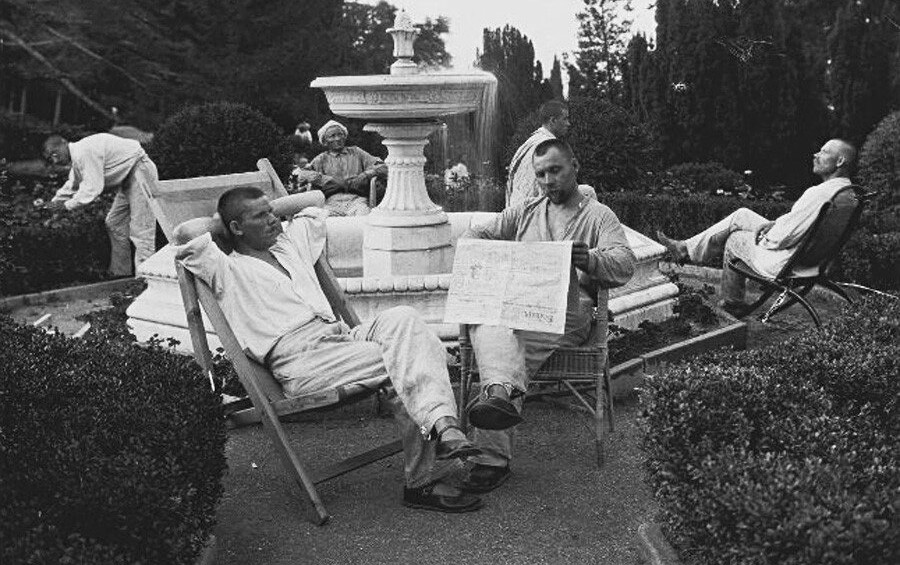
As a working interpreter in Soviet Russia, the Quaker-Communist Anna Louise Strong had access to the newly developed working class sanitariums and vacation resorts, taking her vacation August, 1924 at the Sverdlova Sanitarium in the Caucasus mountain town of Essentuki. The Newsstand will be on break for the next week, unfortunately not at a Soviet spa. Solidarity.
‘Vacationing With Russian Workers’ by Anise (Anna Louise Strong) from the Daily Worker. Vol. 2 No. 149. September 12, 1924.
August, 1924. I am down in a health resort in the Caucasus Mountains. I am staying in a sanitarium that is run entirely for workers. Just now as I write the strains of a piano come upstairs from the social hall, indicating that they have been having a concert this evening. That is because it is raining; if it were fine weather, they would be out, as usual, strolling along the cliff in the moonlight or sitting on benches under the trees.
Perhaps the word “Caucasus” suggests wild bandit tribes and rough living to the average American. Just as “sanitarium” suggests a place where sick folks lie in bed. I assure you that neither of these pictures is a true one. Imagine the mountains of Southern California turned into a summer resort. Assume that some one has discovered sulphur springs, and sparkling soda springs, and iron springs, and lakes of sulphur mud, tucked away in the various valleys, and has established there a host of hotels with open verandas, and vast stone bathing pavilions with many rooms and hundreds of attendants and scores of rest couches for use after the baths.
Musicians Entertain Patients.
If any have anything the matter with you, from rheumatism to heart trouble, there is a big clinic in the center of each town, and smaller clinics in all the sanitariums, where your doctor will tell you what kind of bath to take and what kind of water to drink for what ails you. If you disdain medical care, and have merely come for a rest, then there are mountains to climb, and band concerts in the various parks. Many of the best musicians of Moscow are down here, paying their way by their performances.
The best sanitariums in all these towns are run by the Sostrak, or Social Insurance, and are exclusively for workers. The lucky chance of a vacancy occurring at the last moment, together with my trade union card and my credentials as correspondent for the labor press of America, got me a room in one of these. It is in Essentuki, where they have 20 different mineral springs of varying strength and qualities, and hot mud baths that are supposed to be good for various ailments.
On Comradely Basis.
As soon as I got my paper entitling me to live at Sverdlova Sanitarium, a pleasant maid took me upstairs to my room. In an American hotel I suppose one would call her the chambermaid, since she makes my bed and washes the floors every day. But in the friendly atmosphere of Sverdlova, she had her arm around my waist before we got upstairs and was confiding to me that she was just a new Communist and was ever so glad to meet a comrade from America who could tell her all about the workers there. Did they have sanitariums like this? he wanted to know. Or was it only after the revolution that workers got sanitariums like this.
While I was taking off my things she brought me in a pile of linen. I gasped as I surveyed it. Not only sheets and bed spread and towel, and table cover, but also a set of underwear, a pair of sandals, a handkerchief! And a new tooth brush with a box of tooth powder. And a new cake of soap. Evidently the Social Insurance which is run by the Department of Labor, believes in setting certain standards for the workers who come from all parts of Russia.

I forgot to mention the bath cloak! The maid took me down to a bath house where I received a hot bath and a shampoo. Then I was presented with the garment which was to be my most comfortable friend for the rainy weather which unfortunately followed, a large cloak of warm fuzzy material which you wear around the park after taking your various baths.
The dinner bell rang and we all trooped into the dining room, which consisted of a large veranda supported by great white pillars and closed on three sides. On the fourth it looks out towards avenues of tall trees, under which you stroll after lunch or sit on benches. There were seven long tables in the dining veranda, each with a different diet. A doctor who was a specialist on diets arranged the menus; and if you needed more milk’ or more acid or more or less of any- thing in your system, you just sat at the proper table and got it.
There are 225 guests at Sverdlov, which is only one of a dozen or more sanitariums opened this summer by the Sostrak. It must not be supposed that these are all the sanitariums for workers. There are many more. Five minutes walk away is a special sanitarium owned by the Oil Workers of Baku; they have quite a number of sanitariums and vacation houses in these mountains. For Baku has a hellish climate in summer, and these are the nearest mountains; so large numbers of them come here for their vacations.
Unions Have Sanitariums.
Other large unions have also their own sanitariums and vacation houses; for the first two night of my stay in Essentuki I stopped at the House of the Trade Union of Educational Workers, the union I belong to. We have half a dozen vacation houses of our own scattered around Russia. So have all the other organizations. But the Sostrak is the special organization of the Department of Labor, which care for the health of workers. It is supported by special taxes on all employers; (I myself, for instance, have to pay into it an amount equal to 16 per cent of my interpreter’s salary because I am to that extent an employer of labor). But it is administered by the Department of Labor in close co-operation with the unions.
Next to me at table sits a worker from Siberia. He makes felt boots, He is here because of rheumatism acquired by standing many weeks in water during the civil war, and by keeping on standing in water during his work. I asked him why he didn’t wear rubber boots if the place where he worked was so wet. He laughed.
Hope for Better Technique. “On Monday when they heat up,” he said, “it is so full of steam that you can’t see the next worker six feet away. If you changed your underwear fifty times it would be always wet. It drips into any boots you have and makes pools of water inside. Some day we’ll get better technical methods, and the factory will be improved; but Russia is still poor; we haven’t the money for proper technique.”

But he told me that he liked making boots, in spite of the fact that he knew it gave him rheumatism. “I changed once to typographical work,’ he said, “but I didn’t like it. I wanted to get back to the felt boot factory.”
“Who’ll Do The Dirty Work?”
“Why?” I asked. He looked a trifle nonplused for a moment and then replied that he supposed it was because he was skilled at the job…There you have the answer to a lot of fake questions that have been raised for generations about the possibility of socialistic work. “Who will do the dirty work, or the mechanical work, or the dangerous work?”
Conditions in Russia are certainly not ideal yet, and thousands of men are doing disagreeable and unhealthy jobs on account of mere lack of money for improvements. But, once you take the social stigma away from manual labor, and give the worker a pride in his group and his organization, and men will not only do work, but will LIKE it, even work that is dirty and unhealthy and dangerous. They will like it because they are skilled in it and because they get out of it the sense of achievement.
Across the table is a tall, handsome man in white trousers and white Russian blouse. He tells me his “specialty” is making window glass. He announces it just as a doctor might say that his specialty was nose and throat, or internal diseases. He wants to know all about me, because I am an American.
Only Learning.
“Don’t you find it very lonesome in Russia?” he says. “We are so much less cultured than you Americans” …I gasp at this and ask him what he means. “We have only just learned to read and write,” he tells me. “The things that come after this, science and technique, and art and how to behave courteously to each other–we have hardly begun with those things yet. But your American workers–they know how to read and write since they were children. They must be much more civilized than we are. You must find us very dull and crude.”
Quite the contrary is the case, I assure him. For what good is reading and writing if you spend it reading comic supplements and trashy stories. The average Russian worker, I tell him, has a much wider interest in the world at large than the average American.
Russia “Not So Bad.”
“Politically, I suppose that is true,” he says, “because of our Revolution. But in all other things you must be far ahead”…And I think of the excellent symphony music which the workers in Sverdlov Sanitarium enjoy both in the park and in their own “veranda concerts,” and assure him that even in other things Russia is not so uncultured as he thinks. Four or five women and girls sit also near at hand at our table. A stenographer: from the Ural Metal Trust at Ekaterinburg, a textile worker from near Moscow, and an office employee from the War Invalids Organization. Two of them have their babies with them; babies seem to be less in the way in Russia than in any other country.

Not only have the workers the best sanitariums, with the possible exception of a few for the highest officials of the Republic (the sanitariums of the Central Committee, which are just as good), but when we go for our baths in the various establishments, we have it all arranged beforehand by the sanitarium. The private people are standing in line and waiting sometimes for hours if there are many of them. But the organized people in the sanitariums, and that means among others the workers, go in without waiting.
We have free tickets to parks and concerts that all the private people have to pay for, it is part of the sanitarium privilege. And everything, from food and beds to doctors’ treatment, is all free in the Sostrak Sanitariums. There is no cashier’s desk where you can pay for anything; I myself will have to settle my bills when I get back to Moscow, for no one down here seems to be authorized to accept money. The workers are sent on a slip of paper from the Sostrak, and that entitles them to everything the land provides.
A Trip to Kislovodsk.
Yesterday I went for an all-day excursion to Kislovodsk, another summer resort higher up in the mountains. The glass worker from the Donetz Basin took me, as he knew the ropes. After we had climbed over half a dozen hills and visited several friends, we came upon another sanitarium, the highest up in the mountains.
We noticed that it, too, belonged to Sostrak. So we walked in and showed our little tickets and were told to stay to dinner. We had vegetable soup with perozhniks (a frech baked roll with meat filling) and tomato and cucumber salad, and chicken and ice cream. It was so good that we decided to come back for supper! And we did, on the strength of that little Sostrak ticket.
We discussed how pleasant it would be when Communism really arrived, to be able to go anywhere just on one little card, and drop in for meals at the places you liked, not merely in a dozen Sostrak vacation houses, but in all the vacation houses in the world…The average American won’t understand this at all. He will say that he can go now to any hotel and pick out his meal, on the strength not of a ticket but of a dollar bill. So he can, but there’s a world of difference in the feeling. All the difference between strangers–and home. We didn’t know anybody in that new Sostrak place, but they felt and acted like comrades. If we could go to places all over the world and feel like that…
The Daily Worker began in 1924 and was published in New York City by the Communist Party US and its predecessor organizations. Among the most long-lasting and important left publications in US history, it had a circulation of 35,000 at its peak. The Daily Worker came from The Ohio Socialist, published by the Left Wing-dominated Socialist Party of Ohio in Cleveland from 1917 to November 1919, when it became became The Toiler, paper of the Communist Labor Party. In December 1921 the above-ground Workers Party of America merged the Toiler with the paper Workers Council to found The Worker, which became The Daily Worker beginning January 13, 1924. National and City (New York and environs) editions exist.
PDF of full issue: https://www.marxists.org/history/usa/pubs/dailyworker/1924/v02a-n149-sep-12-1924-DW-LOC.pdf
 Revolution's Newsstand