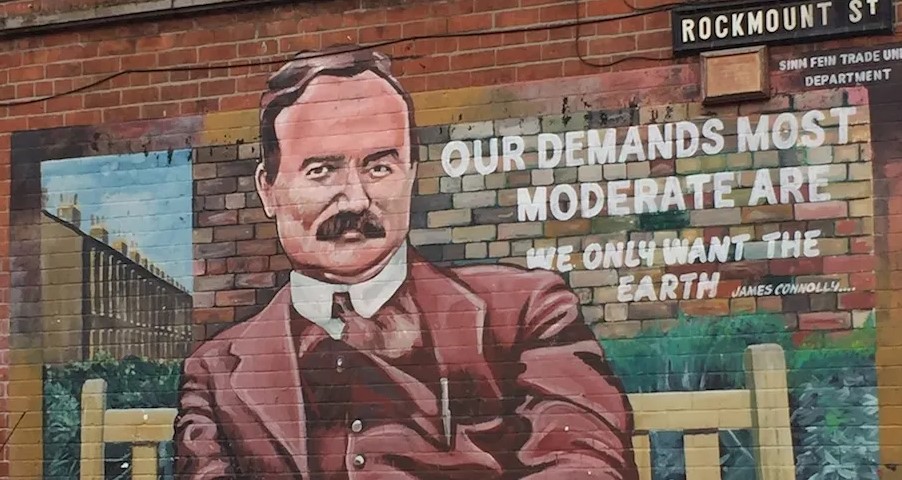
Connolly’s role as an English-speaking Marxist from a colonized country in theorizing the anti-imperialist struggles of oppressed nations is almost unique in the pre-war movement and continues to demand the attention of revolutionaries today. Among the earliest of Connolly’s works published in the United States is also one of his most lasting, oft-quoted essays.
‘Socialism and Nationalism’ by James Connolly from The People. Vol. 6 No. 46. February 14, 1897.
RINGING IRISH WORDS.
From An Irishman to Irishmen on the Revolution.
The below is an article by James Connolly, of Dublin, in the Belfast, Ireland. “Shan Van Vocht” on Nationalism and Socialism–Nationalism meaning Ireland’s political independence from England.
There is a danger that by a too strict adherence to their present methods of propaganda and consequent neglect of vital living issues, the Nationalists may only succeed in stereotyping our historical studies into a worship of the past, or crystallizing Nationalism into a tradition, glorious and heroic indeed, but still only a tradition.
If the National movement of our day is not merely to reenact the old sad tragedies of our past history, it must show itself capable of rising to the exigencies of the moment, it must demonstrate to the people of Ireland and the world at large that Irish Nationality is not merely a morbid idealizing of the past, but is also capable of formulating a distinct und definite answer to the problems of the present, and a political and economic creed capable of adjustment to the wants of the future. This concrete political and social ideal, I believe, will be best supplied by a frank acceptance, on the part of all earnest Nationalists, of the Socialist Republic as the goal of our endeavors.
The Republic, that is to say, the progressive applications of the principles of true democracy to the national, industrial, and agricultural affairs of our country. Not a Republic, as is France, where a middle-class monarchy with an elective head parodies the constitutional abortions of England, and in open alliance with the Muscovite tyrants of Poland, brazenly proclaims their apostacy to the ideals of their revolutionary forefathers; not a Republic, as in the United States, where the power of the purse has established a new tyranny under the forms of freedom, where one hundred years after the feet of the last British red-coat had polluted the streets of Boston, British landlords and financiers impose upon the necks of American citizens a servitude compared with which the tax of pre-Revolution days was but as is a pin scratch to a bayonet wound.
No! the Republic I would wish our fellow countrymen to set before them as their, ideal should be of such a character that the mere mention of its name would at all times serve as a beacon light to the victims of every form of oppression. holding forth promise of freedom and plenty as the reward of their efforts on its behalf.
It may be pleaded that the ideal of a Socialist Republic, implying as it does a complete political and economic revolution (vesting the entire ownership of land, railways, machinery, and instruments of labor generally in the hands of those who use them in town and country, to be controlled by their own associations, freely elected on a basis of perfect equality and universal suffrage, subordinate to and represented in the Democratic Congress of an independent Irish State), would be sure to alienate all our middle class and aristocratic sympathizers, who would dread the loss of their privileges and property. What does this objection mean?
That we must conciliate the privileged classes in Ireland. But you can only disarm their hostility by assuring them that in a free Ireland their “privileges” will not be interfered with that is to say, you must guarantee that when Ireland is free of foreign domination the green coats of an Irish army will guard the fraudulent gains of capitalist and landlord from “the thin hands of the poor” as effectually and as remorselessly as the scarlet-coated emissaries of England do to-day.
On no other basis will the classes unite with you. Do you expect the masses to fight for this ideal (sic.)? Or when you talk of freeing “Ireland.” do you only mean the chemical elements which compose the soil of Ireland? Or is it the Irish people you mean? If the latter, from what do you propose to free them? From the rule of England? But all systems of political administration or governmental machinery are but the reflex of the economic forms which underlie them.
If you could remove the English army to-morrow and hoist the green flag over Dublin Castle, unless you set about the organization of the Socialist Republic, your efforts would be in vain. England would still rule you; she would rule you through her capitalists, through her landlords, through her financiers, through her usurers, through the whole array of commercial and individualist institutions she has planted in this country and watered with the tears of our mothers and the blood of our martyrs. England would rule you to your ruin even while your lips offered hypocritical homage at the shrine of that Freedom whose cause you had betrayed. Nationalism without Socialism; i.e., without a reorganization of society on the basis of a broader and more developed form of that common property which underlay the social structure of Ancient Erin, is only national recreancy, since it would be tantamount to a public declaration that our oppressors had so far succeeded in inoculating us with their perverted conceptions of justice and morality, that we had finally accepted them as our own, and no longer needed an alien army to force them upon us.
As a Socialist I am prepared to do all one man can do to achieve for our Ireland her rightful heritage, independence; but if you ask me to abate one jot or tittle of the claims of pure justice, in order to win the sympathy of the privileged classes, then I must decline. Such action would neither be honorable nor feasible.
Let us never forget that he never reaches Heaven who marches thither in the company of the devil. Let us openly proclaim our faith, the logic of events is with us.
New York Labor News Publishing belonged to the Socialist Labor Party and produced books, pamphlets and The People. The People was the official paper of the Socialist Labor Party of America (SLP), established in New York City in 1891 as a weekly. The New York SLP, and The People, were dominated Daniel DeLeon and his supporters, the dominant ideological leader of the SLP from the 1890s until the time of his death. The People became a daily in 1900. It’s first editor was the French socialist Lucien Sanial who was quickly replaced by DeLeon who held the position until his death in 1914. After De Leon’s death the editor of The People became Edmund Seidel, who favored unity with the Socialist Party. He was replaced in 1918 by Olive M. Johnson, who held the post until 1938.
PDF of full issue: https://www.marxists.org/history/usa/pubs/the-people-slp/970214-thepeople-v06n46.pdf
 Revolution's Newsstand