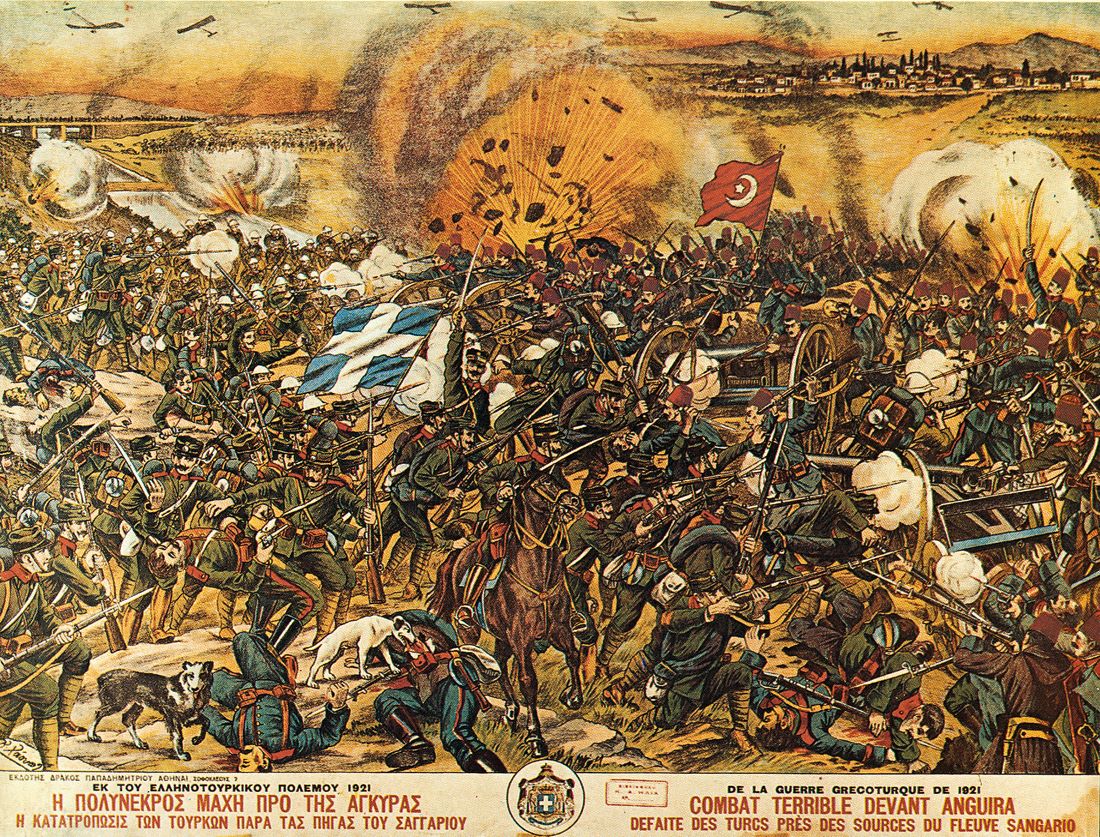
After an expansionist Greece lost its war against an emerging Turkish Republic in 1922, reclaiming territory in Anatolia became a rallying cry of the Greek right, while anti-Greek chauvinism became a central tenant of Kemalism. Here, the Balkan Communist Federation issues a declaration on the conflict.
‘The Turko-Greek Conflict’ from International Press Correspondence. Vol. 5 No. 15. February 18, 1925.
When the other peoples, after having shed their blood five years in the imperialist war, laid down their arms, the Greek bourgeoisie carried on the war further and plunged the masses of the people into the blood bath of Asia Minor in order to fulfill its insane dreams. The Greek people had to pay dearly for this adventure. The people were plunged into misery and the Greek population of Asia Minor especially, had to suffer the most fearful misery. Today over a million refugees are perishing in Greece and expect in vain of the Greek bourgeoisie that it will do something to ameliorate the sufferings of which it is the cause.
The blood which has been shed on the fields of Asia Minor and Thrace has not yet dried, when a fresh conflict between the Greek and the Turkish bourgeoisie is being kindled, which could result in the most serious developments in the relations of the two states, and in the Balkans in general, and could bring about a new war.
Whilst the Turkish government expels the Greek Patriarch from Constantinople, the Greek government declares on its part that Greece is prepared to defend its “national honour” and to reinstate the Greek patriarch in Constantinople even by means of a new war.
No matter how much reason there may be for assuming that these actions on the part of the two governments are, in the main, of a demonstrative character, the fact nevertheless remains that, having regard to present conditions in the Balkans, the danger of a new war is by no means excluded. Besides this there exist forces outside which would be interested in a war between Greece and Turkey if they could be sure of it remaining localised.
In the first place Yugoslavia, which has hitherto adopted a hostile attitude to Greece, suddenly considers it necessary to extend a friendly hand to Greece and to support it in its bellicose attitude towards Turkey. It appears as if Yugoslavia wishes to plunge Greece into a war-adventure, calculating that as a result Greece would find itself in a difficult situation and that Yugoslavia would be able to profit by it in order to seize Salonika, the most important port on the Aegean Sea.
The Bulgaria of Zankov would, for its part, like to induce Greece to enter into a conflict with Turkey, as it cherishes with undisguised malicious joy the thought that, after the people of Greece had been plunged into a war, it could, together with Yugoslavia, stab Greece into the back and seize possession of Trace and the Aegean coast.
But the great imperialist robbers Italy, France and England, are specially interested in sharpening the Turko-Greek conflict.
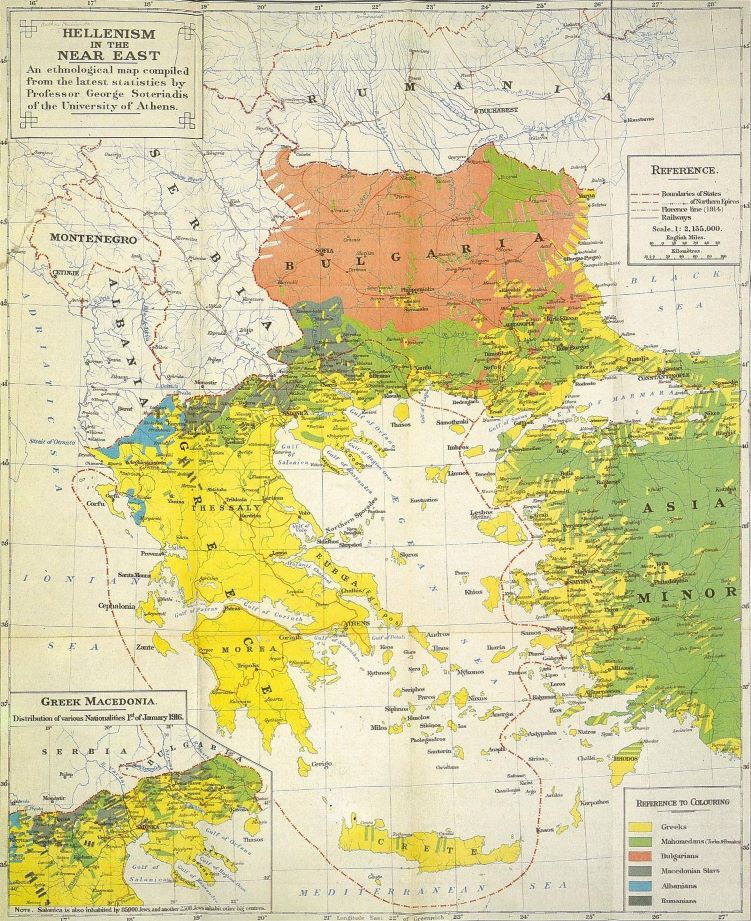
Italy, although it has already seized several Greek islands, intends to carry out still further robberies; the more so as it is necessary for Italy to achieve successes abroad in order to throw dust into the eyes of the masses who are disappointed with the fascist regime.
England which has always endeavoured to satisfy its interests at the cost of Turkey, now wishes to make use of the Greek people in order to compel Turkey to submit to its own imperialist desires. Chamberlain is encouraging Greece in its “rightful cause” a fact which is proved by the circular of the Greek Minister of education to the schools, in which it is emphasised that “England stands wholly and entirely behind Greece”.
France sees in the sharpeninig of the present Turko-Greek conflicts a means for strengthening its influence over Turkey as against England and a means in order to hold Greece in check.
Of course, these robbers, both great and small, hide their intentions under the cloak of hypocritical expressions of desire for peace. But in secret they are fanning the Turko-Greek conflict, whilst they openly speak of intermediation. In the last resort, only the great and little robbers will profit from the kindling of the Turko-Greek conflict and its eventual outbreak into a war at the cost of the sacrifices and of the blood of the working masses in Greece and in Turkey.
The Greek bourgeoisie is now endeavouring to take advantage of the stirring up of chauvinist hate among the Greek masses against the Turks, in order to divert the attention of the workers, peasants and the great masses of refugees from Asia Minor from their own demands to the great questions outside of Greece, before all, however, to suppress their advance-guard, the Communist Party, the Labour Confederation, the organisation of ex-service men and the Young Communist League.
The great strikes of the workers which arose out of the unbearable situation of the working class, the desperation of the peasants, who themselves are proceeding to take over the estates of the big monasteries and big landowners in Thessaly, which in spite of all the promises of the government have not up to now been given over to them, the misery of over a million refugees all this the Greek bourgeoisie perceives quite clearly. As however it is determined not even partially to satisfy the urgent requirements of the working masses, it is proceeding to its usual manoeuvre in stirring up nationalism, and in the meanwhile is organising fascism and preparing to annihilate with fire and sword every national revolutionary movement of the workers, peasants and refugees. It is also carrying out mass persecutions and arrests of the Communists, the members of the Labour Confederation, the leaders of the ex-service men and of the Thessalonian peasants.
Should the working masses during the present Turco-Greek conflict fall victims to the nationalist incitement in Greece, it will mean that instead of bread they will get fascist bullets; instead of land, fascist daggers, instead of work, fascist acts of violence.
The bourgeoisie in Turkey is on its part stirring up chauvinism and nationalism among the Turkish workers and peasants against the Greek people, in order to avoid carrying out the agrarian reform and satisfying the interests of the working masses in general.
As a result of its policy of estrangement, and eventually of hostility, to the Soviet Union, the Turkish bourgeoisie itself is causing Turkey to become completely enslaved to the great imperialist powers.
At the present time, when the bourgeoisies of Greece and Turkey are involved in a sharp and dangerous dispute with one another, it is the most urgent duty of the working masses in Greece and in Turkey to take up definite measures in defence of peace. They must extend to each other the hand of solidarity in order to take up the fight against their own bourgeoisie, to enforce the satisfaction of their demands, to protect their liberty from the attacks of fascism and to prevent the breaking out of a conflict and the possibilities of fresh bloodshed.
If, however, in spite of everything it should come to an open war between the Greek and Turkish rulers, the working masses must be prepared for the civil war.
Not war, but fraternal understanding between the Greek and Turkish peoples!
Bread, land, farming implements and credits for the refugees! Solution of the Agrarian question in the interest of the working peasants.
Satisfaction of the vital needs of the working class! Dissolution of the fascist organisations!
Liberation of suppressed nationalities from their yoke! Complete Freedom for organisation and struggle of the working and peasant masses!
Against imperialism in the Balkans! For the liberty and independence of the Balkan peoples by their brotherly union in the Balkan Federation!
For this the working masses in Greece and Turkey must fight determinedly under the lead of the Communist Parties and the Balkan Communist Federation.
In addition to this the workers of the Balkan countries, and also the proletariat of Italy, France and England must expose the intentions of their governments to kindle the Turko-Greek conflict. The working masses must not forget that the fire kindled at one end of the Balkans can quickly extend to the whole of the Balkans and serve as the commencement of a new imperialist war.
Moscow, February 1925.
For the Presidium of the Balkan Communist Federation: G. Dimitrov.
International Press Correspondence, widely known as”Inprecor” was published by the Executive Committee of the Communist International (ECCI) regularly in German and English, occasionally in many other languages, beginning in 1921 and lasting in English until 1938. Inprecor’s role was to supply translated articles to the English-speaking press of the International from the Comintern’s different sections, as well as news and statements from the ECCI. Many ‘Daily Worker’ and ‘Communist’ articles originated in Inprecor, and it also published articles by American comrades for use in other countries. It was published at least weekly, and often thrice weekly.
PDF of full issue: https://www.marxists.org/history/international/comintern/inprecor/1925/v05n15-feb-18-1925-inprecor.pdf
 Revolution's Newsstand