
Katayama looks at surviving traditional common land tenure and co-operative enterprises in capitalist Japan.
‘Communistic Practices in Japan’ by Sen Katayama from The Communist (C.P.A.). Vol. 3 No. 1. April, 1921.
WE read in the history of Japan that the rulers–when the people still lived in a primitive way–again and again abolished and prohibited private ownership of land. Almost peri- odically they confiscated land and property of the rich. Then, the entirely land practically and in reality belonged to the people. Legally, however, it belonged to the rulers.
During the feudal regime which lasted about three hundred years, the idea of land ownership took precedence. The right of tenancy was sold and bought by the farmers, although the real owners of the land were the feudal chiefs. There were three kinds of land in Japan distinguished by the nature of ownership: first, cultivated land and forest practically owned by the common people; second, common land which we still possess; third, government land. The cultivated land of the people was taxed quite heavily by the feudal chiefs, but the tax on forest was insignificant.
Common land which belonged to a particular village or group or groups of villages was not taxed. This common land played a great part in the village life of the people during the feudal regime. The villagers, under certain regulations, would get as much as they could, such as opening common land, cutting grass or shrub in the spring for fertilization, and otherwise the land was used perfectly free by all. In some places even during the feudal period, we find that the entire land of a village was owned in common and divided for the purpose of cultivation according to the ability of the families. Of course, there were many incidents of cultivating land and harvesting crops in common which, I am sure, still exist.
Land Tenure in Loo Choo Islands (Okinawa-ken)
Okinawa-ken consists of a group of Islands in the southern part of Kinoshino originally belonging to China but for several centuries governed by the Japanese feudal chiefs. Until very recently these islands were kept on a communistic basis by the villagers living on them. Each villager owned land as a unit and was responsible for the taxes and rent on the land. The land was equally divided among the male of the village for a certain period, and at the end of the period the land was redistributed. The division was executed by lots. There seemed to be no difficulty in that. The people of the island took good care of the land, for they looked upon it as something sacred. The duration of tenure ranges from 7 to 13 years; this differs in each island. Under the communal land system there were no very poor people nor were there any very rich ones. The land was neither salable. transferable nor subletable. Each island owned a banana orchard as common property, the proceeds of which were set aside for famine. The common ownership of land in villages was abolished only after the Russo-Japanese War, for the government wanted to introduce capitalism into the islands. However, so far as I know, on account of long years of custom to hold land as sacred property of the villages, hardly any farmer would sell his land to an outsider.
We have several such single islands which have been practicing communal life for many centuries. Hotsu Shima (Shima means island), one of those little islands about ten miles from Atami, a fashionable hot spring which is a few hours ride from Tokyo, for many decades there have been living on the island about 32 families. Everything is held in common. Land is owned, cultivated, harvested and granaried in common. The work is done mostly by girls and married women, for the men go fishing. The island owns two big fishing boats and many small ones; all fishermen work in common for common production. They live a most happy life. They are well supplied with things, but rice they import for the island can not raise sufficient for all. It has one gram mar school. The population of the island is about 150; there is no room for new families. Thus the children–with the exception of the oldest son and daughter–have to leave the island to get their living on the main island. This arrangement has been kept up for generations and very satisfactorily.
Hatsu Shima is well known to the public as a communistic island. The people on it live a most peaceful and happy life!
Partial Communism Practiced in Inatori and Shirahama
Inatori Mura and Shiraham Mura are two well known villages on the Izu Peninsula, a little farther south of Atami. Both villages are not far from Shimada where Commodore Perry first anchored, in 1868.
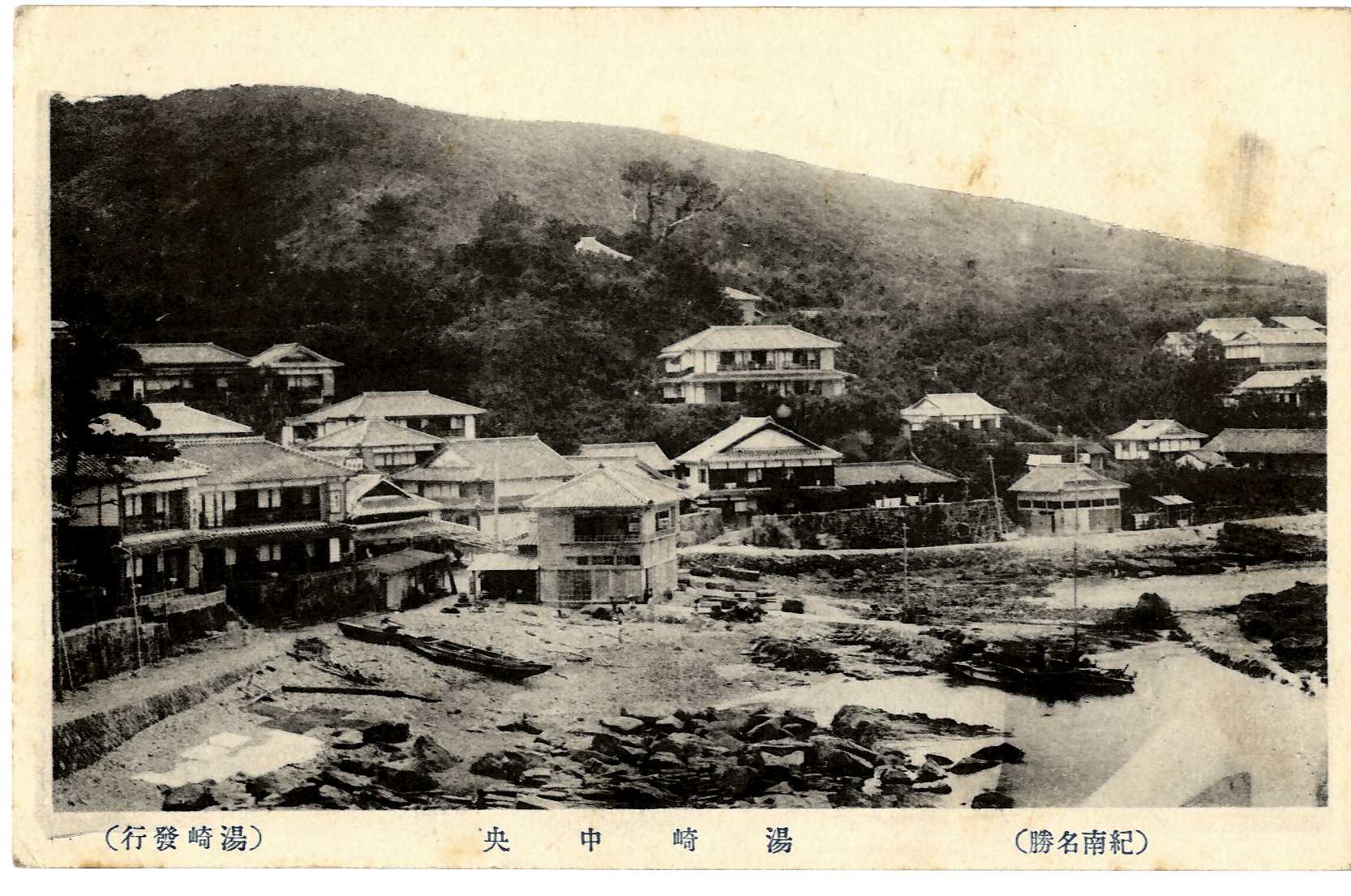
These two villages communized the industry of the sea weed. Part of the sea weed grows near the shore, and the women pick and dry it. In many cases the husband stays in the booth while his wife dives all day long to pick out the weed. Thus she earns 4-5 yen a day, while her husband earns only 2 yen, because his work is rather easy; he only has to pull his wife up on the water every three or four minutes. The price for picking is fixed for all the season and each one is paid according to the amount of weed he picked. There are little shacks built along the shore to dry the weed in, pack it, and get it ready for shipment. Thus the common treasury of the village is enriched every year. In the village of Inatori there are 500 fishermen and 300 farmers. The village pays rent and other expenses out of the proceeds of the industry. It sustains a public school and a hospital. Besides those annual expenses it has large tracks of common forests bought some years ago on which various trees are planted, and sometimes the villagers will get a vast income from it, and it will be utilized among the villagers. Mutual aid and improvement system of the island is so well organized that no family ever need turn into a loan shark victim or be in need or in distress.
Shirahama Mura is far better governed than Inatori Mura and has a larger yearly income. Thus it can enjoy many more common advantages than the latter. has a fine public school, hospital and other institutions of public utility. Of course all the business in these villages is conducted on the principle of private ownership so that the richer a village is the more it is benefited. However, the villagers generally get quite a large income on account of the sea weed industry which is carried on a communistic basis. The profit of the said industry is equally distributed among the members of the village.
If sea weed carried on a communistic basis gives the two islands such great benefit, then if rice which the greatest industry in Japan would be carried on a communistic basis, what a great profit it would bring to the entire nation!
There are few other villages which carry on more or less in common the sea weed industry. But those two villages mentioned above are the most successful. As a rule fish industry which is not incorporated under a company is carried on the principle of co-operation and profit sharing. For instance, a boat owner furnishes a boat and fishing material–eight fishermen the number in one boat–do their own work. After the expense for food of the fishermen is taken off, the profit is divided into ten shares; the owner of the boat is given two shares.
Communism is not entirely foreign to the Japanese. It is only under the modern civilization which was introduced about forty or fifty years ago that the idea and practice of private property became prominent in Japan. An older person like the present writer remembers well the happy and easy going village life which prevailed in the middle of the nineteenth century, when the villagers enjoyed a great many of the communal activities. It is true that they had no political rights, but economically the relation between the villagers and the chief ended with the payment of the land rent. For the rest he was left to live an entirely free and contented life. The Communism that exists in Hotsu Shima today is most primitive, but it can be improved and enlarged with results of the modern civilization that will surely over and above excel modern capitalism.
Emulating the Bolsheviks who changed the name of their party in 1918 to the Communist Party, there were up to a dozen papers in the US named ‘The Communist’ in the splintered landscape of the US Left as it responded to World War One and the Russian Revolution. This ‘The Communist’ began in September 1919 combining Louis Fraina’s New York-based ‘Revolutionary Age’ with the Detroit-Chicago based ‘The Communist’ edited by future Proletarian Party leader Dennis Batt. The new ‘The Communist’ became the official organ of the first Communist Party of America with Louis Fraina placed as editor. The publication was forced underground in the post-War reaction and its editorial offices moved from Chicago to New York City. In May, 1920 CE Ruthenberg became editor before splitting briefly to edit his own ‘The Communist’. This ‘The Communist’ ended in the spring of 1921 at the time of the formation of a new unified CPA and a new ‘The Communist’, again with Ruthenberg as editor.
PDF of full issue: https://www.marxists.org/history/usa/pubs/thecommunist/thecommunist3/v3n01-apr-1921.pdf
 Revolution's Newsstand