
Covington Hall looks back at the bloody fight of the Brotherhood of Timber Workers to unionize the Southern lumber industry and the role his combative newspaper ‘The Lumberjack/Voice of the People.’
‘Reveries of Grabow’ by Covington Hall from Industrial Worker. (New) Vol. 1 No. 16. July 29, 1916.
On July 7th, four years ago, occurred the massacre of the Louisiana lumberjacks at Grabow, which marked the beginning of the end of one of the hardest and most heroic struggles ever made by the wage workers of Louisiana against the landlord-lumber-kings
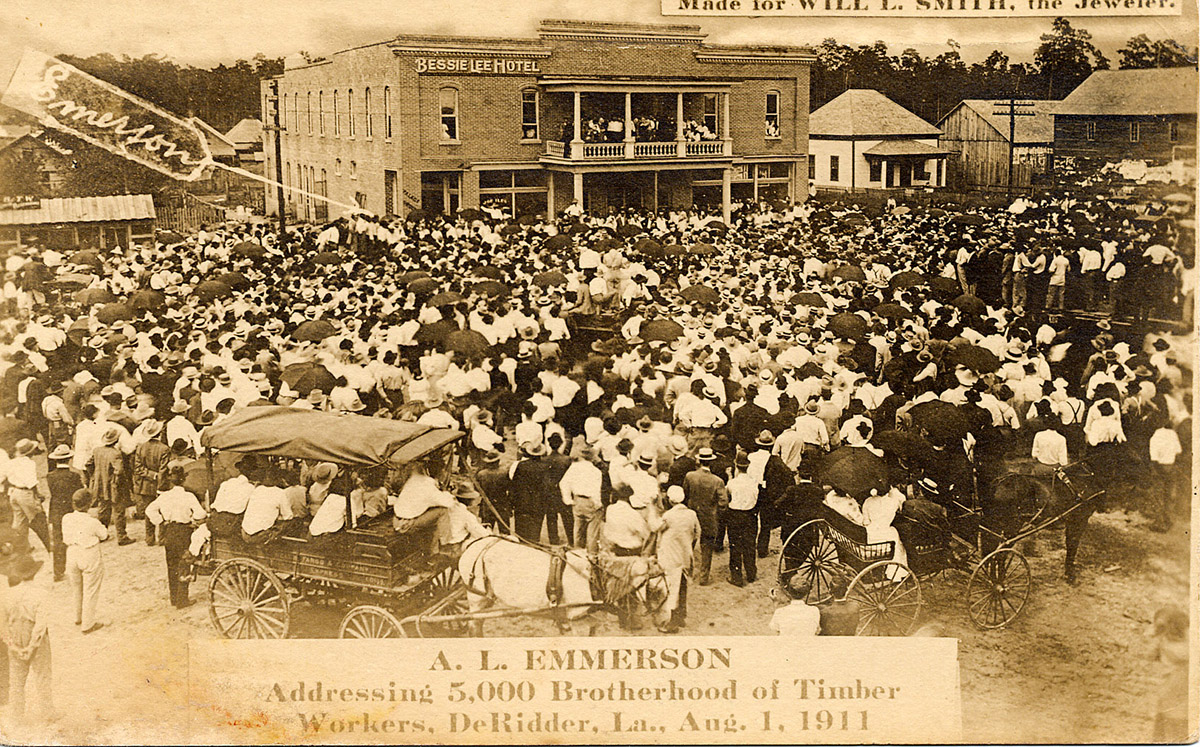
Many things have happened since that Lexington of Southern labor was fought. After it came the attempt of the Southern Lumber Operators Association to hang Organizer Arthur L. Emerson of the Forest & Lumber Workers’ Union and of fifty-eight fellow workers. But labor united regardless of affiliation, the Lumber Trust snarling to the last, was driven from its prey. The boys were all freed, but the main purpose of the massacre and trial had been accomplished–the power of the union was broken and its remnants slowly disbanded. “The Lumberjack” was blacklisted out of Alexandria and a little later Secretary Jay Smith was forced to close the office of the Southern district and to leave Louisiana in order to earn a living for his family.
“Free Our Men or Fight”

Then the name of our paper was changed in New Orleans, to “The Voice of the People,” under which name it took part in the revolt of the seamen in the Port of New Orleans against the brutalities of the Fruit Trust. This great struggle was led by the Marine Transport Workers of the I.W.W. led by such men as Constantino Filigno, Frank Albers and Jose Filguera. In the strike we had four men killed outright by the police force of New Orleans, acting for the Fruit Trust, and fifteen or twenty wounded, while seventy-six were thrown into jail and charged with everything from mutiny against the British flag to inciting to riot and murder; but once more, united labor faced the bosses and their tools. The courts, police and detectives were forced to abandon the trials and free our fellow worker. The cases against all of them were practically thrown out of court, a thing that will happen any time labor drops its petty differences and faces the State with a declaration of “Free our men or fight.”
After the breaking of the seamen’s strike, in the doing of which the officers of the U.S. Government rendered the Fruit Trust signal aid, “The Voice,” left with nothing but its editor and a handful of black-listed rebels back of it, was forced to move again to Portland, Oregon, where it arrived about August 1st, 1914, just as the entire lumber and other industries of the Northwest were being shut down by the capitalists on account of the world war. So, despite the splendid efforts of the I.W.W. in Portland and elsewhere, the paper was finally, after a stormy career of about two years, compelled to suspend.
Then I went and saw the Illinois Central Railroad trying Carl Person, just as the Lumber Trust had tried Emerson, the same buzzard corporation lawyers with their foul detectives in charge of the courthouse, and I said, with Jack Whyte: “To hell with the courts!”
Fight Will Yet Be Won
Sometimes I think it is all a terrible dream, the things I have seen and been through in these few short years, but it is not. Often the fight seems lost forever, yet the “Old Guard” is still there, and from time to time, I am getting letters from Louisiana, Texas and Oklahoma, proposing that we try to get together and renew the battle for a free South and World, and then I know the fight is not lost, and will yet be won.
I think, and think, and think, of how the Lumber Trust can be whipped and brought to terms, forced to acknowledge that they who work for their living are human beings, with human wants and human rights.
And over, and over, the only answer is, SABOTAGE–the Lumber Trust cannot be beaten in an ordinary strike, for folded arms simply means putting empty stomachs against acres of lumber, that grows more valuable every hour it air-dries. And so the pines whisper, “SABOTAGE,” and the cypress sigh, “SABOTAGE,” and the souls of Ed. Lehman, of Roy Martin, of Decatur Hall, of “Leather Breeches” Smith, from Valhalla, cry for vengeance and the cry is “SABOTAGE!” And I say, yes, the soul of Lehman is right–SABOTAGE alone can free the slaves of lumber; SABOTAGE will make the lumberjacks lords of the forest. And so, all my reveries on Grabow run into this one magic word, the key-word to the conquest and overthrow of the emperors of Lumber, the word they dread above all others, the mighty, freedom-bringing word, Sabotage! By this sign, O lumberjacks, ye shall conquer, Sabotage! Sabotage!! Sabotage!!!
The Industrial Union Bulletin, and the Industrial Worker were newspapers published by the Industrial Workers of the World (IWW) from 1907 until 1913. First printed in Joliet, Illinois, IUB incorporated The Voice of Labor, the newspaper of the American Labor Union which had joined the IWW, and another IWW affiliate, International Metal Worker.The Trautmann-DeLeon faction issued its weekly from March 1907. Soon after, De Leon would be expelled and Trautmann would continue IUB until March 1909. It was edited by A. S. Edwards. 1909, production moved to Spokane, Washington and became The Industrial Worker, “the voice of revolutionary industrial unionism.”
PDF of full issue: http://iw.applefritter.com/Industrial%20Worker/1916/1916%207%2029%20IW%20.pdf
 Revolution's Newsstand