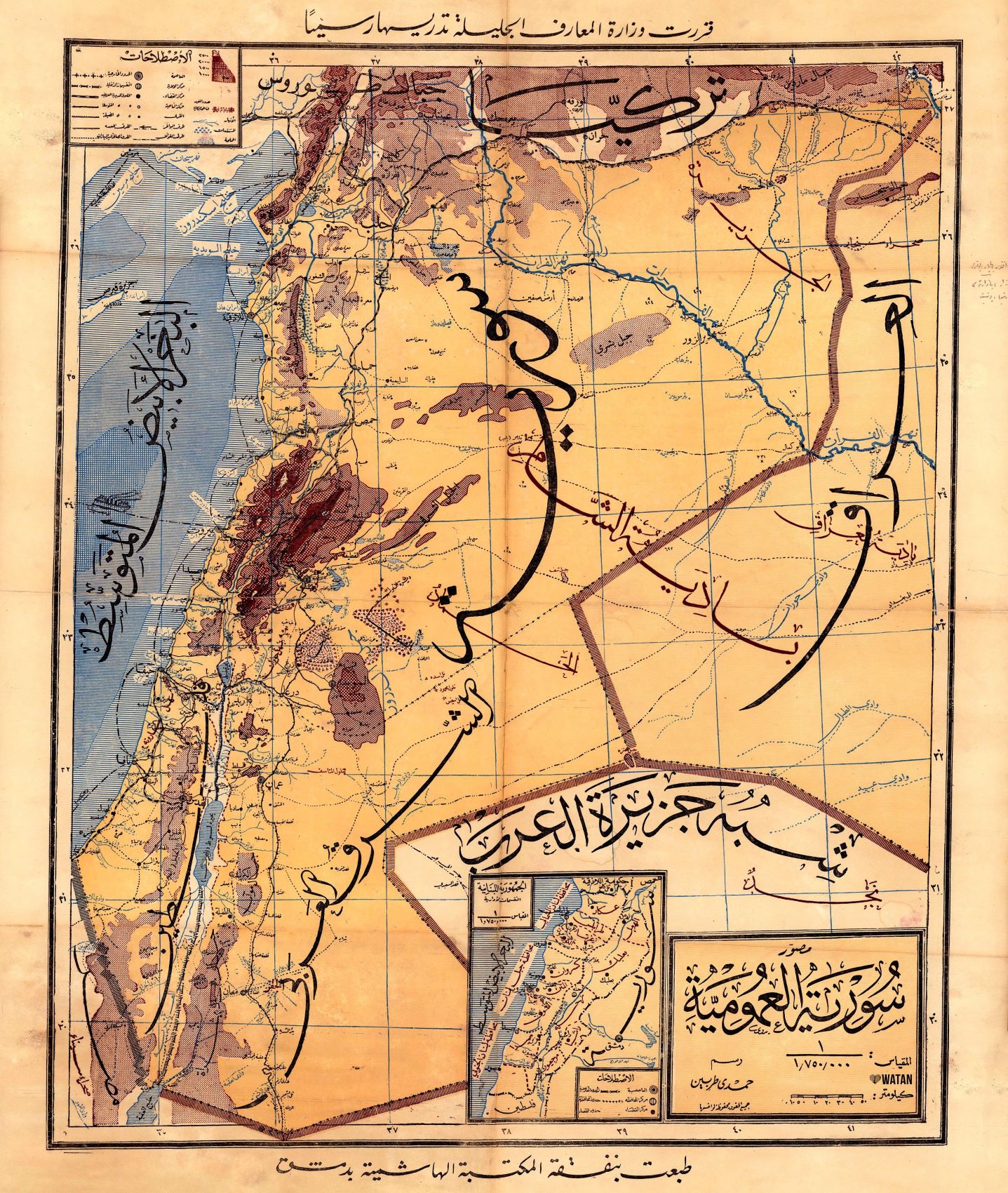
A founder and leader of the Palestine Communist Party for much of the 1920s, Joseph Berger-Barzilai summarizes the differing approaches of the British in Mandatory Palestine and the French in Mandatory Syria (which included today’s Lebanon and Turkey’s Hatay province), as well as the character of the early resistances that developed.
‘The Imperialists and the Revolutionary Movement in Syria and Palestine’ by Joseph Berger from International Press Correspondence. Vol. 5 No. 40. April 29, 1925.
That which distinguishes French imperialism in Syria from English imperialism in Palestine is its militarist character The commissar and commander of the military forces has acted ruthlessly towards that section of the population which did not submit to the French commands and was hostile to the foreign occupants. As a result, the national revolutionary emancipation movement in Syria in general has assumed an equally sharp character, which is reminiscent of the time when the Arabs defended their independence in the fight against the Turkish despots. Right up to recently, Syria has remained a country of constant revolutionary ferment, continual outbreaks, raids and conspiracies. In September 1924 the daring raid upon Damascus by a “band” which seized possession of some police depots, for some time held a whole section of the town in its hands, and then were able to conceal themselves in the town unhindered, created a great sensation. As this attack was not accompanied by any plundering, this event, like the revolts which broke out at the same time in the South East of the country, bore a purely political character.
The anti-French movement is of course developing under illegal conditions. The most powerful organisation in the country “Hissn-el-Wataniel-Arabi” (Arabian National Party) carries on its work by illegal committees and has no possibility of coming out into the open. The French system of suppression is seen to be still more harsh as regards its treatment of the press. The opposition press is throttled (for example, the big bourgeois newspaper “Ol Makkikech”, (“Truth”) has been suppressed). A number of people who had played a leading part in the national revolutionary party were sentenced to terms of imprisonment or expelled from the country.
In spite of the repressions the Arab revolutionary movement in Syria is constantly growing. The Arab national movement is gradually assuming the character of a movement of the broad masses of the people. This is chiefly due to the difficult economic situation in which Syria finds itself at present. The peasantry of the most cultured district in the Lebanons are emigrating in masses as their situation is intolerable. The wages of the town workers are lower than those of pre-war times, while the cost of food has considerably increased. Syria formerly constituted a trade route for Turkey, but it is now isolated and its trade is almost entirely crippled. The native Arabian industry is dying out; on the other hand the French capitalists are enjoying every sort of privilege. The government has not moved a finger in order to improve the existing state of affairs. Not only that; the budget is loaded with the burden of the repayment of the Turkish debts (in the interests of the French finances), with the enormous parasitic official apparatus, and with public undertakings which are not in any way for the benefit of the national economy of Syria, but are necessary to the French for their strategic aims.

The national emancipation movement itself is gradually changing its character. In the past this movement for emancipation formed an integral part of the Pan-Islamic movement, chiefly uniting in its ranks the Mohammedan elements of Syria and aiming at the creation of an All-Arabian State with the Sheik of Mekka, Hussein and his son Feisal at the head. This movement is now becoming a movement of the whole people. Broad circles of one-time mutually hostile Mohammedan and Christian intellectuals are uniting together in a common struggle against France. At the same time, with the defeat sustained by Hussein, there have also been dispelled the hopes of an All-Arabian State under the protectorate of any European State. At present the movement has lost its bearings and has no clear aim. But the number of supporters of the liberation movement is growing. It is also gaining confidence in its own powers and we shall probably witness in the near future the powerful growth of a national insurrectionary movement in Syria, arising from the profound discontent with the imperialist domination.
Far more clever and refined is the behaviour of the English in the English mandatory area in Palestine. In the first place they refrain from relying solely upon the bayonets of their troops. Just as in the other colonies, they prefer to create a support in the country itself. The French in Beyrout rely upon the rule of their own general, the English in Palestine, however, impose the task of consolidating their power upon the liberal Zionists. Compared with the policy of Gouraud or Weygand in Syria, the policy of Sir Herbert Samuel in Palestine bears a “conciliatory” and “peaceable” character. The English act as if they were not occupying the country in their own interest, but in order to fulfill a solemn and repeated “promise” to the Jewish people to “set up in Palestine a national home for the Jews”.
In Syria it is the imperialist government itself which appears as the leader of the struggle against the native population. In Palestine, however, the English have created a buffer in the shape of the Zionists. The policy of the Zionists in Palestine is aggressive and absurd, and is regarded by the Arab population as a serious threat against their existence. The Zionists enjoy various privileges and advantages from the English government. A minority, amounting to not more than 13% of the population, enjoy special privileges from the government through the Executive organ of the Zionist organisation, and determine along with the government the number of Jewish immigrants to be admitted into Palestine etc. In order to provide settlements for the Jewish immigrants the Zionist organisation and other Jewish capitalist concerns are purchasing land from the Arab big landowners and expelling the Arab peasants from their little plots of ground.

It is not surprising that the Arab national movement in Palestine is directed in the first place against Zionism. So long as the Arab national movement was led by rich Arab feudal landowners, it had, instead of carrying on a struggle against the English rule, rather competed with the Zionist organisation in seeking to win the favour of the British government. It is only since the English government, which for long played the part of “impartial judge” between the Arabs and the Jews and artificially diverted the anger of the suppressed Arab masses from itself against the Zionists, was compelled openly to admit that it stands on the side of the Zionist Party, that the national movement in Palestine adopted a strong policy and took up the fight against imperialism.
In Palestine the government is directing its persecutions mainly against the young, but well organised Communist Party, which is conducting the most active and successful fight against imperialism and against Zionism. The connection of this Party with the national revolutionary elements and the growing popularity of its slogans among the Arab working and peasant masses constitutes a serious danger for English imperialism in the Near East, as it threatens it with the collapse of its cunning policy in Palestine.
International Press Correspondence, widely known as”Inprecorr” was published by the Executive Committee of the Communist International (ECCI) regularly in German and English, occasionally in many other languages, beginning in 1921 and lasting in English until 1938. Inprecorr’s role was to supply translated articles to the English-speaking press of the International from the Comintern’s different sections, as well as news and statements from the ECCI. Many ‘Daily Worker’ and ‘Communist’ articles originated in Inprecorr, and it also published articles by American comrades for use in other countries. It was published at least weekly, and often thrice weekly.
PDF of full issue: https://www.marxists.org/history/international/comintern/inprecor/1925/v05n40-apr-29-1925-inprecor.pdf
 Revolution's Newsstand