
The use, and betrayal, of Kurdish nationalist aspirations by various powers has long been in the imperialist playbook. Joseph Berger, head of the Comintern’s Eastern Department, reports on the Ararat/Barzani Revolt.
‘The War of the Kurds in North Iraq’ by Joseph Berger from International Press Correspondence. Vol. 12 No. 18. April 21, 1932.
A few days ago a member of the British Parliament requested information from the government regarding the situation in North Iraq, where fighting has been going on for some time past. The answer which he received shows that the news contained in the English press regarding a regular war against the Kurds inhabiting the district of Iraq adjoining the Turkish and Persian frontiers is in accordance with the facts. The Kurdish tribes are waging a stubborn fight not only against the Iraq expeditionary troops commanded by British officers, but also against British aeroplanes, and they have even succeeded in shooting one of them down.
The fights against the Kurds in North Iraq reveal the inner contradictions of British imperialism. These fights have been going on for over a decade. The Kurdish revolts, which are repeatedly suppressed by expeditions, break out with almost unfailing regularity every Spring. Even the official descriptions given by the British authorities regarding the original source of these outbreaks have to admit that the Kurdish tribes, even during the time of the war, were armed with weapons of British origin. The Kurdish Sheiks formed valuable auxiliary troops in the fight against the enemies of England in the world war. Since then, the officers of the British secret service have been continually in touch with these sheiks in order to incite them against the Turkish Republic. It has been repeatedly ascertained that English, and also French, officers were behind the revolt in Kurdistan against Mustafa Kemal Pasha, and that these revolts were intended to exert pressure on the Turkish government in order to induce them to comply with the desires of the organisers of anti-Soviet intervention.
British imperialism intended to set up an autonomous Kurdish buffer State in Iraq. This “autonomous” State, as was repeatedly emphasised in the urgent petitions by Kurdish notables to the League of Nations, was to secure the Kurdish national minority rights against the attacks of the “Arab” State by nominating special British officials in the Kurdish district and garrisoning it with British troops. The purpose of this persistent agitation for an independent Kurdish State was all too apparent. It was a question of setting up in Kurdistan a direct British administration and to have a pretext for its military occupation.
The endeavours of the British imperialists in North Iraq are, for the rest, only a part of the operations that are being carried out in all the advanced frontier districts of the Near and Middle East. The English have in a similar manner sought and obtained pretexts for separating the North-West province of India and subjecting it to a direct military dictatorship, just as in the same way the military occupation of Kashmir is already being carried out.
Just as in the other cases mentioned, the imperialist plans cannot be carried out otherwise than by making war on the native population. Owing to the desperate situation of the native mountain tribes, small outbreaks, often instigated by British agents themselves for their own purposes, develop into general revolts against which, as is shown by the case of the recent Kurd revolt in North Iraq, all means of modern war-technique must be employed.
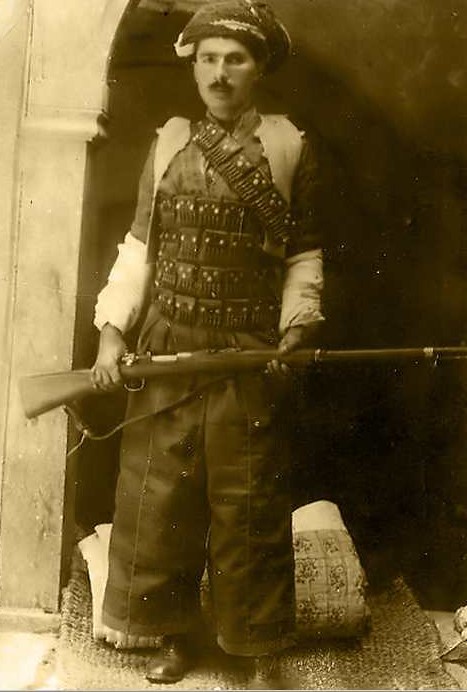
The Iraq government is endeavouring to conceal the truth regarding the extent of the fighting in North Iraq, and the command of the British air forces only give reports regarding their own losses. So far as can be seen from the Arab press appearing in the neighbouring countries of Iraq, North Iraq is the scene of an insurrection which in extent exceeds the former insurrections. The expeditionary troops must have suffered considerable losses, judged from the great number of wounded which have been transported to the hospitals in Baghdad. The Kurdish partisan detachments, headed by Sheik Barsan, are being pursued far into the mountains. But the fighting is not confined to them. Whole Kurdish villages in which only women, children and old folk have been left behind, are being destroyed by bombs and aeroplanes and the population exterminated.
This little colonial war deserves attention because by means of it a new attempt is being made to push forward the imperialist troops into the neighbourhood of the Soviet frontiers. The British military actions in the North-West province of India mean at the same time an advance into Afghanistan territory. The military occupation of Kashmir is intended to create a basis for an attack on Tibet, and later on the Central Asiatic Republics of the Soviet Union, Through Kurdistan, Persia and Turkey are to be threatened on their most vulnerable frontiers; from there it is not far from Soviet Armenia and Soviet Aserbeijan. Already once, in 1920, British troops made this “promenade” to Baku. At that time they were forced to retreat. Behind the fights against the Kurdish mountain tribes there is to be seen a part of the preparations for the great war of intervention for which the imperialists are directly heading.
International Press Correspondence, widely known as”Inprecorr” was published by the Executive Committee of the Communist International (ECCI) regularly in German and English, occasionally in many other languages, beginning in 1921 and lasting in English until 1938. Inprecorr’s role was to supply translated articles to the English-speaking press of the International from the Comintern’s different sections, as well as news and statements from the ECCI. Many ‘Daily Worker’ and ‘Communist’ articles originated in Inprecorr, and it also published articles by American comrades for use in other countries. It was published at least weekly, and often thrice weekly.
PDF of full issue: https://www.marxists.org/history/international/comintern/inprecor/1932/v12n18-apr-21-1932-Inprecor-op.pdf
 Revolution's Newsstand