
‘The Land and the Peasant in South Africa’ by James Shields from International Press Correspondence. Vol. 6 No. 15. February 25, 1926.
In a country such as South Africa where agriculture forms the main source of the country’s wealth the peasant question must inevitably play a big part in the conduct of working class policy. No working class political party can afford to neglect the securing of allies for the workers in order to assist them in their task of capturing power and especially is this so with regard to South Africa placed as she is in the position of being a colonial country. It has been correctly stated that the national and colonial questions affecting the workers’ parties in A large measure resolve themselves into the peasant question.
In South Africa the task of winning over the peasantry has hardly yet been put to a preliminary survey although big scope exists for sowing real working class propaganda in this connection on an extremely fertile field. We find, for instance, that the value of agricultural and pastoral production in the Union of South Africa in 1923 amounted in value to £ 73,833,000 or almost one half the total wealth production of the whole country.
This big sum and the resulting profit therefrom was wrung from the merciless exploitation of the agricultural workers who number close on half a million. The last census of farm employees taken in 1918 shewed a total of 486,062 excluding native locations, reserves, etc. Since that period much more acreage has been put under cultivation, the year 1922/23 alone witnessing an addition of about 3,000,000 acres. This increased cultivation must naturally have resulted in an increase of employees since the amount added represents roughly an increase of 33 per cent. The exact figures are as follows: Acreage under cultivation in 1922 — 10,691,278 Acreage under cultivation in 1923 — 13,196,674
Of the total number of farm employees engaged in agriculture about 74 percent are natives belonging to the Bantu races, the remaining 26 percent being made up of Europeans, Asiatics, and other coloured people. What are termed the Cape coloured people by the way, are originally descended from the early Dutch settlers and British soldiers who co-habited with the native women. They number about half a million all told in the whole Union, and range in colour from the almost white type to practically the colour of the Bantu. All these sections are unmercifully exploited on the land, the heaviest burden of all generally falling on the natives.
Quite apart from this total there are also a big number of small farmers whose lot is little better than that of the employee who works for wages. A certain system known as the bywoner system is in vogue whereby the middleclass farmer lets out a part of his land to another to the extent of a half or one third of his whole farm. This tenant to whom the land is let out is known by the name of bywoner. The Bywoner uses his own stock and farm implements, and also hires his own labour. When the harvest is gathered he has to hand over a half or one third as the case might be or his total harvest to the land owner, and consequently if no harvest accrues as a result of his labour it means that he therefore pays no rent. The landowner is the gainer from this transaction, losing nothing even if the harvest turns out bad: but a bad harvest means bankruptcy for the Bywoner (landless farmer).
According to the law the Bywoner is not allowed to employ more than two natives with their families, but this number is very often exceeded. The natives so employed generally find that their only return after six months’ work amounts to little more than a few shillings, whilst their employer himself in many cases is little the richer except for a few bags of oats, maize and potatoes. Very often after the harvest season hundreds of these small farmers find themselves in a state of insolvency, and since the insolvency charges are generally high the native farm worker often gets nothing at all for the work he has put in. There is a rule laid down which states that in cases of insolvency wages become a preference claim. The poor native, however, finds the Courts almost wholly inaccessible to him and so is unable to put a claim forward.
After the harvest it’s nothing unusual to find hundreds of land workers trekking around looking for work or trying to find some place where they can make a fresh start. Many of them are driven into the towns in despair at their failure, but the towns hold no prospect either.
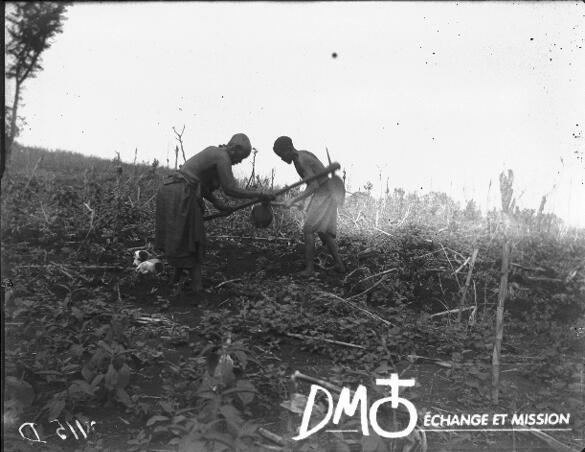
Quite a big number of the small farmers who eke out a precarious livelihood year after year feel a distinct grievance against the white town worker, who earns on an average about twenty five pounds per month. This animosity between town and country is being deliberately fostered by the master class, and its dangerous consequences to the workers can be recognised when it is remembered that the burghers of the back veldt (farmers) were mobilised, rifle in hand, and arrayed against the striking miners of the Rand in 1913 and 1922. These land elements at that time were of the opinion that the town workers had no right to strike since their wage rates were comparatively high and they were much better off than the poor farmers.
As a result of the steady ruination of the small farming class the power of the big farmers and land corporations is greatly increasing. More and more are the big landowners buying out the small men, very often by means of the most unscrupulous measures. We might take as an example the case of a small farmer who works his piece of land with the help of a few natives or coloured workers. If this farmer requires any stock, etc., to enable him to carry on his work, he is forced to apply for credit at the country store or land bank. Very often it happens that money is advanced on the harvest whilst the crops are still in the field, and if the cash so advanced happens to be perchance on say twenty bags of maize then thirty bags require to be paid in return when the crop becomes ripe.
In the Cape Province most of the farms are owned by big grain and sheep farmers. The grain farmers employ, in most cases, some two or three hundred coloured labourers. The wage of the coloured farm labourer works out at 2/6d per day with the inclusion of perhaps a few tots of cheap wine. They are only employed for a part of the year being paid off for a stretch of three or four months after the harvest is gathered. The overseers on these farms are Europeans who receive the magnificent wage of about 30/- or £2. O.O. per week There are quite a fair number of small peasants (mostly coloured) in the Cape Province who carry on the growing of vegetables, but their return in this respect is very poor.
As a result of the harsh and oppressive conditions inflicted on the land workers as a whole it is nothing surprising to find that difference of colour does not hold in the country in the fashion it does in the towns. As a matter of fact there is a great deal of fraternisation between coloured, natives, and poor whites. Especially is this so on the sheep farms where the lonely isolation obliterates the racial prejudice.
The wages of a shepherd vary from 10- to one pound per month with the addition of one sheep for slaughter and 75 to 100 lbs. of meal per annum. On some occasions the shepherd is allowed to keep a number of sheep of his own.
A standing grievance of the land wage earner is the impositions of the Master and Servants Act which the wealthy farm owners are continually wanting strengthened. This Act makes it a criminal offence for a labourer to leave his master’s employ, and is viewed with great disfavour by the struggling toilers on the land.
The time has now arrived in South Africa when the ideas and thoughts of the landless peasant, the small peasant, and the agricultural proletarian must be translated into a practical programme of demands and urged as widely as possible.
The workers of all shades can be rallied on a common platform of struggle for immediate demands, and so far as the land workers of South Africa are concerned the following portrays their chief needs:
1. Land for the poor peasants.
2. Setting up of Co-operatives with State credits.
3. All produce payments to be made in cash.
4. Prohibition of indentured labour.
5. Setting up of technical training schools, for farm youth.
6. Nationalisation of the Land.
The Communist Party is the only party which, so far, has paid any attention to the land workers’ problems, and that but very recently. One of the chief tasks in front of the South African Communist Party is the active propagating of the above demands amongst the labouring and struggling masses, and the undertaking of serious systematic work among the rural population. To the extent with which it is successful in the carrying out of this work depends to a big extent the growth and development of the Communist Party in this country.
International Press Correspondence, widely known as”Inprecorr” was published by the Executive Committee of the Communist International (ECCI) regularly in German and English, occasionally in many other languages, beginning in 1921 and lasting in English until 1938. Inprecorr’s role was to supply translated articles to the English-speaking press of the International from the Comintern’s different sections, as well as news and statements from the ECCI. Many ‘Daily Worker’ and ‘Communist’ articles originated in Inprecorr, and it also published articles by American comrades for use in other countries. It was published at least weekly, and often thrice weekly.
PDF of full issue: https://www.marxists.org/history/international/comintern/inprecor/1926/v06n15-feb-25-1926-Inprecor.pdf
 Revolution's Newsstand