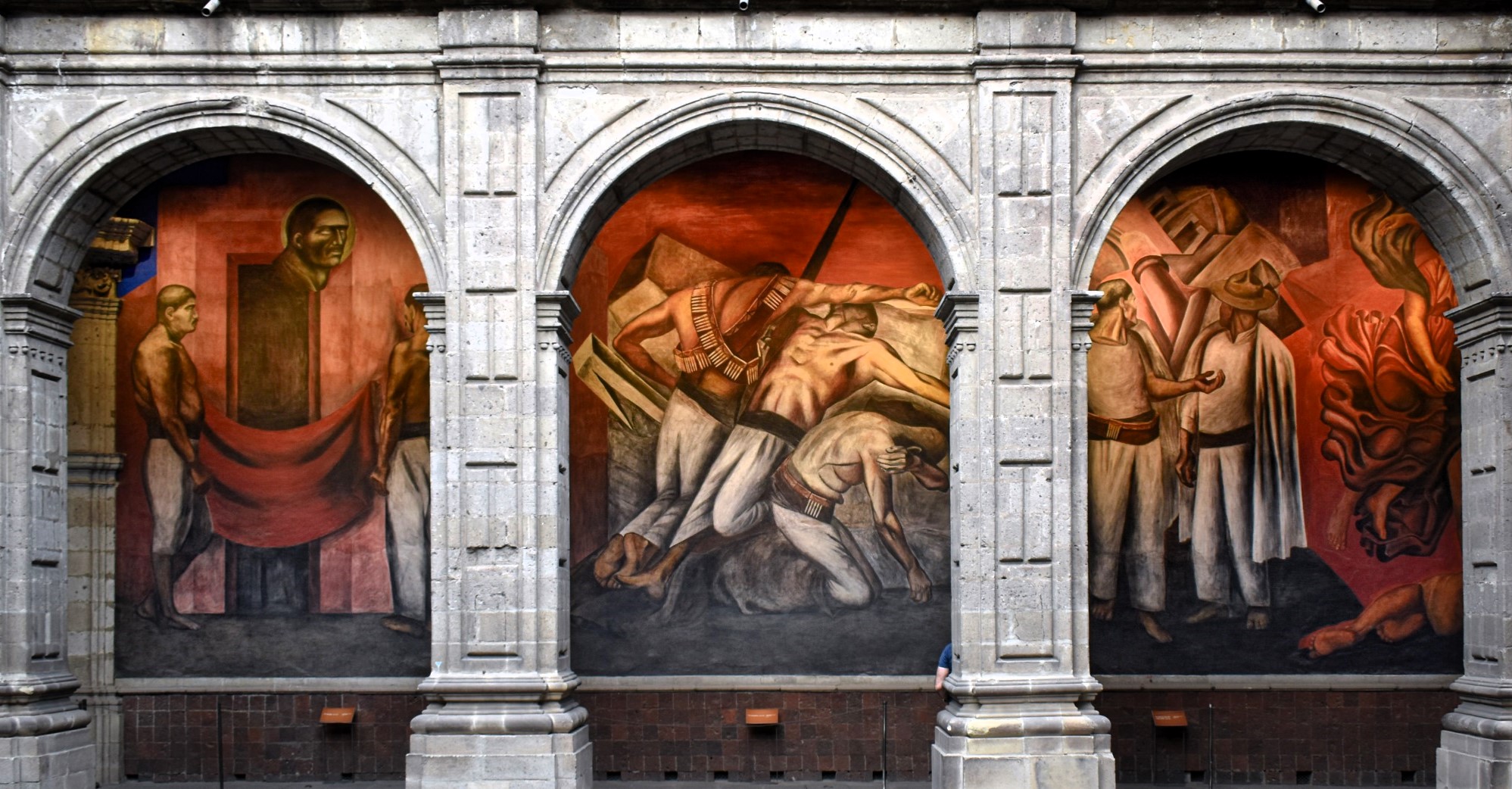
A review of the murals of Jose Clemente Orozco.
‘Orozco’ by Anita Brenner from New Masses. Vol. 8 No. 7. February, 1933.
Jose Clemente Orozco is one of the greatest painters of our day. But it is the business of a critic to do more than recognize this fact, to go beyond amplifying it with appraisals and appreciations of the technical, emotional and intellectual excellences of his work. Precisely what combination of these and environmental and hereditary factors has made him great as a painter, is ground for aesthetic speculation; but analysis of the position he occupies in relation to his time, and of the part he plays in the line of development of twentieth century painting and action and thought, is more useful.
Orozco is generally called a revolutionary artist. His work identifies him at once as a critic of the social order under which he lives. His antagonism is translated in two modes: satire, when he turns his attention to the individuals and classes which represent social oppression; and profound emotion of a semimystical character — backed with anger — when he looks upon the oppressed. In that all the forces of his nature set him squarely against the social status quo, and in that he does not espouse any liberal or reformist cause, he is wholly a revolutionary. Unlike Forain, almost his contemporary, he does not accept the horrors which feed his bitterness with Christian resignation. At a moment when the fight of organized labor in Mexico is identified with the personality of a leader-racketeer, Orozco, in the pay of the government in which this man was a power, lampoons him without fear or mercy. When on the other hand he beholds the underdog putting himself beyond suffering in the picturesque filth and stench of a low saloon, he records that sight savagely, with none of the Bohemian indulgence of a “friend of the people” gone slumming. While Rivera depicts a republic in the hands of workers and peasants as a fait accompli, Orozco cuts sharply into immediate realities with a mural showing politicians and labor racketeers banqueting at a loaded table below which blinded workers slash at each other’s throats.
As a revolutionary Orozco is a destroyer. All his work cries No! to the social and physical violence done upon the oppressed, in whatever euphonious name. He takes the position Goya held, and because in this respect he comes closer to Goya than has any other artist before or since, except Daumier, the catch-phrase “Mexican Goya” was very early attached to him, and the name of Goya or Daumier or both is nearly always invoked, like a justification or an apology, in routine reviews of his work. Yet a simple confrontation of any work by Orozco with any Goya shows at once a vast difference between them. Orozco is a modern, and in his work structure is the basis of the formal vehicle, while in Goya that weight is borne by design; Orozco works with masses and blocks from which line emerges; Goya works with tonal values and lines, often with the calligraphic ideal of a Japanese.

It is so clear that Orozco speaks the language of his time artistically as well as socially that confusion arises only after some need for a pedigree is established by commercial or semi-commercial requirements. His famous series of revolutionary sketches was taken to a prominent art merchant by this critic several years ago, before Orozco’s name was familiar outside of Mexico. “I cannot exhibit these things,” said the merchant, “they don’t belong in an art gallery.” And added, “I would advise you to take them to the New Masses.” It was necessary for a new gallery to open for Orozco to hang in the temples of art, but once hung, these same sketches achieved the commercial dignity of great works of art. Then their character set up contradictions and implications which for commercial purposes must be explained away somehow. Successfully enough, to make of Orozco himself a contradiction: a successful revolutionary artist.
This conflict set up in the artist a struggle between that which was contained in his Mexican work and that which contained success, as is clearly revealed in the erratic departures of the work done after his first experience of being a lion, on condition of being a tame one. Confusion and conflict push form and content into a wind of chaotic mysticism which can be superficially explained with a surrealiste label, but which is nevertheless strange — see Broken Columns — to a painter whose line of development from social critic and political insurgent — in action as well as in expression — to revolutionary muralist nowhere contains the material for such departures.
But the possibility of the conflict which has been causing them, and which is yet unresolved, was indeed contained in this, that Orozco, throughout his insurgency, seems nevertheless to have been in his own mind a free agent, a more than sympathetic spectator but still always a lone man committed to neither side of the class struggle. His repudiation of opportunism is plain in the banquet mural done in Mexico but not immediately apparent in his astonishing burlesque of Rivera at the New School for Social Research. The struggle in his mind seems to be so great that it is difficult even for a critic familiar with the artistic and personal background of this piece of work, to identify sometimes, which is parody and which assertion.
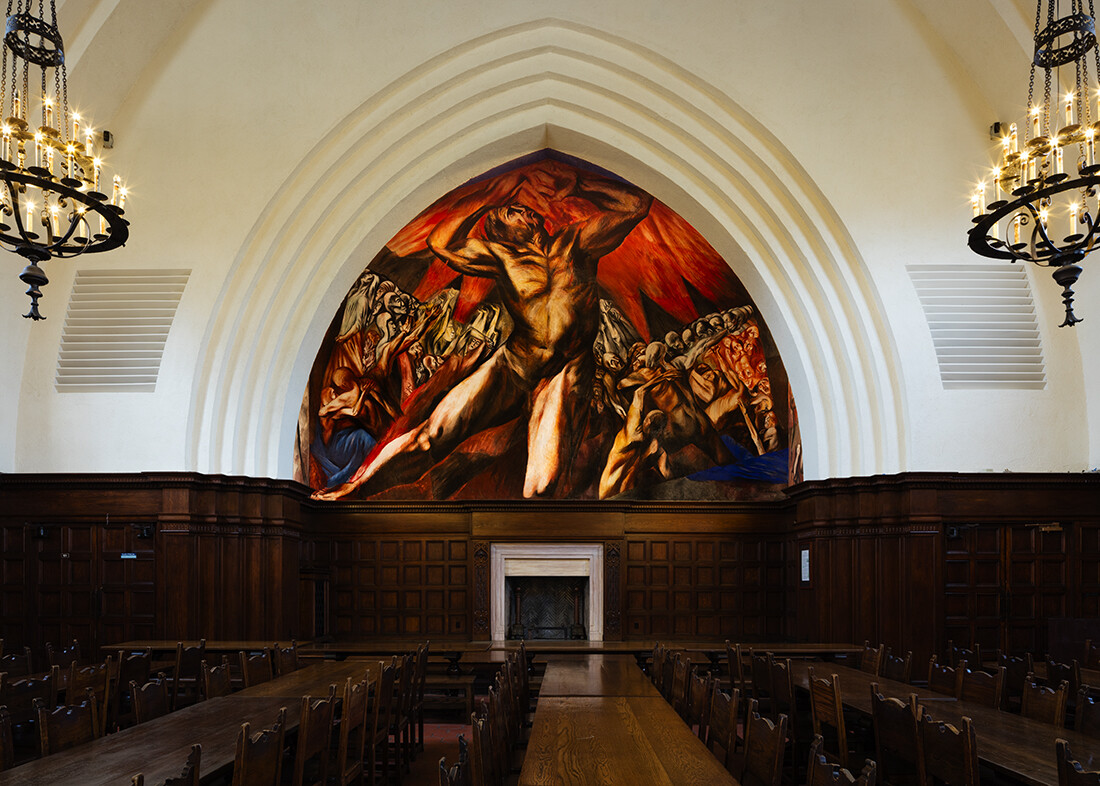
Because the dimensions of Orozco’s emotions are as monumental as the structural quality of his work, the dilemma of choice between his feelings and intellect and his interests assumes the heroic proportions of classic tragedy; it represents too, the daily fare of all the clear-minded artists and intellectuals of his time. The first monograph of his work to be published is therefore of personal interest to all his contemporaries, and a necessary text-book for all students of art. It represents him adequately, though it cannot convey the qualities which make his murals at the National Preparatory School in Mexico and at Pomona College in California uniquely great. Most of his work as a political caricaturist has been saved for a future volume, but enough is reproduced in the Delphic Studios monograph to give some idea of it. The book contains many illustrations and has a biographical calendar and a brief introduction by Alma Reed.
The New Masses was the continuation of Workers Monthly which began publishing in 1924 as a merger of the ‘Liberator’, the Trade Union Educational League magazine ‘Labor Herald’, and Friends of Soviet Russia’s monthly ‘Soviet Russia Pictorial’ as an explicitly Communist Party publication, but drawing in a wide range of contributors and sympathizers. In 1927 Workers Monthly ceased and The New Masses began. A major left cultural magazine of the late 1920s and early 1940s, the early editors of The New Masses included Hugo Gellert, John F. Sloan, Max Eastman, Mike Gold, and Joseph Freeman. Writers included William Carlos Williams, Theodore Dreiser, John Dos Passos, Upton Sinclair, Richard Wright, Ralph Ellison, Dorothy Parker, Dorothy Day, John Breecher, Langston Hughes, Eugene O’Neill, Rex Stout and Ernest Hemingway. Artists included Hugo Gellert, Stuart Davis, Boardman Robinson, Wanda Gag, William Gropper and Otto Soglow. Over time, the New Masses became narrower politically and the articles more commentary than comment. However, particularly in it first years, New Masses was the epitome of the era’s finest revolutionary cultural and artistic traditions.
PDF of full issue: https://www.marxists.org/history/usa/pubs/new-masses/1933/v08n07-feb-1933-New-Masses.pdf
 Revolution's Newsstand