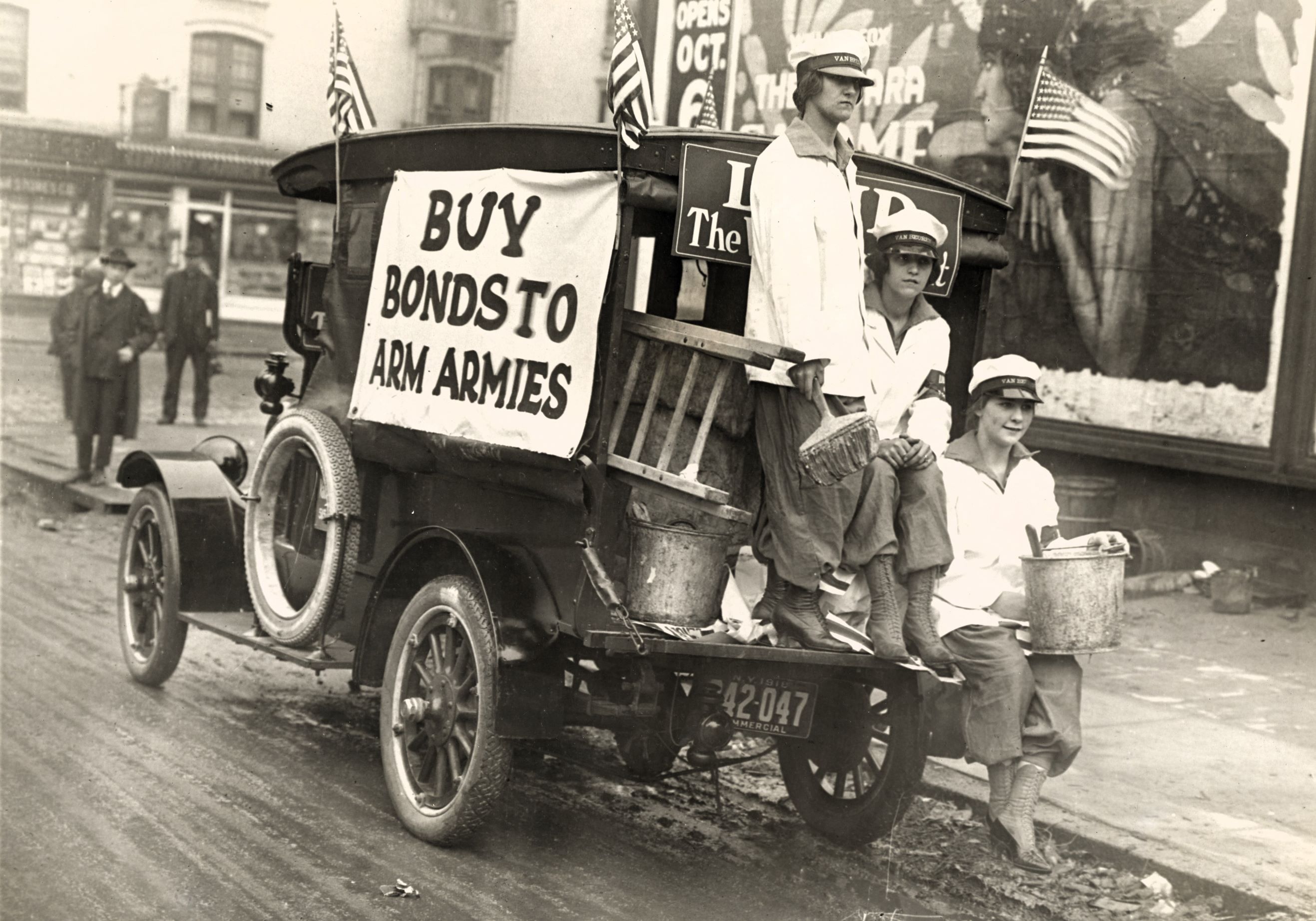
As the United States entered World War One, this important piece by Louis Fraina from the inaugural issue of Class Struggle analyzing the forces that shaped a rising U.S. imperialism and demanded the formerly ‘isolationist’ Woodrow Wilson participate in the conflagration.
‘The War and America’ by Louis C. Fraina from Class Struggle. Vol. 1 No. 1. May-June, 1917.
The entry of American Capitalism into the war is the culmination of a process interesting in itself, and still more interesting as a token of what is to come.
When the war burst upon the world, America — and I shall use the word as meaning American Capitalism, and its intellectual minions — reacted to the war with an overwhelming sense of fear and horror. Its own interests not being involved, the fear of an unprecedented catastrophe dominant, America’s traditional democracy flared up in a flame of protest. Austria was damned for its brutal onslaught on Serbia, Germany for its rape of Belgium; the horrors of war, and this war in particular, were emphasized and the general feeling was that the war might end and end speedily.
These reactions were not wholly insincere. Compounded of fear and prejudice, of a belief that a real menace was loose in the world, this feeling of horror — impulsive and crude, in a measure hypocritical — was still very real and very strong. The idealism of Capitalism, and this idealism is a messy mixture of Capitalism at its best and its worst, cried out against the war and for peace. There was a strong propaganda for international arbitration, disarmament and other schemes to end war.
This feeling lasted about six months. Originally largely impulsive, it gradually turned into an expression of economic needs and economic facts. American Capitalism was hit hard by the war, its industry clogged up and its over-seas trade tremendously reduced. War was seen as a wasteful process, as a menace to industry and trade. The era of fabulous profits was still a thing of the future. Few capitalists, in spite of their vaunted far-sightedness, saw the huge profits ahead. There was a threat of economic disaster. Wall Street experienced a “Black Christmas.” Everybody felt heart sore and pocket sore, and yearned for peace. When the Devil is sick, the Devil a monk would be.
As a matter of record, it is pertinent to mention that the talk at tins time of the Allied “fight for democracy” was perfunctory and unconvincing. President Wilson, about the time Belgium was invaded, urged our people to be neutral “in thought and deed.” The talk about democracy became stronger and stronger, it is true, but no action was urged. It was all simply a pious aspiration. The speedy coming of peace was the dominant thought during 1914.
The year 1915 marked a complete change in the spirit of America. The talk of peace drooped, and a smug, complacent yawping about “the war for democracy and civilization” took its place. The cry of “war to the finish” and “no premature peace” swelled into a mighty chorus. Why?
Largely and essentially because the era of fabulous profits had set in. The war had become Midas. The Allies settled down for a hard war and a long one; the mobilization of every available man and industry for purposes of war and the insatiable thirst of Mars for more guns and more munitions, compelled the Allies to turn to America for food, for money and for munitions. President Wilson, who at the beginning of the war suggested in a proclamation the advisability of not making loans to the belligerents, calmly and complacently forgot all about it when Wall Street floated huge loans in this country for the Allies at usurious interest. It had become a war of workshop against workshop; and the American workshop was kept increasingly busy.
The Christmas of 1915 in Wall Street was different from the preceding one. Bonuses were distributed by men who had made thousands out of the carnage, and generously gave away a penny. The country was feverish; it basked in the shower of Gold, and bent all its resources and all its cunning to wring the last penny out of the Allies — whom the newspapers very generously and very magnificently praised for their heroic struggle against the Hun and the Vandal. But, as the Allies were spending money at an astonishing rate, why not spend a little more so that the high-minded captains of industry in this country might make wo and three hundred per cent, profit? Even an unselfish war for democracy must be made to pay in dollars and cents. Otherwise, what’s the good of it all?

Only a supreme novelist could adequately describe the emotions of this period; only a supreme economist analyze the economic factors at work; and only a genius picture for all time the complex of economic and psychological forces that dominated that splendid, marvelous and horrible period of prosperity and death, and of its idealism stalking forth as justification of the shameless exploitation of a world sinking into ruin.
This period gradually flowed into a new one — the two became merged, and the end of one and the beginning of the other are not very clear. This new period, roughly the year 1916, while making still greater profits, was marked by a deeper realization of the causes of the war and its aims — of the great economic and political issues involved. It was seen to be a struggle for world-power, not in the sense of a Kaiser’s mad ambitions, but as a clash between two great economic groups struggling for the industrial and financial domination of the world, and particularly for the control of its investment markets.
The war, in a sense, has been the economic education of American Capitalism. Imperialism has not been unknown in this country, but it was in a form weak, parochial, without a worldvision. The war has changed all that, and American Imperialism now stands forth aware of its strength, conscious of its purposes, and preparing its armed power to impose these purposes upon the world.
In a way, the loans to the Allies were a factor in developing this new understanding generally. When, through the parochialism and cowardice of American finance, it became difficult for the Allies to secure loans here, they retaliated by paying for all their purchases in gold. The influx of gold became tremendous. It threatened to choke American Capitalism in its own plenitude. Howls of warning arose that this golden flood was swamping the country, that by inflating credit it might produce a panic. Loans were again made easy to secure; and America learned that foreign trade to-day depends largely upon investments — upon the capacity of an exporting nation to finance a prospective customer.
Where during 1915 it was simply a problem of making money hand over fist, this process in 1916 became a means to an end— the end being economic and financial supremacy in the world. Organized endeavor took the place of reckless profiteering alone; the present was related to the future, and immediate economic activity became a phase of the general process of making this country a world power.
The organization of the American International Corporation was the sign and symbol of this awakening to the opportunity of seizing world power, backed up by a vigorous propaganda for mightier armaments. This International Corporation represents the great interests of finance capital, and of such powerful economic units as the steel industry. Its purpose is to seek out investment markets, exploit and control them. It is a definite expression of the new era in American trade — an era of systematic export of products organized by the export of capital. Its capitalization of $50,000,000 is purely nominal, a mere bagatelle in comparison with the millions upon millions controlled by its sponsors. It is around the activity of this corporation, in China, in Chile, anywhere an opportunity offers, that American Imperialism is organizing itself. It is an ominous sign of the times. And, with characteristic American energy, it is going its European progenitors more than one better.
In pace with this development in its economic consciousness, America experienced a change in its attitude toward armaments. The earlier period of the war, and to a lesser degree the second period, was marked by the aspiration for universal disarmament and the conviction that war is wastes — except in the case of a confirmed militarist such as Theodore Roosevelt. But as the war went on, as the economic interests at stake were realized, as American Imperialism became aware of itself, the propaganda for “preparedness” and larger armaments assumed tremendous proportions and inevitably developed into a demand for universal military service.

This change in the policy of armaments is faithfully expressed in the gradual changes in opinion of President Wilson. The New York Evening Post, in its April 4 issue, very aptly summarizes this change in the President:
“The stages of the President’s changes of opinion are perfectly clear. In December, 1914, he was absolutely opposed to turning America ‘into an armed camp.’ In December, 1915, he yielded to the demands for preparedness. In January, 1916, he desired ‘incomparably the greatest navy in the world.’ In April, 1917, he yields to the principle of conscription to which he has hitherto been opposed or at least withheld his consent. From the beginning of the war he argued eloquently against our going into it, and because of his having kept us out of it he is reelected to the Presidency. In April, 1917, he decides for war, and thereby, curiously enough, wins the acclaim of the very business interests that most bitterly fought his re-election.”
The chronology of the President’s changes is significant. It fits in remarkably with the three stages of America’s reaction to the war that I have previously described. In President Wilson there is seen, accordingly, a man who expresses accurately the needs and demands of the economic interests dominant in the country.
What are the economic facts that have produced this complete change in American opinion and preparations for war, and that lie at the roots of our developing Imperialism!?
The credit balance of American foreign trade from the outbreak of the war to January 31, 1917, represents a huge total of $5,574,000,000. The statistics, as given by the New York Times, are as follows:
The foreign trade of the United States, imports and exports combined, since the outbreak of the war in Europe at the end of July, 1914, has amounted to the huge sum of $15,622,785,853. Exports during this period were a little more than double the imports, and the balance of trade in favor of this country resulting from these thirty months of trade was $5,501,568,835. This table shows how this vast trade has accumulated and the huge movement of gold which resulted from it:
The “other items” include payments to foreign ship owners for freight on part of our imports, the net amount of interest and dividends on our stocks and bonds still held abroad and other less important items.
There is nothing in the annals of economic history to compare with this achievement. It marks an industrial and financial revolution in America.
The statistics are not significant because of what they express in foreign trade alone. Trade in itself is not a cause of belligerency between nations to-day. The statistics of trade must be considered in relation to a nation’s stage of economic development; they must be related to the whole process of industrial and financial activity and international trade.
The outstanding fact in this industrial revolution is that America, from a debtor nation, has become a creditor nation. Two years ago American Capitalism owed the world more than two billion dollars; to-day the world owes America nearly three billion dollars. Where this country previously imported masses of capital, to-day it is exporting capital, and is developing the power to export it in still larger masses. The loans to the belligerent governments, paying good interest, represent a financial reserve for the future. And these loans are steadily growing — at present they amount to more than $2,500,000,000.
What do these economic facts, this accumulation of capital, signify? The accumulation of capital and the necessity for its export are the urge behind Imperialism. The export of capital lies at the very roots of Imperialism. The export of American capital to Mexico, and to Central and South America generally, has been the factor in the initial development of Imperialism in this country, with its menace to peace and freedom at home and abroad. How much more menacing will this Imperialism become when the export of capital assumes larger dimensions!
To-day, due to the war and as indicated in the statistics, the accumulation of capital in this country is proceeding at a terrific pace; and after the war means must be sought for its profitable investment. Undoubtedly, this capital could be profitably invested in this country; our resources and industrial capacity are as yet only slightly developed; but as the returns would be comparatively small and slow, foreign investments will beckon alluringly. Moreover, the investment of part of this surplus capital in this country, and the impetus it will give to the already tremendous expansion in production, will require new outlets in the way of foreign trade. But export trade to-day must largely be developed and financed through foreign investments. James A. Farrell, president of the United States Steel Corporation, emphasizes the necessity of the export of capital, of investments, as “a commercial preparedness measure,” as the means of increasing trade and exports by financing the needs of these growing countries “which are America’s best customers.” Great Britain’s $20,000,000,000 of foreign investments, according to Farrell, “retain and strengthen its hold on the neutral markets of the world.” Accordingly, an irresistible tendency will arise to invest in undeveloped countries, where returns are both quick and large, and the profits dual — a profit on the actual investment in the way of interest, and a profit on exports which will be stimulated by the investments, as investments in undeveloped countries carry the proviso that the bulk of the purchases must be made in the country of the investor. This tendency is now active in the circles of financial capital, where systematic preparations are being made to secure dominance in the investment markets of the world, and through that dominance in export trade.
The political expressions of these economic forces of American Imperialism are clear and drastic:
Armed force, potential and actual, is required to conserve the exclusive interests of American Capitalism in Latin America, and preserve it for “our own” monopolistic exploitation; armed force and an aggressive foreign policy are required to maintain the “prestige” of the United States in world politics and guarantee American capital a preferential, or at least an equal, opportunity in Asia and the other undeveloped markets of the world; a strong centralized national government is required to back up Imperialism, and to secure a faithful and obedient Working Class the “just distribution” of the profits of Imperialism by means of slightly higher wages and social reforms; and an autocratic administrative control of industry is required to co-ordinate the vast economic, units of to-day, and to free the energies of concentrated capital by governmental beneficence and by compelling small capital to compromise and satisfy its interests by sharing in the spoils of a triumphant Imperialism.
The central feature of this development is the unity of Capitalism and its conflicting interests into an efficient, systematized and brutal State Socialism; and the fusion of bourgeois progressivism with Imperialism in the interests of general reaction.
All these factors have been developing rapidly and powerfully before the war, in this country and Europe; and the consequences of the declaration of a state of war against Germany will tremendously accelerate the process, just as war has done in Europe.
The impulses that organized to force this country into the war are, roughly, three: (1) to protect America’s immediate profits, menaced by Germany’s resumption of the ruthless submarine campaign; (2) to protect American “prestige”; and (3) to use the opportunity of war to prepare the necessary national psychology of reaction and of armed force for the greater clash of Imperialism that is coming.
The inclusion of “prestige” in these three groups is not incidental, or unimportant. Prestige is a real factor, a strong asset, in the struggles of international Capitalism. Time and again it has been invoked to protect the economic interests of a nation. And the acts of Germany were a menace to the prestige of America — not in the sense of “national honor,” but as a political factor to be used for economic ends. This is the idealism of Capital!
Germany’s submarine campaign struck directly at the huge profits of American Capitalism. During 1916 America’s exports totalled $5,481,423,000, of which $4,209,166,000 went to the Allies — seventy-seven per cent. The vast purchases of Great Britain, France, Russia and Italy in this country were partly financed by loans to the Allied governments which in turn yielded a profit. Profit upon profit! And the submarine campaign menaced these profits, and larger profits still to come. From the time of the declaration by Germany that the ruthless submarine campaign would be renewed, until President Wilson acted, the bulk of American exports temporarily ceased. Ships remained in our harbors; traffic congested the railroads, and freight piled up on the wharves. Something had to be done. And the policy of armed neutrality, in itself a compromise, inevitably led to war.
It is out of these profits, menaced by Germany, that America is carving out its imperialistic future. And to protect these profits, to insure its future as the financial centre of the world, American Capitalism draws the sword!
There is no longer talk of America leading the world to the Mecca of peace. The horrors of futile slaughter no longer evoke sanctimonious tears. Touch its money-nerve, and the beast in Capitalism leaps forth murderous and unashamed.
But, more important than the other factors in promoting war, is the opportunity war provides America to develop the necessary national psychology and armed force for the greater clash of Imperialism that is coming. It is a mistake to assume that America is to fight simply to protect its immediate economic interests. There are larger issues at stake.
A war just now fits in admirably with the plans of American Capitalism. In financial circles, war is accepted as beneficial to industrial expansion. The war will mean more profits immediately; and, what is more important in an age of Imperialism, acquiring military and financial reserves for the future, and making this country a power in world politics. That is the basis upon which the government is proceeding. That is the leit-motiv of the propaganda for war and a policy of war. That is the purpose of conscription. They have not urged conscription as an immediate war measure; they have imposed conscription, universal military service, as a measure for the future. They wish to accustom the Working Class to the barracks and the court martial; to “put over” conscription in a time when it is dangerous to resist. In other words, conscription and innumerable other measures of war are not for use in this war particularly, but for use in the days of peace and as a preparation to back up American Imperialism in the wars ahead.
And some of the plans of conquest of this Imperialism are already being formulated. They call for the conquest of Mexico and Central America, and the imposition of some form of economic protectorate over the other Latin American nations. They call for the acquisition of British territory adjacent to the Panama Canal. They call for the creating of a navy as large as that of Great Britain, Germany and Japan combined. The attacks upon Japan are becoming more and more venomous. A large part of this propaganda is directed against Great Britain as the real menace, and the great competitor after the war! And all this, of course, goes hand in hand with social, political and governmental reaction.
American Imperialism is awake. It knows that after the war it will not be easy going. The nations of Europe, even in the midst of mutual slaughter, are organizing their industrial, social and political resources for the economic “war after the war.” Their latent energy is tremendous; and the war is compelling them to forge an organization that, in its marvellous increase of productivity, will largely make up for the ravages of war. And Japan, the America of the Far East, has been making money out of the war hand over fist and preparing industrial and financial reserves for the coming clash.
America, accordingly, is building for the future. It will use the war as a pretext and an opportunity. The real menace of this war is not what it may do here and now, but the instruments of oppression and terrorism that it forges for use in the days of peace.
The future of American Imperialism is now being decided, and of Imperialism throughout the world. The vistas ahead are dripping with blood. Imperialism will again turn the world into a shambles, unless the forces of democracy and revolution latent in the Working Class are aroused and organized for action.
And, in a very real sense, the future of Socialism in this country and throughout the world is being decided. Fidelity to our revolutionary principles is necessary not merely because of what we may accomplish now, but in the moral and physical reserves that we develop for the future.
In carrying through its program of war, American Imperialism is fulfilling its destiny economically and financially.
In carrying through the program of revolutionary Socialism, we shall act as an inspiration to the International and determine its reconstruction along revolutionary lines.
But woe to the Socialist movement in this country, and throughout the world, if it collapses as the movement collapsed in Europe, if it allies itself with Imperialism, or if it adopts a policy of empty protest!
The Class Struggle and The Socialist Publication Society produced some of the earliest US versions of the revolutionary texts of First World War and the upheavals that followed. A project of Louis Fraina’s, the Society also published The Class Struggle. The Class Struggle is considered the first pro-Bolshevik journal in the United States and began in the aftermath of Russia’s February Revolution. A bi-monthly published between May 1917 and November 1919 in New York City by the Socialist Publication Society, its original editors were Ludwig Lore, Louis B. Boudin, and Louis C. Fraina. The Class Struggle became the primary English-language paper of the Socialist Party’s left wing and emerging Communist movement. Its last issue was published by the Communist Labor Party of America. ‘In the two years of its existence thus far, this magazine has presented the best interpretations of world events from the pens of American and Foreign Socialists. Among those who have contributed articles to its pages are: Nikolai Lenin, Leon Trotzky, Franz Mehring, Karl Liebknecht, Rosa Luxemburg, Lunacharsky, Bukharin, Hoglund, Karl Island, Friedrich Adler, and many others. The pages of this magazine will continue to print only the best and most class-conscious socialist material, and should be read by all who wish to be in contact with the living thought of the most uncompromising section of the Socialist Party.’
PDF of full issue: https://www.marxists.org/history/usa/pubs/class-struggle/v1n1may-jun1917.pdf
 Revolution's Newsstand