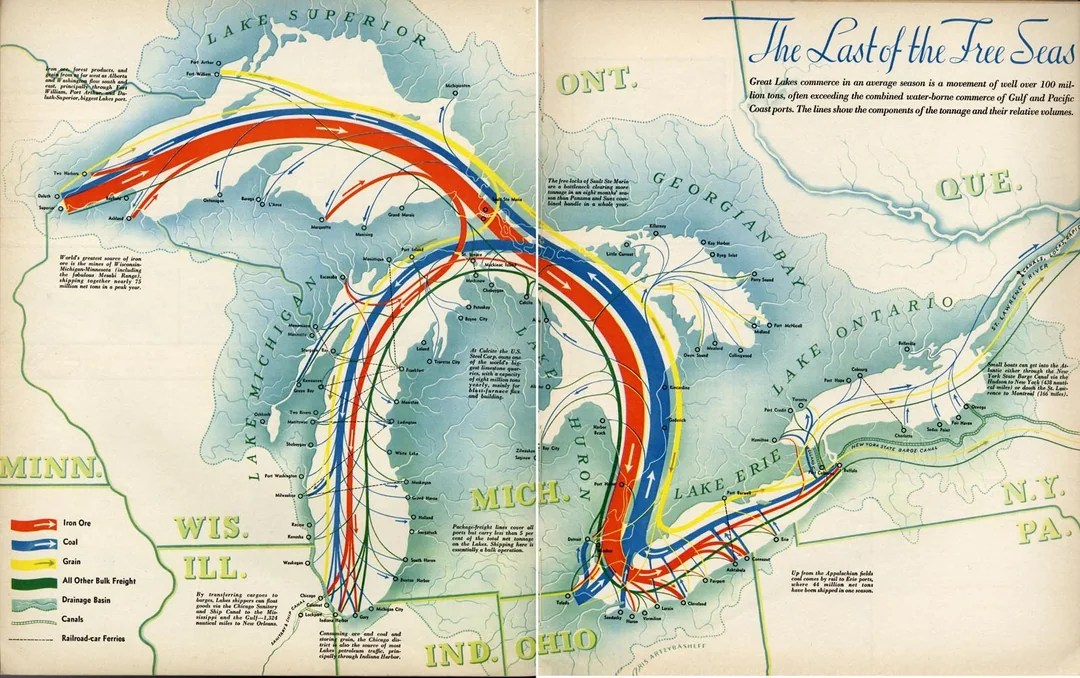
We don’t often think of the Great Lakes when we think of shipping, however it was, and is, a central transportation artery for U.S. industry, with 100s of millions of tons being handled by 10s of thousands of workers.
‘510’s Fresh Water Campaign’ by a Lake Sailor from Industrial Pioneer. (New) Vol. 1 No. 12. April, 1924.
Spring is almost here again; navigation on the Great Lakes will soon be open and members of MTWIU 510 are busy laying plans for an intensive organization campaign on the lakes during the coming season. On this account a few figures showing the immensity of the marine industry on the Great Lakes may not be amiss.
The average yearly tonnage of the Great Lakes is about 100,000,000 tons. This vast tonnage, greater than that floated on the Mediterranean, Black Sea and Suez Canal combined, is about one-half the total tonnage of water-borne freight in the United States.
Iron ore and coal make up 90 per cent of the tonnage of the lakes, the remaining 10 per cent being accounted for by grain, lumber, stone, and package freight. Iron ore, however, is far ahead of any other commodity and makes up about 75 per cent of the total.
Most of the ore is loaded at Duluth-Superior and Two Harbors, Minn., both ports of great strategic importance in the coming organization campaign. Escanaba, Ashland and Marquette formerly were great ore ports but of late years the demand for the particular grades of ore loaded at these ports has fallen off and not much ore has been loaded in any of them.
The ore cargoes are nearly all discharged at Lake Erie ports. Ashtabula, Conneaut, Buffalo and Cleveland are the principal unloading ports from which the ore is forwarded to the mills in the Pittsburg and Youngstown districts. Ore discharged at Buffalo is used in the Lackawanna and Wickwire plants, located in that city. Lake Michigan ports, chiefly South Chicago and Gary, use approximately 10 per cent of the total ore tonnage.
Coal Big Factor
Coal forms the chief item of west-bound lake freight. A total of 31,313,000 tons were carried in 1923, most of it to Lake Superior ports from which much of it is shipped to the grain-raising states of the Northwest. John Farmer in North and South Dakota and Minnesota is dependent on tie lake sailors for his winter fuel. Lake Michigan gets approximately 25 per cent of the coal carried, Sheboygan, Milwaukee, Green Bay and Manitowoc being the principal unloading ports.
The lumber cargoes come chiefly from Lake Superior and Georgian Bay ports and nearly all the lumber hookers unload at Chicago, North Tonawanda and Cleveland. Package freight is carried between all ports of any importance on the lakes; Buffalo, Duluth, Chicago, Milwaukee, Cleveland and Detroit are the ports to and from which the bulk of it is moved. Grain moves between Duluth-Superior, Fort William and Port Arthur, Ont., and Buffalo. Grain forms an important item of freight in the fall months, many boats are used in this trade and many million bushels are transported every year.
Some idea of the magnitude of the industry IU 510 is attempting to organize this summer may be gained by comparing a few lake figures with those of salt water. The Panama Canal and those located at Sault Ste. Marie (four locks on the American side of the river and one on the Canadian) offer a fine opportunity for comparison. In 1921 the Panama Canal passed through 11,599,214 tons and Sault Ste. Marie, commonly called the “Soo” Canal handled 48,259,254 tons. Last year, one of the busiest ever known on the lakes, the difference was much greater.
Many Men Needed
To operate the fleet of boats necessary for carrying this enormous tonnage approximately 35,000 sailors and firemen, oilers and cooks are needed. Not all of them are aboard ship at any one time, however, as every port on the lakes, during the navigation season, has large numbers of men who have been paid off and who are waiting for another job. A good guess would place the number of men actually employed during the summer months at about 26,000.
Most of the lake sailors are unorganized. At one time the Lake Seamens’ Union, the Marine, Firemen, Oilers and Watertenders and the Marine Cooks’ and Stewards’ unions had the men pretty well lined up and the boats operated on the ‘“‘closed shop” plan. But since 1908, when the last agreement between the Lake Carriers’ Association and the unions expired, the majority of the boats have been “American” plan. The unions still have agreements with some of the lumber and passenger carrying companies but these employ only a negligible part of the men on the lakes. With the loss of the strike of 1908-1912 most of the sailors fell away from the craft unions and until now the Lake Carriers’ Association has had everything its own way.
Blacklist Must Be Abolished
This LCA is really another arm of the Steel Trust; most of the boats coming under its jurisdiction are owned by companies either wholly or partly controlled by Gary and his tribe. They have established fink shipping halls in all important lake ports and all men hired for association boats must be vouched for by the finks in charge. Around these fink halls has developed one of the most vicious and unfair blacklisting systems in America. No one who dares to voice disapproval of the high-handed tactics of the master is wanted, and by shipping all men through these fink halls only docile slaves can get the privilege of killing themselves for the master. These fink halls are an eyesore to militant labor, an insult to be resented with as much power as possible, and the members of IU 510 are determined to abolish them and establish union halls from which to ship the men. The abolition of these affronts to the dignity of Labor will be the first step to victory on the lakes and will pave the way for other betterments, such as the three-watch system, which exists only in the fireholds and engine rooms. The wheelsmen and watchmen still work twelve hours, and the deckhands often longer.
Meetings have been held in Buffalo and Chicago and a central conference was held in Cleveland on March 17, just before the opening of navigation. Realizing what a large undertaking they have embarked on, the members of IU 510 are co-operating with IU 440, IU 210 and IU 520 in order to be able to bring pressure to bear at as many points as possible. With the sailors, railroaders, miners and steel workers presenting a united front to the steel trust something is sure to be accomplished. It’s high time. Slavery cannot be endured forever.
The Industrial Pioneer was published monthly by Industrial Workers of the World’s General Executive Board in Chicago from 1921 to 1926 taking over from One Big Union Monthly when its editor, John Sandgren, was replaced for his anti-Communism, alienating the non-Communist majority of IWW. The Industrial Pioneer declined after the 1924 split in the IWW, in part over centralization and adherence to the Red International of Labour Unions (RILU) and ceased in 1926.
PDF of full issue: https://archive.org/download/industrial-pioneer_1924-04_1_12/industrial-pioneer_1924-04_1_12.pdf
 Revolution's Newsstand