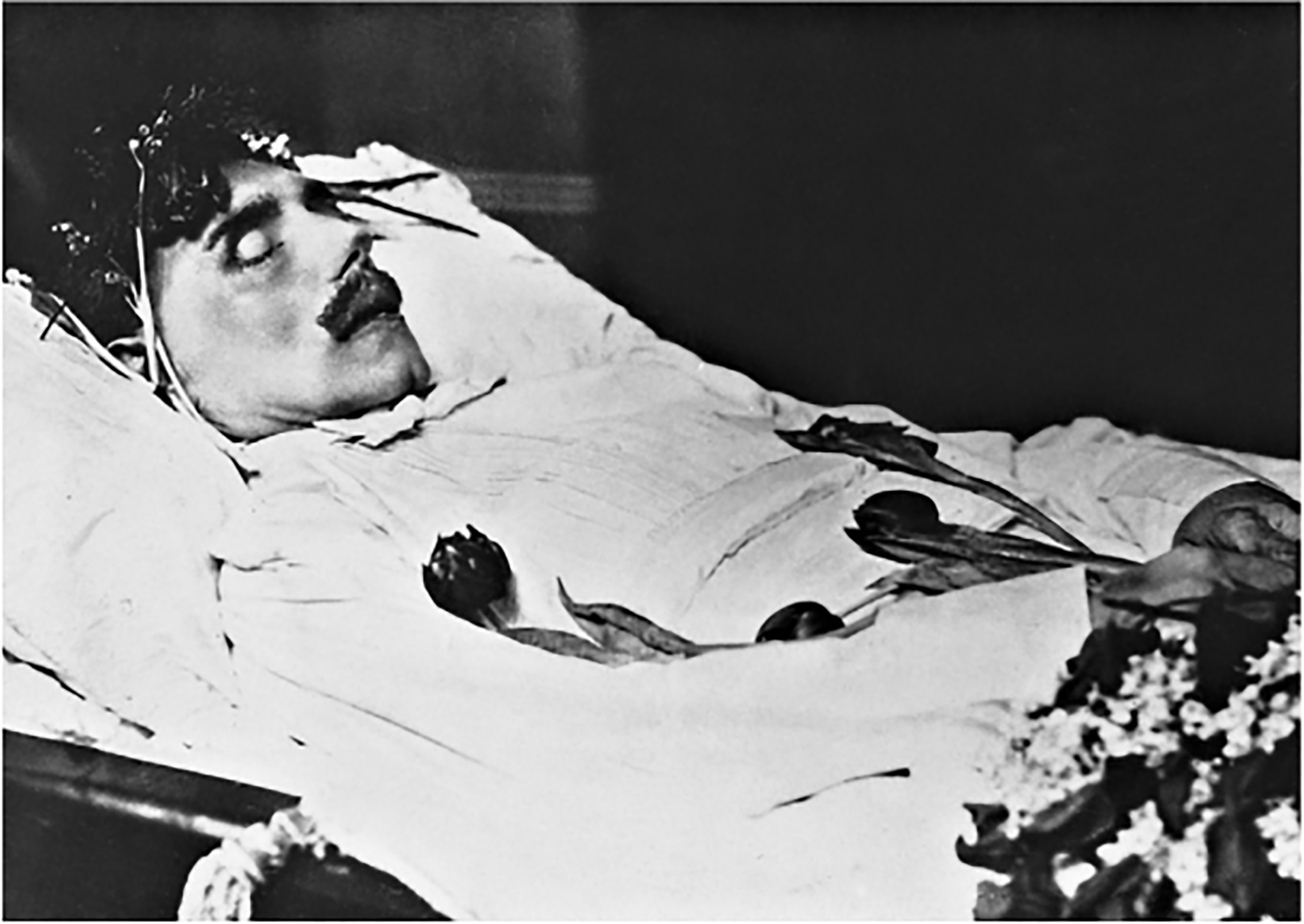
Willi Münzenberg’s biographical essay introducing Karl Liebknechts speeches focuses on why the person of Liebknecht, who wrote no great theoretical works, was and would endure as a central figure in the international workers’ movement.
‘Karl Liebknecht’ by Willi Münzenberg from Voices of Revolt No. 4. International Publishers, New York. 1927.
THE best-known and most popular labor leader in Germany in the last few decades was Karl Liebknecht. No other leader has enjoyed anything like the enthusiastic affection which was his among the masses. Even so critical an observer as Karl Kautsky is obliged to admit: “No monarch ever met with such an enthusiastic reception on the part of the masses as did Liebknecht when he arrived at the Anhalter Bahnhof on his return from prison.”
Thousands accompanied him from the railroad station to the Soviet Embassy, tens of thousands were about him when, in the stormy days of December, 1918, and January, 1919, he delivered his fiery speeches, hundreds of thousands followed the coffin in which his murdered body was brought to the Friedrichshain Cemetery, and millions of workers’ hearts repeat the name of Liebknecht, and thus it will ever be, as long as human hearts continue to beat.
Even today, almost ten years after his death, no political meeting can take place in Germany in which one does not hear the name “Karl Liebknecht,” no workers’ demonstration is held in which one does not hear the song: “Kari Liebknecht kaben wir’s geschworen...” (“We have sworn (allegiance) to Karl Liebknecht”)
But the name Karl Liebknecht is not famous and beloved only in Germany, but is pronounced with the greatest veneration all over the world.

In the cruel factories of the Chinese industrial districts, in the coal-mines of the United States, among the workers of the North of Europe, and in the mines of Cape Town, there bums in letters of flame the great name, “Brother Liebknecht,” which was coined by Henri Barbusse in his wonderful novel, Le Feu (“Under Fire”).
What is the cause of the mighty magic exercised by the name of Liebknecht upon such great masses after the lapse of ten years? Hans Schuhmann, of Dresden, attempts in his book, Karl Liebknecht, to explain its immense suggestive power in part by referring to Liebknecht’s great oratorical gifts. Unquestionably Karl Liebknecht is second only to Ferdinand Lassalle as the most brilliant and eloquent leader of the German labor movement. His delivery, consisting of short and sharply chiseled sentences, rich in images, and supported by the ardor of a truly internal and profound passion and an impetuous and unbridled temperament, carried with it all listeners, whether friends or enemies. While other orators may content themselves with moving their auditors to the point of voting for a paper resolution, Liebknecht was followed by many thousands of workers to the barricades after his speeches in the Tiergarten.
But the thing that makes Liebknecht the hero of the labor movement was something more than his great talent as an orator; it was his brave and manly advocacy of the revolutionary ideas he had accepted as correct, and his fidelity to the proletarian revolution for which he paid with his blood and his life. Liebknecht belonged directly to the working masses more than any other German leader. In the decisive days of December, 1918, and January, 1919, Liebknecht was constantly active in the various meetings, participated daily in three or more industrial conferences, and did not only live with the masses, but had become a part of the masses. More than any other leader, Liebknecht, from the first days of his political activity to the time of his death, emphasized the revolutionary tactic in the proletarian class struggle, a tactic which he carried out himself and advocated in his own person.
Karl Liebknecht was the revolutionary leader of the German workers.
Even before the war, there was a whole world of difference between Liebknecht and most of the leaders of the Social-Democracy. Things that appeared ridiculous and childish to them, were great and sacred to him: the proletarian Youth Movement, and a specific anti-militaristic agitation in what was then the greatest and most barbarous military nation of the world. It was while standing in the midst of his youthful adherents, who worshiped him as a god, that he was arrested on May 1, 1916, on the Potsdamer Platz; it was for his work in connection with the proletarian Youth Movement and his antimilitaristic propaganda; that he suffered his first year and a half of imprisonment in 1909 and 1910.
Very characteristic of Liebknecht are the proud sentences which he spoke before the Supreme Court at Leipzig in 1909:
“It is a far more serious thing to cast oneself, being a lawyer, the head of a family, being a man entirely without property, into the whirlpool of politics and to take up the struggle against the well-armed defenders. of our present system. This is far more dangerous than drawing up indictments, and I cannot see how the Chief State Attorney can justify himself in casting on me even the shadow of a suspicion of cowardice. You may destroy my livelihood and that of my children, but nothing can prevent me from continuing to struggle for my political program.”
This is the Karl Liebknecht who was the only Deputy in the German Reichstag who had courage enough, on December 2, 1914, to shout his enthusiastic “No” to the war-intoxicated chauvinists. This is the Karl Liebknecht who, surrounded by a few young men, came out in a public demonstration. against the war on the Potsdamer Platz on May 1, 1916, with the slogan: “Down with the Government!” This is the Karl Liebknecht who accepted his condemnation to four years of imprisonment with the cry: “No General has ever worn his uniform with greater pride than the pride with which I shall wear the convict’s garb I” This is the Karl Liebknecht who, after the bloody victory of Gustav Noske’s men over the Berlin workers, when thousands of post s on the walls of Berlin called for his assassination, when hundreds of murderers were being egged on to putchism out of the way, wrote with his assurance of victory:
“Proceed but slowly! We have not fled, we are not beaten…
We are here, and here we remain! And the victory will be ours.
For Spartacus means fire and spirit, Spartacus means soul and heart…
For Spartacus means Socialism and World Revolution!”

If millions of youthful workers to-day consider it their highest goal to be similar to Liebknecht, it is for the reason that Liebknecht is the founder of the Proletarian Youth Movement, and continues to live on as the most courageous, the bravest advocate of the revolutionary class struggle, the hero of the first forceful collisions in Germany to bring about the proletarian revolution. One venerates Marx, reveres Lenin, loves Liebknecht.
Karl Liebknecht left behind him no theoretical writings that have become standard works. His brilliant essays, written while in jail, are known only to a limited circle. Liebknecht is effective through his personality. By his life and by his death, Liebknecht did more to rouse, to awaken, to enhance the revolutionary will than others have done by means of huge volumes of theoretical treatises.
In the presence of this man, this human, in the presence of this hero of his convictions, even opponents and enemies, though filled with hatred, respectfully lower their flags. But it is far more important for us at present to understand Liebknecht as a statesman and as a leader of the workers.
Not only does Karl Radek in his masterful obituary article, but also Karl Kautsky, attempt to estimate Liebknecht on the basis of a comparison with his father. But while Radek ultimately comes to a conclusion which does full justice to Karl Liebknecht, Kautsky’s work makes him appear in an unfavorable light as compared with his father, Wilhelm Liebknecht. Kautsky. attempts to put the matter so as to give the impression that’ the vehemence and ardor which were characteristic of Wilhelm Liebknecht also, had been dampened by two well meaning, paternal friends, Karl Marx and Friedrich Engels, and that the experiences of the English labor movement had also had their share in transforming the old war-horse into a complacent Social-Democratic Secretary, while Karl Liebknecht, surrounded by Russian friends and filled with the spirit of the subterranean revolution, was destined to go up in flames and consume himself.
But Kautsky forgets certain essential things. In the first place, these two men, who have otherwise many points of similarity, lived in two entirely different periods. The bourgeois-democratic insurrection of 1848, to which Wilhelm Liebknecht attached himself as an· enthusiastic “Soldier of the Revolution,” petered out and went to seed; there followed the decades which transformed Germany into a federation of states already containing the beginnings of a large-scale industry, the first boom period of which made possible even for the workers an improvement of their situation, however modest that improvement might be.
Karl Liebknecht was born at a time when the young German industrial state, emerging enriched as a result of the Franco-German War, was beginning to feel its oats and to reach out beyond its geographical boundaries. When Karl Liebknecht entered the political arena, Germany had begun to practice a colonial policy, to build a fleet, to indulge in Weltpolitik. The first years of Karl Liebknecht’s political activity coincide with the evolution of Germany into an imperialistic state, with the evolution of the Prussian-German militarism into the most powerful military organ of the world. In the distance the World War is impending; the insurrection of the armored cruiser “Potemkin” in Russia in 1905 means, for Karl Liebknecht and his political friends, the announcement of the approaching proletarian revolution. What Kautsky finds worthy of censure in Karl Liebknecht, namely, his ardent and impetuous insistence on revolutionary tactics in the labor movement, precisely Liebknecht’s understanding and his effort to make the proletarian prepared for the most terrible catastrophe which is to supervene–this is Karl Liebknecht’s greatest merit. Together with Rosa Luxemburg, Klara Zetkin, Franz Mehring, and Karl Radek, Liebknecht undertakes the task of calling the attention of the German workers to the menacing danger, and of transforming the Social-Democratic Party into a revolutionary workers’ party opposed to militarism, war, and imperialism. He scourges the party Executive Committee for its complete breakdown in the Morocco Crisis, which made war appear a matter of the immediate future; he became the most patient, the most persistent accuser of the military clique and those behind it, the Krupps and the like. Liebknecht became the man best hated in Germany by all the military caste; he died as the victim of their wrath in 1919. Together with his little circle of political adherents, Liebknecht came out emphatically in favor of al general strike even in the political struggle, demanded. the use of such a strike not only for achieving a better suffrage law in Prussia, but in general as a means of combat in the revolutionary class struggle of the proletariat. The application of the tactics used by him and his group accelerated the collapse of the monarchy in Germany and served as a preparation for the creation of workers’ and soldiers’ councils.
Together with a few leaders of the German workers’ movement, Liebknecht understood from the outset the imperialistic character of the World War, and was the only man who had courage enough to vote against the war credits, and to take up the struggle against the war not only in Parliament, but also illegally. History has justified Liebknecht’s opinion of the war and of its outcome. It was not Liebknecht who erred in his judgment of the course of events, as Kautsky would have us believe, but Kautsky himself and all his circle, who transformed their former theory, “the conquest of the political power by the proletariat!” into a theory of close co operation between bourgeoisie and Social-Democracy.

Liebknecht was the most outspoken opponent of the reformists who were transformed by the war into social-chauvinists, and, in the after-war years, into social-Fascists. How correct Liebknecht’s judgment of Noske in the latter’s first opportunist proclivities, is shown by the speech delivered by Liebknecht against Noske and his consorts at the party congress at Essen, in 1907. The experiences of the post-war period, and particularly the experiences of the Russian Revolution, no doubt introduced many corrections and additions into the political and antimilitarist program of Liebknecht. Surely Liebknecht would have been the first to accept these changes himself, had he had the opportunity to remain alive until the present time. But it is no discredit to Liebknecht in his services to the revolutionary labor movement, to have failed to introduce these changes. The performances of the individual can only be evaluated on the basis of the conditions at the time, and by comparison with the performances of other persons living in the same epoch and under the same conditions. Let this be borne in mind, and we shall behold Liebknecht standing before us a lone, defiant stronghold in the wild tumult of war and chauvinism. We shall see him as a beacon lighting the way for the working class out of the venomous swamp of Reformism and Opportunism-which leads only to destruction–to the proletarian revolution and its promise of ultimate victory.
Speeches of Karl Liebknecht. Voices of Revolt No. 4. International Publishers, New York. 1927.
The fourth in the Voices of Revolt series begun by the Communist Party’s International Publishers under the direction of Alexander Trachtenberg in 1927.
PDF of original book: https://www.marxists.org/history/usa/parties/cpusa/voices-of-revolt/04-Karl-Liebknecht-VOR-ocr.pdf
 Revolution's Newsstand