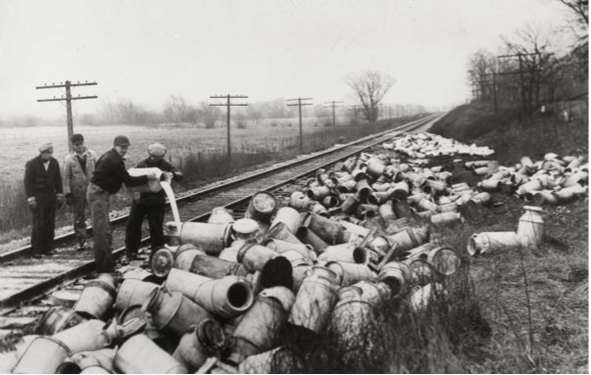
The deadly New Deal strike against the milk trust by Wisconsin farmers.
‘The Wisconsin Farmers Strike’ by Farrell Scherning from Labor Defender. Vol. 9 No. 6. June, 1933.
Org. Sec’y, Milwaukee District I.L.D.
The six-day strike now sold out and betrayed, by the one-man leadership of Walter M. Singler, President of the Wisconsin Cooperative Milk Pool, has forged a new link in the unity of the poor farmers and the city workers.
On the eve of the strike the governor pleaded in the name of economy for the farmers to wait for the “national plan of the New Deal” to raise funds for farm relief; but one million dollars have been spent, for the wages of thugs, for machine gun bullets, and for poison gas to crush in blood and terror the struggle of the Wisconsin farmers for the right to live, to plunge them deeper into the mire of the crisis.
The pressure of the farmers caused the leaders to call the strike. The farmers in Wisconsin would no longer suffer in silence. When all efforts to halt the strike failed the governor ordered all milk plants closed. This act was hailed as a display of friendship for the cause of the farmers. “The New Deal is at work in the farm strike,” the papers said. But the governor knew that the strike would be a bitter battle, he knew the strength of the Milk Pool, he realized the anger of the farmers; HE NEEDED TIME TO PREPARE THE MACHINERY OF WAR TO BE USED TO CRUSH THE STRIKE. When the trust had mobilized its thugs and had them ready for the attack, the counties one by one were opened for shipment of milk; and the most brutal attack was launched against the farmers. The farmers had been tricked-THE PLANTS HAD ONLY BEEN CLOSED TO PREPARE FOR A MINIATURE CIVIL WAR.
At Shawano 5,000 farmers picketed the dairy. Deputies made brutal assaults on them, but not brutal enough to suit the governor. By his order the sheriff was ousted “for not properly handling the situation.” In his place Schmedeman appointed an officer in the American Legion, a former world war officer, Dittman, who immediately turned the county into a war zone. National guardsmen and militiamen were called and sworn in as “special deputies.” With fixed bayonets, machine guns and poison gas they attacked the farmers. But even such extreme terror as this could not stop the farmers; with rocks and clubs they beat back one attack after another. When gas bombs were hurled at them they caught them and flung them back at the deputies. In this section the battle front extended for nearly twenty miles, in Shawano, and Brown counties. The farmers were trapped in barbed wire entanglements, and attacked with clubs and gas. The field was filled with wounded farmers, moaning with pain from the wounds inflicted on them by the clubs and bayonets of the guardsmen. One 18-year-old farmer boy was shot in the back by the captain of one of the companies of guards. Another picket was pushed from a truck and killed.
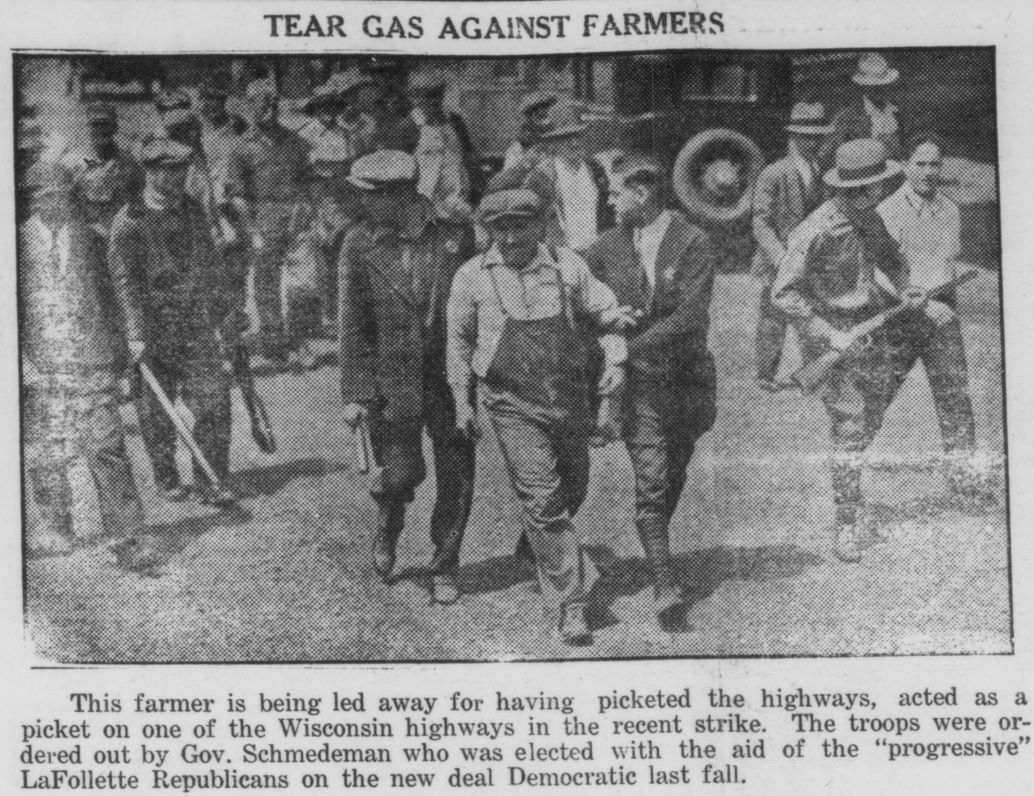
In the Milwaukee area, the fight was furious. The battle at Durham Hill a few miles from the city will long be remembered for the heroism of the farmers and the brutality of the deputies, and police from Milwaukee. Farmers were attacked with bayonets and clubs; yet they held their lines for five days. Militant groups of farmers followed trucks carrying milk into the downtown sections of Milwaukee, there to be attacked, clubbed and stoned by the police. The farmers were fighting for more than a higher price for milk they were fighting for the right to live.
On the sixth day, with the terror having failed to halt the strike, with the ranks of the farmers becoming more solidified, Singler declared the strike at an end. Thus for the second time in three months the farmers have been betrayed. In February when the farmers had victory within their grasp the strike was halted by this same misleader on the same flimsy excuse to wait for the farm legislation of the Democratic party.
The New Deal and the fables of progressivism in Wisconsin have been exposed as monstrous lies. The Milk Trust may rejoice at its victory for a short time, but the seeds sown in the milk strike cannot be killed. The farmers will come back again. Soon the workers and farmers in Wisconsin will unite in greater struggles against the bosses offensive of hunger and terror which will result in victory for them.
Labor Defender was published monthly from 1926 until 1937 by the International Labor Defense (ILD), a Workers Party of America, and later Communist Party-led, non-partisan defense organization founded by James Cannon and William Haywood while in Moscow, 1925 to support prisoners of the class war, victims of racism and imperialism, and the struggle against fascism. It included, poetry, letters from prisoners, and was heavily illustrated with photos, images, and cartoons. Labor Defender was the central organ of the Scottsboro and Sacco and Vanzetti defense campaigns. Editors included T. J. O’ Flaherty, Max Shactman, Karl Reeve, J. Louis Engdahl, William L. Patterson, Sasha Small, and Sender Garlin.
PDF of full issue: https://www.marxists.org/history/usa/pubs/labordefender/1933/v09n06-jun-1933-lab-def.pdf
 Revolution's Newsstand