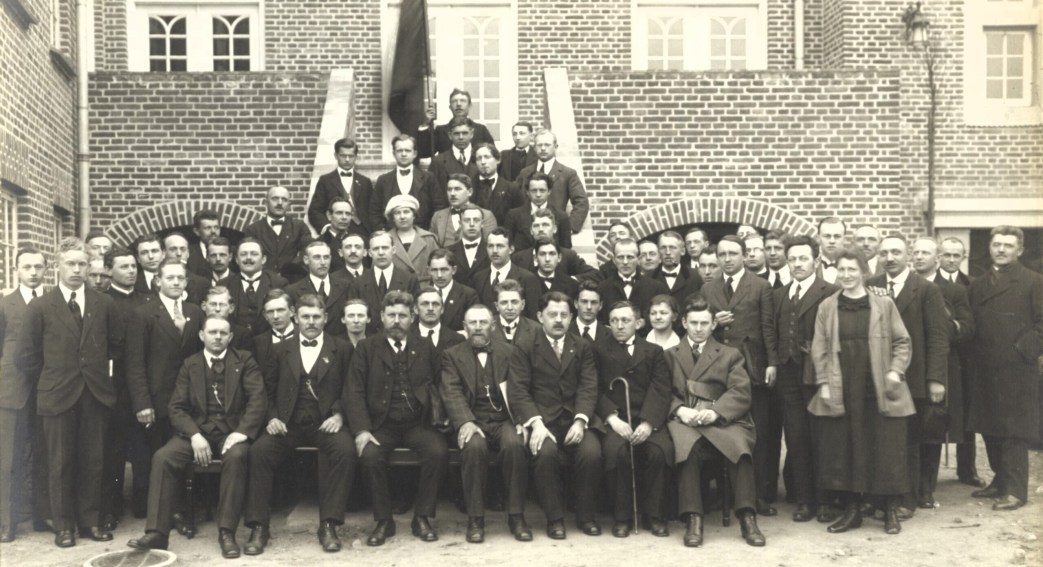
Four years had elapsed since the 5th Comintern Congress in 1924 and its 6th in 1928. In that time, the Comintern had changed enormously, both in terms of the ‘Bolshevization’ of the older parties, and with many new parties, particularly from the colonial and neo-colonial world joining the International. In anticipation of the 6th Congress, the Comintern published a volume with reports from its constituent members on their work the previous years. This report from the Danish party includes a review of the current situation in Denmark, the role of the Social Democrats and trade unions, left tendencies in the workers’ movement, as well as the activity of the C.P. in various sectors.
‘Report of the Communist Party of Chile’ from The Communist International Between the Fifth and the Sixth Congresses, 1924-28. Published by the Communist International, 1928.
THE ECONOMIC AND POLITICAL SITUATION.
WHEN in 1924 a social democratic government came into power in Denmark the stabilisation of capitalist economy was taken in hand systematically. This process can be divided into three parts: 1.—Stabilisation of the Money Standard. With American help and by means of a rigorous taxation policy the krone was soon brought from 50 per cent. to par. 2.—Radical Limitation of Expenditure for Social Purposes, a task carried out to the full by the large-farmer government which succeeded the social democratic government. This was done firstly through the reduction of civil servants’ salaries, as well as through the discontinuance of extended unemployment benefit; also by the reduction of contributions to the unemployment funds and by stopping the benefit for the unemployed in occupations where strikes took place. This marked anti-labour legislation was carried without serious resistance on the part of the social democrats. But other means were also used to deal the working class a blow, as, for instance, the law “for the defence of industrial peace,” a penal law which restricts the freedom of action of the trade unions. 3.—A Protectionist Tariff Policy in favour of Industries Unable to Compete with Imported Goods. The process of rationalisation and the attack on wages were linked up with this measure. Although Danish industry ts technically backward and divided into many small and medium enterprises, it is fairly centralised in regard to its capital. About 25 big capitalists control three-quarters of the entire share capital.
In 1927 the unfavourable trade balance was on the increase. The increase of imports is mainly made up of coal, pig iron, semimanufactured metal and textile goods. The percentage of unemployment is very high: in 1920-26, 20 per cent., in 1926, 29.8 per cent., and in 1927 31.6 per cent. of the workers were unemployed. The following industries are particularly affected by unemployment:—Textiles, boot-making, tobacco and woodworking.
In agriculture, which forms the basis of the Danish economy, net profits are small in spite of increased gross-turnover. The explanation for this is: (1) the fact that the value of the krone was raised to par; (2) higher rates and taxes and loan interest; (3) reduction in the price of bacon and butter; (4) decreased profitableness of pig rearing (low selling price of pigs and high price of forage). In the fishing industry there is talk of increasing difficulties caused by permitting Norwegian competition to the Greenland fishing area, and there is a demand for State support.
The enormous dependence of Denmark on American capital is very noticeable. However, economic connection with Great Britain is even closer because she is the main purchaser of Danish agricultural produce.
Also in regard to foreign policy Denmark’s orientation is towards Great Britain. There is continual serious friction with the Faroe Islands and with Iceland because of the strong aspirations there for autonomy. These questions and the freedom of the waters around Greenland (a Danish preserve) give continuous cause for chauvinist conflicts between Norwegians and Danes.
The present Madsen-Mygdal large-farmer government is a minority government. It has, however, the support of all the bourgeois parties because of its reactionary and anti-labour programme. There are in point of fact understandings existing between all the bourgeois parties, including the social democrats. This harmony is at times disturbed by the Conservative demand for more effective tariffs, to which the agrarians are opposed because this would raise the prices of articles which peasants need most. These tariff-demands also have the support of the social democrats. S6nderjylland (Northern Schleswig) is a cause of considerable worry to the Danish bourgeoisie. This is also the sphere of action of the autonomist, fascist peasant leader Cornelius Petersen.
THE SITUATION IN THE SOCIAL DEMOCRATIC PARTY.
The Social Democratic Party is moving more and more to the Right and is a faithful ally of the bourgeoisie. With its big staff of paid functionaries, in good positions, it becomes more and more alienated from the real proletariat. Although it proclaims itself a friend of labour, it is currying favour with the petty bourgeoisie, who constitute a considerable part of its electors. In the Second International it belongs to the ultra-Right wing. Its attitude towards the working class is reflected in the activities of the “Socialist” government, from which just one example may be given. During the big industrial struggle in 1925 it even obtained the king’s sanction to an emergency law against the workers on strike, which did not come into force only because the strike was called off. The Party Congress in Vejle, 1927, unanimously endorsed the policy of the social democratic leaders. The Congress also approved “rationalisation as a means against unemployment,” and pointed out that factory councils must act as an “institution of common collaboration and peace within industry.” In regard to the Soviet Union the extremely strong social democratic press (60 dailies) is a worthy branch of the Berlin “Vorwarts” and frequently surpasses the latter. In order to sabotage the class struggle, the social democrats endeavour also to divide the trade unions into groups and sections and to keep alive the craft spirit.
THE SITUATION IN THE TRADE UNIONS.
Almost 96 per cent. of the industrial workers are organised in trade unions, but only 5 per cent. of agricultural labourers. The remainder consist of those who cannot be organised and those who have stopped paying membership dues. In order not to lose their influence over the masses, the reformists and opportunists have split the trade union movement. By means of conciliation boards and compulsory arbitration, the reformists have impaired the fighting strength of the unions. As to the question of international! unity, the Executive of the Trade Union Federation belongs to the Right wing of Amsterdam. But this is certainly not true of all trade union executives. One of the biggest wage struggles broke out in 1925; it was led by the unskilled workers’ union, which is represented in all industries and is the biggest trade union in Denmark, having 85,000 members. The then social democratic government showed its true colours when, after an eleven weeks’ struggle, the Union drew the transport workers’ group into the strike. This affected export capital, and immediately the famous emergency legislation was passed. The inactivity of the bureaucrats of the federation during the whole struggle and the hostility of the social democrats induced the unskilled workers’ union to leave the ranks of the Trade Union Federation, so that the latter embraces now only a minority of the trade unions.
LEFT TENDENCIES IN THE WORKING CLASS.
While organised political opposition is not yet noticeable within the Social Democratic Party, and is no more than a discordant note, the growth of an opposition has made much more headway in the trade union movement. For instance, three Danish trade union organisations have already sent delegations to the Soviet Union. On their return they published a manifesto in defence of the U.S.S.R. and the necessity for trade union unity. Also several unions and delegates to the congresses of the brother trade unions in Soviet Russia. The demand of the Communists for effective measures against the social policy of the government met with such response that the Trade Union Federation was compelled in 1927 to convene the first National Trade Union Conference for the discussion of these questions. Another sign of left orientation is the formation in the capital a year ago of a cartel of the oppositional trade union clubs. This cartel, which publishes a monthly organ, embraces at present 15 clubs, one of which in the provinces has a membership of 1,085. The cartel holds 53 leading offices in the trade unions and is developing rapidly.
THE ACTIVITY OF THE COMMUNIST PARTY.
(a) The Situation Within the Party,
The Enlarged Party Plenum of July, 1927, which removed, after a brief but thorough discussion, the Helbach Executive, which was sabotaging all real Communist work, appointed a provisional executive and began in all seriousness to consolidate the movement in accordance with the advice and instructions of the E.C.C.I. The Congress in August put an end to the prolonged and almost chronic Party dispute between the social democratic Left, and its tendency in the former executive and the Party majority which was on the side of the Comintern. Since then the Party has been developing. It has become more active, its influence is spreading and there is a new spirit in the ranks of the membership. The Party has also begun to improve its organisation by drawing into its ranks purely proletarian sections of industrial workers.
(b) General Activity and Campaigns.
The Party did good work in the campaign against the imperialist attack on the Soviet Union. It organised mass meetings in the capital and fraternisation meetings with the German and Swedish workers. It was the leader in the Sacco and Vanzetti campaign, and was for weeks the centre of the attention and sympathy of the workers in spite of the open sabotage of the social democrats and the trade union bureaucrats. The Party and the Young Communist League did splendid educational work among the crews of the British, Polish, Italian and Dutch fleets. A very successful campaign was carried on against the reactionary measures of the government in regard to the unemployed. Unity committees were formed in the trade unions. Effective mass propaganda was carried on against the white terror, class justice and the assassination of Comrade Voikov.
(c) Agitation and Propaganda Activity.
Systematic work in this sphere began only in August, 1927. A sub-department for agitprop and literature has been formed in the C.C. The literature committee has been very successful with Norwegian, Swedish, and also German revolutionary literature, and has lately also published a whole series of books. A central evening school in Copenhagen is now in its second winter. Short winter courses dealing with Marxist-Leninist subjects were organised in some of the provincial branches. The central agitprop sends information and instruction material to all departments and nuclei every fortnight.
The Party has only a weekly organ, to which a relatively big number of workers’ correspondents contribute. Within eight months its circulation has increased over 2,000 copies. The following newspapers are to a great extent under Communist editorship: “The Lantern,” monthly organ of the Seamen’s Club, circulation about 2,000; “Trade Union Struggle,” monthly organ of the Cartel of trade union clubs, circulation 1,500; “Working Woman’s Educational Bulletin,” monthly organ of the “Women’s Education League,” circulation about 2,000; “Struggle,” a youth newspaper published irregularly, and the “Trumpet,” an irregular publication of the Young Pioneers. Factory newspapers do not as yet exist. Printed branch newspapers had to be discontinued.
(d) Work in Trade Unions.
This work is now carried on according to the decisions of the II. International Org. Conference. A central trade union committee has initiated the organisation of local committees, it has carried out a registration of all trade union members, and has already amalgamated the most important groups into fractions which are instructed and controlled by it, as are also the leaders of the branch fractions. Thus, work is being given a definite form in all spheres (departments, cartels, unions, clubs, enterprises); it has greatly helped to increase the influence of the Party among the masses.
(e) Work Among the Rural Population.
This work was almost entirely neglected or carried on in an abstract fashion up to August, 1927. The Party is elaborating at present an agrarian programme and has already worked out provisional directions for work among agricultural labourers (particularly organising them in a trade union), and work within Cornelius Petersen’s (Sunderjylland) separatist-fascist movement. Generally speaking, the Party is endeavouring to link up the struggle of the cottagers and small peasants against their oppressors with the struggle of the industrial workers.
(f) Work in the Non-Party Mass Organisations.
The decisions made in this direction by the Congress have not yet been carried out. Among the few exceptions are several sport leagues in the south of the country and also the Workers’ Wireless League.
(g) Work Among Women.
Systematic work among women has been only possible since the Party Congress. The theses on this work dealt with the task of driving the working women into the class struggle and the manner in which it is to be done. There is still within the Party a certain amount of Conservative resistance in this sphere which has to be overcome, and this is now being done. The party has a certain influence in the union of Women Industrial Workers, on the one hand in the strong metal workers’ section of this union, and on the other hand through the women’s Educational League.
The organisational work of the Communist Party of Denmark has, until recently, been very weak, and only since the latter half of 1927, as a result of direct assistance given by the Organisation Department of the E.C.C.I., have more or less considerable changes being effected. At the time of the Fifth Congress it had 750 members; on March 1st, 1928, its membership had increased to 1,341. According to the figures of May, 1927, the membership being 969, we have the following social composition of the Party members: workers 69 per cent., office employees, etc., 13.2 per cent., housewives 9.7 per cent., semi-proletarians 4.9 per cent., agricultural labourers 1.7 per cent., intellectuals 1.2 per cent., bourgeois elements 0.3 per cent. (3 members). According to the same data 36 per cent. of the Party members were employed in factories and 13.7 per cent. in factories employing more than 50 workers each. The reorganisation of the Communist Party of Denmark on the factory nuclei basis began systematically in January, 1928. Up to that date the Party had only 2 real factory nuclei. Until lately, the Party had no factory newspapers whatever. The trade union fractions also began to organise in January, 1928, on the basis of the decisions of the Second Organisation Conference. Systematic construction in the entire Party apparatus has begun since January, 1928. The circulation of the press, which in January, 1928, was 6,500 copies, indicates the connection of the Party with the masses.
The Communist International Between the Fifth and the Sixth Congresses, 1924-28. Published by the Communist International, 1928.
PDF of full book: https://archive.org/download/comintern_between_fifth_and_sixth_congress_ao2/comintern_between_fifth_and_sixth_congress_ao2.pdf
 Revolution's Newsstand