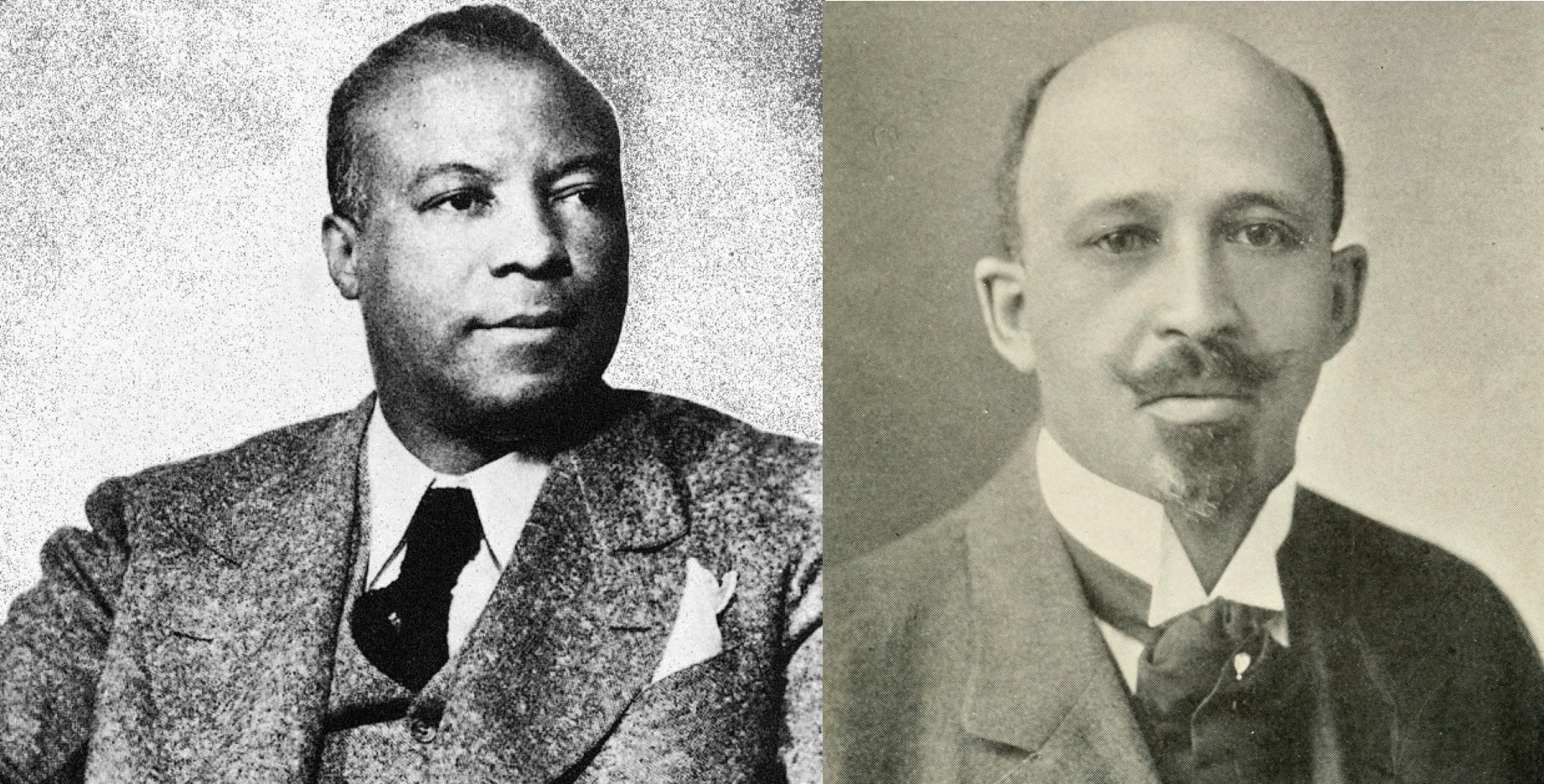
Our conception of W.E.B. Du Bois as a stalwart and leader of the left is largely due to his post-WWII politics and activism. It would have surprised his contemporaries before that time. Particularly over his support for U.S. imperialism in World War One and leadership of the liberal N.A.A.C.P. during the first Black/Red Scare was Du Bois chastised as a misleader by a younger generation of Black radicals (Du Bois was already fifty at the end of WWI), like founding Communist Cyril Briggs, and the Messenger’s A. Philip Randolph. In 1917 a 27-year-old Randolph had joined the anti-war Socialist Party that Du Bois had quit in support of Woodrow Wilson in 1912. Randolph’s article summarizes the issues with and attitude of many in the ‘New Negro’ movement of the World War One-era towards Du Bois. Particularly interesting is Randolph’s defense of the I.W.W. against Du Bois’ ‘pro-German’ canard. Randolph’s active support of the I.W.W. in this period put him on the far left, and outside of, the Socialist Party’s trade union orientation of the time.
‘The Crisis of The Crisis’ by A. Philip Randolph from The Messenger. Vol. 2 No. 7. July, 1919.
The MESSENGER has frequently pointed out that the editor of the Crisis, Dr. W.E.B. Du Bois, while possessing more intelligence than most Negro editors, is nevertheless comparatively ignorant of the world problems of sociological and economic significance.
In the June Crisis he enters an apology for the leading editorial in the April Crisis. The June issue’s editorial, entitled “I.W.W.” reads:
“An editorial in the Easter Crisis (written during the editor’s absence) has been misunderstood and was, perhaps, itself partially misleading.”
Note this argument, if it may be dignified by that name. The editor of the Crisis attempts to excuse his errors and misstatements on the ground that he was absent from his office. But obviously the editor had no business writing if conditions were such that he did not and could not know the facts.
In the April Crisis, Dr. Du Bois says: “Suppose we had yielded to German propaganda, suppose we had refused to shoulder arms, or had wrought mischief and confusion, patterning ourselves after the I.W.W. and the pro-Germans of this country. How should we hold up our heads?”
We take Du Bois to task here for two reasons: first, the statement of fact, and, second, his erroneous interpretation. A Negro alleged professor of sociology and economics doesn’t understand the difference between the I.W.W. and pro-Germans. The I.W.W. is the only national organization of labor unions which does not discriminate against Negroes. A Negro, therefore, should be the last person to try to cast aspersion upon the I.W.W. Again, the Negro has gotten absolutely nothing from his shouldering arms and failing to produce mischief and confusion. He has been most loyal, but in turn, as his deserts, he is most lynched, most Jim-Crowed, most segregated, most discriminated against, most disfranchised. The Germans were alleged to be the enemy. But Germans are not lynched, while Negroes are. Germans can ride in any part of the car in any state in the Union. The Negro is confined to the Jim-Crow car in the South. Negroes are disfranchised. Germans are not. Negroes cannot enter most places of public accommodation and amusement free and unhindered. Germans can enter any place of public accommodation and amusement in any part of the United States. (Lest we should be misunderstood, we wish to state that we do not think that any bar should be set up against the Germans. We only call attention to this discrepancy to expose the hypocrisy of the United States government on the one hand and the venality and ignorance of Negro leaders on the other.)
In the April Crisis the editorial continues, “We are not by nature traitors.” This statement does not sound like the Du Bois of old. It partakes more of the old, me-too-Boss, hat-in-hand Negro generally represented by Robert Russa Moton of Tuskegee. Of all the fool-hardy claims made by the Negro, not one is so silly and asinine as “we are not by nature traitors.” The vice of being traitorous depends entirely upon what one is traitorous to. Treason of the slave to his master is a virtue. Loyalty of a slave to his master is a vice. Liberty and justice have advanced in the world in proportion as people have been traitorous to their tyrants and oppressors. George Washington was a traitor to British tyranny. Wendell Philips, William Lloyd Garrison, Lovejoy and Lincoln were traitors to the slave autocracy of the United States. John Brown, upon whom the same Du Bois writes a worthless rhetorical book-was a traitor to old slave holding Virginia. The 200,000 Negroes who fought on the Union side to free themselves and their brothers from chattel slavery were traitors to the slave-holders. It was treason beyond doubt for any slave to attempt his emancipation. But the actual character and type of the treason and the traitor depends entirely upon what that treason is to. The Russian people were largely traitors–traitors to the Czar, the proper kind of traitors. The Negro will never gain his just rights until the great masses, 12 million strong, become thoroughly permeated, saturated and shot through with treason to the institutions of Jim-Crowism, lynching, race discrimination, segregation, disfranchisement, and to every instrument which maintains, perpetuates and fosters these pernicious institutions.
The Crisis continues; “The Crisis did not say or intend to say that no Negroes belong to the Industrial Workers of the World, nor did it intend to condemn that organization. On the contrary, we respect it as one of the social and political movements in modern times that draws no color line. We sought to say that we do not believe that the methods of the I.W.W. are today feasible or advisable, and too, we believe the Socialist Party, wrong in its attitude toward the war, but we raise our hats silently to men like Eugene Debs, who let not even the shadow of public shame close their lips when they think themselves right.”
The MESSENGER takes sharp issue with the Crisis on every one of its fundamental propositions both with respect to the questions of fact and the questions of opinion. The Crisis clearly implied that Negroes did not belong to the I.W.W. and spoke disparagingly of it as a Pro-German machine. Not only that. The Crisis representatives, like William Pickens, constantly speak of I.W.W.’s and Pro-Germans in their speeches as did William Pickens in the recent conference on “Lynching” held in New York. As to the methods of I.W.W., we state advisedly, and with sufficient reservation, that Dr. Du Bois, like most Negro professors, has no more. knowledge of them than he has of the Bolsheviki. For his edification, and that of our readers who de- sire real information, we wish to say that the chief methods of the I.W.W. are industrial unionism. They oppose the principles of pure and simple unionism. They organize by the industry rather than by the trade. To illustrate, in a printing plant where the pressmen are on strike, by the American Federation of Labor pure and simple unionism methods, scab pressmen could be employed side by side with the union linotypers, compositors and others employed in the establishment. The principles of industrial unionism, adopted by the I.W.W. would demand that when the pressmen strike, the compositors, linotypers and all others employed in the shop should lay down their tools and cease from work until the strike is won. This method is both simple and feasible. It is advisable in every respect. Its efficiency and feasibility are shown by the fact that organized labor of the most advanced countries of Europe, Australia, Canada, and South America are rapidly adopting the One-Big-Union principle for their labor organizations. This no doubt is as new to the editor of the Crisis as it is to the average clay eating cracker of Georgia.
With respect to the Socialist Party, we endorse wholeheartedly its position on the war. History will record its position as one of the most courageous, far visioned and intelligent points of view taken by any group in the world. All wars (with exception of Revolutionary Wars like the French Revolution and the Russian Revolution) are against the interest of the people. This the Socialist Party knew and stated. That it has been against the interests of the Negroes, is hardly open to question. Lynching has increased. Race prejudice has been augmented. Discrimination is rampant. Unemployment and poverty stare the great masses of Negroes in the face, while the high prices of living continue to ascend with the rhythmic regularity of a funeral dirge. All other countries have been making slight concessions (some of them big concessions) by way of the extension of suffrage to the male and female electorates. But on account of the ignorance and spinelessness of the Negro leaders (?) not a single state has even discussed the extension of the franchise to Negroes in the South. And why should they? Why should the states think of extending to Negroes that for which no Negro leader has had the temerity, even to ask? We reiterate then, that the Negro has received nothing by virtue of his participation in the war, but has lost much–much which he will be a long time regaining, despite the Crisis’ unwarranted assertion to the contrary.
The Crisis editorial for June continues: “We believe that the crushing of the monstrous pretentions of the military caste of Germany was a duty so pressing and tremendous that it called for the efforts of every thoughtful American. But we recognize that some people did not agree with us and these folks we honor for their honesty, even though we question their reasoning.”
With this sentiment the MESSENGER also takes sharp issue. We were not, at any time, interested in this reactionary, militarist government of Germany. We desired to see it crushed, as crushed it would be undoubtedly with the rising tide of German Socialism and German democracy. But as monstrous a task as that was, and as imperative as it was, we did not for one moment regard it as important as crushing the southern bourbon caste system of peonage in the United States. The Huns–of Georgia are far more menacing to Negroes than the Huns of Germany. The Huns of Alsace have never threatened the Negroes’ life, liberty and property like the Huns of Alabama. The Huns of Lorraine are as shining angels of light compared to the Huns of Louisiana. No barbarians of Turkey could ever be compared with the howling dervish, dancing barbarians of Tennessee. The danger from the Huns of Saxony did not take rank in our minds with the Huns of Mississippi. It is only due to a sort of Negro professor’s chronic short-sightedness and usual venality which could for one moment regard the danger from the alleged German Hun as greater than that from the American Hun. illustrate more pointedly: the three class Prussian electoral system of voting was the criticism upon the German franchise. But three-fourths of the Negroes of the United States, who own more than Seven Hundred Million Dollars worth of property are deprived of the right to vote, right under the nose of the editor of the Crisis. A white man’s vote in Mississippi amounts to 13 votes in Kansas. A white man’s vote in Alabama is equivalent to 11 votes in Minnesota. The comparison is quite similar with any southern state. Consequently, any Negro professor of economics or sociology, who had any knowledge of political science and the honesty to proclaim it, must have known that the American political system was behind the German political system under the Kaiser. Up to 1910, the highest vote of white men in any southern state was 19 per cent. in the State of Virginia. The average vote of southern white men was less than 17 per cent., showing that there is no political democracy, even for white men, under the political caste of the United States. With respect to economic democracy, Germany had more social legislation and the best administered government of Europe, even under the Kaiser. This is a matter of common knowledge among social students and ought to be known even to an old school Negro professor of economics and sociology like the editor of the Crisis. With respect to race prejudice, one observation is sufficient. At all times it was possible for a Negro to attend the university of Kaiser Wilhelm, but no Negro could put his foot into President Woodrow Wilson’s university–Princeton–which, by the way, is in the United States. Dr. Du Bois honors those of us who disagreed with him for our honesty but he questions our reasoning. Since he has done no reasoning, we deplore his absence of reasoning, and since the facts are so overwhelmingly against his position, we question even his honesty.
The Crisis continues: “It is no credit to American Negroes if they had no conscientious objectors. It is tremendously to their credit that the vast majority of them thought straight and fought true in a mighty world crisis.”
The answer to the first sentence is that there were plenty of Negro conscientious objectors and there. should have been more. Every Negro who went into the army should have been a conscientious objector. He had a right to be the most conscientious, conscientious objector in the United States. Lynched, burned at stake, Jim-Crowed on street cars and railroads, barred from places of public amusement and accommodation, segregated in the army and navy itself, disparaged for his work and underrated for his services, denied an opportunity for employment, except where necessity forced it–the Negro had a right to have been the objector of objectors. A word of information too, for the Crisis. The Negroes knew nothing, as a whole, about stating their claims. But so far as their objections to fighting were concerned, they were galore. Almost every Negro with whom you talked would tell you that he wondered what we were fighting for. And as he read the periodical lynchings, almost daily. his opinions were confirmed. It might be surprising to Dr. Du Bois to know that the masses of Negroes in the United States have no more confidence in his sincerity and judgment, than they have in that of Moton. The mere fact that the Negro was compelled to. fight, is no evidence of his desire to fight or his satisfaction with his enforced lot. It is just like the Jim-Crow car. We go into the South and we are forced to ride in it. We do it sullenly, reluctantly and under the whip of the lash, while our very soul protests against every inch of that cattle travel. We are disfranchised and can’t vote. We submit to it. But where would be the manliness of any red blooded Negro who would glory in and exult in his disfranchisement merely because he was forced to submit to it.
In conclusion let us say, that the Crisis has reached its crisis. It no longer represents the opinion of the millions of Negroes of the United States who are insisting upon justice without compromise or apology. The Crisis does not voice their sentiments any more than the Tuskegee Student. The editor of the Crisis lacks (1) intelligence, (2) courage, or (3) he is controlled. In our generosity, we would say that he lacks all three, to a certain degree. He has not had modern training in economics and sociology and his knowledge of political science has not proceeded in economics beyond Adam Smith, and in sociology beyond Auguste Comte. He is essentially a classicist. His emphasis is placed upon music, Latin, Greek, French and trigonometry, to the disparagement of economics and sociology–the business of getting a living and improving the standard of living. In very truth, he lacks intelligence. We recognize, however, that Dr. Du Bois has more intelligence than the Crisis manifests, but this is subordinated to his rapidly waning courage. Third and last, he is undoubtedly controlled by the Capitalist Board of the National Association for the Advancement of Colored People. If he lacks intelligence, he can’t lead correctly. If he lacks courage, he dare not lead correctly. If he is controlled, he will not be permitted to lead Negroes, in their own interests.
The problem of the Crisis is the problem of intelligence, courage and control. It is the crisis of the Crisis. The sooner its influence wanes among Negroes, the sooner will they have begun to pass their crisis. The chief problem of the American Negro today is the ridding himself of misleadership of all kinds, and especially that of so-called organs of public opinion.
The Messenger was founded and published in New York City by A. Phillip Randolph and Chandler Owen in 1917 after they both joined the Socialist Party of America. The Messenger opposed World War I, conscription and supported the Bolshevik Revolution, though it remained loyal to the Socialist Party when the left split in 1919. It sought to promote a labor-orientated Black leadership, “New Crowd Negroes,” as explicitly opposed to the positions of both WEB DuBois and Booker T Washington at the time. Both Owen and Randolph were arrested under the Espionage Act in an attempt to disrupt The Messenger. Eventually, The Messenger became less political and more trade union focused. After the departure of and Owen, the focus again shifted to arts and culture. The Messenger ceased publishing in 1928. Its early issues contain invaluable articles on the early Black left.
PDF of full issue: https://www.marxists.org/history/usa/pubs/messenger/1919-07-v2n07-jul-Messenger.pdf
 Revolution's Newsstand