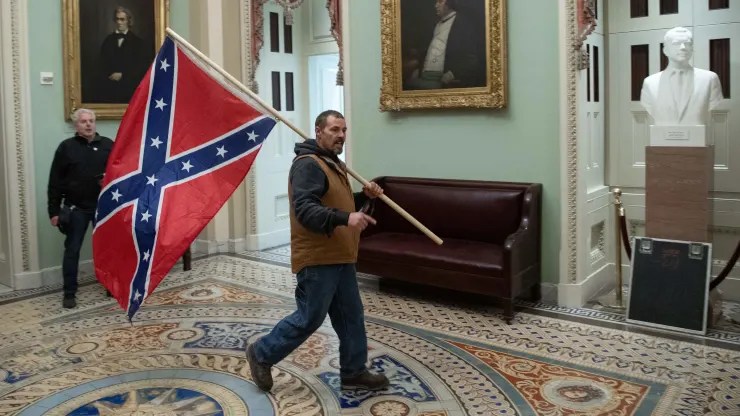
We still live with the Confederacy. In an article as relevant today as when it was written Messenger editor and former Black officer in France during World War One, William N. Colson, on the U.S. Civil War that has not yet ended.
‘Confederate-Americanism’ by William N. Colson from The Messenger. Vol. 2 No. 2. February, 1920.
“How in one house,
Should many people, under two commands
Hold amity?
‘Tis hard; almost impossible.”
King Lear, Act 11. Sc. 4, 1 243.
THE collective American mind abounds in error. Goaded on by the spur of war, it sought foolishly to decry the hyphen in order to emphasize Americanism. The hyphen meant disloyalty; no hyphen, loyalty. The Americanism of today is not the Americanism of mental and physical liberty. Americanism today amounts to sedition hunting, or the more flagrant demonstrations of the mobbish American Legion. Preoccupied in reviling the German-American and the Irish-American,–those zealous defenders of America for Americans failed to search out the wolves in their own midst. Among the most hyphenated, the most disloyal, and the most treasonable citizens of the United States today are a class of native-born, old-stock Americans, who continually flaunt in the faces of all real Americans their rebellious ideas and treasonable deeds. That powerful class, which the United States government and the Department of Justice so gracefully ignore in their bigoted fight against radicalism, aliens, and political prisoners, is the backbone of the solid South, the Confederate-Americans.
Confederate-Americanism stands for precisely what the Confederate Rebellion of 1861 stood for. Adopting the right of secession, that movement arrayed itself clearly in favor of five great issues: slavery, sectionalism, racial superiority, States’ Rights, and the economic solidarity of the South. Cotton was king under the Southern Cross, and as long as cotton grew, and there were slaves to work it, the South felt that its empire was secure. In this economic setting, slavery was believed to be a divine institution. Church and State treated the Negro as a beast. Anglo-Saxon superiority, biological, social, economic, political–was a foregone conclusion. Conflicting loyalties sprang up among the Southern folk long before 1800. It was first of all It was first of all a loyalty for the South, and secondly, for the Union. As the economic revolution, due to modern invention, swept on, the South lodged all its fell motives behind the extenuating doctrine of States’ Rights. Here was a negative, reactionary movement to conserve the status quo. The status quo meant slavery, moral and mental stagnation, and social decadence. Though Washington, Jefferson and Madison all believed in the “social contract” theory of Rousseau, it was not until the protest of Virginia and Kentucky against the Alien and Sedition Laws that Southern states became pronounced in their views that “the authorities, rights, and liberties reserved to the states respectively or to the people” had become impaired. The view of the South was that the several states had contracted each with the others and had delegated to an agent powers, the violation of which they themselves reserved the right to judge. The North, on the other hand, believed with Locke that sovereign individuals formed a compact with the general government and transferred to it power over life and property. When the great test came at Lincoln’s election, the Southerners, under the guise of States’ Rights, placed themselves, their sectionalism and institutions, over and above the Union and the Constitution. With Davis, Toombs, Yancey, Rhett, and Benjamin at the helm, and Lee, Jackson, Stuart, Gordon, and Forrest on the field they sought to uphold their traitorous and disloyal actions until the final surrender at Appomattox.
The reconstruction government following the Civil War was a failure. Emancipation was a law, but not a fact. The case of Texas vs. White, decided by the Supreme Court in 1868, held that the South had no right to secede. But the folk-ways were strong, and amid the chaos and confusion of the new order–the ex-Confederates saw their golden opportunity and they used it. It was but the awful reflection of what the Southern Confederacy had always stood for–the old order.
The rebels began to organize. Out of the Confederate Survivors’ Associations grew the United Confederate Veterans, which was formed in 1889. Its membership is 50,000. The number of Confederate American Organizations is now legion. The principal groups are the United Daughters of the Confederacy, the United Sons of Confederate Veterans, the Confederate Committee of National Preparation, the Society of the Army and Navy of the Confederate States, the Cavalry Association of the Army of Northern Virginia, the Jefferson Davis Monument Association, and the Confederated Southern Memorial Associations. From these nuclei have sprung the most insidious and seditious propaganda ever known to the United States. Through the medium of such papers as the Confederate War Journal, the Confederate Veteran, The Lost Cause and the “Confederate columns” of daily newspapers-everywhere, throughout the South the sentiment of loyalty to and reverence for the Confederacy and its treasonableness is preserved and instilled in the rising generation. Historical associations grew out of the urge of these media until today Southern children, both white and black, are taught history from the seditious view of Confederate-Americanism. The Confederate Gray Book, a post-war production, was designed to vindicate the South in the eyes of the world. The effect of this violent propaganda, unhindered and unhampered by the Federal Government and the Department of Justice, may be seen in the following facts. All the Southern states make the birthdays of Robert E. Lee and Jefferson Davis legal holidays. Eight Southern states celebrate Confederate memorial days. Most of the Southern cities have erected costly monuments to the memory of Davis, Lee, Gordon, Jackson, Stuart, and others. The Robert E. Lee Camp of Confederate Veterans, whose membership includes General K. M. Vanzandt, Commander-in-Chief of the United Confederate Veterans, has started recently a movement in Austin, Texas, to erect a monument to the Ku Klux Klan. A visit to any state capital building south of the Mason and Dixon line will reveal a museum, given almost wholly to the memory and glorification of the Confederacy. Confederate flags gaily bedeck Confederate cannon, and it is often difficult to discern the Stars and Stripes behind the Stars and Bars. Southern states and cities, since the Civil War, have appropriated large sums of money for the purposes of Confederate-Americanism.
The very essence of Confederate-Americanism, however, may be observed at a Confederate Reunion. One of these was recently held at the National Capital! Anyone who was at Richmond in 1907 or 1915, in Dallas in 1902, or in Nashville in 1904, may vividly recall the 75,000 or 80,000 persons present at each re-union; how the Confederacy and not Americanism was at a premium; how the orators lauded slavery and the fallen empire; how sectionalism ran mad; how the glories of the past were the topics of the hour; how the Negro was considered to be better off a slave and a beast than a man; how full the cities were of Confederate flags and rebel yells; how Thomas Nelson Page and Thomas Dixon were praised for their splendid historical services; how enthusiastic the parades were; how the Queen of the Reunion was crowned; how sham battles were fought at Petersburg and Chattanooga; how memorials were sent to the United States Congress asking pay for freed slaves and lost cotton; and how live and vital a spirit and reality Confederate-Americanism was! Watch the crowd when the Star Spangled Banner is played. Now watch the so-called Americans when the band strikes up Dixie! When the Jefferson Davis monument was unveiled in Richmond on June 3d, 1907, business was suspended for five minutes throughout the entire South. Who has not seen the slave body guards at these re-unions-old Negro cooks. and teamsters, slave comedians and entertainers,–poor fools, following their former masters? Yet, this regime–the very recrudescence of the Rebellion of 1861, flourishes not only with the acquiescence but with the approval of the Federal Government and many leading public men of the nation.
Confederate-Americanism has gained such headway that it now threatens to become the dominant Americanism. It dominates the present Federal Administration. It dominated the American Expeditionary Forces, with the majority of generals and a preponderance of sentiment. The President of the United States and his Cabinet are largely Confederate-Americans. When Wilson returned from France, the Confederate-Americans gave him a rebel yell at Carnegie Hall, New York City. They located most of the National Army Camps in the South. United States Army Camps were even named after rebels! Confederate-Americanism dominates Congress. Congressman Caraway of Arkansas lauded the sedition of the Confederacy on the floor of Congress on November 19th, 1919. On October 16th, 1919, Senator John Sharp Williams, on the Senate floor, commended the Confederacy after reading resolutions from the United Confederate Veterans, and in a later speech, directed against the Irish, exhibited his own basic loyalty. On November 15th, 1919, while discussing the Railroad Bill, Congressman Summers of Texas said in the House of Representatives: “My father was a Confederate soldier, and I used to hear him and his old comrades talk about the days of long ago, and when I was a little boy I made up my mind that if I ever grew up, I would get me at least one Yank, if I had to pot shot him.” These Confederate-American Congressmen are those who owe their offices to votes stolen and plundered from the Negro. But let anyone scrutinize the Congressional Record or the Northern press for the past thirty years, and he will be amazed at the apathy and acquiescence of men and movements supposed to reflect the most American ideals. Even Theodore Roosevelt admitted his own acquiescence to the spirit of Confederate-Americanism in one of his letters to the noted historian, Sir George Otto Trevelyan. Even Congress has made positive concessions to Confederate veterans.
Wherever Confederate-Americanism reigns, we may expect therefore peonage, wage slavery, illiteracy, loyalties in favor of state and section, opposition to woman suffrage, a lack of social legislation, segregation, the Ku Klux Klan, discrimination, “keeping the Negro in his place,” sectionalism, disloyalty, treason, the doctrine of States’ Rights and sedition. According to the plan of Confederate-Americanism, no person or child in the South is left out of its program of propagandism. Confederate-Americanism is a menace to American ideals. It is treason and disloyalty. It means slavery and death to the Negro. It retards the progress of the South and of the nation. If the Department of Justice desires a task of merit, let it root out the scourge of Confederate-Americanism.
The Messenger was founded and published in New York City by A. Phillip Randolph and Chandler Owen in 1917 after they both joined the Socialist Party of America. The Messenger opposed World War I, conscription and supported the Bolshevik Revolution, though it remained loyal to the Socialist Party when the left split in 1919. It sought to promote a labor-orientated Black leadership, “New Crowd Negroes,” as explicitly opposed to the positions of both WEB DuBois and Booker T Washington at the time. Both Owen and Randolph were arrested under the Espionage Act in an attempt to disrupt The Messenger. Eventually, The Messenger became less political and more trade union focused. After the departure of and Owen, the focus again shifted to arts and culture. The Messenger ceased publishing in 1928. Its early issues contain invaluable articles on the early Black left.
PDF of full issue: https://www.marxists.org/history/usa/pubs/messenger/v2nRN-02-feb-1920-Messenger.pdf
 Revolution's Newsstand