
And they still do.
‘New York Restaurant Slaves Work in Filthy Kitchens’ by G.Z. from The Daily Worker. Vol. 6 No. 31. April 11, 1929.
Low Wages, Slave 12 Hours A Day
By a Worker Correspondent. It has been my lot to work in hotels, restaurants and cafeterias from one end to the other of this prosperous land of the free, (free and prosperous for the ruling class) from Seattle to Miami, from Los Angeles to Boston. I have been a waiter, cook, dishwasher or counterman in cheap and dirty coffee pots as well as in Statler Hotels.
But in 15 years of slavery as a restaurant worker, I have never seen worse conditions of exploitation than in my present place of employment, in one of the big chain cafeterias located in the garment section of Manhattan.
Argues With Boss-Gets Fired.
I landed in this burg broke and hungry. I came here from the anthracite region of Pennsylvania where I was fired from a job in a swell restaurant because I got into an argument with the boss. He was damning the striking miners, led by the National Miners’ Union, for a bunch of dirty foreign Bolsheviks who hurt business. When I gave him an argument, he got sore and fired me. I hopped the next freight for New York City.
A Rotten Job.
I saw a sign in a window of a cafeteria “Busboys wanted,” and applied for the job. It seems that it was an extra job during the rush hours. I worked two hours at the noon hour and three hours at night. I could not take time for a cup of coffee until my work was over. Then the boss approached me and held out $1.25. This and two lousy meals of leftover soup and hash and bread pudding was all I got for five hours’ hard work.
At the Employments Sharks Next morning, after a night in a flop-house with bedbugs crawling all over me, I applied at an employment agency on Sixth Avenue for a regular job. After taking my fee of $3.00, they sent me to a restaurant where the proprietor told me the job had been filled the day before.
The agency refused to return my fee saying they would have a job for me in a day or two. Next day they sent me to a coffee pot where I was offered a job as dishwasher for $12.00 per week, 12 hours a day, 7 days a week. Disgusted I started out to look for myself.
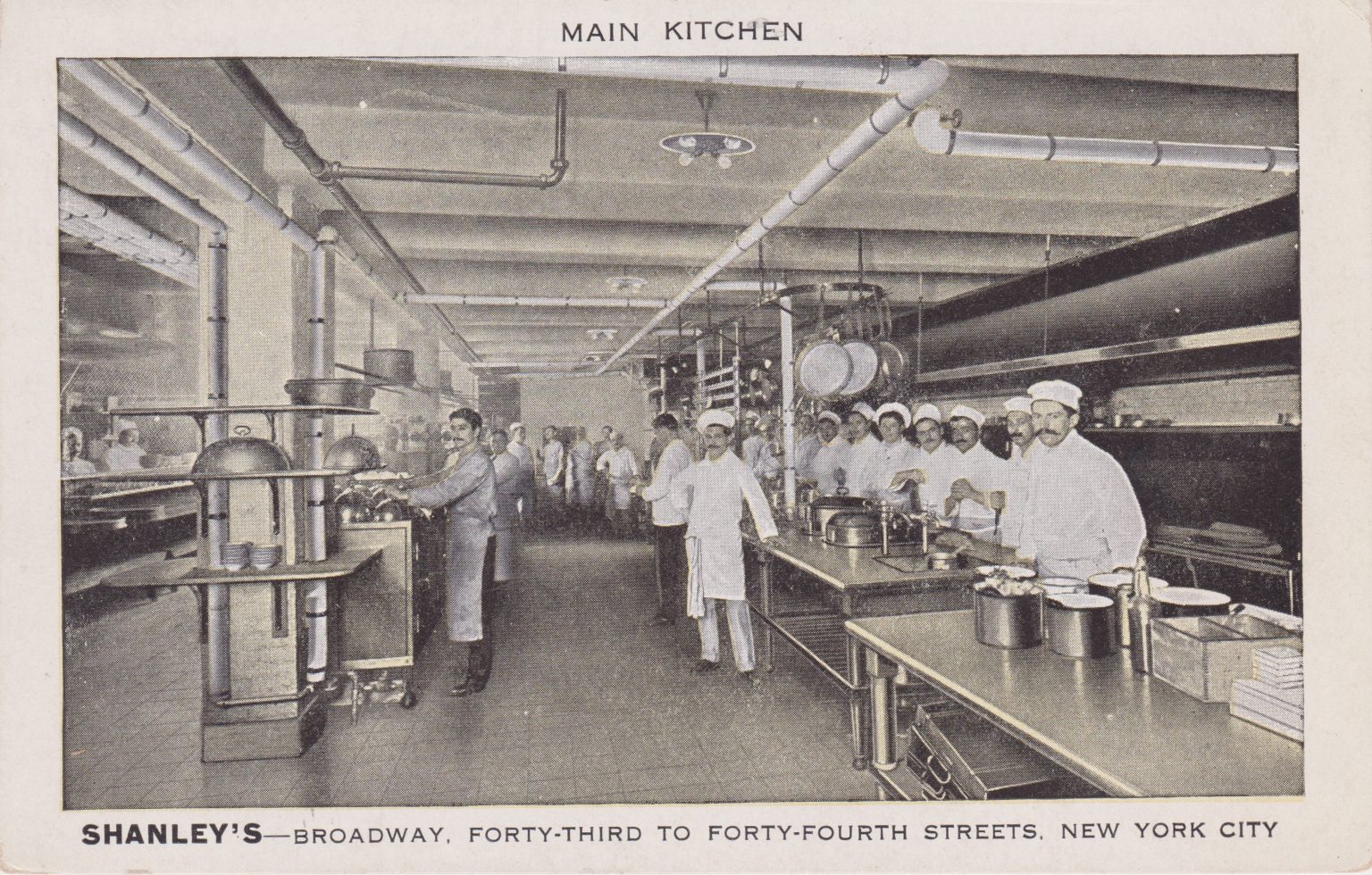
Finally, after several days I found my present job in one of the big chain cafeterias. I work for 12 hours daily, 6 1-2 days a week, as a counterman for $25.00. The dining room of this place is clean and white. We are forced to keep everything spotlessly clean.
The menus and signs on the walls boast of cleanliness and service rendered the patrons. It is advertised as a place where everything is sanitary and the food wholesome, pure food health place. But if the customers took one look into the kitchen they would never come back. There everything is as dirty as it is clean in the dining room. The floors are always sloppy except early in the morning and late at night when they are swept. The shoes of the kitchen workers are always wet and most of them suffer from perpetual colds, catarrh, rheumatism and all have had the flu during the past winter. They lost a lot of time, but did not stop work until forced to go to bed and returned to work long before they were well. And the health authorities wonder how these diseases spread so rapidly during an epidemic.
If the boss or his lick-spittle manager sees any of us throwing away a piece of meat, butter or bread, we are bawled out and warned we will be fired if we do it again. The toilet and wash room is the worst of all.
It is nauseating to go into the filthy place. Old socks, underwear, and papers stay in the corners for weeks. The cracks in the floor are filled with stinking dirt, pieces of rotten food, soaked with urine. It is unfit for hogs, let alone human beings.
Union, Union.
I read in the Daily Worker that the Hotel, Restaurant and Cafeteria Workers’ Union is going to organize these cafeteria slaves, and I hope this letter will show how badly we need a union to help us fight to abolish these conditions. I have joined the union and am working on a committee to organize the other slaves in my shop. When a strike is called we will go out 100 per cent. -G. Z.
The Daily Worker began in 1924 and was published in New York City by the Communist Party US and its predecessor organizations. Among the most long-lasting and important left publications in US history, it had a circulation of 35,000 at its peak. The Daily Worker came from The Ohio Socialist, published by the Left Wing-dominated Socialist Party of Ohio in Cleveland from 1917 to November 1919, when it became became The Toiler, paper of the Communist Labor Party. In December 1921 the above-ground Workers Party of America merged the Toiler with the paper Workers Council to found The Worker, which became The Daily Worker beginning January 13, 1924.
PDF of full issue: https://www.marxists.org/history/usa/pubs/dailyworker/1929/1929-ny/v06-n031-NY-apr-11-1929-DW-LOC.pdf
 Revolution's Newsstand