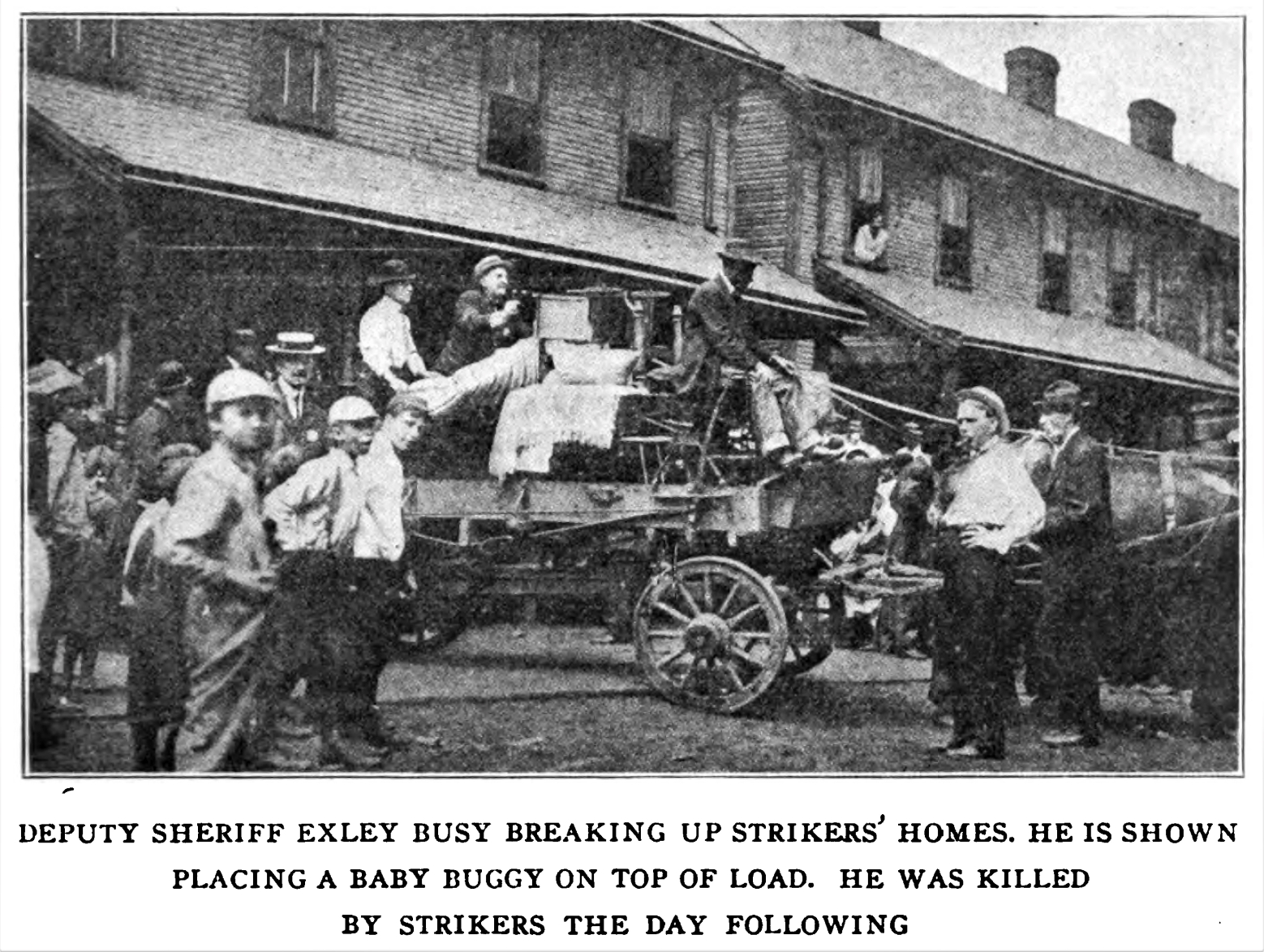
Intense violence accompanied the strike of largely immigrant workers against the Pressed Steel Car Co. at McKees Rocks south of Pittsburgh.
‘Three More Bodies of Strikers Found’ from The New York Call. Vol. 2 No. 203. August 25, 1909.
Death List of McKees Rocks Slaves Growing Steadily From Day to Day–DEBS AT INDIAN MOUND TODAY–Strikebreakers Flee From Hoffstot’s Prison Pen–Federal Government forced to Act on Peonage Charge.
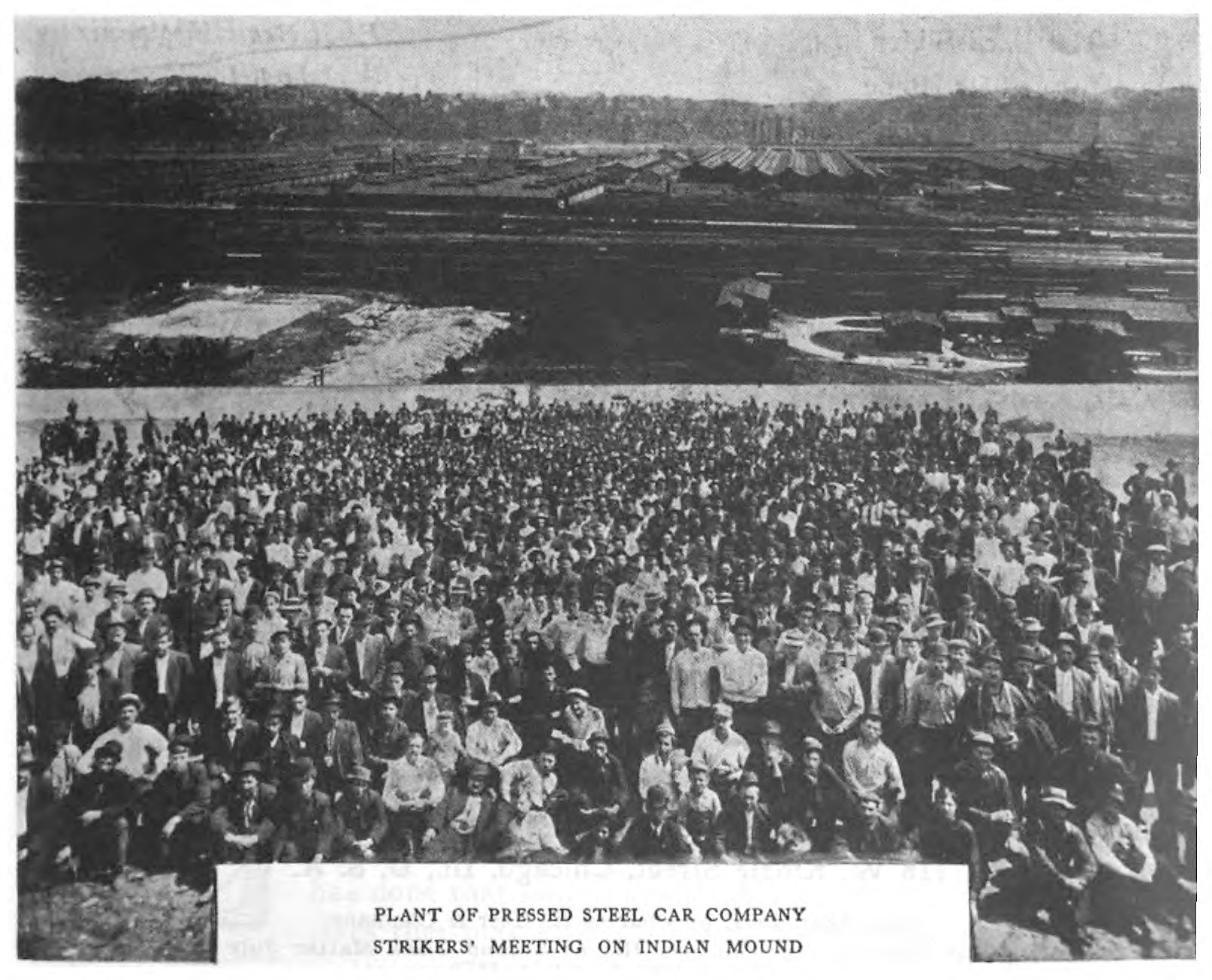
PITTSBURG, Pa., Aug. 24. Eugene V. Debs at midnight announced that at 9:30 tomorrow morning he would be at the Indian Mound to address the strikers.
“I have been threatened,” said Debs, “that I will receive bodily harm if I attempt to speak, but I will be there to make an address if I am alive. No Pennsylvania troopers will prevent me from addressing these men. I have as much right to free speech as has Theodore Roosevelt, and I intend to exercise It.”
PITTSBURG, Pa., Aug. 24. Three dead bodies, one of which has been identified as Mike Canefie, a striker, of the Pressed Steel Car Works, were found in McKees Rocks late today. Two bodies were found at the foot of Orchard and Weeds streets, while the third was under a pile of ties.
Canefie’s body was under a pile of ties directly under O’Donovan’s bridge, where the bloodiest fighting took place Sunday night. There is a bullet wound just above the heart, and from the position of the body it is believed that Canefie, after being wounded, crawled away from the scene of the fighting and hid under the ties, where he died.
The two bodies of those found at the foot of Orchard street were in a clump of weeds. Both men had been shot. One of these bodies is supposed to be that of Stanley Cervensky, who has been missing from his home for more than a week.
The other body has not yet been identified, but it is believed it may be that of John Butter, who has been missing since Sunday.
Victim Buried.
The funeral of Joseph Eruska, one of the strikers killed in the fighting Sunday night, was held today from the Greek Catholic Church. Only a limited number of strikers were in the funeral procession and there was no demonstration.
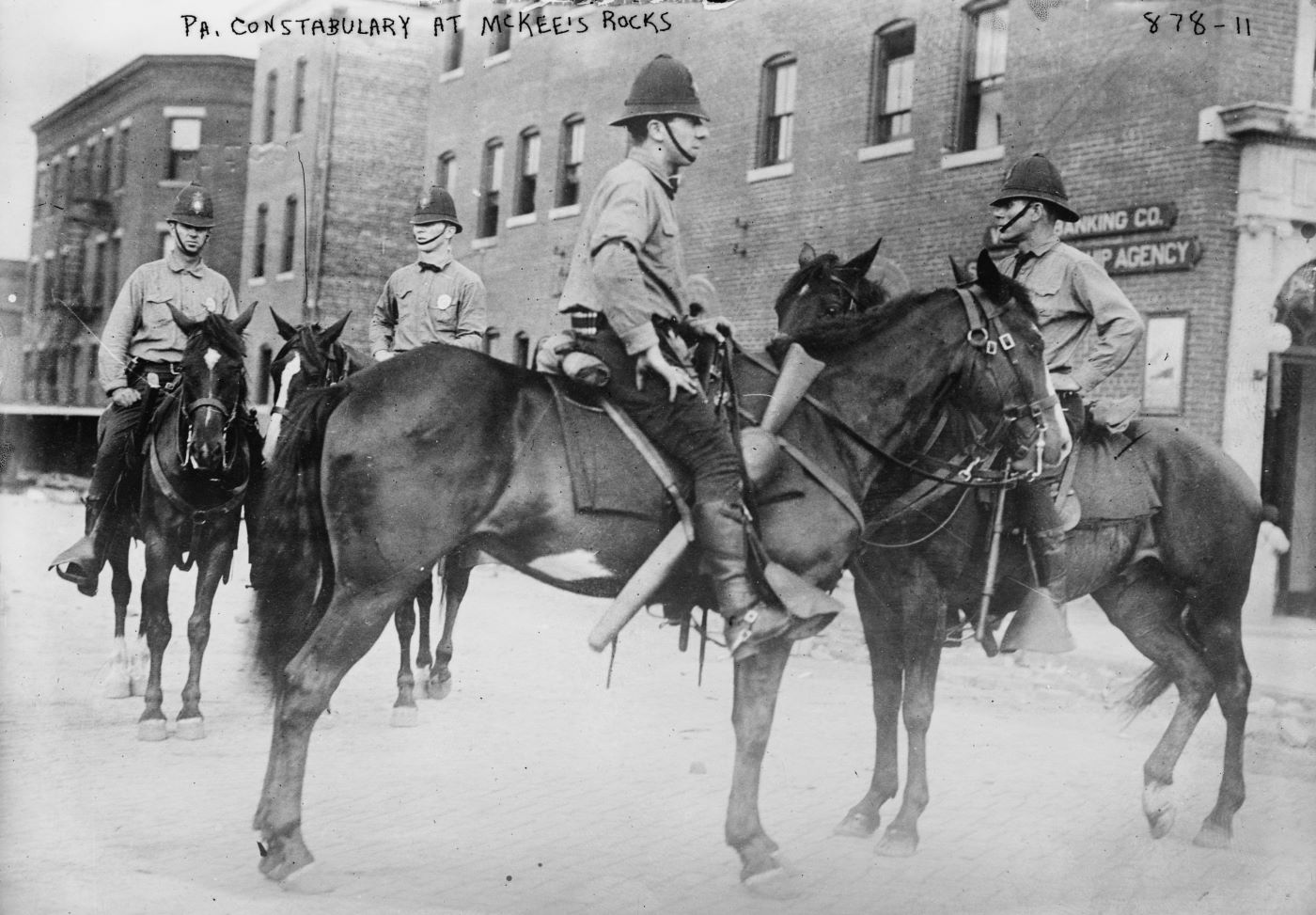
The bodies of Troopers John Smith and John L. Williams were shipped to their homes today, the one to Centralia, Pa., and the other to Pueblo, Col. The burial of Deputy Sheriff Harry Exley was also held today. Troop B, of the State Constabulary arrived at the plant of the Pressed Steel Car Works today and was immediately placed on duty.
From now on troopers and deputy sheriffs will patrol Schoenville and the car plant day and night.
The arrest of strike sympathizers will continue, and an additional box car jail has been prepared, as the two in use are overcrowded with prisoners.
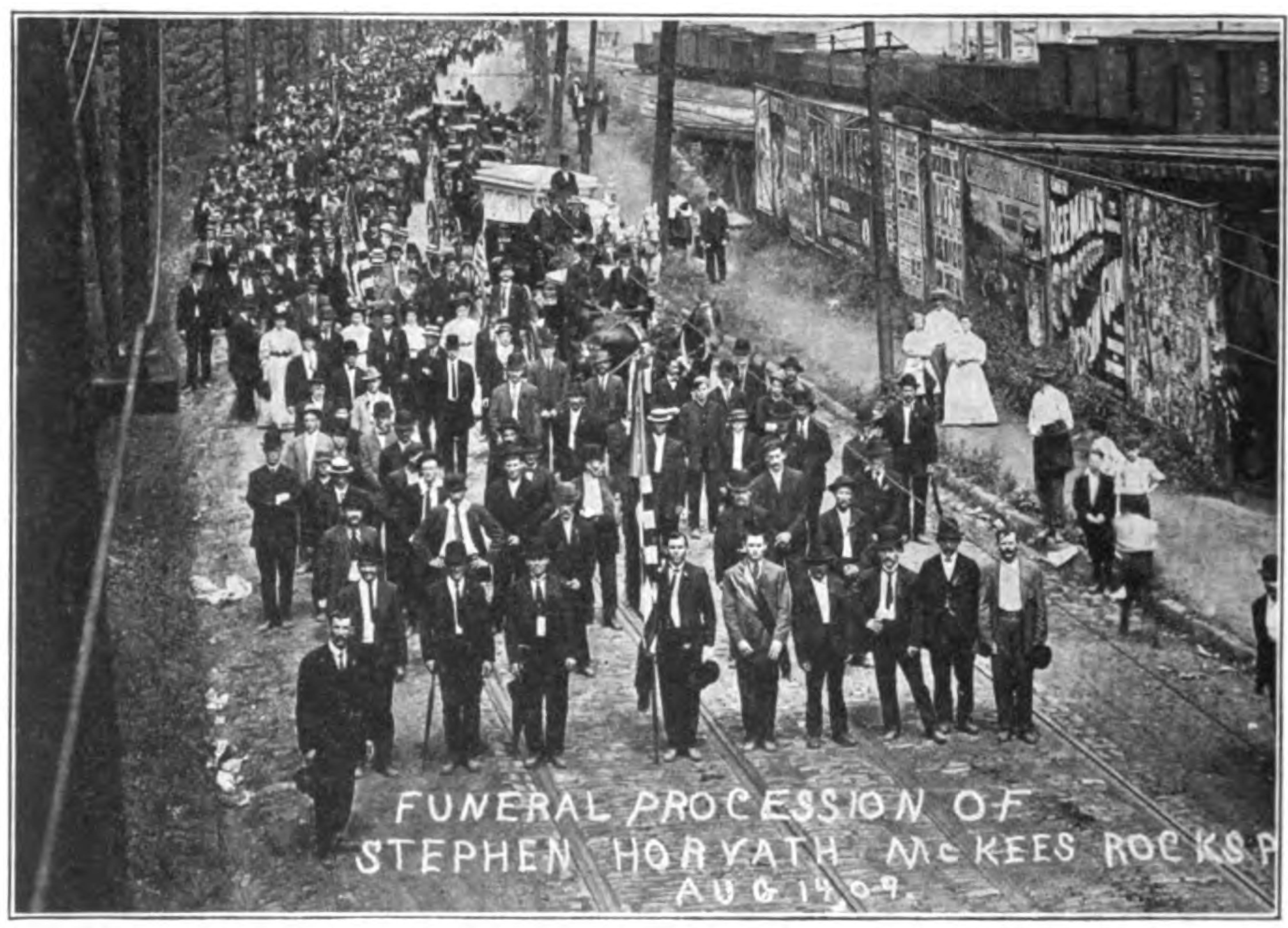
No person, male or female, is allowed to enter or leave the strike zone without being thoroughly searched.
State Thugs Arrest Peaceful Citizens.
Trooper Logan Meyshaw at noon arrested two street car men, employes of the Pittsburg Railways Company, who were in uniform, and two Americans. These men were standing at Nichol avenue and George street, and it is alleged they were upholding the action of the strikers and denouncing members of the state constabulary. Trooper Mewshaw ordered them to move away, and they refused. The trooper then marched the four to the box car.
Fearing the constabulary would raid them, the strikers called off a meeting which was to have been held at noon at the Indian Mound.
Although it is quiet in Schoenville, never has there been such an under-current of restlessness and ill-feeling as is felt now. The strikers are now depending on charity for food. The commissary wagons which deliver bread are stripped long before they have completed their rounds, and the men and women, with the children gathered about them, shake their fists in the direction of the car shops and denounce the officials.
The deaths of two more wounded strikers last night, bringing the dead total up to eleven, increased their anger, and oaths of vengeance were sworn over their bodies by their comrades.
600 Scabs Desert Plant.
More than six hundred strikebreakers left the company plant late yesterday, and it is reported a trainload is waiting to take their places. No attempt has been made to bring those men in, but this move is expected later.
As a result of threats made by the constabulary, through Trooper Woolfe against the strikers executive committee, the committee has decided change the location of its headquarters and is preparing to move to 604 Highland avenue.
C.A. Wise, president of the committee, says he was stopped on the bridge by Woolfe, who said: “I’ll get you yet, and the other boys will get the rest of your committee.”
President Wise declares that the committee has continually advised the men to refrain from violence and that the trouble was directly due to the actions of Deputy Exley.
Lewis Karplick, the motorman, and Fred Hauch, the conductor of the car from which Deputy Sheriff Harry Exley was taken and killed, both declare that the recklessness of Exler brought on Sunday night’s battles. Karplick further asserts that Exler fired the first shot.
How Exley Started the Fight.
Motorman Karplick said: There were about twenty-five passengers on board when our car reached Nichol and George streets, among them few women. Deputy Exley stood on the platform. Exley had taken many chances with the strikers, walking among them with his hand on the butt of his revolver and being otherwise offensive. For this reason he was well known and much disliked.
“At George street a delegation strikers, looking for strikebreakers, boarded the car and ordered the passengers off. The conductor advised them to comply, and all did so except Exley, who refused. When several the strikers ordered him to get down he brandished his weapon and replied: “Not so long as the chambers of this gun are filled with bullets.” Then, to the surprise of everybody, he pointed his revolver at the crowd and commenced to shoot.
“As soon as Exley fired the first shot the strikers returned fire. Women in the crowd gathered stone for their husbands. A great crowd strikers moved back, but as soon as it was seen that Exley had emptied revolver they closed in on the car. Exley was knocked down and shot, stoned and kicked until he begged for mercy.
Showed White Feather at End.
“For God’s sake don’t kill me,” he cried. At that moment a bullet struck him and he did not speak afterward. During all this time the troopers were not present. Afterward another car came in which there were a number of negro strikebreakers. The strikers attacked it. The troopers then left the barracks, after which shots flew thick and fast.”
“Exley was recognized before the car was stopped,” said Frederick Hauch. “Persons on the car jeered him and others outside called him names. I stopped the car and told everyone to get off for I wanted trouble. All got off but Exley. He would not move. Someone called him a deputy sheriff and then he said: ‘Yes, I am a deputy sherif all right,” and turned back the lapel of his cost and displayed his badge. Then I heard a shot and saw Exley pointing his revolver and fire. The crowd was firing in return and I leaped from the car and escaped. Then someone pulled the trolley from the line and Exley was left in darkness. I was on the outskirts of the mob and couldn’t see just what happened, but bricks were thrown and every window in the car smashed. The last I saw of Exley was when he was dragged out unconscious by the mob. When crowd scattered Motorman Karpliek put Exley on the car and took him to the office of Dr. McKinnon. He was dying. Several deputy sheriffs saw the attack on Exley, but were unable to go to his aid.”
Strikebreakers Terrified.
It is said that Sunday night while the battle was at its height the strikebreakers inside the plant became frantic. They shuddered and cried frantically to be taken across the river to Bellevue by the route they had been escorted into the stockade by armed thugs.
So violent did the strikebreakers become that the day force of deputies, who had retired to their barracks for the night, were immediately pressed into service. They were given their riot guns and marched in a body to the car shops in which the strikebreakers are quartered.
All of the latter were prepared to retire to their cots, but the constant roar of bullets made sleep impossible for them. A large force of deputies stationed at both ends and throughout the barracks to prevent any attempt at escape.
Will Investigate Peonage Charge.
An official investigation of conditions inside the stockade of the plant of the Pressed Steel Car Company will begin tomorrow morning. From the Department of Justice at Washington, United States District Attorney John H. Jordan, late today, received orders to move at once on the big plant in investigation of the charges of peonage which have been made against President Frank H. Hoffstot of the with company in conjunction Samuel Cohen of the employment bureau at the car making plant. Attorney Jordan is under orders to make the investigation most complete and as secret as possible, yet he is empowered to take with him in his search through the plant those who may prove that they have an interest in the workings of the plant. It is understood that the strikers who have made the charges of peonage against Hoffstot and Cohen will be given ample opportunity to send a committee mills to with Jordan through the make good their claims that workmen are held there against their will, that they are insufficiently fed, etc.,
Hungarian Attorney’s Good Work.
The Hungarians will be represented by Attorney Edgar Prochink, who, as acting counsel for the Hungarian consul at Pittsburg has been very active in behalf of his countrymen, whom he claims are being held and abused inside the great stockade. It was most likely today’s bitter protest by Prochink that brought the official order from the Department of Justice at Washington to investigate conditions.
Fearing that District Attorney Jordan was about to permit the information against Hoffstot and Cohen today, Prochink this afternoon wired his consul at Washington asking that the attention of the Department of State be called to the McKees Rocks affair. This was apparently done, for late this afternoon the order came in cipher to Jordan to begin the investigation. Should conditions inside the stockade be found nearly as bad as have been alleged by the strikers the arrest of Hoffstot and Cohen may be expected. Word was passed quietly to the mounted state troopers in charge of McKees Rocks this evening that it was expected that conditions inside the mills would be the same tomorrow morning as they were tonight–that men must neither be permitted to enter or leave during the night.
Continue to Disarm Workers.
A systematic search of the houses of strikers for weapons was begun in McKees Rocks by the constabulary today on John Doe warrants sworn out before a Pittsburg magistrate. An old law under which the house of anyone suspected of concealing weapons can be searched on a warrant was found and the work begun. The deputy sheriffs assisted the constables in their work of search and there were many clashes and not a few arrests made during the afternoon.
Sixty-six strikers were given a hearing late this afternoon on charges of carrying concealed weapons, and either lodged in the county jail or released for a court hearing on bail. They were brought from the strike district on a boat which has been named the Prison Tug, each handcuffed and they were hurried before Magistrate Heber McDonald who hastened through the formality of holding them for court. These were the persons arrested since late yesterday, a load of fifteen having been brought to jail yesterday evening. Warden Lewis, of the Alleghany County jail, announces that he will be able to accommodate but a few more McKees Rocks prisoners in the jail, which is not filled to capacity.
The New York Call was the first English-language Socialist daily paper in New York City and the second in the US after the Chicago Daily Socialist. The paper was the center of the Socialist Party and under the influence of Morris Hillquit, Charles Ervin, Julius Gerber, and William Butscher. The paper was opposed to World War One, and, unsurprising given the era’s fluidity, ambivalent on the Russian Revolution even after the expulsion of the SP’s Left Wing. The paper is an invaluable resource for information on the city’s workers movement and history and one of the most important papers in the history of US socialism. The paper ran from 1908 until 1923.
PDF of full issue: https://www.marxists.org/history/usa/pubs/the-new-york-call/1909/090825-newyorkcall-v02n203.pdf
 Revolution's Newsstand