
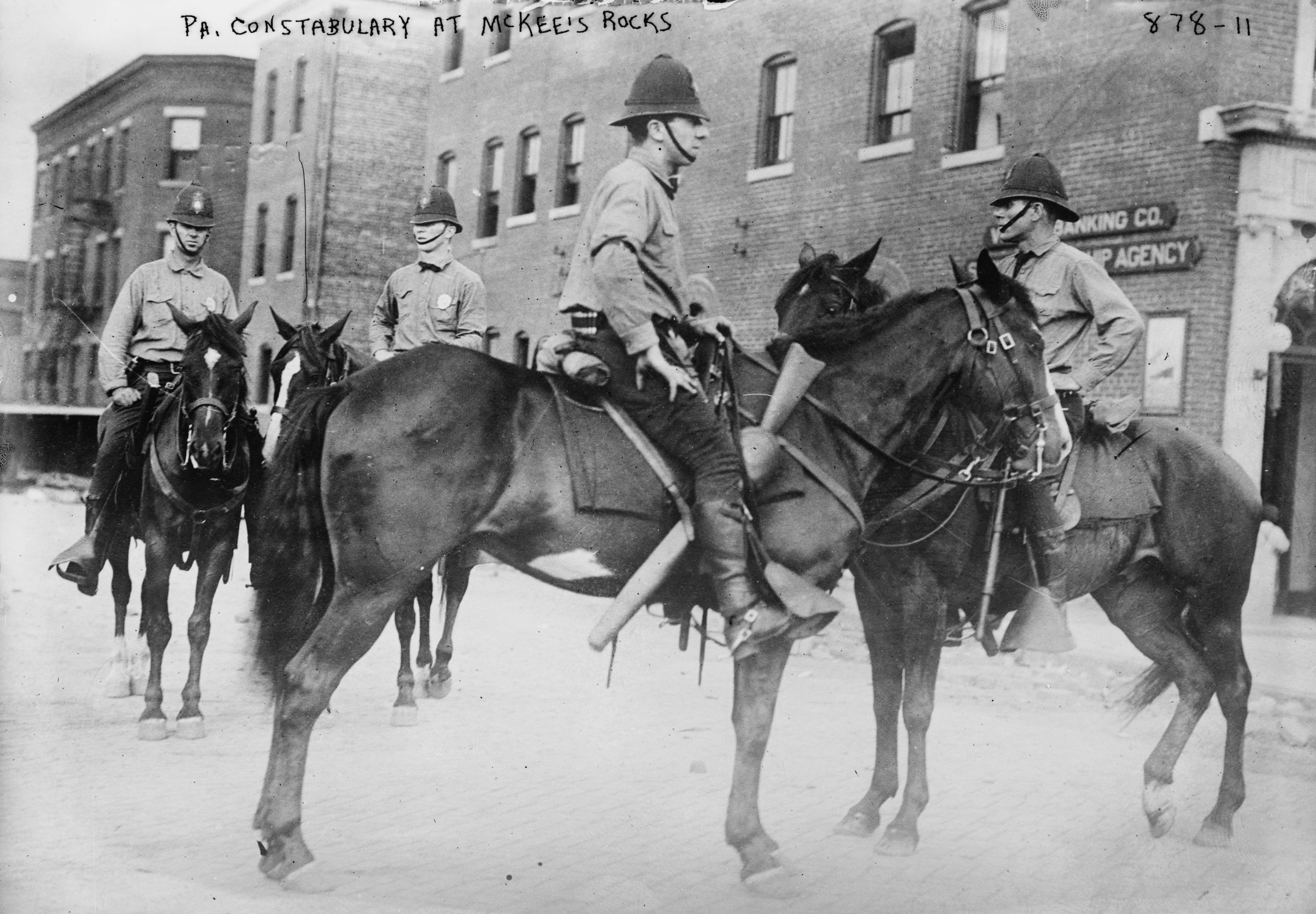
The origins of many local constabularies in the United States are rooted in policing labor; either to control the enslaved or break strikes and unions. The Pennsylvania State Constabulary, still extant, is an example of such a force. James H. Maurer reports.
‘Written in Blood: The Gruesome, Gory Record of the State Police’ by James H. Maurer from Labor Age. Vol. 15 No. 3. March, 1926.
OHIO is threatened by the State Police. This “cross between the Irish Constabulary and the Russian Cossack,” as it has been called, is being urged for the Buckeye State by a so-called Gasoline Consumers League. Were the plot to succeed there, State Constabulary forces would soon be part and parcel of the machinery of other American states. Then would we be justified im calling ourselves “More Prussian than Prussia.” President Maurer of the Pennsylvania Federation of Labor has had long contact with the American Cossack. He knows whereof he speaks, from the bloody records of the Keystone State.
LET’S look through a few old newspaper clippings. They will provide a picture of the past history of the State Constabulary in Pennsylvania. They are here on my desk in the headquarters of the Pennsylvania Federation of Labor in Harrisburg.
Here is one of February 4, 1924. It is taken from the Philadelphia Norra American of that date. “Penna. Discharges 45 Troopers in Year” read the headlines. Thirty-five of these were dropped for bribery or suspicion of bribery in bootlegging cases, and the clean-up was part of the Pinchot administration’s program.
Here is another, from the Altoona Times of October, 1920. “State Cossacks Knock Eye Out of Aged Man,” it says, “Two are convicted—a constabulary officer intercedes for third, who escapes legal desserts.” Then follows the account, from Media, Pa., of how the three troopers attacked James W. Kearsley, a 60-year-old man of Boothwyn, knocking out his eye with a jack. A jury convicted them of the charge.
At the same time we read of the arrest of another trooper, Corporal Dixon by name, for running amuck while drunk on duty, threatening a garage keeper at Shippensberg and drawing his gun on a local policeman in Chambersburg. Prior to this rash act, he had terrorized the National Hotel of that place, by “shooting it up” in western style. In Clearfield on September 8, 1921—reports the CLEARFIELD Process—State Trooper Connreider assaulted a young man, his rival, with a headache stick, and then sought to put the young man under arrest. The only crime that the young man had committed was in courting a girl from a local candy store with whom Connreider was likewise smitten.
From the Lancaster Examiner, we note the arrest of State Troopers Frank McMahon and Leslie Parks for an attack on a 13-year-old girl, and their later arrest for manslaughter in killing a woman on the highway.
The Grimy Record.
So run the other clippings: “Assault — Bootlegging —Extortion — Rape — Arson — Drunkenness —- Murder.” All of these stand in red letters against the bloody ruffianism that has disgraced Pennsylvania for twenty years.
At Ashland, Pa., they are used by the local political machine to drag an independent candidate for sheriff, Con Foley, off his speaking platform, and arrest him. The crowd, however, rescued Foley from the police and he went on with his speech. At Washington, they hang a young Russian to the rafters of a barn to compel him to confess to murder. At numerous other places they stir up brawls, while drunk, that almost grow into riots.
That is only a small bit of the indictment against them. They are another curse that has been added to the stripes laid on the shoulders of the workers of Pennsylvania.

In the bloody history of labor in the Keystone State, from Homestead to the present day, we have had to contend with the Pinkertons, the railroad police (established in 1865), the Coal and Iron Police (created in 1866), the Militia and the State Constabulary. These “law and order” makers are in addition to the deputy sheriffs, constables, local police forces and motorcycle police.
The State Police came to be added to this imposing list in this way: It was in the year 1902, it will be recalled, that the great Anthracite Strike took place. The militia were called for by the operators, led by “Divine Right” Baer. They were sent in to maintain order. That is exactly what they did do. They were workingmen and sons of workingmen. They came out of the mines and mills and factories. They policed the anthracite region, and did it well. There was no disorder anywhere throughout that section, just as there 1s none today. (Under Governor Pinchot, by the way, the State Police have not been sent into the coal region during the present conflict.)
Rioting Desired.
For six months the miners held out. The country clamored for peace by voluntary arbitration. The miners were willing to grant this. But the operators would hear nothing of peace except at their own terms. Then it was that Theodore Roosevelt stepped in and settled the difficulty, with concessions to the men. The militia, in the coal region so long, had become well acquainted with the miners. They played ball together and cards and other games. There was quiet during their entire stay, because they would not be used for riot-incitation.
The Employing Interests did not want quiet at times of strike. They wanted disorder and turmoil. Led by the Manufacturers Association—whose criminal record is spread on the pages of United States commissions—they succeeded in foisting the State Police on Pennsylvania in 1905.
It was a year of great corruption in our legislature. The State Capitol was erected then, at the cost of $13,000,000—the graft in connection with which sent many men to jail or to suicide. It was a proper time to put over the American Cossack on the state.
As my friend, Phil Waggaman, former vice-president of our Pennsylvania Federation, wrote of them several years ago:
“The prime object in passing this law was to create a powerful, strike-breaking institution. But this, to state it plainly, was a little too rank even for the corrupted legislature to stomach. The bill cleverly stated that the Constabulary was established to patrol rural districts and to apprehend criminals. But the patrolling is done in the immediate vicinity of the barracks and a small number of real criminals are apprehended. The people living in the rural sections of Pennsylvania, are as law-abiding as can be found anywhere and do not want the State Police and do not need them. If they were needed, it would require an army of 15,000 men, granting that each policeman could patrol three square miles of the 45,000 square miles of the state.
Arrests Without Warrants.
“They are used, principally, to break peaceable strikes, and patrolling the rural districts and catching criminals are only secondary considerations; a sort of pastime when there are no strikes in progress They are paid by the state and employed by the corporations and housed by them. Their power is practically unlimited. Only the legislature, while in session, or the Governor, when the legislature is not in session, are their superiors. They make arrests and search houses without warrants. Martial law, or something near it, prevails when they arrive in a community. The civil authorities are powerless to act. They cannot prevent these police from coming and have no legal method of ridding the locality of this band of undesirables. A request from a corporation to the County Sheriff brings them to the scene and they soon start something, that being their stock-in-trade.”
Tools of the Manufacturers Association.
Through the years that have followed since they have come into Pennsylvania, the State Constabulary have carried their trail of blood through every industrial dispute. Do you remember Bethlehem in 1910? The steel workers in that accursed city tried to free themselves from the iron rule of Schwab. They were met by the State Police—with violence, rape and murder. Do you recall the Great Steel Strike of a later date? There, again, these Cossacks were the chief weapons of the Steel Trust against the men. In the coal revolt in District 2—when the non-union workers to the south of this central Pennsylvania district came out—assault, rape and murder in cold blood were again prominent features of the strike, with the State Police in the Cossack role. These things have been put into books and into official records, and cannot be gone into detail here.
The proof of their servile service to the Employing Interests is to be seen in the zeal with which these interests rush to their defence, if they are attacked. As a sample: In 1914, the Constabulary had become so noxious to the good people of the State that there was a move on foot to abolish them. The Pennsylvania Manufacturers Association immediately cried out, “Murder! They issued a pamphlet in the shape of their Monthly Bulletin, headed “A Plot Against the State Police.”
They declared the move against the police to be “startling news,” which all “law-abiding citizens” should view with alarm. They then continue: “Yet thinly veiled anarchy, emboldened by its success in Washington, dares to strike it a blow in the dark.”
The encouragement at Washington referred to, which “thinly veiled anarchism” had received, was the election of Woodrow Wilson and the favorable action to Labor in his first term. The “anarchism” itself was the Labor Movement, of course. By such extreme terms did this criminal organization, which investigations at Washington showed ought to be shut up, hope to divert public attention from its own putrid record.
Says the Manufacturers Association further— this arch-enemy of the workers: “Several states are preparing to establish forces similar to the one in Pennsylvania. Every state should have one. (Their italics.) Law-abiding people here wonder how we ever got along without the Constabulary.” The “law-abiding people,” of course, are the anti-union manufacturers, bankers and their ilk. Figures show that crime is increasing in Pennsylvania since the coming of the State Police, and as we have seen, the Police themselves have contributed their share to this increase.
Costly Strike-Breaking Machine.
In March, 1922, Lynn C. Adams, Superintendent of the State Police, sent out a questionnaire to coal operators, for the purpose of co-operating with these operators in breaking the impending coal strike. In a note in that questionnaire, the Superintendent was even so kind as to inform the operators how they could secure the help of the State Police, merely by calling on the Sheriff for such service. Among the questions asked is this one: “Have you an understanding with the sheriffs of the counties in which your operations are located?”
To maintain this enormous strike-breaking machine, the people of the State have had an extra burden of taxation placed on them. The appropriations for two years for the Constabulary grew from $450,000 in 1905, when the department was created, to $1,889,545 in 1921. The number of men employed increased from 340 to 448, The appropriation in 1923 was cut down to $1,448,000. But this was because the state was broke to the tune of some $35,000,000—and cuts were made in all departments, to help make up the deficiency.
There has been much talk about economy in government going the rounds of late, led off by the White House. One of the best pieces of economy for any state is to abolish the State Police, if it has one, or to kill any attempt to introduce such a system, if the Constabulary does not exist.
As a strike-breaking institution, the State Constabulary is a great success. If the good people of Ohio or of any other states where this idea is being proposed value their liberties, they will see that the State is never cursed with a State Constabulary.
Labor Age was a left-labor monthly magazine with origins in Socialist Review, journal of the Intercollegiate Socialist Society. Published by the Labor Publication Society from 1921-1933 aligned with the League for Industrial Democracy of left-wing trade unionists across industries. During 1929-33 the magazine was affiliated with the Conference for Progressive Labor Action (CPLA) led by A. J. Muste. James Maurer, Harry W. Laidler, and Louis Budenz were also writers. The orientation of the magazine was industrial unionism, planning, nationalization, and was illustrated with photos and cartoons. With its stress on worker education, social unionism and rank and file activism, it is one of the essential journals of the radical US labor socialist movement of its time.
PDF of full issue: https://www.marxists.org/history/usa/pubs/laborage/v15n03-mar-1926-LA.pdf
 Revolution's Newsstand