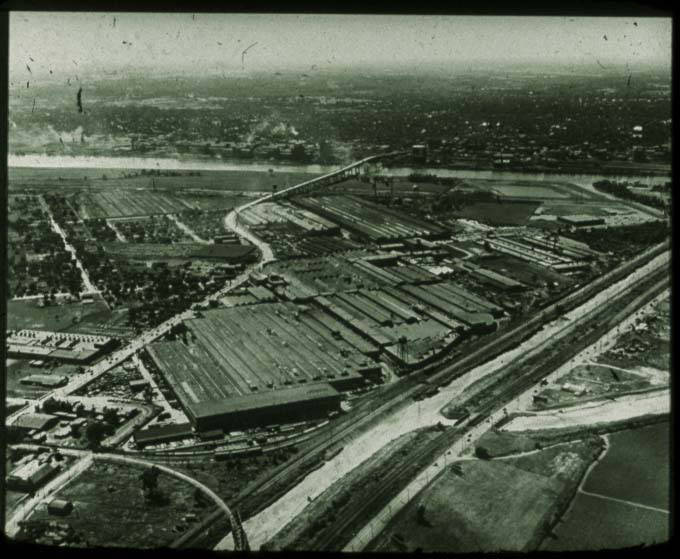
Socialists with the C.I.O.’s Steel Workers Organizing Committee make the first crack in the giant Peoria, Illinois Caterpillar plant after a two-day sit-down of 11,500 workers in April, 1937. It would not be until 1941 that the Cat would be fully unionized by the U.A.W.
‘How Militant Union Action Won Peoria Caterpillar Strike’ by Frank N. Trager from Socialist Call. Vol. 3 No. 109. April 17, 1937.
Frank N. Trager is Socialist Party National Labor and Organization Secretary
PEORIA, Ill. In this open shop town dominating the indus- trial life of central Illinois the Steel Workers Organization Committee came to do battle. Led by miner Joe Dernoncourt, organizers and workers in the giant plant of the Caterpillar Tractor Company began signing up eager and willing members.
In the face of threats, spies and stool pigeons, discrimination, layoffs they signed up a clear majority of the 12,000 employees of the company: Then came the showdown by which the union won a contract!
To appreciate the significance of a union contract with “Cat” in Peoria requires imagination and renews confidence in workers everywhere. For this company, the largest of its kind in the world, covering 150 acres, has dominated not only the lives of workers in Peoria but has contributed to the open shop, anti-union practice of the whole central Illinois area. Excluding the organized miners and a few AFL crafts, this territory. has been a “happy hunting ground” for the Illinois Merchants and Manufacturers Association and Chamber of Commerce.
How Militants Work
The SWOC attempted to negotiate an agreement with Caterpillar during March and up April 6. There was little doubt that they had a majority of the employees but the company rejected any peaceful settlement. When negotiations bogged down the afternoon of the 6 a determined strike committee swung into action.
Ed Lobb, former secretary of the Bloomington Socialist Party local, discharged for union activity, gave the signal to Ken Gordon in Plant X, the assembly line plant. Gordon and Lobb successfully stopped the line just before the change in shift at 4 P.M.
While they were operating in X, Howard Day, recording secretary of the Union, former member of the Illinois Socialist State Committee, Orville Meyer, Ira Izold, Lloyd and Jim Shipley (Jim’s wife, a member of the auxiliary, is secretary of the Peoria Socialist local), and other members of the strike committee stopped operations in plants M and N, persuaded the evening shifts to walk out on strike and together with the boys from X completely controlled “Cat” by one of the best executed sitdowns in these parts.
The sitdowners blockaded the plant with Caterpillar tractors, set up inside strike committees, and prepared for a siege. A picket line was established, the woman’s auxiliary began its job of relief work, a daily strike bulletin was issued.
Bosses Use Parolees
The plan of the progressives in the union had to be carefully guarded and swiftly executed because the boys knew of at least 500 parolees, half of whom worked for “Cat” who, it was reported, were paid by the local Chamber of Commerce as “stools.” They came from Joliet prison, and were forced into such a position by the threat of losing their parole!
On the next day, Wednesday, by inspiration from the company a mass meeting was called for the following morning at the Peoria armory. Here the men were asked to vote on “to continue work” or “to return to work.” At the same time one of the business agents of the AFL machinists stepped into the picture and tried to represent the strikers! These strike-breaking activities completely failed of their purpose.
Dernoncourt, using the Socialist sound truck which we had just brought back from Michigan auto strike duty, explained to the men what the real situation was. The picket lines held fast, the sitdowners hung out a sign “To do or die with the CIO.” Their militancy and determination to win mounted in proportion to the not too subtle attacks from “Cat.” That afternoon, Thursday, the union strike committee went back into negotiatlons with the firm.
Win Strike.
The men were quietly confident, added to their picket lines–“just to show boss Heacock when he comes out” and waited. At 6 P.M first rumors came through: The union had won a signed agreement. At 6:30 it was confirmed when Clinton Beller and John Evans came over with the news that they had the contract signed, sealed and delivered.
The final touch was added when, using the sound truck as a guide, we marched from the plant site in East Peoria through the main part of Peoria, cheered at union headquarters and went down to the Women’s Auxiliary strike benefit dance, converted now into a Victory celebration. As we went through the town we announced the basic union slogan: Make Peoria a Union Town–and we had every assurance that by putting “Cat” in the union bag the workers were on their way–on their way to build a democratically run, militant union in Caterpillar and among the other industries in Peoria.
Socialist Call began as a weekly newspaper in New York in early 1935 by supporters of the Socialist Party’s Militant Faction Samuel DeWitt, Herbert Zam, Max Delson, Amicus Most, and Haim Kantorovitch, with others to rival the Old Guard’s ‘New Leader’. The Call Education Institute was also inaugurated as a rival to the right’s Rand School. In 1937, the Call as the Militant voice would fall victim to Party turmoil, becoming a paper of the Socialist Party leading bodies as it moved to Chicago in 1938, to Milwaukee in 1939, where it was renamed “The Call” and back to New York in 1940 where it eventually resumed the “Socialist Call” name and was published until 1954.
PDF of full issue: https://www.marxists.org/history/usa/pubs/socialist-call/call%203-109.pdf
 Revolution's Newsstand