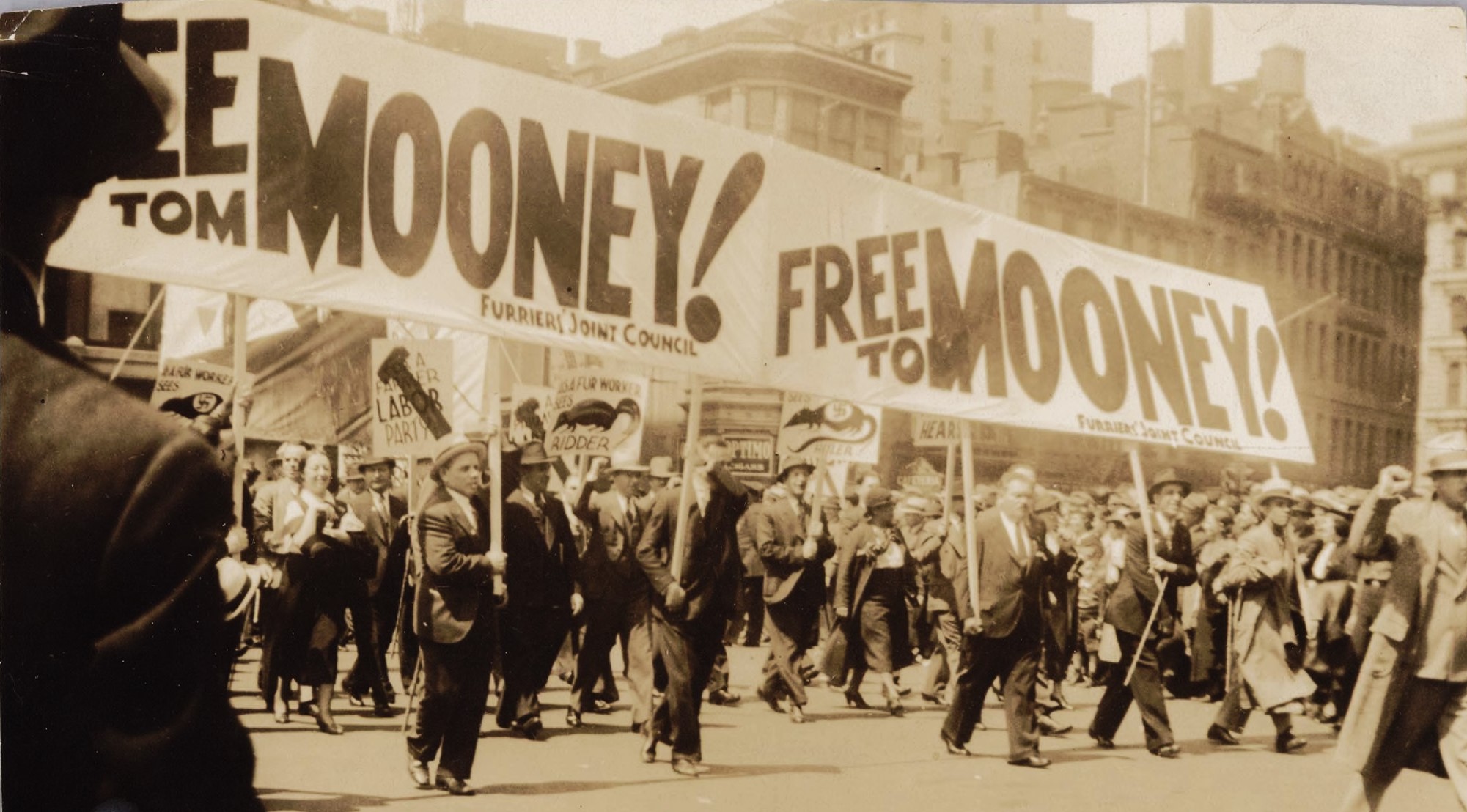
‘We Demand Recognition of the Status of Political Prisoners in the U.S.A.’ from Labor Defender. Vol. 10 No. 3. March, 1934.
A call to all members of the I.L.D. and its friends to join the campaign for recognition of class war prisoners and securing of special privileges for them as such, behind prison bars
The forces of the International Labor Defense, its affiliated organizations, its friends and sympathizers, must be mobilized for the struggle for the improvement of the prison regime of political prisoners. The campaign must be waged throughout the labor press, in every liberal and sympathetic periodical, by mass meetings, demonstrations and organized protest movement against the refusal of the authorities to recognize their political status, struggle must be based upon the everyday need and demands of the political prisoners, for a preferential prison regime. The struggle must be waged under the main slogan for the unconditional release of class war prisoners.
The existence of political prisoners in the United States is denied by prison authorities. Yet there are literally thousands of political prisoners, men and women whose only crime is that they have dared to struggle against the burdens of the crisis shifted onto their shoulders; that they dared struggle against the deportation of militant foreign born workers, against the denial of equal rights for the Negro masses.
The nature of the “crime” of these individuals is carefully hidden behind the charges made against them of violation of the penal law. When the question of recognizing the political status of certain men in Sing Sing, imprisoned for their activities in economic and political struggles, was raised with Warden Lewis E. Lawes, for the purpose of securing for them the privilege of receiving publications of the labor press which he had banned, he said, “I do not recognize the status of political prisoners as such. Each and every man has been convicted of the violation of the penal law.”
Although the status of political prisoners is not extended to these imprisoned victims of the class struggle, yet in many ways their position is clearly recognized. Literature from militant labor organizations is denied them (in Auburn, N.Y., San Quentin, Calif., Blawnox, Pa., Kirby, Ala., etc.) Their moral corruption is attempted. Every effort is made to split them from their organizations, to destroy their militancy, to separate them according to nationalities, to isolate the youth and to impose upon all other special humiliating measures. So far in America the beating and tortures imposed upon political prisoners in Europe is reserved for the greater part for the Negro prisoners.
The struggle for human conditions in prison for these men and women must be regarded as a major national campaign of the American working class.
Behind this denial of the political status to such men and women, whose numbers are now daily increasing, state and federal governments seek to hide the class character of their persecution. State and federal constitutions guarantee the right of free speech, freedom of assemblage, the right of freedom of the press, the right to demand redress of grievances. These were among the basic issues in the silk mill strikes in New Jersey, strikes of the cotton pickers and agricultural workers in California, strike struggles of the miners in New Mexico and Utah, the steel workers in Pennsylvania, the struggles against the enforcement of the NRA codes, for unemployment insurance at the expense of the government and employers.
But the class war victims of these struggles were charged with disturbing the peace, inciting to riot, sedition, unlawful assemblage; and such frivolous charges as blocking the traffic, littering the streets, or some other “violation of the penal law.” Thus does the ruling class seek to evade the recognition of political prisoners. This ruse must be ruthlessly exposed.
Behind such charges as these, the frame-up of Tom Mooney, Warren Billings, Angelo Herndon, the Scottsboro boys and the innumerable victims of class and national persecution, have taken place.
European and Latin American countries have long recognized the distinction between those arrested for the violation of the penal law and those arrested because of their opposition to the economic and political system under which they live.
The government of the United States has recognized many of the refugees from political and economic struggles in other countries, as having the right of political asylum here. The Machados from Cuba, the hangers-on from the former Czarist court, former ruling class butchers, forcibly ousted by the masses they oppressed, find sanctuary here.
The victims of the legal terror of the ruling class who fight this enslaving economic and political order are forced into the category of common criminals. Even when amnesty is granted, it is not extended to them. In this way those who control the government seek to prevent the rising wrath of the masses from finding expression against the persecution of workers and their sympathizers who have fought against misery and oppression.
The toiling masses in the International Labor Defense, its friends and sympathizers, must answer every act of terror in the prisons with the broadest popularization of the demands of the political prisoners. Demonstrations must be organized in front of prisons and of courts. Families of the political prisoners must organize demonstrations in their neighborhoods. Around released prisoners mass organizational struggles must be developed in behalf of those who have been left behind.
Patronage must be taken by International Labor Defense districts and branches by working class organizations and those friendly to it over political prisoners for the struggle in their defense and for the recognition of their special status.
The struggle must be extended beyond a fight for political prisoners in this country, and with equal energy and attention for the struggle for political prisoners in Germany and Austria and other European countries, in the colonies and semi-colonies.
Labor Defender was published monthly from 1926 until 1937 by the International Labor Defense (ILD), a Workers Party of America, and later Communist Party-led, non-partisan defense organization founded by James Cannon and William Haywood while in Moscow, 1925 to support prisoners of the class war, victims of racism and imperialism, and the struggle against fascism. It included, poetry, letters from prisoners, and was heavily illustrated with photos, images, and cartoons. Labor Defender was the central organ of the Scottsboro and Sacco and Vanzetti defense campaigns. Editors included T. J. O’ Flaherty, Max Shactman, Karl Reeve, J. Louis Engdahl, William L. Patterson, Sasha Small, and Sender Garlin.
PDF of full issue: https://www.marxists.org/history/usa/pubs/labordefender/1934/v10n02-feb-1934-lab-def.pdf
 Revolution's Newsstand