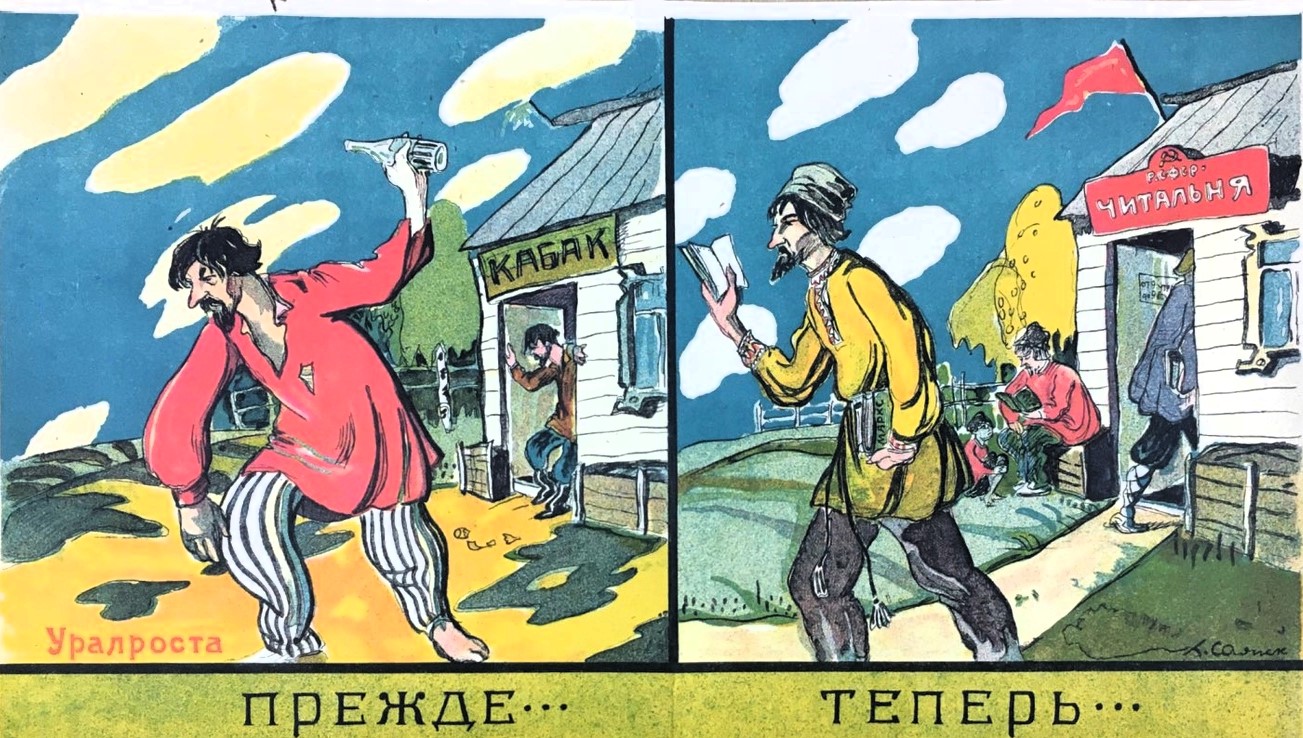
Details on the enormous amount of activity done by the Revolution in the cultural field during its first years.
‘Cultural Work and Education in Soviet Russia’ from Soviet Russia (New York). Vol. 2 No. 12. March 20, 1920.
The Russian autocracy was able to exist until the twentieth century only because of the exceptionally antiquated methods of popular instruction. The funds necessary for this instruction were always granted unwillingly; the curricula in the schools, in their sterility and lack of concern with real life, apparently sought to instill in the child a distaste for knowledge. An altogether automatic religious instruction, dead languages, orthographic subtleties, notably the rules relating to the use of the letter “yat’’,—such were the trials that the student had to undergo in order to obtain his “certificate of maturity”. Half of the primary schools, moreover, were in control of the clergy.
It was not until after the revolution of 1905 that our government, self-styled “constitutional”, under constant pressure from the democratic Zemstvos, considered the question of general primary instruction; but the reform which — almost on the point of being realized was checked in 1914 by the outbreak of the world war.
The great Russian revolution thus finds Russia half illiterate and ignorant.
The power of the workers and peasants, represented by the People’s Commissariat for Public Instruction, declared a most pitiless war upon this popular ignorance. The chief aim of the Soviet government is to render instruction accessible to all, and to join in the closest bonds the school and the socialist constitution of labor. In place of the multiplicity and heterogeneity of the old types of schools, the Soviet power emphasized the principle of one school and practical work. The application of the scholastic reform has had to contend with the obstinacy of pedagogues and their failing comprehension of the exigencies of the hour.
Even in the heart of red Russia, in Moscow, the principle of manual work has not yet been instituted in all the schools. But wherever the organizers give themselves with all their heart to the creation of the new school, it is seen that cordial relations and a mutual confidence are established between masters and pupils, and the work is rapidly organizing.
The children’s clubs in Moscow are an excellent innovation. The children frequent them the hours of 9 and 7. There are at their disposal studies, galleries of design, a library, a workroom, a dining room where they receive tea with sugar and bread. The whole intimate life of the club is based on the principle of a working commune.
The school of applied work has broken rudely with automatic study and the immobility during interminable hours in class; it has been transferred to the factories, the shops, the fields, to receive instruction from the workers and acquire working practice. It is thus that the schools organize kitchen-gardens. In the districts they are allotted plots of ground for the planting of vegetables and fruit trees. In many governments communal summer colonies are organized for students in frail health and for children still too young to attend school, as well as groups which pursue in the open air the studies begun at school. Every child must attend the communal colony about a month, so that four parties can take advantage of the summer in the provinces of Samara, Kursk, Kharkoff, Minsk, etc. Besides their importance from the point of view of education, these communes are also of great assistance in the preparation of provisions for the winter.
The school of applied work develops initiative in the children and prepares them for life in society. Student assemblies are organized; these send their representatives to the scholastic pedagogic councils; there are also conferences for adolescents. In the middle of May there were held conferences of the young people in the schools, notably at Moscow. Questions of pedagogy and organization were discussed and it was decided to institute in the schools communist sections, tribunals of comrades, commissions for economic organization and the safeguarding of the work of the children. One hundred and nine delegates took part in this conference.
While occupied with the education and instruction of the new generation, the Soviet power has manifested an intense activity in the direction of extra-scholastic instruction for adults. This activity includes so many forms that their mere enumeration constitutes in itself a long terminology. Observe for example the number of sections included under the extra-scholastic division of the section for Public Instruction in the government of Penza:
1. Section for cultural and educational social activities. 2. Section for libraries. 3. Section for lectures and schools for adults. 4. Section of the Museum. 5. Section for popular lectures and conferences. 6. Section for cottage reading-rooms. 7. Section for people’s houses. 8. Section for proletarian universities. 9. Section for popular theatres. 10. Section for clubs. 11. Section for scientific societies.
Moreover, something has yet to be added to this great variety.
12. The traveling book-shops and libraries. 13. The vessels and trains devoted to the transport of instructors and literature. 14. The mobilization of all educated people to read journals aloud. 15. The cinematograph exhibition and the traveling phonographs devoted to communist propaganda. 16. The aeroplanes which drop appeals, literature, etc.
To illustrate the work accomplished in the sphere of public instruction in the distant provincial localities, let us take as an example the little town of Clebove in the district of Rybinsk. A circle for culture and education was organized there in May, 1918, which now has 161 and 125 meetings of directors; they gave there 7 spectacles, one concert and 12 lectures (on hygiene, agriculture, the study of Russia, etc.), and opened a library. Moreover, the circle owns a building for children, where they may spend their recess and take tea.
The second year of the Socialist regime has been marked by the appearance of libraries in real “holes”, where it was difficult before the revolution to find even a single book (other than a religious book). The village libraries have been established thanks to the books which were confiscated in the mansions of the old estate. And thus the cultural capital which had remained hidden for hundreds of years has been at last put in circulation for the profit of the working people.
Note, for example, the fi activities for May, 1919, of the library at the Palace of the Red Army in Kazan: 8514 volumes representing 5852 different works, of which 75% were novels, 2360 books of a Communist nature, 20 reviews and 8 journals. This library is used on the average by 3400 to 3500 persons every month.
The villages have their libraries and their communal cottage reading-rooms. The district of Viazma of the government of Smolensk furnishes an example typical for all of Russia; it has 59 library reading-rooms of which 20 are central branches containing from 1000 to 2000 volumes.
Besides these libraries one notes also the popularity and success of the so-called traveling bookshops. The communists of the district of Shatsk. (government of Tambov) were the first to organize a book-store on a wagon, and take it from one village to another. In these traveling book collections are found small] libraries of thirty volumes enclosed in a chest which circulate from village to village until it has made the tour of the whole commune.
Frequently we have not sufficient resources at our disposal to execute the enormous work involved in the instruction of the masses in a country so exhausted by the war as was Russia. That is why we must utilize without exception all the forces that we have in the direction of the greatest effectiveness. This explains the rapidity of the organization of visits by experienced teachers. A few months ago special trains were reserved for the transport of instructions and literature. While traveling about from place to place in their trains these specially organized groups of agitators and learned: men organize in the stations meetings, lectures, conferences, cinematograph shows: they distribute Socialist literature and publish in the trains even papers treating of the events of the day in this or that given region.
Since the opening of river traffic, steamers and barges devoted to the transportation of instructors and literature have been placed with the same Jai pose on the Volga, the Dniepr, the Don, the Volkhoff, the canals of the Marie system and the lakes of the Region of the North.
One of the methods for spreading—culture and education which appears to be unknown in the Occident consists of mobilizing educated people for reading aloud to the illiterate. From the little town of Kalesnikovo (provinces of Riazan) one person wrote: “All of the mobilized must read journals and pamphlets to the illiterate, and explain to them the unfamiliar words.”
The ignorant masses of the rural districts are most interested in the theatrical presentations. The theatre exercises so great a power of attraction that the peasants gladly travel several kilometres to reach it, and very readily pay 10 rubles per person. It matters little that the decorations are crude, that the artists are inexperienced amateurs, that the repertoire is poor, the wigs and beards tors more than compensates for the shortcomings of the mise en scene. Occasionally among the actors real talents are discovered, who instinctively interpret their role in a lively and original manner without having attended any dramatic school, and having pursued no courses. Sometimes also decorators with genius are found. In the village of Kransha (government of Nizhni-Novgorod), which has only 80 families, there is already a people’s house provided with a good stage where performances are given on fete-days. All the decorations have been painted by a peasant of the vicinity, a self-taught painter, D. I. Abramytcheff, who has gathered about him the local amateurs in the dramatic art.
It is interesting in this connection to remark the manner in which the peasants have welcomed that innovation, the people’s house. When the initiators addressed themselves to the “mir” (the village community), in order to ask for wood to build a people’s house, the older ones suspected some folly. But after the first performances the community sent delegates to them of their own accord: “Take as many horses as you need to draw the wood. We can very well see that you are working in our interest”.
The dramatic circles are now sprouting up in the villages like mushrooms after a rainstorm. For example, one person writes from the district of Malmyzh (government of Viatka), that everywhere are “cultural and educational circles, and there is not one commune where they have not organized a performance”.
The theatre enjoys the double role of the director and the gardener of culture. Little by little the other organizations of instruction begin to group themselves about the theatre: circles for self-instruction, musical circles, libraries, reading rooms, clubs, etc.
The spectacles succeed in loosening the Russian peasant’s purse-strings—his who is so economical, and who was never before inclined to satisfy his cultural needs. What need could an illiterate person have for a library? In the village of Popoff, district of Poutiloff, the communist section was even able to present a series of spectacles, and to organize a reading-room with the funds thus collected among the focal peasants.
The repertoire of the village theatres is limited, but it is interesting to remark that it contains al most exclusively classic works. The favorite is Antoline; thus they adapt for the stage his little novelettes such as the “Wicked-Minded”, “Chirurgy”, etc. Then they also present plays like “Poverty is not Vice”, Ostrovski’s “To Endorse for Another”, Gogol’s “Marriage”, Leo Tolstoi’s “From Her All Virtues are Derived”.
Latterly there has been a tendency for separate circles of amateurs to join together in organizations sharing their artistic resources with greater regularity, improving costumes and decorations, organizing traveling theatrical libraries, and receiving considerable subsidies from the State in view of the fact that they act in perfect accord with the district sections of the Commissariat for Public Instruction. In the district of Rybinsk, the various existing circles have thus, joining in this way, grouped together their beet actors and formed an elite troupe which now gives performances throughout the entire district.
The organizations of railway workers place themselves also at the disposition of the travel troupes. At Kieff a carriage-stage was — which was dedicated to the Commissar for War, Podvoyski, and which gives popular performances along the whole route of the railway line. In addition to the carriage-stage there are two other cars, one of them containing the decorations and costumes, and the second the artists. The Committee of Instruction for the line Moscow-Kursk has established a dramatic school. The same Committee also organized 25 theatres during 1918, which serve the various localities off the railway line, and receive books as well as cinematograph films from the central theatrical library.
The Red Army defends Socialist Russia against the wild bands of the Russian counter-revolution and foreign imperialism. Upon the conscious performance of their revolutionary duty by the soldiers of the Red Army depends the victory of the world proletariat as well as the establishment of the reign of labor and the era of liberty upon earth! That is why the Soviet power is occupied with an indefatigable ardor in the instruction of the great masses of workingmen who have been called to arms in the ranks of the Red Army.
All the methods and processes of educational and cultural work which have been experimented with in city and village, are taken over into the military sphere with the adaptations required by —— of life in the barracks and in the field.
The cultural work in the Red Army is directed by the political Section of Instruction on the General Staff. There are local subdivisions of this section in all the commissariats of war in the military districts, as well as with the active armies.
In the units of the territorial army up to the present there have been enrolled 64 communist sections, 97 commissions for culture and education, 50 clubs, 27 schools for elementary learning, 27 reading-rooms and 63 libraries (37,000 volumes).
Almost 10,300 copies of journals are distributed every day among the red soldiers of the city of Moscow. During the first three months of the year 1919, the Red Guard clubs of Moscow organized 108 spectacles, 101 concerts and 552 lectures. The same intensive work in the diffusion of instruction is being realized in the Red Army throughout the territory of the Republic. The number of cultural and educational organizations has increased more than twenty time during the first four months of the current year: Jan. 1, 19190May 1, 1919 Libraries—Reading-rooms 77 1614 Schools 69 674 Clubs 204 642 Theatres 6 211 Cinematographs 26 221
The regions retaken from the bandits of the reaction seem especially to re-establish with feverish activity the cultural values destroyed by the White Guards. Thus, during the few months that have passed since the workers and peasants of Ukraine shook off the yoke of Skoropadski, the Commissariat of War of the Kieff district has succeeded in organizing 54 clubs (23 in the government of Kieff, 27 in that of Chernigoff, 4 in Podolsk), 67 schools, (24 in the government of Kieff, 27 in Chernigoff, and 16 in Podolsk), and 264 libraries (32,000 books and pamphlets).
The cultural and educational work does not cease, even on the most active fronts, in a military sense, and is carried on almost under artillery fire.
In the region of Samara there have been organized in the railway stations political bureaus, which furnish literature to troops stopping there and organize meetings, lectures and talks. Almost all the army units have communist propaganda sections. This revolutionary propaganda extends to the enemy camp, and there often achieves better results than artillery fire; the White Guards come out in whole regiments to the side of the Soviet power.
The Red Army, while under arms, does not forget cultural interests of a superior order. It reclaims, through fighting, all that had been lost during the sombre years of autocracy. Almost every day, in different army units, schools are opened for the illiterate and those with but little education. But the Socialist soldier is not content with that; he is already tormented with a spiritual thirst. And now they are organizing under fire a university for Red Guards (under the political section of the Northern Army General Staff). The war-councils, the collaborators in the political section of the General Staff, who lecture there, and the tutors, all are communists.
There is no reason then to be astonished at the fact that the Red Army becomes morally stronger every day. A member of a cavalry unit writes from the front to the journal, the “Red Tocsin”; “The work of the Socialist Party is being organized; the ignorant masses are being enlightened; gambling and drunkenness are combated. Each aspires not only to the conscious existence of a revolutionary soldier, but is infused at the same time with the spirit also of a free citizen. We acquire new knowledge, new sentiments, a new energy. Thanks to the incessant activity of those of our comrades who are more — and who organize performances and soirées under the most difficult conditions, we can pass our time freely, gaily and cordially with the citizens who inhabit the localities which we traverse. Indefatigable comrades, you have our cordial thanks”.
This constant mobilization of the spirit animates the young communist army with that spiritual force which cannot be destroyed by the mercenary bands and the others who for more than a year already have vainly been trying to throttle heroic Russia of the workers. e cultural and educational organizations of the Red soldiers are the long-range guns which will silence the most perfect batteries bought by international capital.
Soviet Russia began in the summer of 1919, published by the Bureau of Information of Soviet Russia and replaced The Weekly Bulletin of the Bureau of Information of Soviet Russia. In lieu of an Embassy the Russian Soviet Government Bureau was the official voice of the Soviets in the US. Soviet Russia was published as the official organ of the RSGB until February 1922 when Soviet Russia became to the official organ of The Friends of Soviet Russia, becoming Soviet Russia Pictorial in 1923. There is no better US-published source for information on the Soviet state at this time, and includes official statements, articles by prominent Bolsheviks, data on the Soviet economy, weekly reports on the wars for survival the Soviets were engaged in, as well as efforts to in the US to lift the blockade and begin trade with the emerging Soviet Union.
PDF of full issue: https://www.marxists.org/history/usa/pubs/srp/v1v2-soviet-russia-Jan-June-1920.pdf
 Revolution's Newsstand