
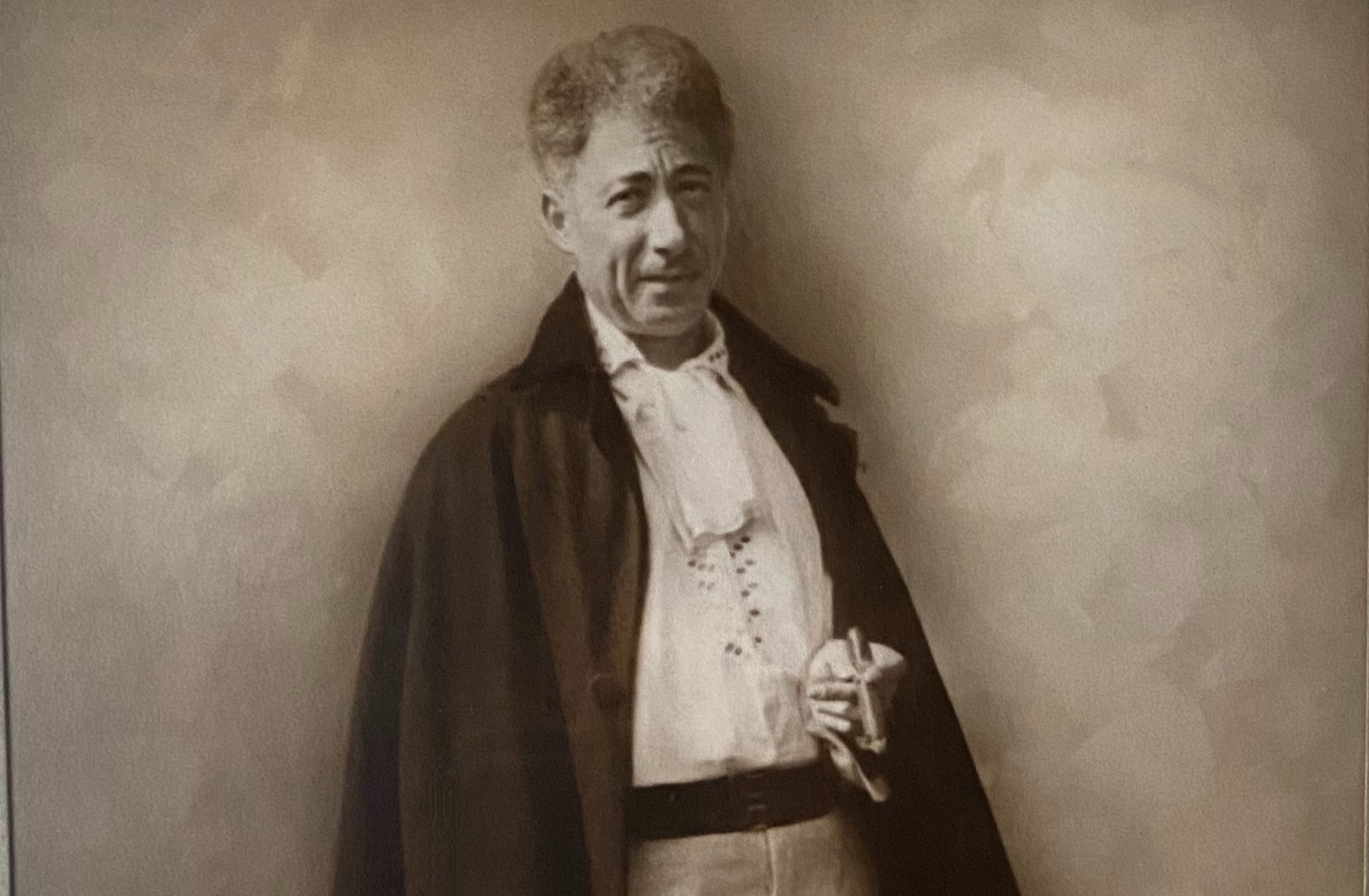
Moishe Nadir, satirist and playwright, from ‘playboy’ to revolutionary, was one of the most popular and influential voices of the already rich Yiddish-language Communist press of the 1930s
‘Moishe Nadir: Poet and Revolutionist’ by Isidor Schneider from New Masses. Vol. 14 No. 11. March 12, 1935.
MOISHE NADIR, whom thousands of workers will gather to honor, and to most of whom his tall figure and strong, ruddy face is already familiar, can serve as a type of the proletarian poet. He was born in Galicia, eminently a peasant land. Even the Jews in its small towns were rustics and occupied a peculiarly exploited position in Jewry.
As a matter of fact, Moishe Nadir won a position first as a humorist, partly because he wrote in the Galician dialect, the very sound of which, like Negro dialect in the days of the minstrel shows, provoked laughter. His father was a tutor in the old country, an occupation which, when he migrated to America, reduced him to the lowest ranks of the proletariat. Moishe was fourteen when he came to this country. At eighteen he sailed back to Europe, knocking about in Belgium, Switzerland, Austria and Germany for four years as an itinerant photographer. On his return to America he earned his living as a window-cleaner and later as an embroidery worker on reefers and children’s jackets. Sweatshops were universal in those days. The Jewish workers were as yet little organized, and Moishe Nadir, reacting against sweatshop misery, was one of the leaders in the organization of a union in his industry, the Reefers and Children’s Jacket Makers’ Union. In his organizational work, as in his writing at that time, he had little class consciousness. In the one, he reacted as an outraged human being, in the other as a satirist. He was a rebel, but his rebellion took vague forms. He was an individualist. The philosophy of anarchism ap- pealed to him, but he looked to the socialists for an organization of human society capable of fostering human freedom. His first mature writing appeared in an anarchist publication, Die Frei Arbeiter Stimme. The first political group with which he identified himself was the Voice of Labor, a socialist youth organization in which he later felt a deep disappointment–it was so prophetically full of young political careerists, some of whom are today to be found among the Old Guard of the decaying Socialist Party.
During the war years he was an anti-militarist and lost a job for his views. With the organization of The Freiheit, whose staff he joined, his political views crystallized. The test for him came with the Arab rebellion in Palestine against English imperialism, of which the Jews were the victims. Then, in the shock of that disaster which forced a re-consideration of the Zionist enterprise on all thinking Jews, the last shreds of Jewish nationalism were burned away and he felt himself completely and unalterably within the world revolutionary movement.
His literary development followed a parallel line. He began writing very early, and his first appearance was as a humorist. He told the bitter truths of his personal experiences and these self-revelations were so mordantly expressed, with such eccentric honesty, that combined with the quaint Galician idiom that he used, they were catalogued as humor and gave him an almost immediate vogue. For a long time his expression was individual. His influences, unlike those of the earlier Yiddish poets, were German rather than Russian and Polish, and he considered himself and was considered a man apart. He did not belong to any of the constantly separating, shifting and recombining literary cliques of which the Yiddish bohemia was and is today full. He was, until he became a proletarian writer, an arch-individualist, honored as a poet, respected as an essayist-dramatist and feared as a critic. There was a time, when he was doing drama reviews, when he had to disguise himself to get into the theatres, the doormen having been instructed to keep him out. At one time he got into Thomashefsky’s Theatre by going through the stage door disguised as the “star.” He tried all literary forms and won a commanding position in each.
The transition from individualist verse to proletarian writing was severe, as it is for every writer who makes the turn, but it brought him, as it has brought others, to a new literary flowering. His fertility, to an American poet accustomed to a small output, is amazing. This is due, in part, to the special situation in which the Jewish proletarian writer finds himself. The world of Yiddish literature is still large enough for a writer to flourish in, but it is compact enough to keep the writer in touch with his audience. There is not the separation by distance, machinery, and a complicated publishing apparatus, which is one of the tragedies of the writer elsewhere. Where the average American poet is content with a sale of two hundred and fifty copies of his book, and no contact with an audience except a few scented letters brimming over with gush, the Yiddish poet can expect a sale of several thousand. He is recognized in the street and the cafes; he is asked to read at workers’ meetings. Indeed, few of the Yiddish workers’ meetings are carried on without a reading of proletarian poetry.
This situation, to the envy of any American poet acquainted with it, is characteristic of the revolutionary movement everywhere. In America, even for the poet writing in English, it is providing a new audience as well as a new subject matter. Those who wish to know how the revolutionary movement honors its cultural leaders will have a good object lesson in the celebration at St. Nicholas Arena on Saturday night, March 9.
LYNCH FRUIT
(Poets, get your fiddles tuned)
On the tree blooms the rope blossom.
(Johann, one of your Vienna waltzes!)
On the noose gleam dark necks.
Strained eyeballs cry alarm.
The plowshare stalks an earthquake.
With the ropes dance the dead.
The stake shakes its red comb
And crows over the grain of death.
SPARK AND TEAR
Scorn is clean, is dry
‘Tis the powder in my horn
But the moistly brooding “I”
Menaces my scorn!
Will self-pity drench it
Or will hate’s spark blast self-pity?
Here drops my tear,
Far from my powder splashes.
Let not shrug or twitch direct it.
Dry must stay my powder!-
This my necessary art,
To keep spark and tear apart.
WORLD
“The Night Has a Thousand Eyes”
I have only two eyes.
In a thousand I am blind.
With friend Heraclitus, blind as I
I watch the eternal flux.
I have only two ears.
In a thousand I am deaf,
though every grain of dust
symphonically sings.
Two tired legs have I,
On a thousand I sought fortune.
Ten times I’ve circled earth
and ten times, bare, returned.
In the translations above I have been able to do no more than paraphrase the thought, to transpose Nadir’s vigorous and original images into some relative English equivalents. I have made no attempt to reproduce the rhythm and the verse arrangements and inevitably some of the nuances are lost.
The New Masses was the continuation of Workers Monthly which began publishing in 1924 as a merger of the ‘Liberator’, the Trade Union Educational League magazine ‘Labor Herald’, and Friends of Soviet Russia’s monthly ‘Soviet Russia Pictorial’ as an explicitly Communist Party publication, but drawing in a wide range of contributors and sympathizers. In 1927 Workers Monthly ceased and The New Masses began. A major left cultural magazine of the late 1920s and early 1940s, the early editors of The New Masses included Hugo Gellert, John F. Sloan, Max Eastman, Mike Gold, and Joseph Freeman. Writers included William Carlos Williams, Theodore Dreiser, John Dos Passos, Upton Sinclair, Richard Wright, Ralph Ellison, Dorothy Parker, Dorothy Day, John Breecher, Langston Hughes, Eugene O’Neill, Rex Stout and Ernest Hemingway. Artists included Hugo Gellert, Stuart Davis, Boardman Robinson, Wanda Gag, William Gropper and Otto Soglow. Over time, the New Masses became narrower politically and the articles more commentary than comment. However, particularly in it first years, New Masses was the epitome of the era’s finest revolutionary cultural and artistic traditions.
PDF of full issue: https://www.marxists.org/history/usa/pubs/new-masses/1935/v14n11-mar-12-1935-NM.pdf
 Revolution's Newsstand