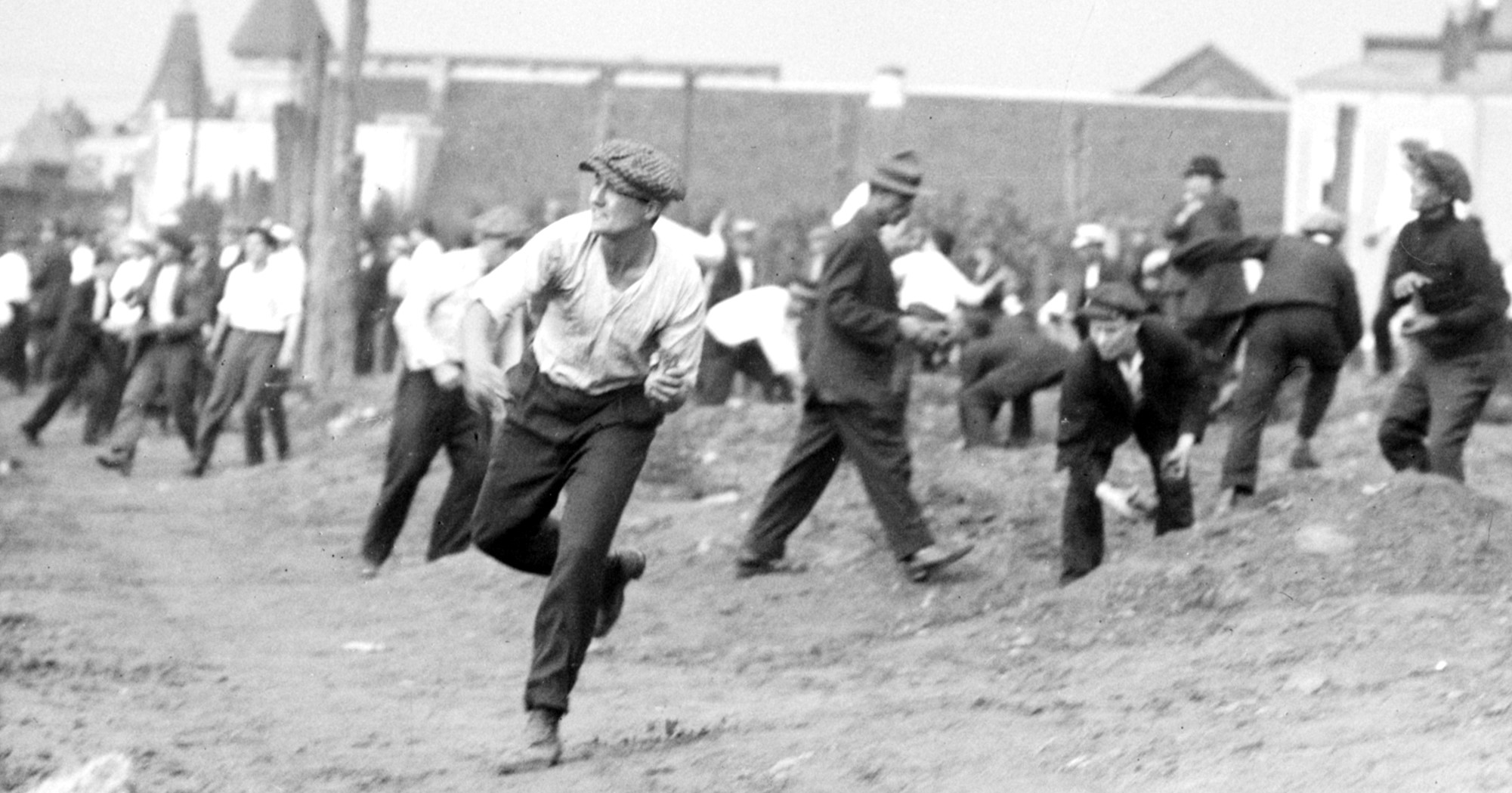
The dramatic story of the war-time uprising of workers against John D. Rockefeller’s Standard Oil in Bayonne, New Jersey.
‘The Rebellion of the Oil Slaves’ by N. Honig from Daily Worker. Vol. 5 No. 301. December 20, 1928.
Strikers Sniped at From Roofs; Rout Rockefeller Thugs; Win Control of Bayonne
Gold buttons, even when set with an array of microscopic diamonds, cannot dam the rising tide of discontent of the Bayonne oil workers. Some of the slaves of Rockefeller rose in rebellion this year. Without leadership, betrayal was their lot. But they will rise again. Fire smoulders in the eyes of the old timers at the Standard plants, and even in the eyes of the younger workers when they talk over their grievances. For they remember 1915, the red-letter year in the lives of the slaves of Rockefeller.
In that year, these exploited workers rose up, and rising, made the bosses thruout the United States, glutted with war time super-profits, tremble. For several days during that famous strike, the city of Bayonne was in the hands of the oil strikers. The officials and business men of the city, admitting the power of the strikers, bellowed for federal troops.
Sky-High Profits.
In 1915, the profits of the bosses in every industry in the United States sky-rocketed to heights undreamed of in those days. Every plant was working a double shift, producing clothing, coal, munitions, foodstuffs, and oil for the Allied armies. The oil industry profited most of all industries, excluding the munition makers, but the wages of the oil slaves remained at the same low level, 98 cents to $3 for a 10-to-12-hour day. The speed-up doubled, tripled.
Sam Gompers, his eyes roaming around for new graft, seized on Bayonne as a fertile field. “The oil workers must be organized,” said he. “The A.F. of L. will begin an intensive campaign.”
The first shot in the Gompers “campaign” was a conference with the officials of the Standard, the Tidewater, and the Gulf Refining Companies. The second shot was from the oil bosses–a bribe to Sam. Exactly how much the Standard Oil parted with to keep the A.F. of L. out of Constable Hook is not known. But the A.F. of L. “organization” of the oil workers never took place.
The Slaves Strike.
The oil workers waited patiently for the A.F. of L. to organize them. Meanwhile the speed-up grew greater. The Standard Oil efficiency experts devised new back-breaking methods every day.
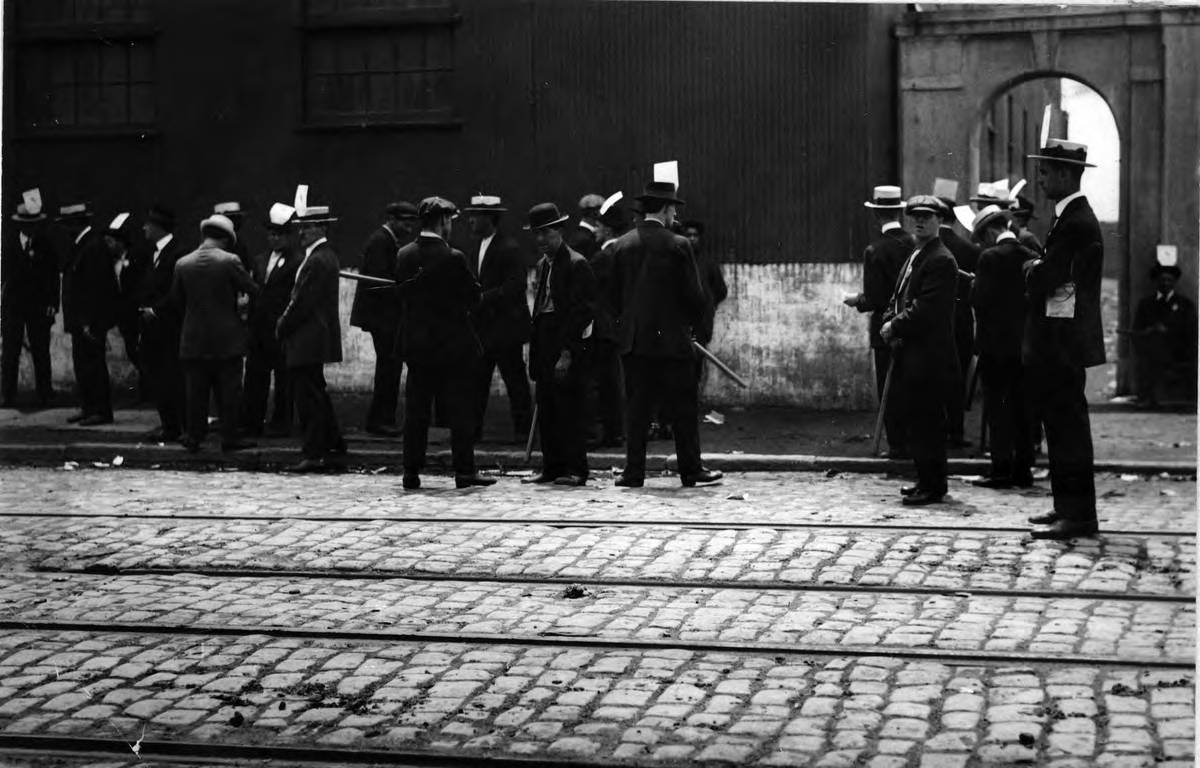
Sheriff deputies armed with sticks stand in front of the Tidewater Oil Company’s gates
Finally, the oil slaves decided to wait for the A.F. of L. no longer. On Tuesday, July 20, 1915, the Standard Oil bosses were astounded when 300 men downed tools, demanding a 15 per cent increase. By the next day, the ranks of the strikers had swelled to over 1,000. Then 1,000 coopers walked out. On Wednesday, the Standard Oil Company plant in Bayonne, working under contract for the Allied powers, was completely shut down. One of the main cogs in the Allies’ war machine had slipped. The Standard Oil was forced to pump in oil from its Philadelphia works, but this was not sufficient. The Standard appealed to the United States government, claiming an emergency. “We received no warning,” the bosses whined.
Rockefeller’s Thugs.
The strikers were 90 per cent Polish, Russian or Hungarian. They were entirely unorganized. Thanks to the Gompers treachery, not a sign of a union existed among the 18,000 Bayonne oil workers.
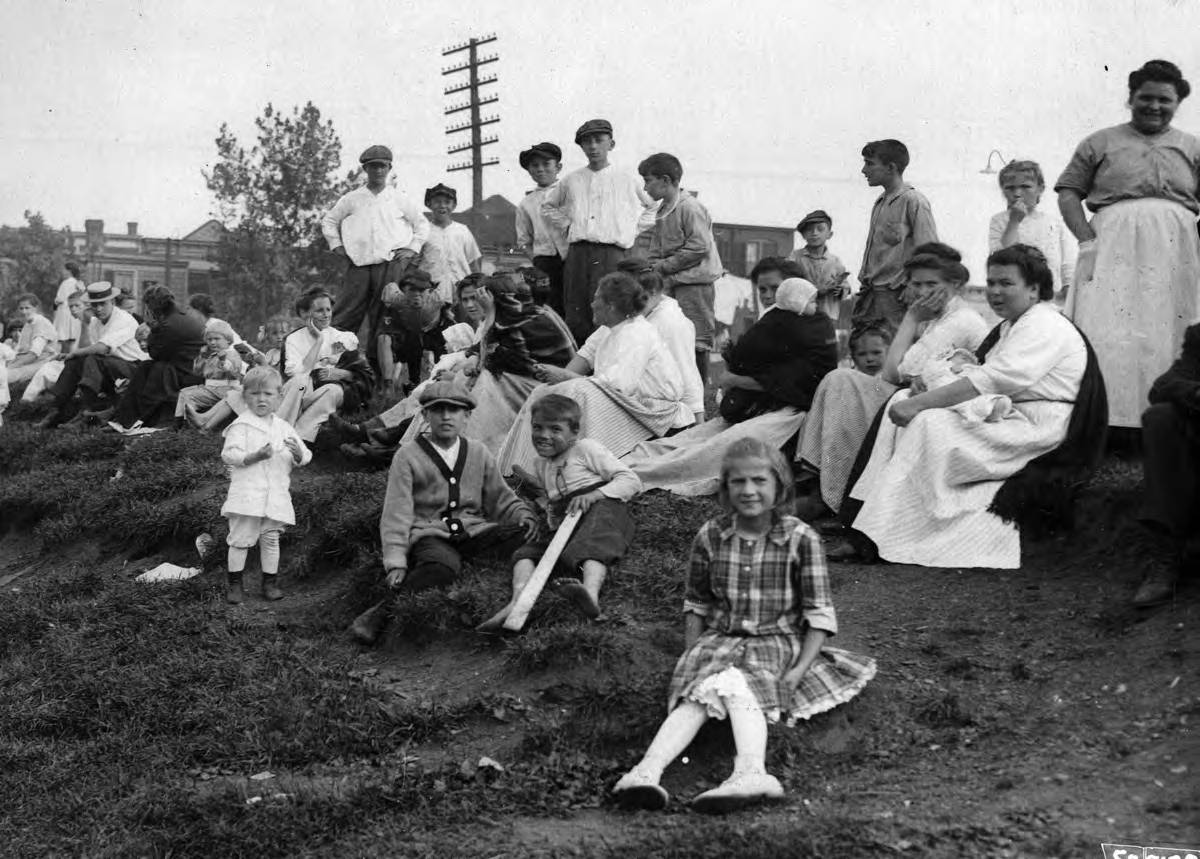
Picketing began immediately–real mass picketing, with wives, daughters and school children on the lines.
The Standard imported scabs from out of town. The pickets made it hot for the scabs. The Standard, which had persistently denied that it controlled any other oil company, then gave indisputable and final proof once and for all that it controlled every other oil firm in Bayonne–the Tidewater, Gulf, Bergenport, Vacuum, etc. For the scabs were brought in thru the yards of these companies.
The 2,000 workers of the Tidewater immediately struck when they saw the scabs being passed thru the yards in which they worked. The oil bosses then brought in an army of gunmen from New York, Buffalo, and other gang centers, and armed the thugs to the teeth. The thugs and police were posted on the rooftops of the workers’ houses on E. 22nd St., the center of the picketing.
Slaughter of Pickets.
The picketing was peaceful until the second day of the strike, when. the army of thugs and company guards suddenly sallied out of the company stockades, charged into the defenseless crowd of men, women and children, and killed two workers and a little boy. Bricks, cobblestones, anything, were picked up by the infuriated workers, who drove the thugs back into the stockades.
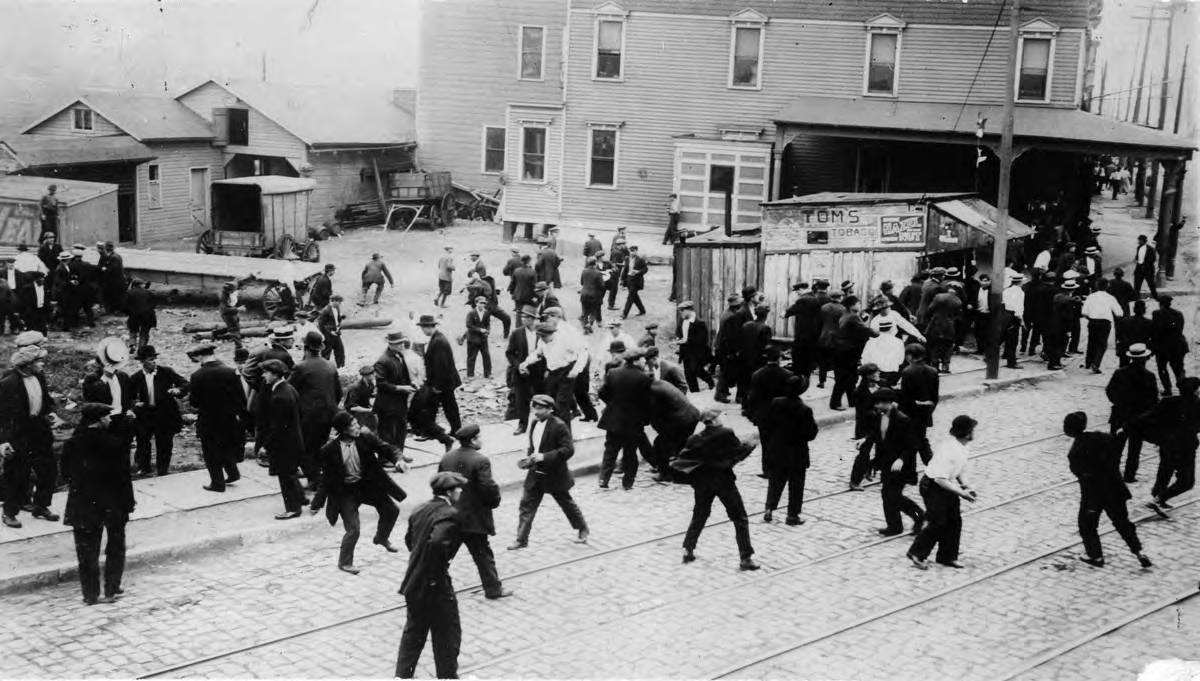
That night, Constable Hook seethed. The strikers’ ranks were swelled by thousands of workers from Bayonne and neighboring industrial cities in Jersey. Police and thugs sniped from the housetops, picking off a worker here and there. Chalked on the sidewalks thruout the city were the signs, “Our brothers have been killed by the bosses and the police. Do your work now.”
Strikers Rule City.
A headline in the arch-reactionary New York Times on Thursday, July 22, spoke volumes. “Bayonne in hands of oil strikers.”
It was now a life and death fight for the oil workers, and they realized that they must arm to protect themselves and their families from the merciless thugs and police of Rockefeller; the same Rockefeller thugs who had proved their disdain for workers’ lives a year before in the Ludlow, Colorado, coal mines. Over 1,000 workers at the Vacuum refineries joined the men of the Standard and the Tidewater.
Another fight was precipitated by the oil bosses the next day, when the city firemen turned their hoses on the pickets, following which the company thugs on the housetops killed 2 more workers and a little boy, and wounded a score. The strikers tore up the embankment around the stockades of the Standard Oil, and charged the guards, but police brought in from neighboring cities drove them back. State troops came and martial law existed.
In order to discredit the strikers, fires were set by the company guards in some of the oil sheds, and “outside agitators acting as German spies” were declared by the companies and the police to be leading the strike.
Victory.
But the Standard was weakening. When the 750 workers at the Bergenport and General Chemical Works, a Standard subsidiary, demanded a 15 per cent increase, they got it. The 1,000 Vacuum oil workers were granted their 15 per cent increase by the Rockefellers, but decided to stay out until the Standard and Tidewaters workers got their increase. The strike spread to the 1,500 workers in the Eagle Oil Co., another Rockefeller concern, in Caven Point, Jersey City. Troops surrounded the Standard Oil plants in Long Island City, when the workers there indicated their intention to strike, and delegates from the Bayonne strikers were imprisoned. But the Rockefellers knew they were beaten, and granted a 10 per cent increase on Tuesday, July 27, a little over a week after one of the greatest American labor struggles had begun.
On that day, John E. Roach, general organizer of the A.F. of L., a bosom friend of Gompers, said to the sheriff, “I want to thank you for your fair behavior during the strike. We have every confidence in the Standard Oil Co.” He then announced that “a campaign will be waged by the A.F. of L. to organize the oil workers of Bayonne.” It never was, needless to say.
The 1915 oil strike was a splendid example of several things. It illustrated what a determined solidarity could accomplish for the workers, even against a power as strong as that of the Rockefellers. It brought into the spotlight the treachery of the reactionary Gompers machine. The aftermath of the strike, the gradual stripping of all the advantages won by the workers in the strike, illustrated the effects of lack of organization into a militant union.
The Daily Worker began in 1924 and was published in New York City by the Communist Party US and its predecessor organizations. Among the most long-lasting and important left publications in US history, it had a circulation of 35,000 at its peak. The Daily Worker came from The Ohio Socialist, published by the Left Wing-dominated Socialist Party of Ohio in Cleveland from 1917 to November 1919, when it became became The Toiler, paper of the Communist Labor Party. In December 1921 the above-ground Workers Party of America merged the Toiler with the paper Workers Council to found The Worker, which became The Daily Worker beginning January 13, 1924.
PDF of full issue: https://www.marxists.org/history/usa/pubs/dailyworker/1928/1928-ny/v05-n301-NY-dec-20-1928-DW-LOC.pdf
 Revolution's Newsstand