The eminent Russian botanist on the relationship of Darwin and Marx.
‘Charles Darwin and Karl Marx’ by Kliment Timiryazev from Karl Marx: Man, Thinker, and Revolutionist; a Symposium edited by David Riazanov, Translations by Eden and Paul Cedar. International Publishers, New York. 1927.
The year 1919 is not only the “diamond jubilee’’ year of the publication of Darwin’s Origin of Species. It is even more important to remember that Marx’s A Contribution to the Critique of Political Economy also first saw the light in 1859, sixty years ago.1 This is not a fortuitous coincidence. Although the Origin of Species and the Critique of Political Economy are concerned with such widely differing spheres of human thought, we can detect in the two books certain common characteristics which justify us in comparing them, though only in a brief sketch. The last page of Darwin’s book, and the remarkable and brilliant fifth page of the preface to Marx’s,2 contain amazingly clear and concise summaries of the respective authors’ fundamental ideas. Now, just as Darwin’s fundamental idea, as expounded in the Origin of Species , was the crown of the previous twenty-five years and more of the great biologist’s activities, so Marx’s fundamental idea, as expounded in the preface to the Critique, was for the great sociologist “a guiding thread” (I use his own expression) for a quarter of a century thereafter, and until he was snatched away by death while his mental powers were still unimpaired. I propose, therefore, to consider the parallelism between these two works, which have left so deep a trace in the history of the latter part of the nineteenth century and the beginning of the twentieth century — and will, of course, continue to leave their trace in ages yet to come.
It was said of Darwin that he was “the greatest revolutionist in modern science, and, indeed, in the science of all ages”; that “from his peaceful workroom at Down he guided the thoughts of all reflective persons into a movement which is almost unexampled in the history of the world.” Compare with this the other revolutionary movement, the one that started from Marx’s little room in Dean Street, Soho, the movement that has modified people’s “existence” as well as their “consciousness” — this, too. has been a movement without parallel in history.
In what consists the general similarity of trend of these two revolutionary movements, both initiated in the year 1859? In this, that both of them, each dealing with a vast assemblage of phenomena (in one case the phenomena of organic life, and in the other the phenomena of the social life of mankind) which theology and metaphysics have hitherto claimed as their own, withdraw these phenomena from theological and metaphysical jurisdiction, and explain them as the outcome of “material changes…which can be watched and recorded with all the precision proper to natural science” (quoted from the preface to the Critique of Political Economy).
Darwin, doubting the validity of the biblical explanation of the origin of the forms of organic life, and disregarding the requirement that science must conform to the teaching of the Bible, rejected scriptural theology and metaphysics, and found the real explanation of the origin of species in the “material conditions” of their genesis. In like manner Marx, having (as he himself tells us) begun to doubt the validity of Hegel’s philosophy of law, went on to take as his “guiding thread,” for all his subsequent researches, the inference that sociological forms and relationships are not self-existent, nor yet existences determined by the activities of the human mind, but are the outcome of the material conditions of life. Both these doctrines work along the general lines of the quest for a primary explanation that shall be rooted in scientifically demonstrable material phenomena. Marx indicated this by speaking of his whole scientific trend as “economic materialism,” or the “economic interpretation of history.” The mode of production of material life forms the “real basis” upon which are erected “as a superstructure” all the “legal, political, religious, artistic or philosophical forms (in a word, the ideological forms)” of human life. But “at a certain stage of their development, the material productive forces of society come into conflict with the existing productive relationships,” and these latter, “which have previously been developmental forms of the productive forces, now become metamorphosed into fetters upon production. A period of social revolutions then begins. Concomitantly with the change in the economic foundation, the whole gigantic superstructure is more or less rapidly transformed.” I continue these quotations from Marx’s classical aphorisms down to and including his use of the word “revolution,” for the reason that the dispute about the relationship of his teaching to Darwin’s turns most often around this word.
We are told that Darwinism is a theory of evolution and that evolution is the antithesis of revolution. It is true that the word “revolution” is not to be met with in Darwin’s writings, but that was because it would have called up recent memories of Cuvier’s Discours sur les revolutions du globe. In ecology, Cuvier belonged to the “catastrophic school.” He believed that, in the course of the earth’s geological history, there had been frequent cataclysms, quick changes of scenery like those that take place in a theatre, whereby whole populations of living creatures had been destroyed and new ones brought into being. On the other hand George Howard Darwin (a noted astronomer, and the only one of Charles Darwin’s five sons to inherit a considerable share of the father’s genius) notes that there is a homological connection, and not a mere rhetorical analogy, between revolution in the domain of political phenomena and revolution in the domain of cosmic and purely mechanical phenomena.3
In their explanations of the world, both Darwin and Marx started from an objective study of the present; but whereas Darwin was chiefly concerned with throwing light on the obscure past of organic life, Marx’s main desire was to foretell the future and to disclose the “trends”4 of the present. Nay more, Marx did not merely wish to foretell the future; he wanted to act upon it. To quote his own words: “Philosophers have been busied in trying to explain the world, each after his own fashion. But the real question is, How are we to change it?”5
Here, however, a reservation is needed. We must point out that Darwin, by giving, not “his” philosophical explanation, but an explanation grounded upon the scientific study of the facts, compelled biologists to turn their attention to the process of creating new organic forms (artificial selection), which had previously been applied half consciously, but was in due course to achieve such marvellous results — as, for instance, in the hands of Luther Burbank, the modern miracle-worker, creator of new species.
Marx considers that economic factors are the essential material determinants of human history, and looks upon all the other alleged causes as “ideological superstructure.” Darwin tells us that the main factor in the evolution of organic forms has been the historical process to which he gives the figurative name of “natural selection” (according to Auguste Comte, “elimination”), this being the outcome of the law of over-population, usually termed Malthus’ law. As is well known, some (Chernyshoffsky, and especially Duhring) have blamed Darwin for this, not knowing or forgetting that Malthus only borrowed his law from the naturalists, who had already applied it to animals and plants (Linnaeus, Franklin).
Now, what is the essence of this process of natural selection? Fundamentally, it is the adaptation of organisms to the conditions of existence. Herein, as Darwin explains in the opening pages of his book, we find the key to the understanding of the organic world, the answer to its riddles. The word “adaptation” has become the slogan of modern biology. That which is adapted, becomes comprehensible to the biologist; for, studying the process of adaptation, he understands the historical genesis of what he contemplates. Haeckel, a master in the art of word-building, has given the name of “ecology” to this branch of the science of biology. But this word is derived from the same Greek root as “economy” and “economics.”6 The word is not much used in England, but has caught on in the United States where, side by side with the physiology of plants, botanists speak of vegetable ecology. But instead of coining a new word, would it not be better to retain the old one, and to explain its full significance? For my part, a few years ago I proposed to call this branch of botany “the economy of plant life.” Thus we find that there is a general agreement between Darwin and Marx as regards what they teach about the primary determinants of evolutionary processes — a likeness which extends even into the field of terminology.
But the similarity is not confined to generalities. It also concerns the products of this economic process. Marx tells us that the first stages in the development of a typically human activity, in the growth of man out of the animal, took the form of the discovery of instruments of production. He writes: “The use and fabrication of instruments of labour although existing in the germ among certain species of animals, is specifically characteristic of the human labour process, and Franklin therefore defines man as a tool-making animal.”7 Karl Kautsky, expounding Marx’s thought, makes use of a word-play which cannot be translated from the German. He says that an animal can “finden” (=find) tools in nature, but man alone can “erfinden” (= discover, elaborate) them. Ernest Rutherford, in one of his lectures, gives a very picturesque description of these first stages of the human inventive faculty. He is speaking of the special kind of tools known as weapons, and he says that their evolution is marked by the concentration of energy upon an ever more limited area. Thus the club strikes a surface of considerable extent; the axe or knife strikes a line; the spear or arrow strikes a point.
For in what can the process consist whereby living animals and plants arc adapted to the conditions of existence, if not in the elaboration of organs, i.e., tools.8
Darwin tells us that we must look upon every complicated mechanism or instinct as the sum of a long historical series of useful adaptations just as much as any of the arts is. Consequently, the basis of Darwin’s explanation of the forms of animal and vegetable life, like the basis of Marx’s explanation of the forms of human society, is — the economic conditions of existence. And the elaboration of tools was one of the first manifestations of a typically human activity. But are we to suppose that this trend of activity is peculiar to primitive man? Do not we encounter the same phenomenon at higher stages of human evolution? Francis Bacon (whom Marx and Engels regard as the herald of the outlook on the world which led in due course to the formulation of historical materialism9), Bacon, who announced the coming of the kingdom of man (this meaning the reign of science, and the victory of man over nature), wrote the following words anent the rise of experimental science, then just beginning: “Nec manus nuda nec intellects sibi permissus multum valet; instrumentis et auxiliis res perficitur.”10 Nor does this apply only to the dawn of modern science. The statement is equally valid as regards the scientific advances of the twentieth century. The celebrated physicist, Otto Wiener, in his lecture on “The Widening of the Domain of our sensory Perceptions,” points out that the most important achievements of physical science have been closely connected with the perfectionment of instruments which can only be regarded as extensions of our sense organs — as (to use J. P. Pavloff’s apt phrase) “analysers of the outer world.” Ludwig Boltzmann, finally, expressed the same thought with his usual clearness when, speaking of Kirchhoff as the discoverer of the spectroscope, he said: “Kirchhoff made our eyes into a new organ.” Thus whether we interest ourselves in the origin of organic forms as a whole or in the origin of human society, at bottom we are concerned with economic processes, with processes of production. In one case it may be the production of organic matter by a plant; in the other it may be the crown of all human activity, the production of knowledge, of science. In either event, our first concern must be to study the origin of the organs or instruments (tools) whereby this production is carried on.
Such is the analogy between historical materialism and Darwinism in the departments where the objects under study are very different, being man, on the one hand, and the animal and vegetable world, on the other. But there is one department of Darwinism in which the topic of study is the same as that studied by historical materialism. Darwin’s Descent of Man was published twelve years after the appearance of the Origin of Species and Marx’s Critique. In this new work, the author did not limit his attention to the biological side of the question. In so far as was necessary for the proof of his thesis that man was descended from lower animal types, Darwin entered into sociological discussions. In two remarkable chapters he showed that man’s intellectual and moral superiority over other animals (the ideological superstructure, as Marx would phrase it) took its rise out of two material peculiarities: first, the greater development of the higher parts of the nervous system, of the brain, and the consequent improvement in the intellectual powers; and, secondly, the greater development of the “social instinct” which was already present in the higher animals. Thus for Darwin, as for Marx, the development of the social instinct, the growth of sociality, is the starting-point of the natural-historical process by which the intellectual and moral characteristics of mankind are evolved. With good reason, many British and German writers look upon Darwin as the founder of the new realistic school of ethics. To expound the parallelism between Darwinism and Marxism in this respect: would, however, require more space than can be allotted here,11 and would take us away from the year 1859, with which we are at the moment chiefly concerned.
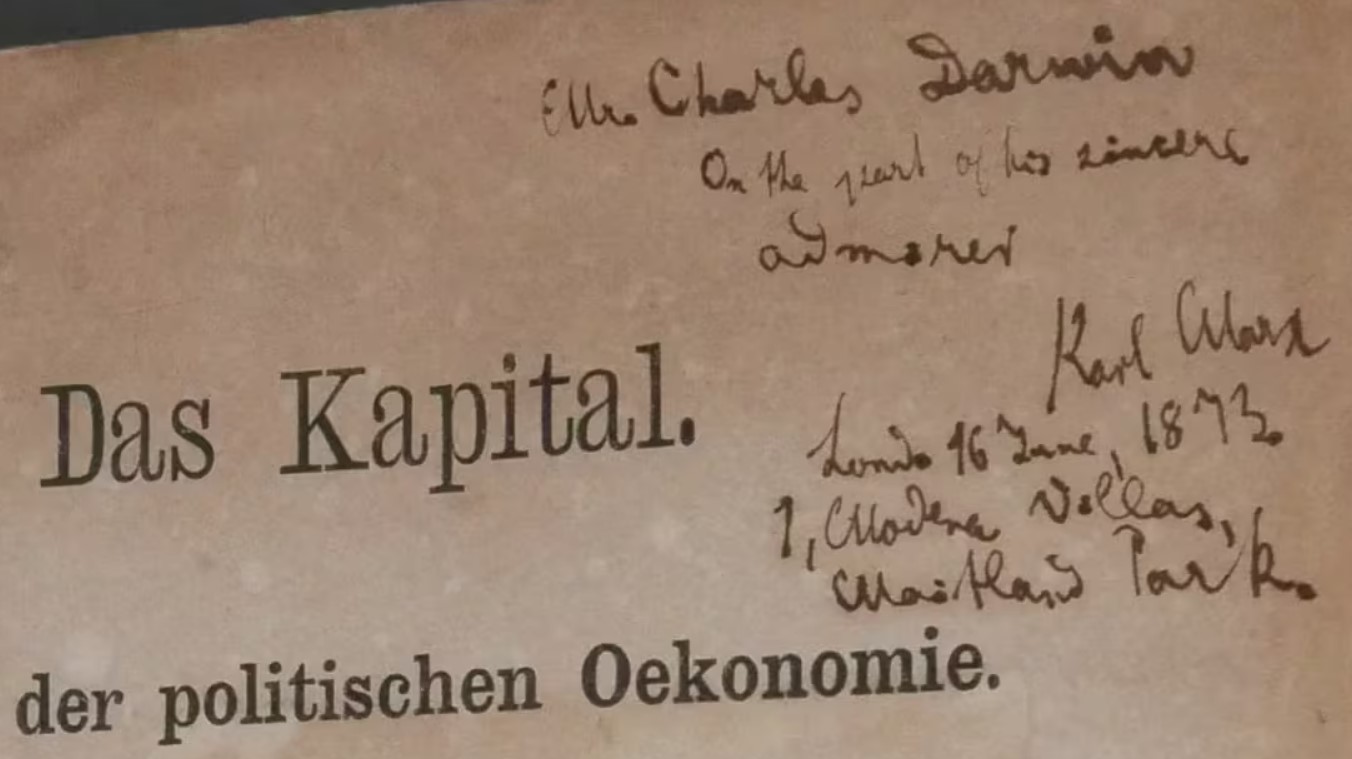
Such are the main lines of agreement in the fundamental notions set forth in these two great works, which were published almost simultaneously, so that neither can have exercised a direct influence upon the other. But one question remains to be considered. Here were two supremely great men, living quite near one another — not more than an hour’s journey. Did they ever come into direct touch with one another? Upon this matter we can appeal to the testimony of Marx’s son-in-law, Aveling. The latter tells us that Marx, an indefatigable and omnivorous reader, had made a careful study of all Darwin’s writings; that when the second edition of the first volume of Capital was published in 1873, Marx sent a copy to Darwin; and that Darwin acknowledged the receipt of the book in the following letter: October 1st, 1873.
Dear Sir, — I thank you for the honour which you have done me by sending me your great work on Capital; and I heartily wish that I were more worthy to receive it, by understanding more of the deep and important subject of political economy. Though our studies have been so different, I believe that we both earnestly desire the extension of knowledge; and this, in the long run, is sure to add to the happiness of mankind.
I remain, dear Sir,
Yours faithfully,
CHARLES DARWIN.
I shall conclude this brief sketch by repeating, for the sake of emphasis, what I wrote at the outset. When we commemorate the “diamond jubilee” of the publication of these two books, when we think of it as a joint commemoration of Marx and Darwin, we do so recognising that the two men marched side by side under the banner of natural science. Both of them regarded natural science as the one solid foundation of their revolutionary views — views that were destined to shake up both the “consciousness” and the “existence” of all mankind very thoroughly indeed! Is it not plain that the way to the overthrow of the outworn culture of the bourgeoisie, the way to the upbuilding of the proletarian culture of to-morrow, is the way of science, of natural science which has discarded the mystical and metaphysical formulas of the past? Auguste Comte proclaimed this as long ago as 1831, when he declared that of all the classes the proletariat was the one most ready to understand and to accept the mental revolution that positive philosophy, the philosophy of science, brings in its train.
NOTES
1. To my shame I must admit that it was not until after 1909 that I first became acquainted with the contents of Marx’s preface to the Critique of Political Economy, through reading an article by V.I. Ilyin (Lenin) in Vol. XVIII. of the Brothers Granat’s Encyclopedia. But I can console myself by remembering that I must have been one of the very first persons in Russia to read Capital. This was very long ago, before Vladimir Ilich was born, and when Plehanoft (whom many Russian Marxists regard as Lenin’s teacher), was only ten years old. In the autumn of 1867 I removed from Simcrirsk (where I had been engaged in chemical researches on the lines laid down by Mendeleyefi) to join P.A. Dyenkoff in the newly opened Petrovsk Academy. I found Hyenkoff sitting at his writing table in his library. In front of him was a new book, a thick volume in German with the paper-knife still amid its pages. It was the first volume of Capital; and at this date, in the dose of the year 1867, very few more copies than this could as yet have found their way into Russia. Then and there, Hyenkoff, rapturously and with characteristic ability, gave me a whole lecture on as much of the book as he had already been able to read. He had seen Marx at work, for he had spent the year 1848 in western Europe (chiefly in Paris); also he had personal knowledge of the doings of the sugar refiners who were among the pioneers of Russian capitalism, and was thus able to illustrate Marx’s doctrines by examples drawn from his own experience. In this way it came to pass that the professor of chemistry in the recently opened Petrovsk Academy was one of the first persons to diffuse Marxist ideas in Russia.
2. Pages 11-13 of N. I. Stone’s translation of the Critique; the passage quoted by Lenin on pp. 122-124 of the present volume.
3. Cf. an article of my own, “Cambridge and Darwin.” Let me add that, when developing this idea that the phenomena of revolution are subject to the reign of law (a notion likely to be distasteful to a bourgeois audience), Sir George Darwin was careful to make the fallowing reservation: “One who, when expressing an opinion upon evolution, invokes the name of Darwin, must do so with a full sense of the responsibility that devolves on him.”
4. Eduard Bernstein vainly rails at Marx for using this expression.
5. This was written by Marx in 1845, but was not published till after his death. It will be found in the appendix to Engels’ book on Ludwig Feuerbach. The German original runs: “Die Philosophen haben dit T Welt verschieden interpretiert, es kommt aber darauf an sie zu ver’indern.”
6. The root of the first half of both words is “oikos,” which means “house,” “habitation.” Derivatively, “economy” means “the management of the household,” and “ecology,” means “the science of habitat, or of environing conditions.”
7. Quoted from Moore and Aveling’s translation of Capital, Vol. I., 1896, p. 159.
8. Cf. the note to p. 367 of Moore and Aveling’s translation of Capital, Vol. I., where Marx writes: “Darwin has interested us in the history of nature’s technology, i.e., in the formation of the organs of plants and animals, which organs serve as instruments of production for sustaining life.”
9. Cf. Die heilige Familie, pp. 201-203.
10. “Neither the bare hand nor the unaided intelligence can achieve much; by tools and by helping-means, a thing is carried through.”
11. It would also be interesting to discuss the relationship of both Marxism and Darwinism to John Stuart Mill’s Utilitarianism, which was published in 1864.
Karl Marx: Man, Thinker, and Revolutionist; a Symposium edited by David Riazanov, Translations by Eden and Paul Cedar. International Publishers, New York. 1927.
Contents: Introduction by D. Ryazanoff, Karl Marx by Friedrich Engels, Engels’s Letter to Sorge concerning the Death of Marx, Speech by Engels at Marx’s Funeral, Karl Marx by Eleanor Marx, The June Days by Karl Marx, The Revolution of 1848 and the Proletariat A Speech by Karl Marx, Karl Marx by G. Plehanoff, Karl Marx and Metaphor by Franz Mehring, Stagnation and Progress of Marxism by Rosa Luxemburg, Marxism by Nikolai Lenin, Darwin and Marx by K. Timiryazeff, Personal Recollections of Karl Marx by Paul Lafargue, A Worker’s Memories of Karl Marx by Friedrich Lessner, Marx and the Children by Wilhelm Liebknecht, Sunday Outings on the Heath by Wilhelm Liebknecht, Hyndman on Marx by Nikolai Lenin, Karl Marx’s “Confessions” by D. Ryazanoff.
PDF of book: https://archive.org/download/in.ernet.dli.2015.54746/2015.54746.Karl-Marx-Man-Thinker-And-Revolutionist_text.pdf
 Revolution's Newsstand