
Martin Craig reviews a showing of fellow sculptor, the Lithuanian-born Jacques Lipschitz.
‘Jacques Lipchitz’ by Martin Craig from Art Front. Vol. 2 No. 2. January, 1936.
THERE is an exhibition running now at the Brummer Gallery, a one-man show by a European sculptor, Lipchitz. It ought to be seen. It ought to be seen by everyone who still has the old-fashioned idea that art can be realistic in the sense of bearing an obvious resemblance to nature, and yet be alive, and vital, and thrilling today. These people should go to see this show and try to be honest with themselves for fifteen minutes. And if this is not enough of an experience to make them a bit doubtful of their views, let them try stepping directly into another gallery, one which is showing the average run-of-gallery stuff that we see these days. And if they are still satisfied with a smug little Eighteenth Century hang-over, they’re practically hopeless.
Getting back to Lipchitz, however, one feels the terrific impact of his powerful forms immediately on entering the gallery. The forms are strange–really like nothing else on earth. They seem to be in the process of a tremendous expansion, swelling up the space of the room and crowding one. Most of his things seem at first unaccountably weird and inhuman. But all are deeply moving.
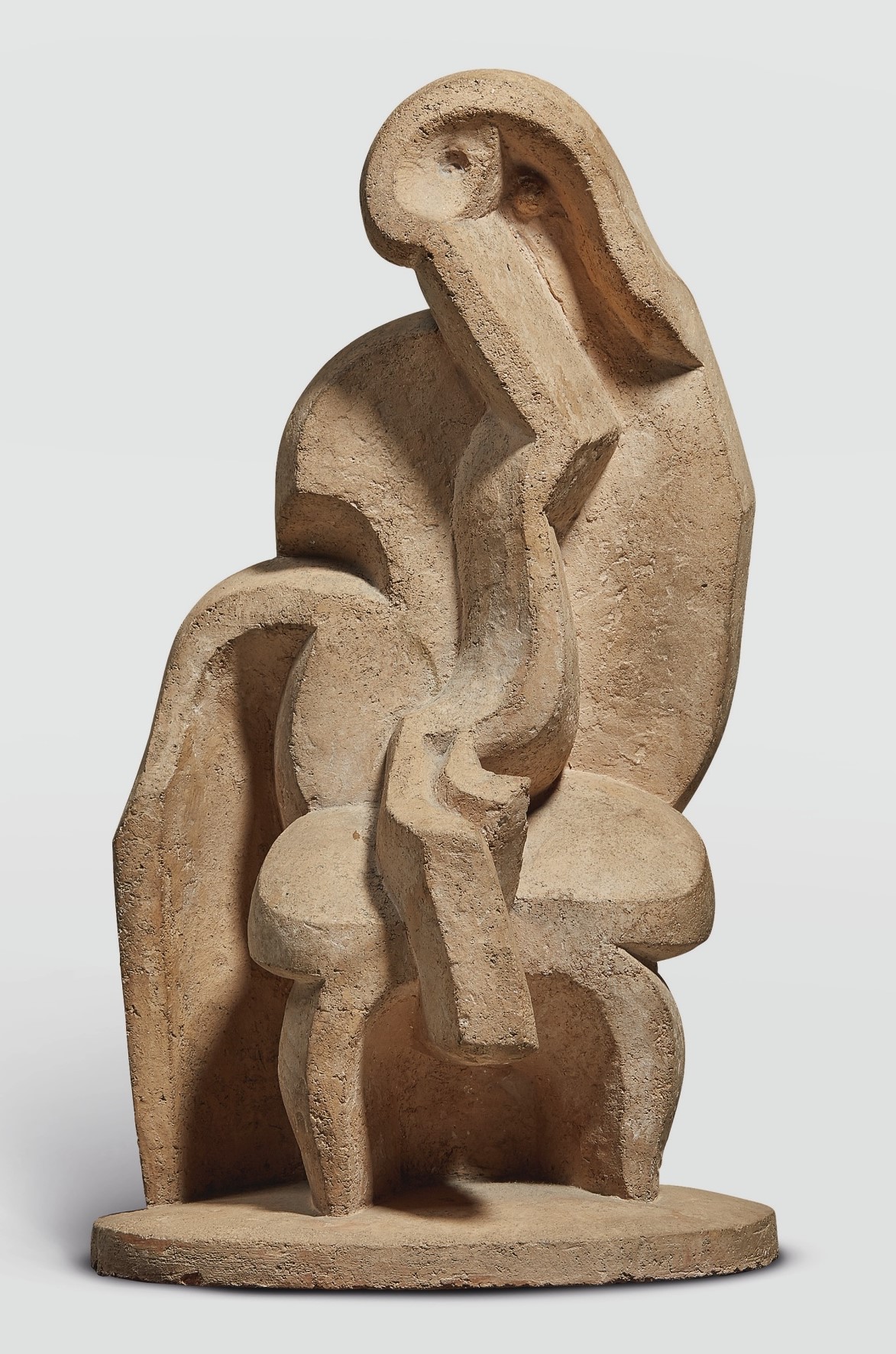
Historically, Lipchitz started out in the purest cubist tradition. His early works are examples of the same forms and the same general method in the arrangement of planes and flattened forms that we find in the paintings of Picasso, Braque and the rest, except that they were done in three dimensions. Yet the result is more than a cubist painting in three dimensions. His consciousness of the relation of forms in space is apparent even here.
In some of his other things of the same period there is a distinctly different attitude at work. Here the aim is a pure architecture, almost Gothic in inspiration. At least two of his pieces, called “Sculpture,” are perfect examples of a sculpture completely divorced from life and natural forms.
So far his approach has been toward the creation of a static and abstract art. Now, however, he turns to the human figure for a starting point. The work of this period still does not contain the intensely human quality that is found later on, but it does give a definite indication of his future direction. Here he simply applies the cubist formula to a natural form, and the result is an abstract and architectural reconstruction of the human figure. His large “Bathers,” done in 1924, is typical.
The next definite stage becomes apparent about 1930. It is this period which seems to me to be most characteristic of Lipchitz’ potentialities, and to be the most important single contribution to modern art views in many years. At the same time that a real social consciousness begins creeping into the subject matter, hist forms begin losing their static quality in design and assuming an intense movement in space. Considering this work from a technical standpoint, the most obvious characteristic is the revolt from the manner of working in a block. The forms begin moving freely through space, encompassing a new conception of spatial design. Heretofore, the conception of sculpture, although defined as the relating of forms in space, amounted to nothing more profound than a series of well-designed views of the statue, on a purely two-dimensional basis of outlines and contours of forms, with a surface variation of light and shade. Hence there was a definite front view, the statue obviously designed to be seen that way, two subsidiary side views, if the sculptor was conscientious, and a rear view if he had a grain of a sculptural idea. Lipchitz is entirely different. There is no particular view from which to look at a work nor is there any view from which the statue becomes more important than any other. As a matter of fact, there is little design at all in this sense. His “flat” or “outline” design is comparatively poor. (To give an illustration of what is meant here by “outline” design take a photograph of the work from any view and trace the outlines of the forms onto tracing paper. The design of the resulting drawing would be the outline design.) It is my opinion that most sculpture is designed from this standpoint and that the general appreciation of design in sculpture does not go beyond this. In Lipchitz, design is essentially spatial, and is felt as a vigorous movement of the forms through space. Of prime importance also through space. Of prime importance also is the fact that the spaces between the forms become important and functional in this design, and are felt as real forms. The holes become equivalent to forms or masses, which play a positive part in functioning equally with the real forms in the design. Here, I feel, is his greatest contribution from the standpoint of sculptural technique.

Important as this is, however, I find that, from a general esthetic consideration, his achievement is even more profound and revolutionary. Essentially he has become a Surrealist, but here again he has taken a vital step forward. The Surrealist movement has been primarily a literary one. Generally the poetic content remains distinct from the plastic, and is of primary importance. Except for a few rare instances, such work is non-plastic, or at best the plastic values are subordinated and even irrelevant to the literary idea with its associations, reminiscent qualities, nostalgias, etc. But Lipchitz’ Surrealism is primarily plastic; the plastic element is not an addition attic; to the poetic idea, but is this poetry itself. to the poetic idea, but is this poetry itself.
The emotions characteristic of a Surrealist work are here directly evoked by the forms themselves, as such, and the idea and its associations become subordinate, but not irrelevant.
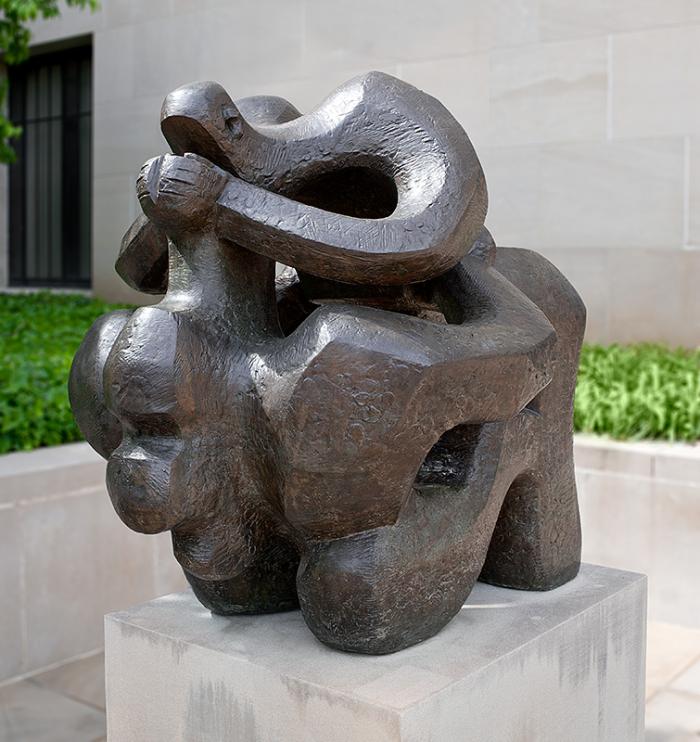
Considering how he has gradually changed from the sculptor working in the remote and rarefied atmosphere of cubism and architecture, to one incorporating a powerful human feeling in his work, it is significant to note the growth of a social consciousness in his material. Pieces such as the “Return of the Prodigal Son” and the “Struggle of Jacob with the Angel” are definitely of social content, though this content is quite directionless. However, in one of the latest pieces included in the exhibition called “Toward a World,” he seems to have arrived at a definite social direction. It seems to me quite understandable that a man of Lipchitz’ obviously deep human qualities would soon realize the sterility inherent in the too “pure” aims of his early abstractions, where the function of art as a human activity becomes purified out of existence; and, realizing this, would logically pass on through the intermediate stages of interest in the human figure, then in the individual as a human being, the emotional relations between individuals, and eventually wind up with considerations of a social order.
If there is to be a vital revolutionary art in the future, then here, I feel, is the road it will take. Certainly it is the one most truly evolved from the civilization and social scheme of our own time, and one of the most effective in arousing our meet profound emotions.
Art Front was published by the Artists Union in New York between November 1934 and December 1937. Its roots were with the Artists Committee of Action formed to defend Diego Rivera’s Man at the Crossroads mural soon to be destroyed by Nelson Rockefeller. Herman Baron, director of the American Contemporary Art gallery, was managing editor in collaboration with the Artists Union in a project largely politically aligned with the Communist Party USA.. An editorial committee of sixteen with eight from each group serving. Those from the Artists Committee of Action were Hugo Gellert, Stuart Davis, Zoltan Hecht, Lionel S. Reiss, Hilda Abel, Harold Baumbach, Abraham Harriton, Rosa Pringle and Jennings Tofel, while those from the Artists Union were Boris Gorelick, Katherine Gridley, Ethel Olenikov, Robert Jonas, Kruckman, Michael Loew, C. Mactarian and Max Spivak.
PDF of full issue: https://www.marxists.org/history/usa/parties/cpusa/art-front/v2n02-jan-1936-Art-Front.pdf
 Revolution's Newsstand