
Like all ‘natural’ disasters, the 1936 Pittsburgh flood that cost dozens of lives and left thousands of homeless, had social causes and consequences.
‘Pittsburgh’s Flood: No Act of God’ by Bruce Minton from New Masses. Vol. 19 No. 1. March 31, 1936.
EACH year at spring the water rises in the Allegheny and Monongahela rivers. Each year the basements in the workers’ district on Pittsburgh’s Northside fill with water and the living quarters are damp and disease menaces the people. Flood is an annual affair: the average is more than one a year.
Three weeks ago the ice began to breakwater did not rush in. It looked very much as though there’d be a flood, worse than usual, as destructive as the catastrophe of 1907 when the water rose to over 38 feet. But the ice went through without mishap and everyone said that the danger had passed. Then came a heavy thaw and rain. The saturated ground in the watersheds could not absorb the water. It poured off the ground as it would off glass.
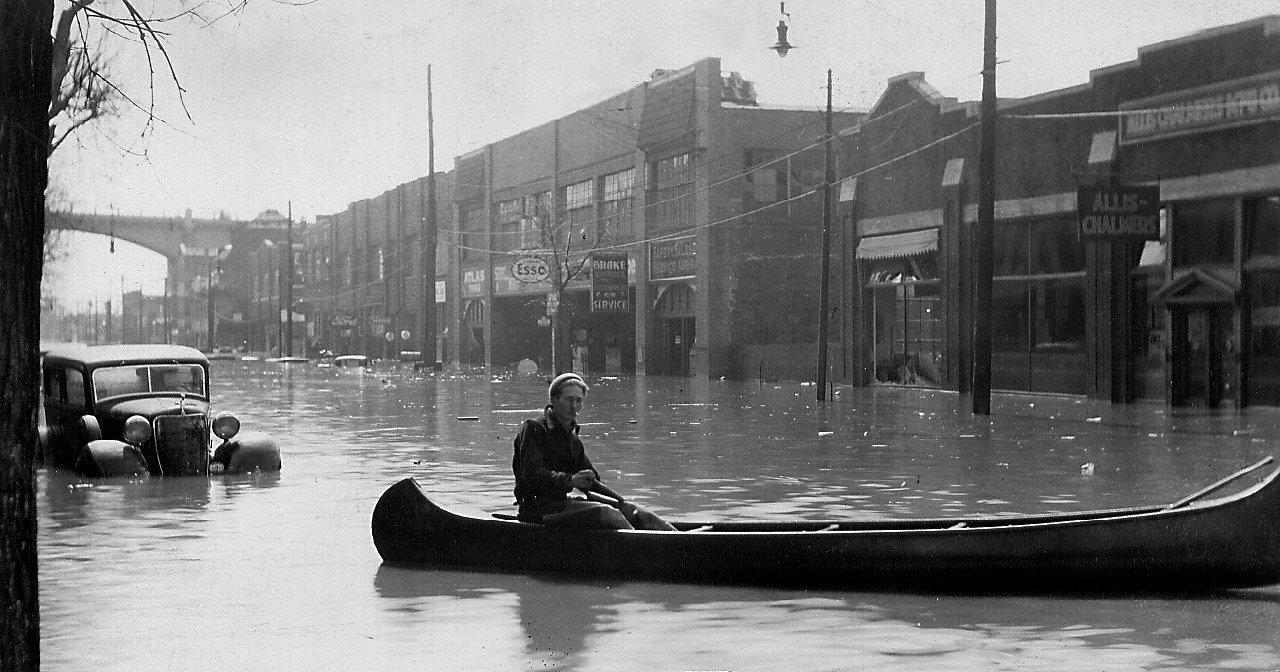
On Tuesday evening, March 17, at six o’clock no one in Pittsburgh thought of flood. Two hours later the rivers were swollen. Warnings came over the radio. By Wednesday morning people feared the flood would approach the 1907 disaster in proportions. By noon it had passed the former high mark. The waters rose to 46 feet, inundating the “Golden Triangle,” the city’s business district bounded by the two rivers where they join to form the Ohio. In the working-class district the water filled the first floor and seeped into the second.
Untold damage. Untold suffering. Fifty-six dead. Thirty-five hundred injured. Twelve thousand families homeless. An Act of God. But the extent of the flood could have been prevented. The high mark need have been no greater than 35 feet–11 feet lower than the waters actually reached. The difference would have saved property and lives. The misery would not have been comparable to the present terrific blow to health and safety. An eleven-foot rise would not cripple electrical power, communication and water supply. Eleven feet is the difference between relatively small damage by flood and holocaust.
The Act of God was No Act of God. It was caused by men, by a small group of men. There was profit for this small group in blocking flood control. They had the influence to halt adequate prevention. A few men could make more from destruction totaling over $250,000,000, than they stood to make if flood control became a reality. For twenty-four years this small group vetoed flood control.
They lost property in the present disaster. But the loss was far smaller than the loss they figured they would sustain if the rivers had been dammed, if reservoirs had been built. The present flood must be considered as “overhead.”
A small group of men vetoed flood control. It is as if they sanctioned the death list, the starvation, the misery, the danger of epidemic, the property loss, the complete pauperization of 12,000 families.
The water did not rush in, it rose steadily, in the end at the rate of a foot each hour. It caught even the big corporations completely off guard. The stock of the H. J. Heinz Company was ruined; the General Foods Corporation lost all supplies stored in warehouses. The department stores were swamped, losing most of the goods in basements and on the first floor. Hotel guests were trapped in their rooms in the “Golden Triangle,” the center of the business district. Workers were marooned in their two-storey brick shacks over on the Northside. Hundreds of refrigerator cars stood in the railroad yards and the water covered them completely.

And in the last three feet of rise the flood reached the power stations. The dynamos stopped. No electric light or telephone, no power with which to pump drinking water into the city. Gasoline supplies ran low when the electric pumps could no longer tap the storage tanks. Fires broke out; the water supply was inadequate to fight them. Streetcars stalled. Communication between sections of the city with the streets under water was next to impossible. The railroad tracks were flooded; trains could not come through to Pittsburgh with help or supplies. Sewers backed up, endangering what little pure water remained. The Red Cross ordered all water and milk boiled for twenty minutes.
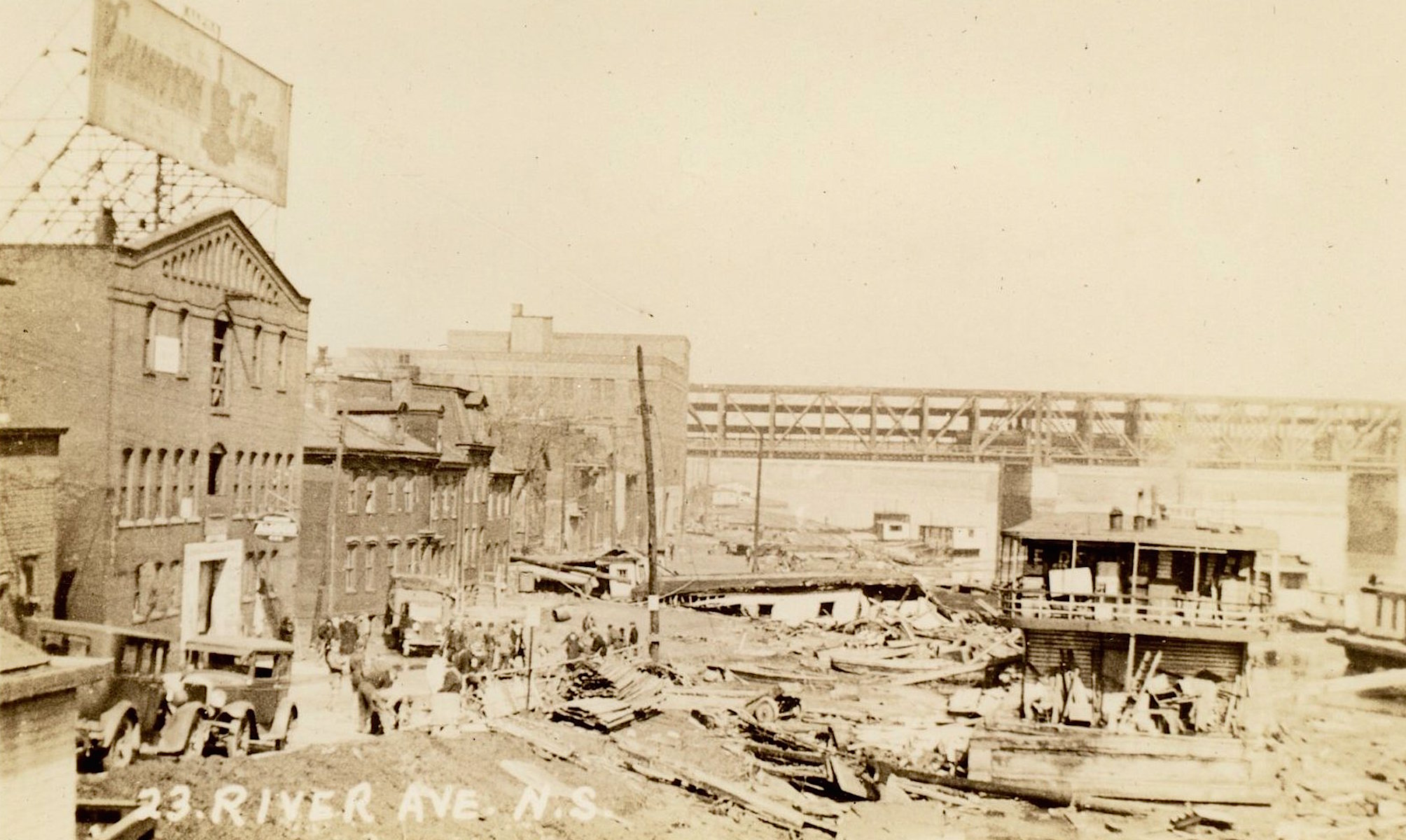
When I arrived by plane in Pittsburgh on Friday morning the water had subsided. Only then could the real extent of the damage be realized. The water poured off, the soft, brown river ooze remained, clinging in a thick paste to everything the water had touched. The National Guard blocked off the Triangle. The crowds that viewed the destruction had a strange elation, an elation that came with the excitement, with the holiday for the thousands of clerks and stenographers who could not get to their places of work. Only the executives rushed around in the restricted area, harassed by the loss of property.
And then the small merchants, the petty tradesmen returned to their stores. Their stock lay in ruins. They poked about the dark stores, trying with candles and lanterns and flashlights to estimate the destruction. Wherever the water had been, goods were worthless. And the little owners began to work with feverish excitement to clean out the mud, throwing shirts and hats and musical instruments and food and books and all their ruined merchandise into the mud-covered streets. Their activity seemed to allay the gnawing worry that perhaps this was the end for them, perhaps the economic ruin which had been haunting them had been accelerated by the flood and now they were once and for all bankrupt. They had no savings. They had no capital to buy new stock with which to make a fresh start. The big fellows along the block could weather this catastrophe. The countless little merchants were done for. Each one I spoke to would stop his meaningless activity and look at me blankly when I asked, “What now? Can you go on?” They would stand there with a bewildered frown and finally shrug, “I don’t know. I don’t know,” they said. “I just don’t know what will happen now.”
I visited the working-class district. I walked through the streets filled with chocolate-colored mud, the streets wet with dripping water from the sides of the houses, steps slimy with river ooze and the floors of the houses thick with the sticky filth. This property is owned by H. J. Heinz Company, 57 Varieties, but there is no variety to the houses they are all the same, two storeys, brick, sodden. The dank, heavy smell of the river clung to them. The gray-faced workers, weary with despair and helplessness, made futile attempts to clean floors, to salvage whatever remained. Or they stood in little groups-stolid, uncomplaining, accepting this new misfortune as they had accepted misfortune all their lives. It was nothing. new, nothing remarkable.
They had clung to their houses, watching the water rise in the basements until it spilled into the first floor. They had piled their furniture in the second floor, hoping the water would stop, watching it fill the room below them. Finally they had been marooned in the houses that threatened to collapse. The police and Red Cross and city rescue squads did not come to their aid. These agencies were busy in the “Golden Triangle” trying to save the few in hotels, trying to move property out of danger for the big owners. The workers were lucky to get out alive. They organized themselves, built rafts and managed to find a boat or two. The herculean efforts of evacuating the area cost lives. There was no chance to take property, even blankets or clothes.
The slimy streets were filled with belongings that these workers bought over long years by skimping and saving. A piano lay before the steps of a house: a man stared at it. “That’s a piano,” he said as I passed, pointing to the battered wood and the wire that wound about it. “I used to play it.” Radios looked like cardboard boxes that had been soaked for days in water. Carpets were matted rags.
I found that even before the flood most of the workers in this area had been on relief. In Pittsburgh the relief authorities subsidize private industry. Men work two or three days a week for a pittance in the Heinz factory or sometimes in the steel mills; relief supplements what they earn-so that in the end they can be more or less sure of seven or eight dollars a week for them and their families.
They have lost everything. When can they replace their furniture, their clothes, their pictures and radios? Not in their lifetimes, not while they are on relief at seven dollars a week. Their future? What worker can look into the future today?
I suppose intelligent people don’t live in the lowlands by the river. The workers are not so smart–perhaps because rents go up proportionately with the height of the land, perhaps because Pittsburgh slums are overcrowded and there remains no other place to live except in the danger area down by the river. The workers in this disaster, as in every other disaster, bear the brunt of hardship and suffering. They must live where they can obtain dwellings for the lowest rent–not where they want to live. They have no means of escaping from danger areas. What is true of Pittsburgh is just as true of Johnstown and Hartford and Wheeling and the countless other places where the misery is as great as that which I saw in Pittsburgh. Countless men and women in every stricken area are now truly “destitute”—satisfactory cases even in the eyes of the most conscientious relief investigator.
THIS misery did not have to occur. The responsibility for the flood can be placed on a small group of men. The flood was no surprise; everyone knew that some spring Pittsburgh would again experience a disaster similar to that of 1907. That was why, way back in 1908, the Pittsburgh Flood Commission was appointed. This commission perfected plans that could have eliminated the present catastrophe. From an engineering standpoint, the plans had merit and practicability. Experts declared that the plans would eliminate almost completely the annual floods that fill the basements in the workers’ quarter, and in abnormal years such as the present, the project would re- duce the loss of property and life. Actually, flood control could have eliminated 11 feet of water-the high point would have been 35 feet in Pittsburgh, 3 feet less than the 1907 mark instead of 8 feet above. The plans have been ready for execution since 1912. The newspapers mentioned them, but that was all. Nothing was done to make flood control a reality either in the state legislature or in Congress.
The commission advocated a series of dams and reservoirs, thirteen in all, later supplemented by a dam now under construction as a P.W.A. project in West Virginia. The project would control the headwaters of the Allegheny, the Monongahela and the Ohio rivers by regulating the flow of water into them and holding back over-supplies of water when these occurred. Such control would not only provide greater safety to Pittsburgh and to all other cities and towns along the banks (incidentally helping to control the flow of water into the lower Mississippi and so lessening the flood danger there) but would also provide irrigation facilities, storage of water, sewage dilution and prove a benefit to navigation. The project is no secret; in fact, the Tri-State Authority (Ohio, West Virginia, Pennsylvania) has published a pamphlet entitled “Let Us Have Protection from Floods.” The project has the full approval of the U.S. Department of War.
The project would have increased the production of electrical power.
That is the catch. Andrew Mellon controls most of the state of Pennsylvania. Andrew Mellon’s holdings form a virtual monopoly in the production of electrical power in the Pittsburgh area. When it came to flood control and the resultant power production, that stepped right on Andrew Mellon’s toes.
In all the talk since the disaster in favor of flood control, in the newspaper campaigns, Mr. Mellon’s name does not appear. Why in all this turmoil about the flood and the “Act of God” does the press not ferret out the “gods” who are responsible for the Pittsburgh flood, the “gods” who live in Pittsburgh? Why doesn’t the Hearst press or the “liberal” Scripps-Howard newspaper with their agitation for flood control (a popular slogan with which to increase circulation) mention Mr. Mellon?

They certainly know that Mellon owns a controlling interest in the U.S. Electric the U.S. Electric Power Corp. And this holding company controls the Class A stock of the Standard Power and Light, another holding company; and in turn the Standard Power and Light controls the Standard Gas and Electric Company, a holding company which owns the capital stock of the Duquesne Light Company, the Equitable Gas Company of Pittsburgh and the Pittsburgh Railway Company (street-cars). They know that Mellon has enormous interests in the Westinghouse Electric Companies. They know that from these corporations–virtually a monopoly of the utilities in the Pittsburgh area–Mr. Mellon makes huge profits. And they know that flood control would allow for the sale by the government of electrical power at a cheaper rate than is now demanded for such power in Pittsburgh and vicinity (since it would be produced from water power rather than from coal as at present). Finally, they realize that flood control means that Mr. Mellon’s monopoly of the electrical power industry would be a thing of the past. For flood control is a public project and electrical power would be sold by the government.
Mr. Mellon’s bituminous coal interests are second only to those of the U.S. Steel Corp. Flood control would allow electricity to be produced from water power and sold at a cheaper rate than it is now sold. Cheaper rates would allow more consumers to buy electrical power and substitute it for coal and gas–which would interfere with Mellon’s Koppers Co. The consumption of coal and gas would diminish. Mr. Mellon could hardly benefit if that happened.
For years Pennsylvania has been run by the Republican Party. Andrew Mellon is the most powerful Republican in the state. So it is not surprising to hear considerable talk in Pittsburgh to the effect that the federal government vetoed flood control in this vicinity because the administration is Democratic and Jim Farley had no intention of handing out funds to a politically hostile state.
If that accusation is true–and it is by no means means far-fetched Farley, the Democratic boss, gave aid to the small group of men whose interests are furthered by preventing flood control, the small group that looks primarily to Andrew Mellon for leadership. And it is also worth remembering a fact which those who howl the loudest for flood control seem control seem to overlook–that Mr. Mellon served as Secretary of the Treasury in three Republican administrations and so far as I can ascertain at no time did he advocate flood control.
The project would cost money. Fourteen dams necessitate an expenditure of eighty-six million dollars. When Congress looked favorably on the project, the state refused to put up its share, claiming that flood control would benefit not only Pennsylvania but other states as well and therefore was of national concern. When the state became more inclined to bear some of the burden, Congress lost interest. For twenty-four years, ever since 1912 when the plan was ready to act upon, flood control in Pennsylvania has been a political slogan and nothing more. It has been a political football kicked round the state in order to pull in the votes: the politicians had no intention of pressing it to fruition.
The present catastrophe destroyed at least $250,000,000 in property–and that is a conservative estimate. Workers lost everything they had saved in a lifetime. Others are out of jobs, without pay while the steel mills and furnaces are closed. Small shop-keepers and little merchants have been wiped out. Over 50 lives were lost, over 3,500 were injured. The cost of epidemic, sickness, starvation, exposure or the dislocation of lives cannot be estimated in dollars and cents.
And yet as a business proposition, flood control is sound. It can pay for itself. To quote a section of the report of the Tri-State Authority:
A summary of the minimum benefits calculated by the Commission is as follows:

Benefits to property of all classes from flood control. $65,560,000. Benefit to navigation. 5,000,000. Hydro Electric 750,000 Water Supply 1,500,000 Sewage Dilution 16,000,000. Total. $87,810,000
In addition there is a regional benefit, or removal of restraint to the development of these valleys, which is very real although not readily calculable. Various studies lead to the conclusion that this benefit is at least as great as the combined calculable benefits or, $175,000,000.
Note that electrical power production is played down in this estimate-an attempt to sell the idea without raising objections from the Mellon and other utility interests. But these corporations are not so easily hood- winked. The best interests of the majority, safety, health, human life don’t count. Misery haunts Pittsburgh and vicinity- misery that could have been prevented.
Capitalism cannot plan for the good of all. It dare not. The safety and the welfare of the millions are secondary considerations. It is the millions in profit for the few that come first, even though that profit is gained from hunger, disease and degradation of the masses.
WITH thousands homeless, without water or light or communication, Pittsburgh took hold. The Red Cross, with an appropriation of one million dollars from the city and a like amount from the federal government, was designated as the official instrument of relief. The grant of money is of totally inadequate. course Governor Earle has already demanded nine million dollars for relief of flood victims.
So far as I could ascertain, the Red Cross has up to now functioned in a haphazard manner. Churches have been commandeered; recreation houses, police stations, libraries are used as temporary shelter for the homeless. Kitchens have been set up to feed those who need help.
Significantly, the state immediately ordered the Emergency Relief Bureau to refuse to handle all flood cases. The Red Cross has federal and private funds. The state does not want to go to any unnecessary expense. Shunting the problem on to the Red Cross means that the state does not have to pay for relief of flood victims.
At present the authorities are ready enough to house the destitute, to feed them as well as possible under the difficult circumstances. The danger to the flood victims who lost homes and possessions is not apparent during the first week when talk of cooperation and public responsibility is the result of the initial shock of disaster. But in two weeks, in a month, when public spirit begins to wane, the administrators and the city council face a relief problem that is by no means temporary. The dislocation of thousands of human beings will stretch over months and in some cases over an even longer period. The Red Cross will not solve the emergency. It will soon withdraw, leaving the destitute to the mercies of local and federal relief bureaus.
Right now, relief is on a temporary basis. Food comes in most cases from private donors-from the corner grocer, from small dealers, from housewives who cook and volunteer their services. The public is beseeched to give generously to the less fortunate–and the public responds. The Atlantic and Pacific chain stores, so far as I know, have not responded-they leave that to the small merchant. Instead, the chain stores raised prices. Plenty of owners saw a chance for a quick profit in time of stress. But the small businessmen and the neighborhood storekeepers, the workers and the middle classes, the professional and white-collar groups give time and money and energy. I have seen no announcement of Mr. Mellon making a contribution. But then Mr. Mellon, in one sense, contributed the flood.
Private charity cannot handle the emergency. The Red Cross will abandon the scene–they do not plan to dip into their reserve for war. The homeless will become a community problem, one that necessitates planned action by the city, the state and the federal government. If the attitude of these agencies toward the problem of relief before the flood can be taken as a gauge, relief will be completely inadequate. Families cannot move back into the damp houses, breeding places for disease. Nor can they afford to recondition these houses. The city must take over this task. The catastrophe does not end when the waters recede or the “Golden Triangle” is open for business. The suffering caused by the flood the great Mellon Flood—will continue for months, in some cases for years.
There is much work to be done cleaning the city. But the unemployed on home relief, the newly-created homeless, are given these jobs. Instead, the city calls only the W.P.A. workers to take over. They can be had at a cost below the prevailing wage, at less than fourteen dollars a week- and the federal government foots the bill. Pittsburgh is anxious to save as much money as possible, to pass whatever expense it can on to the federal government. The attitude does not augur well for the future of the homeless.
THE flood is over. The mud will soon be gone from the “Golden Triangle.” The homeless will become less dramatic as the weeks pass.
There is no way of estimating the real cost of the disaster. But there was and there is a way to avoid future disaster, a scientifically endorsed project of flood control. Mr. Mellon’s interests, the coal operators, the other utility companies, the politicians will be no more eager for flood control in the future than they were in the past.
Flood control is a costly affair. Congress will be asked to appropriate money for the project. It would be well for Congress to find out just who prevented this necessary project from being authorized before. What lobbies, what men? Did Mr. Mellon’s companies block authorization in the years gone by? Did Mr. Mellon himself play a part in the sabotage of property, public safety and health?
These are questions that I would like answered. These are questions on which millions would like detailed information.
The New Masses was the continuation of Workers Monthly which began publishing in 1924 as a merger of the ‘Liberator’, the Trade Union Educational League magazine ‘Labor Herald’, and Friends of Soviet Russia’s monthly ‘Soviet Russia Pictorial’ as an explicitly Communist Party publication, but drawing in a wide range of contributors and sympathizers. In 1927 Workers Monthly ceased and The New Masses began. A major left cultural magazine of the late 1920s and early 1940s, the early editors of The New Masses included Hugo Gellert, John F. Sloan, Max Eastman, Mike Gold, and Joseph Freeman. Writers included William Carlos Williams, Theodore Dreiser, John Dos Passos, Upton Sinclair, Richard Wright, Ralph Ellison, Dorothy Parker, Dorothy Day, John Breecher, Langston Hughes, Eugene O’Neill, Rex Stout and Ernest Hemingway. Artists included Hugo Gellert, Stuart Davis, Boardman Robinson, Wanda Gag, William Gropper and Otto Soglow. Over time, the New Masses became narrower politically and the articles more commentary than comment. However, particularly in it first years, New Masses was the epitome of the era’s finest revolutionary cultural and artistic traditions.
PDF of full issue: https://www.marxists.org/history/usa/pubs/new-masses/1936/v19n01-mar-31-1936-NM.pdf
 Revolution's Newsstand