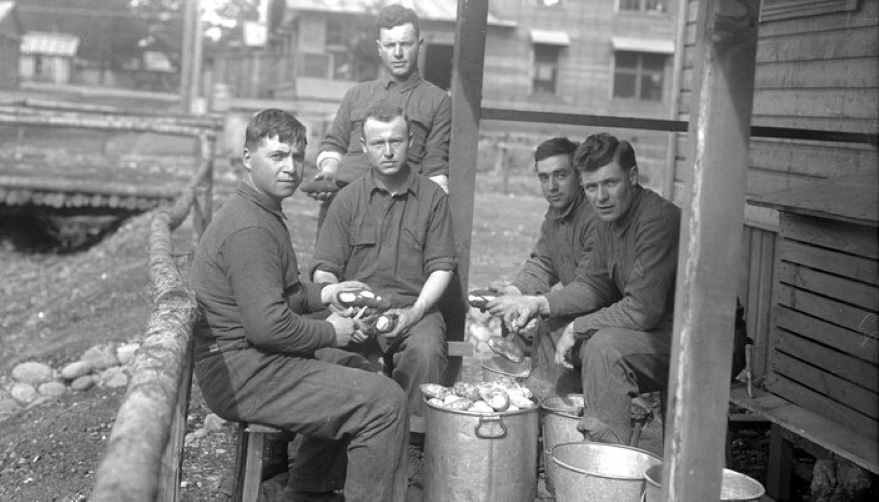
‘Communist Immediate Demands for Servicemen’ from Young Worker. Vol. 8 No. 4. May 1, 1930.
Political Demands
1. The right to form unions or to join existing unions and participate in the activities of these unions. Union men joining the service to be allowed to retain membership and actively participate in their organizations.
2. Servicemen to have the right to join political parties and to organize branches in the army, navy or marines; also to have the right to attend political meetings and take active part in these meetings.
3. Servicemen to have the right to vote and hold office.
4. The right to elect Regimental, Battalion, Company or Ship Committees to represent servicemen in all grievances and questions affecting conditions of service.
5. Abolition of War Department orders prohibiting the enlisted personnel from writing freely to the press.
6. Enlisted personnel have the right to elect their own officers.
Legal Rights
1. No use to be made of servicemen against workers in industrial dispute.
2. Complete abolition of court-martial. Servicemen in all instances to be subject to civil law with free civil defense counsel of the serviceman’s own choosing. Summary and Special Court-Martial offenses to be tried before jury of enlisted men.
3. Abolition of the death penalty and field punishment.
4. All disciplinary action to be subject to approval of enlisted men’s committee.
5. Abolition of guard houses and stockades. No compulsory labor for servicemen awaiting trial.
Pay
1. Base pay of $21.00 per month to be raised to $40.00 per month. All specialist ratings to be increased 25%.
2. Married men to have special allowance of 25% pay additional.
3. Government allotments to dependents in addition to servicemen’s regular pay.
4. Longevity pay (pay for length of service) to start with second year of service instead of fourth year as at present. Increase to be 25% instead of 5% increase now in practice after act of June 10, 1922.
5. Extra pay for special ceremonial parades, guard or extra fatigue occurring beyond regular hours of duty.
Conditions of Service
1. Maximum duty period of eight hours daily including guard duty for all branches of the service.
2. No item of equipment to be purchased by the service man. This to apply to uniforms, belts, caps, shoes, etc., as well as other items.
3. No special duty without full agreement of the serviceman.
4. If preferred by the service man, doctor, dentist and optometrist services to be given by civilian specialists of the serviceman’s own choosing. All expenses for services and material to be paid by the government.
5. Barber, tailor, shoe repair and laundry service to be furnished at no expense to the serviceman.
6. Government issue uniforms to be issued in such form as to be easily tailored to the serviceman’s measure. Alteration expenses to be borne by the government.
7. Adequate lighting of all barracks, reading rooms and other places where servicemen gather. Enlisted men’s committees to make regular inspections to insure enforcement.
8. All regular fatigue duty to be approved as necessary work by a committee of enlisted men selected by vote from among men who are to do the work, before work begins.
9. Servicemen to have the right to resign from the service at any time after enlistment and when exercising this right, to collect without interference, all allowances due them or to become due.
10. If any decrease of pay during enlistment period, service men to have the right to: 1, take immediate discharge; 2, continue for the full contracted period at rate of pay under which contract was made.
11. In case of men joining the service with the expressed intention of learning a trade, no guard or fatigue duty shall be included in their duties. Servicemen choosing to learn a trade after serving a part of their term of service to be exempt from fatigue thereafter.
12. Time served in detention as a result of trial to be counted in the regular service period. This also to apply to time served awaiting trial.
Leaves of Absence
1. Twenty-one days of leave to be automatically given all men who are to leave for service at a point more than five hundred miles from their home.
2. All ranks to have unrestricted right to wear civilian clothing while on pass or on leave regardless of location of their post.
3. Enlisted personnel to have the same allowance of leave as the officers. No restriction of passes to men off dy.
4. Free transportation to point of serviceman’s choice and return for all men on leave.
5. Servicemen to be permitted to remain in tropics during furlough if they desire, particularly those stationed there.
Food
1. Daily ration allowance to be increased 50%.
2. Enlisted men’s committees to control the company or ship mess. Members of such committees to be subject to recall by servicemen at any time. These committees to have free access to expert advice in the matter of deciding whether food is suitable. Committee to have the right to reject any food considered unfit and determine upon a substitute menu.
3. Abolition of “voluntary” mess fund contributions.
Cultural Demands
1. The right to form social clubs, sport clubs, study and dramatic circles without any form of interference from officers.
2. The right of all such organizations to freely associate with and arrange affairs with civilian workers’ clubs without hindrance of any sort from officers. Men participating in these affairs to be free from duty upon such occasions.
3. All servicemen’s clubs, societies, etc., to have free use of all auditoriums, ball parks, athletic fields, etc., as well as polo field and golf links.
4. Contents of book shelves in libraries and reading rooms to be chosen by enlisted men without interference of officers.
5. No distinctions between officers and enlisted men at post or ship theatres, dances, etc. Abolition of “Officer’s Reserved Sections” in these places.
6. Abolition of restricted areas. This to apply to military reservation as well as to areas outside the reservation.
7. The right of servicemen to entertain civilian visitors within the military reservation.
General Demands
1. Abolition of the right to dictate to enlisted personnel concerning marriage. Men to marry or not as they please without asking the permission of officers.
2. No segregation, discrimination or any other form of “Jim Crowism” against Negro troops. Negro workers to be allowed to join any branch of the service in any post of their own choosing the same as white workers.
3. Servicemen’s canteens (Post Exchanges) to be controlled by the enlisted personnel. Funds to be expended as the enlisted personnel directs. Officers to have no right to interference in such proceedings.
The Young Worker was produced by the Young Workers League of America beginning in 1922. The name of the Workers Party youth league followed the name of the adult party, changing to the Young Workers (Communist) League when the Workers Party became the Workers (Communist) Party in 1926. The journal was published monthly in Chicago and continued until 1927. Editors included Oliver Carlson, Martin Abern, Max Schachtman, Nat Kaplan, and Harry Gannes.
For PDF of full issue: https://www.marxists.org/history/usa/pubs/youngworker/v08a%20n01%20-%2011%20Young%20Worker%201930%20Jan%20June.pdf
 Revolution's Newsstand