
Lenin, a close follower of U.S. politics, astutely comments on the outcome of the 1912 Presidential election, an important–almost unique–political moment in U.S. history. The 1912 election which saw the first serious challenge to the two-party system since the Civil War with both Progressives and Socialists running strong campaigns. After losing the Republican nomination to Taft in 1912, Theodore Roosevelt and his supporters split to form the National Progressive Party. In that year’s Presidential election, they beat their Republican rivals, coming in second and garnering 27.4% nationally (Debs received 6%, by far the best ever for a left party). Though the conservatives around Taft retained control, most ‘Progressives’ returned to the Republican fold by 1916 in the event of the World War and intervening electoral failures.
‘The Presidential Elections in the United States’ (1912) by V. I. Lenin from The Communist. 7 No. 2. February, 1928.
IN THE UNITED STATES, Wilson, “Democrat,” has been elected President, receiving over 6,000,000 votes. Roosevelt, new “National Progressive Party,” received over 4,000,000; Taft, Republican Party, over 3,000,000; Eugene Debs, Socialist, 800,000 votes.
The world significance of the American elections lies not so much in the strong growth of Socialist votes as in the very great crisis in the bourgeois parties, in the immense power in which their decay appears. And, finally, the significance of the elections lies in the unusually clear and obvious manifestation of bourgeois reformism as a method of struggle against Socialism.
America has full freedom. And yet here there are two bourgeois parties that have grown remarkably in strength and power in the half century after the Civil War (1860-1865) that arose on account of the slavery question. The party of the ex-slave owners–this is the so-called “Democratic” Party. The party of the capitalists, that once stood for the emancipation of the Negroes has developed into the Republican Party.
Since the emancipation of the Negro the differences between these two parties have become less and less. The struggle between these two parties dealt largely with the question of low or high tariff. This struggle is of no serious consequence to the masses of the people. The people have been deceived; their attention has been sidetracked from their immediate interests by the methods of the ineffective and meaningless duels between the two bourgeois parties. This so-called “two party” system, reigning in America and in England as well, has been one of the most powerful methods of preventing the foundation of an independent labor, that is, genuine Socialist, party. And now in this America, in the country of the most progressive capitalism, this “two-party” system has become bankrupt!
What has brought about such a breach? The power of the working class movement, the growth of Socialism! The old bourgeois parties, the “Democratic” and the “Republican,” had their faces turned to the past, to the epoch of the emancipation of the Negro. The new bourgeois party, the “National Progressive Party,” turned its face to the future. Its whole program centers around the question of whether capitalism is to be or not to be— namely, the questions of the protection of labor and of trusts, as the associations of capitalists are called in America.
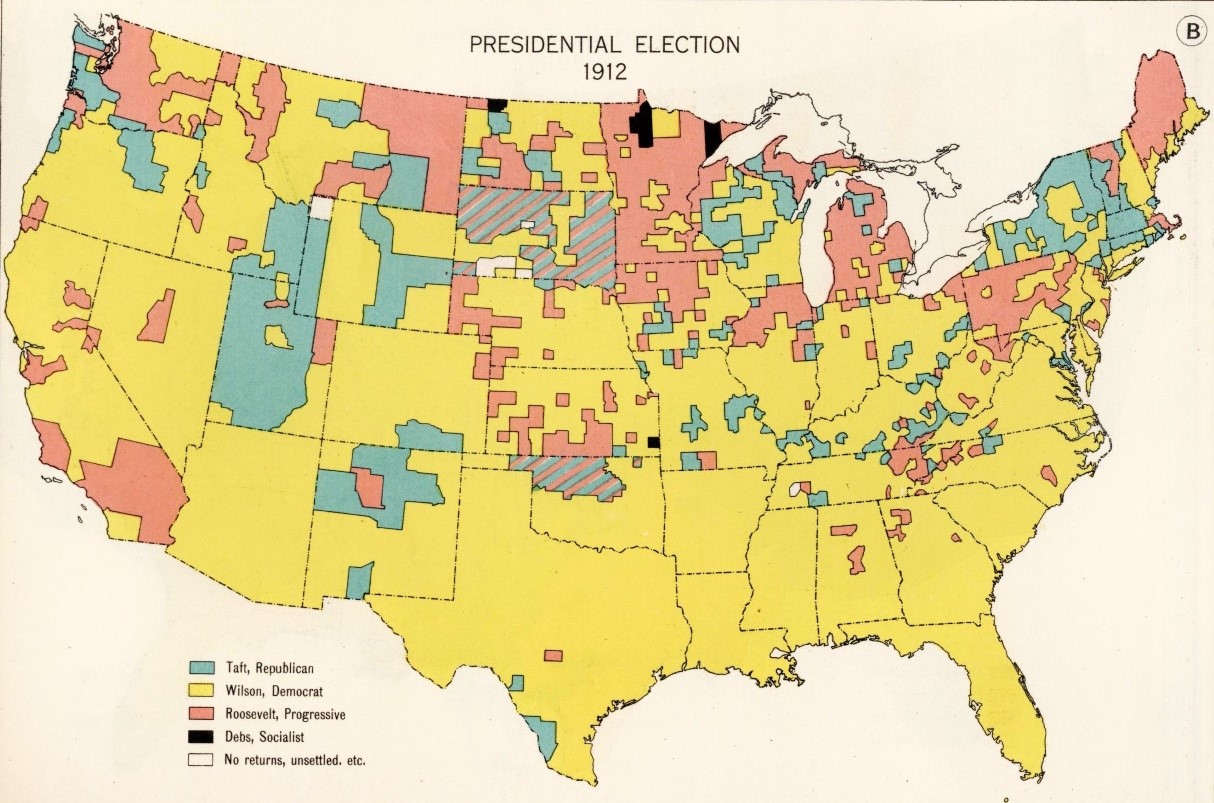
The old parties were the results of the period that was faced with the task of the quickest development of capitalism. The struggle between the parties was confined to this question: how better to help to speed up and facilitate this development. The new party is the child of the modern epoch which has thrown up the question of the very existence of capitalism. In the freest and the most progressive country, in America, this question appears on the order of the day more broadly and vigorously.
The whole program, the whole agitation of Roosevelt and of the “progressives” centers around this: “How to save capitalism by…bourgeois reforms.”
This bourgeois reformism, which in old Europe is expressed in the chattering of liberal professors, this bourgeois reformism in the free American republic, is expressed by an outburst of a party of 4,000,000. This is a la America.
“We will save capitalism thru reforms”–says this party.
“We will give you the most progressive factory legislation. We will introduce state control of all trusts (in America this means of all industry). We will control them in order to destroy poverty and ensure a ‘decent wage’ for all. We will give ‘social and industrial justice.’ We swear by all reforms. Only ‘one reform’ we don’t want the expropriation of the capitalists.“
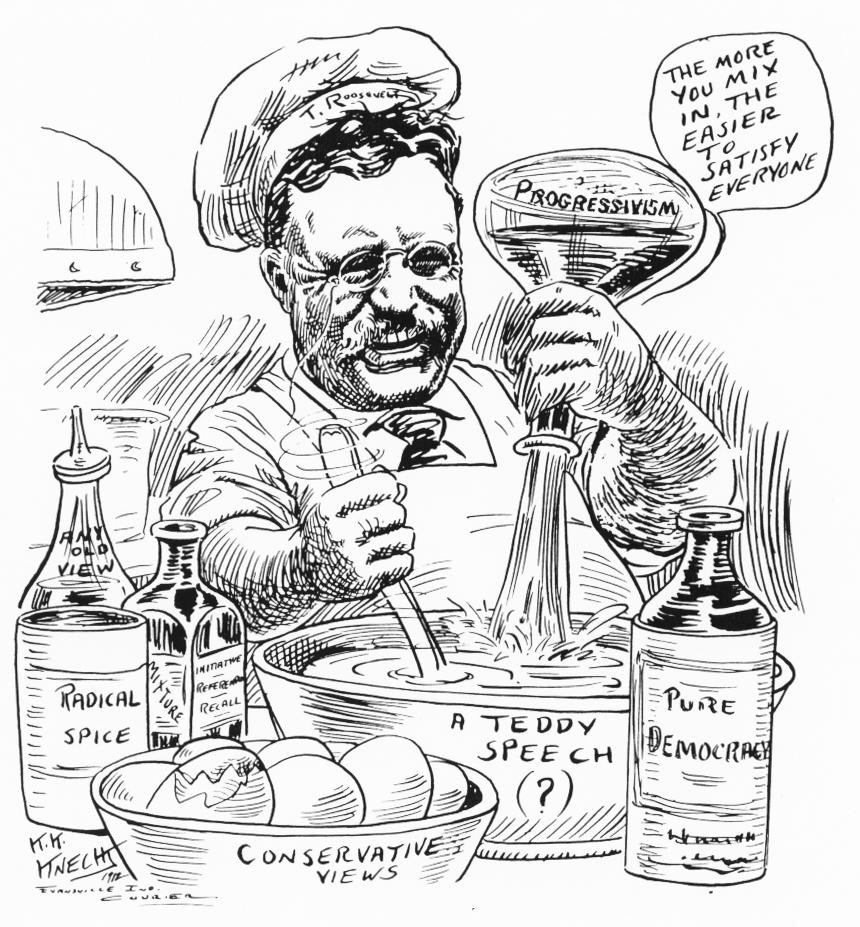
In America the national wealth now amounts to $120,000,000,000. Of this, nearly one-third belongs to the trusts of Rockefeller and Morgan or to those controlled by them. No more than 40,000 people, who make up these two trusts, are the masters of 80,000,000 wage slaves. It is very understandable that while these modern slave-owners exist, all reformism plain deception. Roosevelt is consciously hired by the millionaire-swindlers in order to preach this deception. “State control,” which is promised by him, will be converted, while capital is preserved in the hands of the capitalists, into a method of struggle against strikes and for stifling them.
But the American proletariat is already awakened and is on the alert. With fresh irony it confronts Roosevelt’s success. enlisted four million people by your promises of reform, dear charlatan Roosevelt? Very well! Tomorrow these four million will see that your promises are deception. And besides, these millions follow you just because they feel they can no longer live in the old way.
There are a number of journals with this name in the history of the movement. This ‘The Communist’ was the main theoretical journal of the Communist Party from 1927 until 1944. Its origins lie with the folding of The Liberator, Soviet Russia Pictorial, and Labor Herald together into Workers Monthly as the new unified Communist Party’s official cultural and discussion magazine in November, 1924. Workers Monthly became The Communist in March, 1927 and was also published monthly. The Communist contains the most thorough archive of the Communist Party’s positions and thinking during its run. The New Masses became the main cultural vehicle for the CP and the Communist, though it began with with more vibrancy and discussion, became increasingly an organ of Comintern and CP program. Over its run the tagline went from “A Theoretical Magazine for the Discussion of Revolutionary Problems” to “A Magazine of the Theory and Practice of Marxism-Leninism” to “A Marxist Magazine Devoted to Advancement of Democratic Thought and Action.” The aesthetic of the journal also changed dramatically over its years. Editors included Earl Browder, Alex Bittelman, Max Bedacht, and Bertram D. Wolfe.
PDF of full issue: https://www.marxists.org/history/usa/pubs/communist/v07n02-feb-1928-communist.pdf
 Revolution's Newsstand