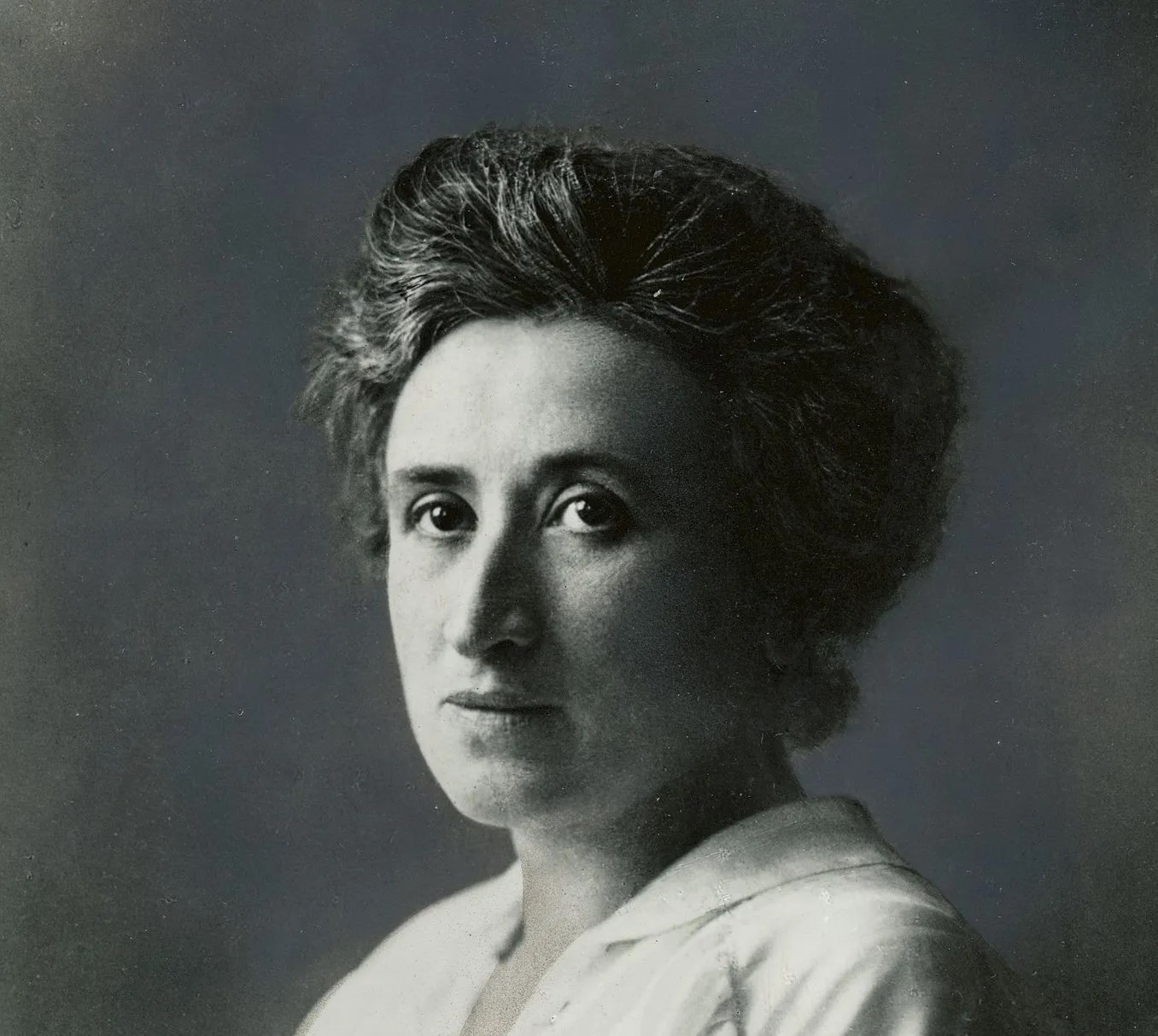
A significant article transcribed online for the first time. Written early in the Russian Revolution while an editor of Vorwärts and first published on February 9 and 10, 1905, this is one of a series of articles with this title. In it, Rosa Luxemburg places the work of the R.S.D.L.P. in organizing an emerging proletariat at the center of the epic transformations underway.
‘The Revolution in Russia’ by Rosa Luxemburg from the Weekly People. Vol. 14 No. 50. March 11, 1905.
(From the German of Rosa Luxemburg in the “Berlin Vorwarts,” translated for The People by Gotthold Ollendorff.)
The development of revolutionary events in the empire of the Czar, by the transplanting of the proletarian uprising from Petersburg to the Russian provinces and to the Lithuanian and Polish territories, has already put aside every doubt as to the fact that, at present, in the empire of the knout, the question is not one regarding a Spontaneous, blind revolt of oppressed slaves, but concerning a de-facto political movement of the class conscious city-proletariat, a movement carried on in complete unison and in the closest political connection, in answer to the sudden signal from Petersburg. The Social Democracy, all over, stands at the head of the revolt.
And this also is the natural position of a revolutionary party at the outbreak of an open, political battle of the masses.
To conquer the leading position in the course of the revolution, to skillfully make use of the first victories and defeats of the elementary uprisings, to gain the power of the stream within the stream itself that is the task of the Social Democracy in revolutionary epochs. To master and to direct, not the commencement, but the end, the result of a revolutionary upheaval, that is the sole object, a political party may in reason aspire to if it will not fall a prey to fantastic illusions of self overestimation or to an indolent pessimism.
But how far the party will succeed in this task, how far it is able to cope with the situation, that most largely depends on how much influence upon the masses in pre-revolutionary times the Social Democracy has undertaken to acquire, how far it has already succeeded in creating a “corps d’ elite” of clear-sighted, politically schooled workingmen, how large the amount of educational and organization work is, which it has performed. The present happenings in the Russian empire can only be estimated and comprehended in the light of the previous experiences of the labor movement, only through the perspective of the entire fifteen to twenty years old history of the Social Democracy.
When the question is put, what share the Social Democracy has in the present revolutionary uprising, it should be stated before all that at no time and right up till now, in Russia proper, nobody at all, the Social Democracy excepted, has been concerned about the working class, about its mental and material improvement, about its political education. The industrial and commercial bourgeoisie proper, as a class, has hot even been able to reach up to al weakly liberalism, and the liberal agrarian noblemen have made wry faces from afar, ever travelling politically upon the narrow path of virtue “between fear and hope.” As political educators of the industrial proletariat, they do not enter into consideration at all. But in as far as radical and democratic intelligence concerned itself about the Russian people, and it did so zealously, especially in the years between 1870 and 1900, it centred its activity as well as its sympathies exclusively upon the rural population, upon the farmer class. As physicians in the villages, as statisticians in the Zemstvos, as villages teachers, as landlords, the Russian liberals and democrats essayed to promote culture: The farmer, “mother earth,” these up to the first years of the decade of 1890 to 1900 were, for intelligence, the main points taken into consideration for the uplifting of Russia and its political future. The industrial city proletarian, together with modern capitalism, on the contrary, were looked upon as essentially foreign to the nature of the Russian people, as a dissolvent, as a sore spot of national life. Even as late as in the first half of the decade of 1890 to 1900, the intellectual leader of the Russian opposition, the late, once brilliant author Michajlowsky, copiously attacked the Marxian doctrine of the social significance of the industrial proletariat, citing, for example, the pity street songs and similar matters as a proof that the factory proletariat lead directly towards a moral and mental degradation of the Russian people.
And in the same courses up to the nineties also the socialistic trains of thought moved in Russia. The terroristic movement of the old “Narodwaja Wola”–theoretically, mainly resting upon the fiction of the communistic farmer community and its socialistic mission up to the end of the eighties still affected the revolutionary circles and held the minds in the ban of the horizon of the old nativism, opposed to the city proletariat, although the political climax of the terroristic tactics had already been passed in 1881, with the removal di Alexander the second.
Under such circumstances it was incumbent to actually conquer at first for the modern Russian city proletariat the social and historic civic right, to demonstrate its social and economic significance, to show the in it slumbering germs of a future revolutionary force and also the special connection of “the idea of the working class” with the political delivery of Russia from Czarism. The hot, theoretical, literary battle against the nativistic, anti-capitalistic theories regarding the right of existence of capitalism and the position of the modern proletariat in Russian society–this task alone has occupied the best part of a decade. Only towards the commencement of the nineties were the terroristic traditions and the nativistic prejudices of the Russian intellect vanquished and the Marxian doctrine impressed upon the minds. so that Social Democratic activity could commence.
But with this the difficulties and the painful errors of practical work also begun. It, at first, naturally, took the form of a secret propaganda in closed, small labor circles. The still totally uncultivated Russian proletarian in most cases had to be enlightened at first in a general sense, he had to be instructed at first in the most elementary principles of education before he could be made receptive of Social Democratic teachings. Thus propaganda of necessity was connected with general educational, work and transformed into an extremely cumbersome, slowly advancing undertaking. Circles of five, of ten, of twenty workingmen for years laid claim upon the best, nay, upon the entire forces of Social Democratic intelligence. Thanks to the conscientiousness and the zeal with which in Russia the temporarily dominant form of agitation is ever carried to its extreme consequence, to absurdity, the unavoidable element of pedantry soon appeared in the circle agitation and the Social Democracy became aware that Socialism within the circles had become almost a caricature of the Marxian doctrine of the class struggle. The workingmen in the circles were not fashioned into fighting, class conscious proletarians, but, so to say, into learned rabbis of Socialism, into perfect sample specimens of enlightened workingmen, who did not carry the movement into the masses, but, on the contrary, uprooted from their native soil, became estranged from the masses.
“Cruelly profoundly” the first phase of the Social Democratic activity was submitted to self criticism, jeered at and thrown aside. In place of the isolated “home work” and the “learned studies” in the circles for Socialism, towards the middle of the nineties, the motto: “mass agitation, immediate battle” was raised. But a mass agitation and mass battle under absolutism, without any political forms and rights, without any possibility of approaching the masses, without the rights to organize and to hold meetings, without the right to coalition, appeared to be like, a squaring of the circle-a hare-brained idea. And still very soon, this very Russia proved by its example, how much mightier and brighter the materialistic social development is, than all the various “legalities,” which, with their rigid yellow parchment faces, instill such a great amount of holy fear and veneration into so many West European Social Democrats. A mass-battle, a mass-agitation under absolutism proved possible. The squaring of the circle was accomplished in the first place in Poland, where, already in 1890, the first Social Democratic organization was founded. But it should be stated that this organization devoted itself to the economic struggle in an empiric, tentative manner, yet it succeeded in calling into life a healthy mass-movement. Russia followed the example of Poland and soon the hopes of the Social Democratic trade unions were raised to a high pitch. By a lively agitation upon the basis of the immediate, material requirements, the masses were actually set in motion and after a long series of smaller and larger strikes the agitation reached its climax in the enormous strike of 1896 in Petersburg. Led exclusively by Social Democrats, this mass-revolt seemed to crown the work and to give this new, second phase of the agitation a splendid testimonial.
But here another flaw revealed itself.
The fast running cart of the Russian Social Democracy encountered disastrously another street corner. While in Poland already in 1893 the first “economic” phase of mass-agitation had been passed and a pronounced political Social Democratic movement begun in Russia, in the heat of mass-agitation, unwittingly politics as well as Socialism had almost completely vanished out of the agitation and what remained was mostly only every-day trades unionism with a wee advance in wages as its ideal, replacing the battle with the bourgeoisie by conferences with the factory inspector.
And as formerly the individual workingmen in the circle by an academic curse, so to say, were led to Marx, so now the entire working class was supposed to be fitted for the class struggle by object lessons, like a class of scholars, to become convinced of the necessity of the abolishment of absolutism by the sabreing of the gendarmes. In this wise, to a certain degree, preparatory work was performed for the experiments a la Zubatow of the government, the creatures of which, later on, in the unions, tolerated by the government babbled the same counsels which the chancellor Count Bulow lately gave in the Reichstag to the striking miners of the Ruhr district.
For the third time tactics were submitted to searching criticism and at the end of the nineties, thorough POLITICAL mass-agitation was adopted. And the soil was so well prepared that the idea of the political battle spread. like wildfire. With the beginning of the year 1901 a new phase–that of political mass-demonstrations in connection with academical revolts–was entered into. Like a thunderstorm, refreshing, purifying the atmosphere, the street demonstration travelled from town to town, from Petersburg, from north to south, from the west, from Warsaw, as far as to the most extreme east in far-away Siberia, to Tomsk and Tobolsk. And again the re-vivified revolutionary forces exploded in a general strike–this time in a POLITICAL GENERAL STRIKE in the south, in ROSTOW ON THE DON in 1903, where daily surrounded by soldiers, from ten to twenty thousand workingmen met under the open sky in public meeting and where men of the people, unknown until then as Social Democratic speakers, addressed the masses with fiery tongues, where tens of thousands cheered the Social Democracy and proclaimed the downfall of absolutism.
And for the fourth time the movement threatened to turn into a “cul de sac.” For it is in the nature of a healthy mass movement, that, if it shall not retrograde, it must advance, develop, intensify. And the Russian labor movement was living the strenuous life. After the first cycle of political street demonstrations, there arose before the Russian Social democracy the frightening question: What now? One cannot solely “demonstrate” forever. Demonstration is but a moment, a prologue, an interrogation mark. Upon the lips of the Social Democracy, the answer hesitated–it was not easy to find.
Then came the war, and with it the solution. That word, which, in the sober, tranquil atmosphere of the hum-drum of every day, is an absurdity, a braggardism, a hollow phrase–revolution–became in Russia, with the beginning of the war, the watchword which electrified all living souls and awakened the loudest echo in the working class. The Social Democracy of the entire empire, in harmonious unison with the events of the war, and accompanied by the thunder of cannon in Manchuria, agitated for the idea of the revolution, the open street battle, the revolt of the proletariat against Czarism. All articles of the Social Democratic press, all the hundreds of thousands of pamphlets of the Russian, the Polish, the Jewish, the Lettish Social Democracy, all meetings, culminated in the cry: “Proletarians, revolt against Czarism!” One agitated with bated breath and with a beating heart, for there is nothing more simple than a revolution accomplished, and nothing more devilishly difficult than one which shall be brought about. A thousand voices invited the revolution and it came, as it ever comes, “unexpected” although prepared-for almost since two decades–inaudible, overnight, like a rising flood, carrying high upon its swollen, angry-darkling waters, all kinds of wrecking and planks, picked up on the road. He who believes that drifting planks guide the flood, may believe that Father Gapon is the author and leader of the proletarian revolution in Russia.
Thus a fair knowledge of the Social Democratic Labor Movement in Russia suffices in order to clearly comprehend that the present revolution–no, matter in what forms it appears, and no matter by what provocation produced in the first place–did not come like a pistol-shot, but is an historical product of the Social Democratic movement of the whole empire. It forms a normal stage, a natural main-point on the line of development of the Social Democratic agitation, a point in which quantity again has been transmuted into quality–into a new form of battle-an accelerated reproduction on a higher scale of the Social Democratic mass-revolts in Petersburg of the year 1896 and in Rostow of the year 1903.
For if one reviews the almost fifteen year old history of Social Democratic agitation in Russia, it does not appear as a well defined zig-zag course, much as in reality it may have so appeared to the Social Democrats there, but as a perfect logical development, in which each higher stage is a result of the preceding one, impossible without it. No matter how bitterly the original phase of the closed-circle propaganda was later on criticised by the Social Democrats themselves, still this humble Sisyphus work undoubtedly in the first place has created that great number of clear-sighted individuals among the proletariat, who later on became the bearers and supports of the mass-agitation upon the basis of economic interests. The intensified economic agitation has stirred the great masses of the working class so far, has inculcated the idea of the class struggle to such a degree, that the pronounced and sharply accentuated political agitation found a grateful soil and thus was able to inaugurate the series of important street demonstrations. And all these phases of development in their entirety, in their ever increasing intensity and the ever growing extent of agitation, these have created that sum total of political clear-sightedness, that capability and that revolutionary frame of mind, which led to the events of January 22 and to those of the week succeeding. And without a doubt it is the sole and direct work of the Social Democracy that, in spite of all the promotion of national prejudices by absolutism, it has so thoroughly developed the sentiment of the political class. solidarity of all the proletarians in Russia, that the Petersburg uprising became the signal of a general revolt of the working class in the entire empire, in Russia proper, as well as in Poland and in Lithuania–a revolt for common purposes, with common demands.
Of course, it does not matter if the historical course of the Social Democratic movement in Russia can be justified as the best, the sole and only proper one. Perhaps there might–especially now than in the past–a much shorter and better road be found. But as social history is an eternal first performance, without repetition, the Social Democracy in particular is concerned to learn and to digest as to its inner logic, the actual ways of the labor movement as it has revealed itself in every country. Certainly the events of the war and the oppression of absolutism, grown insupportable, play a momentous role in these happenings. But that the fact that the present war could bring about such a revolt, that the pressure of absolutism became individually totally insupportable to the great mass of the industrial proletariat-from an objective standpoint this pressure has ever been the same in that, the preliminary work of the Social Democracy reveals itself. The, for official Russia not less disastrous Crimean War; at the time only led to a farce of “liberal” reforms and this farce was the liquidation and the equivalent of that political power, which Russian liberalism by itself has been able to produce. The Russo-Turkish War, which, in its barbaric disposition of tens of thousands of proletarian and farmers lives, was in no way inferior to the present war, and also at the time produced a strong ferment in society, only accelerated the rise of the terroristic “Narodnaya Wola” and, shown in its brilliant but short and sterile career, the amount of political power, revolutionary intelligence based on the liberal and Hemocratic circles of society, is able to command. The founding of the party of systematic political terror was already on its own side from the beginning a product of disappointment in regard to the ability to organize and to move to action the Russian farmer-masses. With this also this class of society in Russia had proven its historic indolence.
And only the present war has been able to conjure up a revolutionary mass movement before which, at once, the armored castle of absolutism trembled. And this is because the present war has found throughout the whole empire a modern working class, stirred up and educated by an agitation of decades, a working class able, for the first time in the history of Russia, to coin into revolutionary deed the revolutionary consequences of the war.
And only upon the basis of this Social Democratic Labor Movement, the liberal sentiments and democratic currents of the intelligence, the blood and life of the progressive nobility, gained force and significance. The proletarian revolution came just at the proper time, just as its immediate precursors, the liberal Zemstvo, action and the democratic intelligence banquets, threatened to be destroyed by their own powerlessness, just when in the whole opposition movement suddenly a serious standstill had entered, which the reaction with the unerring scent of the reigning had already discovered and was preparing to take advantage of. The strong arm of the proletarian masses has shoved ahead the cart with a push and has given it such a velocity that it cannot and will not come to rest until absolutism has perished under its wheels.
Also in the empire of the Czar, the Social Democracy is not the one which reaps where others have sown. Rather to her belong the revolutionary seed, together with the giant work of clearing the proletarian soil. But the harvest belongs to all the progressive elements of civic society and, not least, to the, International Social Democracy.
New York Labor News Publishing belonged to the Socialist Labor Party and produced books, pamphlets and The People. The People was the official paper of the Socialist Labor Party of America (SLP), established in New York City in 1891 as a weekly. The New York SLP, and The People, were dominated Daniel DeLeon and his supporters, the dominant ideological leader of the SLP from the 1890s until the time of his death. The People became a daily in 1900. It’s first editor was the French socialist Lucien Sanial who was quickly replaced by DeLeon who held the position until his death in 1914. After De Leon’s death the editor of The People became Edmund Seidel, who favored unity with the Socialist Party. He was replaced in 1918 by Olive M. Johnson, who held the post until 1938.
PDF of full issue: https://www.marxists.org/history/usa/pubs/the-people-slp/050311-weeklypeople-v14n50.pdf
 Revolution's Newsstand