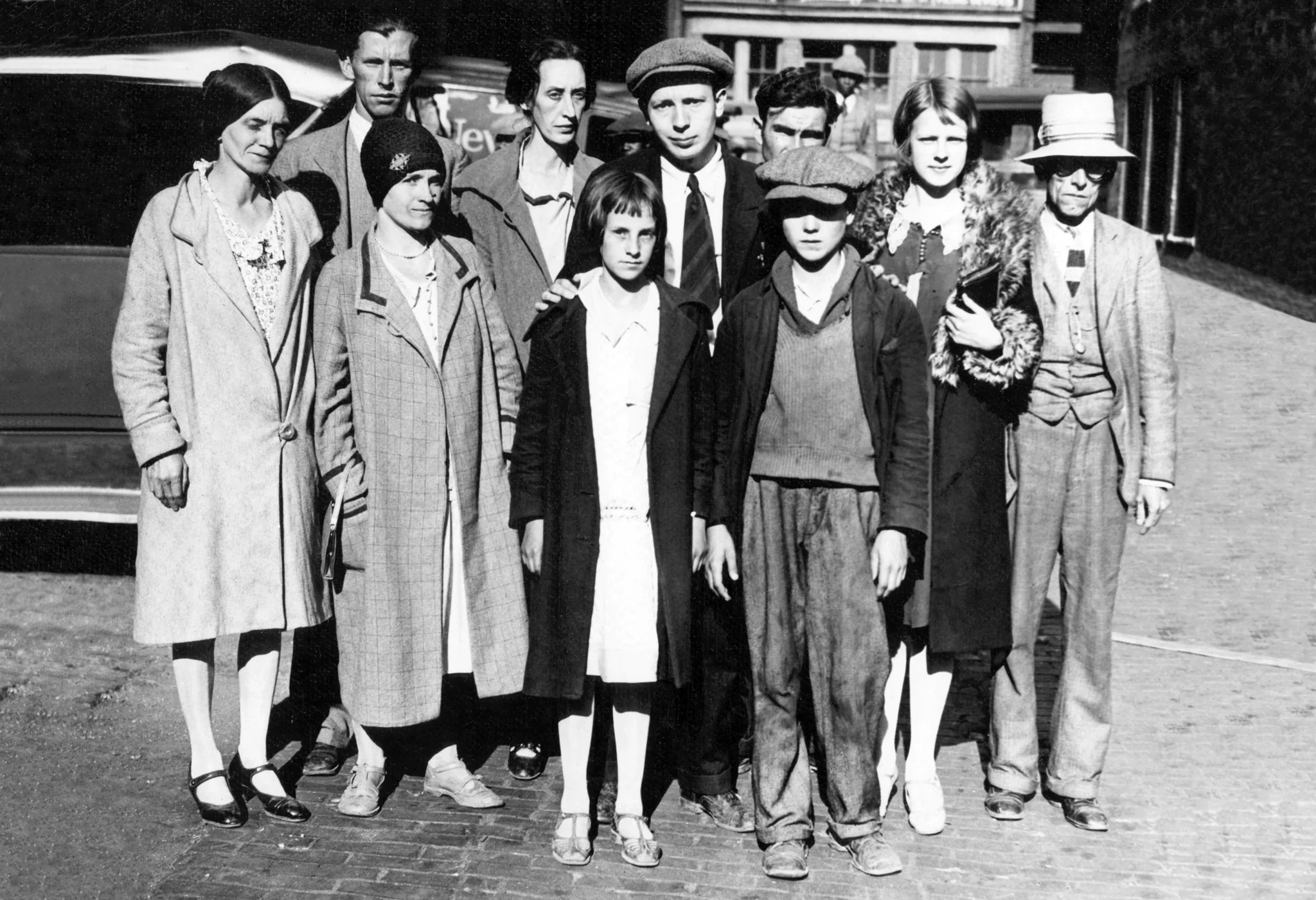
‘Carolina Mill Slaves’ by Harvey O’Connor from New Masses. Vol. 4 No. 12. May, 1929.
“Cotton-tops” and “lintheads,” they are called. The better classes of their own race never speak to them. The prosperous Negro bootlegger despises them.
Pariahs, outcasts! Foreordained to the position of an inferior class because shreds of lint clung to their parents’ shabby clothing. Condemned to live in shacky villages, segregated from the townspeople, from the business people, the clerks, the skilled workers of rail or shop.
That is the sober reality about the 250,000 cotton mill workers of the South. Such is the lot of the Loray mill workers on the outskirts of Gastonia, of workers in hundreds of mills clustered about the cities of the Piedmont or scattered in isolated villages in forlorn places.
Nobody, apparently, cares a continental about the lintheads and the cotton-tops. The “legitimate” unions have nothing but sympathy for them. The mill owners and supervisors regard them as far below a battery of looms or a frame of spindles. The looms and spindles must be kept up, but the workers, run down through generations of wretched peasant life, keep dragging themselves from shack to mill and back again, and that’s the mill stockholders only interest in them. The “better” people of the towns don’t even bother with sweet charity. “Why, they’re just born that way. Why should we do anything about it,” say Christian ladies at their sewing circles.
Who said there were no proletarians in America? Look inside a southern mill village. Look at Henderson, N.C. Men who average $9.50 a week, women who get $6.50 on the average. On Sundays the men wear overalls to primitive methodist chapels, women are dressed in ginghams. Many are unshod. They live in a Cooper mill village on the edge of Henderson. Around the mill runs a wicked barbed wire fence. Through the mill town run devious roads rutted a foot deep. The mill town boasts one telephone, no sanitary toilets, a score or more open wells. In winter the roads are rivulets and battered flivvers sink hub-deep in hopeless mud. The rain and the cold beat upon tar-papered shacks — and win. Water runs in through the roofs, down the walls, between the cracks in the doors.

There are no movies in South Henderson. Not even a drug store. A few old grocery stores stocking sow belly and beans. No fresh milk, no green vegetables. But the wretched collection of hovels called South Henderson have its vices — if no virtues. Down in Moccasin Bottom are wild girls who never could stand the monotony of the whirring spindles. A few bootleggers, too. The God-fearing mill women who go to primitive or holy roller churches complain of the racket down on the Bottom Saturday nights and the goings-on in the shacks.
Gastonia isn’t much different. Just bigger. Instead of three or four mills, Gastonia has 30 or so. The water tanks spot the horizon. Gastonia has an 8-story skyscraper and a daily paper that gives columns to the Chamber of Commerce but never mentions the “untouchables.”
The Loray mill, where the National Textile Workers Union led the workers on strike, lies just outside the city limits. This means the mill doesn’t have to bother with the city cops. Instead its foremen are deputized to keep order. The dirty window-eyes of the 6-storied Manville-Jenckes mill shut in 2,500 workers from the sunshine and the curious passerby.
Women and girls, boys and men trudge into the mill at 7 in the morning. Out they come at 6 in the evening, brushing shoulders will others who will stay by their machines until 6 in the morning, taking 15 minutes off for lunch or munching a sandwich while they work.
Is there a common expression of resignation to a hard, foreordained life in the faces of all these people? So it seems. “Docile, 100% Anglo-Saxon Americans. None of your damned foreigners. These people want to work and they’re willing to turn out a day’s work at a wage a mill owner can afford to pay.” So chant the southern boosters.
The southern boosters are playing with dynamite. Dynamite blows up occasionally. That’s what happened with the Loray mill workers; the South Henderson workers blew up, too, in 1927.
The mill bosses forget that the 100% Anglo-Saxon has produced several loud detonations upon history. There was Wat Tyler and the peasants’ revolts, the Chartist movement, the American revolution, to mention the most resounding explosions. These southern mill workers are an explosive people, hot-headed, handy with a trigger. Especially when they come from the hills. They understand the duty of civil disobedience, and have practised it.
Behind the mill owner’s loud boasts is the very clear understanding that his workers are not so very docile. So the mill owners are careful to organize national guard units. In the Henderson mill strike of ’27, Boss Cooper threw off his business suit when his hands struck and put on his captain’s uniform. He called out his — and the North Carolina — militia. Machine guns and barbed wire entanglements in front of the mill gates, put up by an Anglo-Saxon boss to keep “docile, 100% Nordic” Anglo-Saxon workers from smashing his highly valued spinning equipment into smithereens.
The Manville-Jenckes crowd, who called out the Rhode Island militia to take care of the “wops and hunkies” who struck in Manville in 1926, mustered in five companies of North Carolina militia to handle the Loray strikers. Only 2,500 workers, but there were 2,500 militia men there, armed with field guns, machine guns, gas bombs. Calvary men whose horses would terrify the women and children. Bayoneted, uniformed soldiers.
Then there are the farmers. Most of the mill workers came from the farms, or are only a generation removed. At Henderson, the strikers cried out to the farmers: “We’re hungry.” Cabbages, potatoes, sides of beef, turnips, milk was the answer. Old trucks and mud-spattered wagons drove in from the countryside to Johnson’s store — which occupied the only non-company land in the entire village. The counters were heaped higher than ever they had been when the workers worked.
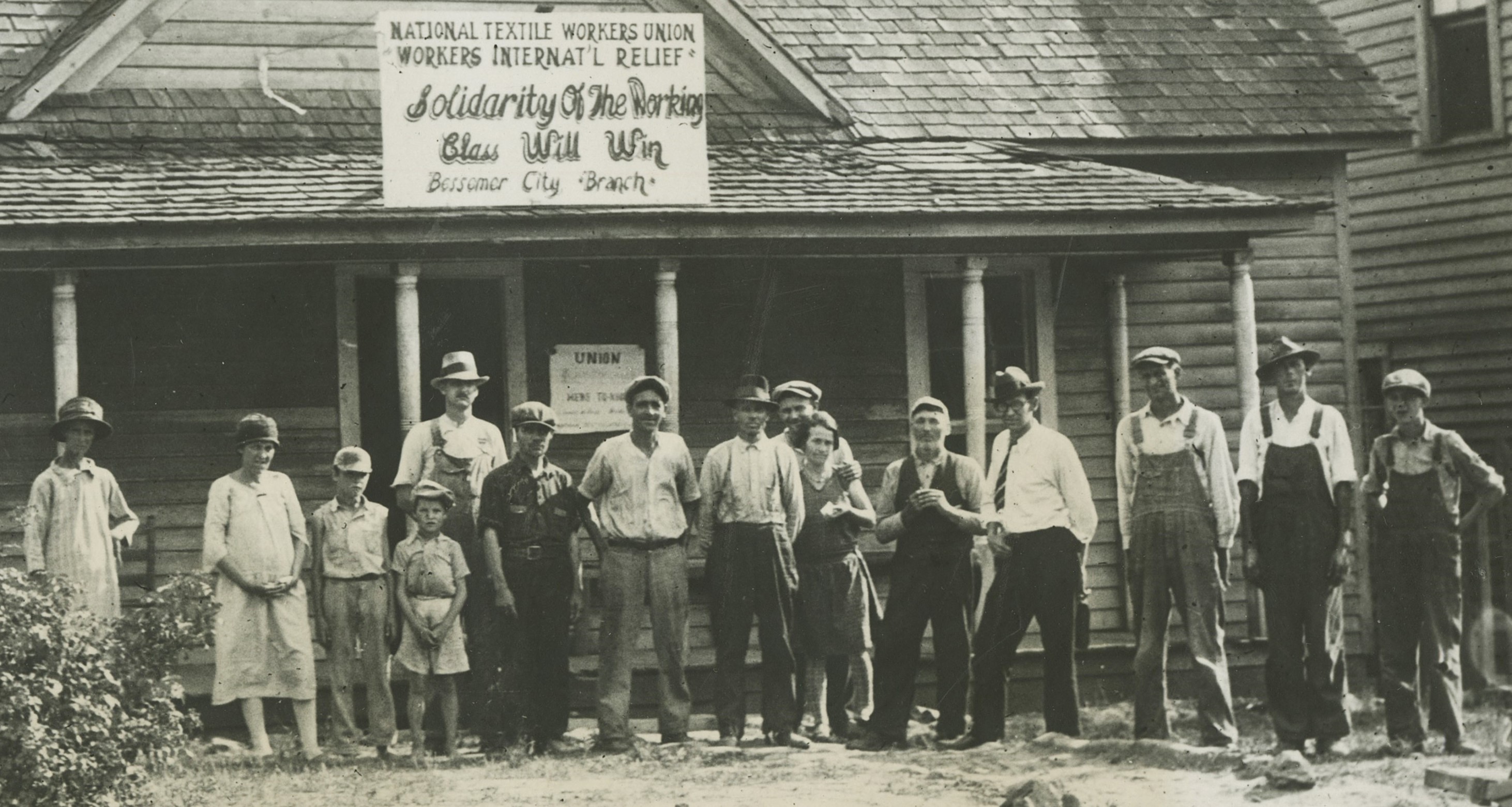
Of course, in that case, there was the hostility of the cotton and tobacco farmers toward the Coopers. The Coopers were not only mill bosses, they also owned cotton and tobacco warehouses, and bought the crops of the farmers. How the farmers hated the Coopers.
Stirring days lie ahead in the Carolina Piedmont. Back in the 1918-1921 period, more than 50,000 mill workers struck, repeatedly. The I.W.W. had much strength around Charlotte and Greenville. Nobody mentioned anything about docile Anglo-Saxons.
Talk to conservative United Textile Workers leaders. “The Southerners are hot stuff,” they will tell you. “Hard to get into action, but when they’re mad, they’re mad clear through.” In Elizabethton, Tenn., in the heart of the mountains where the new $50,000,000 string of rayon plants is being built, a state of civil war followed the successful Glanzstoff strike. Union organizers were kidnapped and run out of town. Armed men in autos patrolled the streets. The organizers came back, with bodyguards. The union office was described as an arsenal. The leading business men formed a vigilante committee.
In the strikes in South Carolina, workers held up trains, stoned mill bosses, barricaded roads, carried guns.
Undoubtedly the southern worker gives the appearance, not so much of meekness, as lack of physical vigor. His eye is lacklustre, his shoulders stooped, his attitude dejected. The terrible devastation of the Civil War, a rotten caste government, lack of leadership, a frightful diet of grease have combined to deplete his vigor. But the eye lights up, defiance springs from mind to the trigger finger. And as for courage, remember it was a Tennessee mountaineer who was acclaimed the outstanding U. S. warrior in France.
The New Masses was the continuation of Workers Monthly which began publishing in 1924 as a merger of the ‘Liberator’, the Trade Union Educational League magazine ‘Labor Herald’, and Friends of Soviet Russia’s monthly ‘Soviet Russia Pictorial’ as an explicitly Communist Party publication, but drawing in a wide range of contributors and sympathizers. In 1927 Workers Monthly ceased and The New Masses began. A major left cultural magazine of the late 1920s to early 1940s, the early editors of The New Masses included Hugo Gellert, John F. Sloan, Max Eastman, Mike Gold, and Joseph Freeman. Writers included William Carlos Williams, Theodore Dreiser, John Dos Passos, Upton Sinclair, Richard Wright, Ralph Ellison, Dorothy Parker, Dorothy Day, John Breecher, Langston Hughes, Eugene O’Neill, Rex Stout and Ernest Hemingway, Artists included Hugo Gellert, Stuart Davis, Boardman Robinson, Wanda Gag, William Gropper and Otto Soglow. Over time, the New Masses became narrower politically and more journalistic in its tone.
PDF of full issue: https://www.marxists.org/history/usa/pubs/new-masses/1929/v04n12-may-1929-New-Masses.pdf
 Revolution's Newsstand