
Led by veterans like George Gilmore and Peadar O’Donnell, a left wing in the I.R.A. split to form the Republican Congress in 1934. Though short-lived, Congress remains a point of reference for the Irish left and socialist Republicans.
‘Left Wing of Irish Republican Army Breaks Away’ by Aodh MacManus from International Press Correspondence. Vol. 14 No. 24. April 20, 1934.
“The crisis is developing in the social democratic parties.”-O.W. Kuusinen, at Thirteenth Plenum E.C.C.I.
Not only in the social democratic parties are crises and disintegration taking place. In the nationally-oppressed countries the petty bourgeois nationalist organisations are in a similar state. The shaking of the foundations of capitalism by the general crisis, the rise of fascism and the upsurge of the workers are having profound effects on these organisations also.
Almost the entire Left-wing of the Irish Republican Army has now broken away and initiated a call for a united front of workers and farmers in the struggle against capitalist imperialism. The crisis has been simmering in the I.R.A. since 1931, when its newly-launched political wing, Saor Eire (Free Ireland), was attacked by the Catholic clergy and banned by the Cosgrave government. Saor Eire was formed as a “Left” party, a halfway house at which the Irish masses were asked to stop instead of going on to Communism. It analysed capitalism as the basis of imperialist rule in Ireland, called for the overthrow of the bourgeoisie and declared for the Workers’ and Farmers’ Republic. Unfortunately for it, the bourgeoisie took it more seriously than some of its sponsors, and it did not survive its baptism of fire. Since then the I.R.A. leadership have not risked burning their fingers again, and have steadily retreated to a “purely military” ́position which in fact meant objective political servitude to the De Valera government and passivity in the face of the Blueshirt fascist menace. In pursuance of this policy, republicans have been kept out of the anti-fascist struggle, leading officers of the I.R.A. gagged by “purely military” orders, and Communist members of the Army expelled on “purely military” grounds.
The revolt against this policy came to a head on April 8, when prominent I.R.A. members and other republicans from many parts of Ireland held a secret meeting at Athlone, and broke with the official leadership by issuing a manifesto calling for a national congress of workers and farmers to plan immediate activity around the slogan of the united Workers’ and Farmers’ Republic.
The statement, which is signed by Peadar O’Donnell, George Gilmore, Frank Ryan, and Michael Price, outlines the position in Ireland as these republicans see it:
“We believe that a republic of a united Ireland will never be achieved except through a struggle which uproots capitalism on its way. We cannot conceive of a free Ireland with a subject working class; we cannot conceive of a subject Ireland with a free working class.”
This teaching of Connolly represents the deepest instinct of the oppressed Irish nation:-

“The republican movement in the Free State area must see that Irish capitalism is the holdfast at this end for the imperial connection and that the forces which defend Irish capitalism are the forces in which the final push for freedom will be called out to maintain the connection with an economy of British lives.
“The lip-service paid to the republic by leaderships that are tethered to Irish capitalism can therefore only confuse sincere republicans and withdraw them from their struggle for freedom.”
The forces to be rallied for the national struggle are declared to be: (1) the industrial working class; (2) the peasant farmers; and (3) the people of the Gaeltacht, the poverty-stricken Irish- speaking western seaboard. The manifesto concludes:
“A congress of republican opinion must be assembled to make the republic a main issue dominating the whole political field and to outline what are the forms of activity to move to its support.
“Into this congress will come anti-imperialists from North- East Ulster, representing sections of workers who have hitherto held aloof from or have even been hostile to the national struggle.
“As the republic when established will be a republic of the workers and small farmers, the forces that will achieve it must be drawn from these sections of our life. In order that these forces may be drawn forward to their task, we, on their behalf, call for a republican congress and pledge ourselves to take up the work necessary to build it.”
The Communist Party of Ireland immediately issued a statement declaring that the revolt of a large section of the I.R.A. is a reflection of the growing discontent alike with the Fianna Fail government and the policy of the I.R.A. leaders; that the policy of the present I.R.A. Council “is one of political servitude to Fianna Fail, complete passivity in the face of the fascist threat, and isolation from the workers’ and farmers’ struggle against the effects of Fianna Fail’s capitalist policy”; and declaring that the Irish Communists will work wholeheartedly for a national republican congress of workers and farmers from all organisations to form the united front against fascist imperialism.
At the same time the Secretariat of the C.P.I. points out “certain important defects” in the “Left” republican manifesto: the failure to name the organisations betraying or hampering the struggle; the avoidance of any indication that the present action means a decisive political break with the I.R.A. Council; and, most important, the obvious uncertainty as to the objectives-whether a united front movement or another political party on the lines of Saor Eire is to be built up.
The most burning need in Ireland to-day is a mass united front movement that will rally the workers and farmers against fascist imperialism and break through the barriers to action erected by the De Valera government and the I.R.A. leadership. Trade unionists, republicans, Labour Party and Fianna Fail supporters, and large sections of the Northern population-the Nationalist population suffering from a renewed persecution at the hands of the Craigavon government, together with thousands of Protestant workers who are no longer deceived by Craigavon’s sectarian Union Jackery–can be won to this united front.
Any attempt to set up another political party, on the other hand, would destroy the possibility of such a united front, and reduce the National Congress to the unrepresentative farce that launched Saor Eire. There is no place for another party “catering” for the workers and farmers, but not springing from their ranks. The party is the supreme representative and leader of the class. For every class there can be only one leadership, one theoretical direction; for the working class that leadership and direction can come only from revolutionary Marxism, from the Communist International and the Communist Party. Any other party at this stage in Ireland could be established only as a barrier between the masses and the Irish Communist Party, and the C.P.I. would fight vigorously any such attempt. It is clear that a section of the leadership of the breakaway have such a perspective; they must be warned that they will be opposed and defeated on this issue.
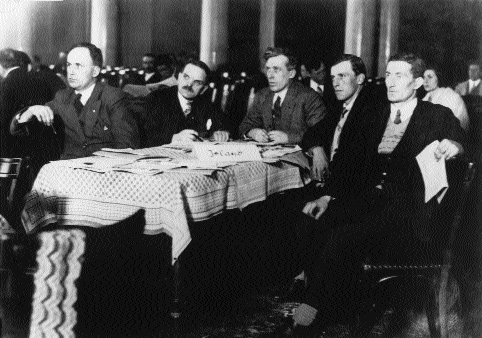
Irish Communists, militant workers and sincere republicans must see that the National Republican Congress fulfils its purpose: to rally the workers and farmers of all organisations for the immediate tasks.
The Communist Party of Ireland calls for energetic work to ensure that the working masses, North and South, and of every organisation, are represented fully at the Congress. In the words of the Secretariat of the C.P.I., “the Congress must be the biggest hosting of anti-imperialist working men and women this country has seen since the Anglo-Irish war.”
International Press Correspondence, widely known as”Inprecorr” was published by the Executive Committee of the Communist International (ECCI) regularly in German and English, occasionally in many other languages, beginning in 1921 and lasting in English until 1938. Inprecorr’s role was to supply translated articles to the English-speaking press of the International from the Comintern’s different sections, as well as news and statements from the ECCI. Many ‘Daily Worker’ and ‘Communist’ articles originated in Inprecorr, and it also published articles by American comrades for use in other countries. It was published at least weekly, and often thrice weekly. Inprecorr is an invaluable English-language source on the history of the Communist International and its sections.
PDF of issue: https://www.marxists.org/history/international/comintern/inprecor/1934/v14n24-apr-20-1934-Inprecor-op.pdf
 Revolution's Newsstand