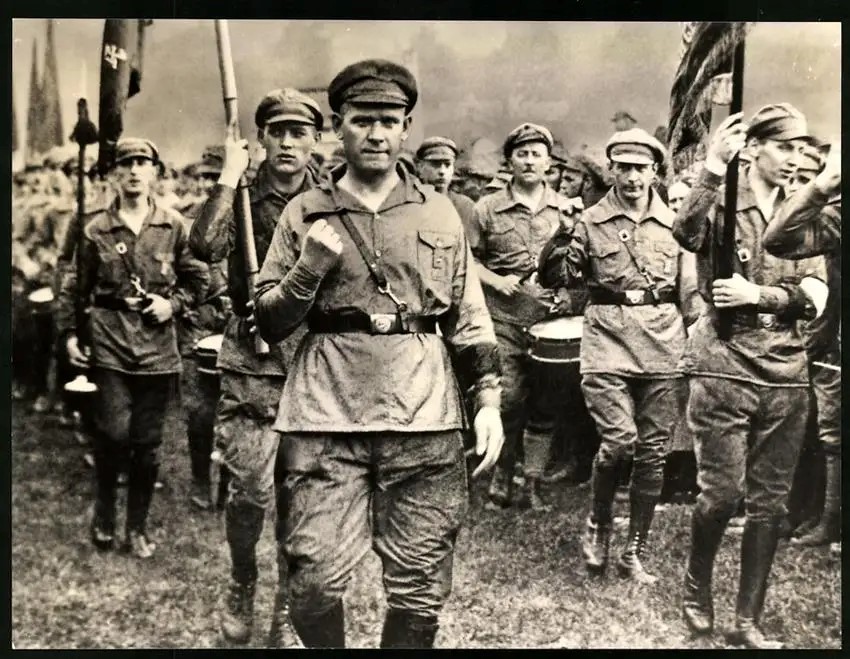
The Roter Frontkämpferbund, Red Front Fighters League, was initiated by German Communists in 1924 to defend their movement from fascist attacks, becoming a national organization headed by Ernst Thälmann the following year when William F. Kruse was in Germany, sending this report on the new R.F.B.
‘The “Red Front” of the German Communist Party’ by William F. Kruse from The Daily Worker Saturday Magazine. Vol. 2 No. 295. December 26, 1925.
GERMAN Communist papers, like those in America and elsewhere, devote much space to the activities of various working class organizations, Party, youth section, trade union, co-operative, sport club, women’s clubs–all these are well night universal. But one form of organization activity seems confined thus far to the kaiser’s old recruiting ground, and that is the Red Front Fighters Bund. This organization’s activities fill columns of space in the Communist Party press, and they send shivers down the editorial spines of the reactionaries.
Every day and every night one finds the Red Front Fighters in meetings, parades, demonstrations, literature distribution and fights. Reactionary leaders in the reichstag demand their suppression, even at a time when the party itself enjoys a nominal legality. The sometimes flippant attitude of some old party leaders toward this movement was one of the major points in their recent indictments by the Comintern. The R.F.B. figure prominently in present party discussions. Good or no good? Permanent or ephemeral? What really is this much-discussed “Rote Front”?
COME to a Communist municipal election meeting. A block away, on every intersection, one sees an unobtrusive young idler with a bicycle. He wears distinctive yet not uncommon garb, a green-gray linen jacket and a peaked cap. Look close in the darkness and you will see a red arm- band, embroidered in black worn low down on the right sleeve. The youngsters stand there for hours, motionless–except for their ever-roving eyes–until the nearby meeting is over.
The “Red Front” on the Job. In front of the hall, the ever present half dozen or more policemen. But in the entrance, between police and meeting hall, fifty or more young huskies, all in the same distinctive garb. And in the hall, especially toward the rear where are the entrances; several hundred more. One of their number almost invariably makes a speech from the platform. Their red flags mingle with those of party units and the youth section. Their cheers are loudest.
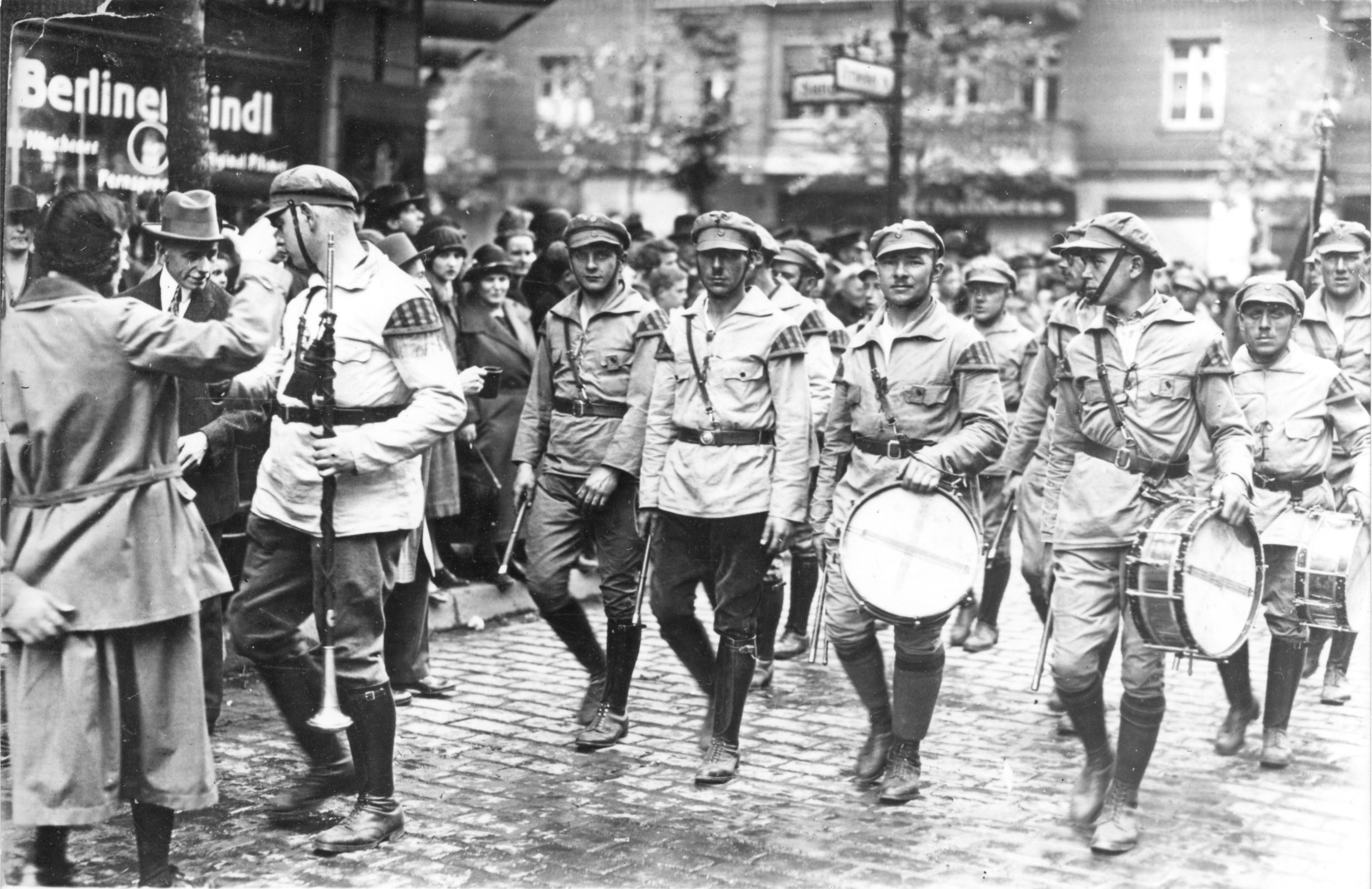
The meeting is over. Masses of workers leave, but stand around the entrance. The police make no move to disperse them, just yet. Music from the hall, a band, and several hundred strong, well-trained voices singing a Red Army song. They march out into the street, four abreast. Hundreds of bystanders join the procession which, with song and drum corps music, winds thru the streets for an hour or more before finally it disbands in front of headquarters. After the parade has gone a block or more from the hall the sullen police disperse the remainder of the crowd. It goes unresistingly now that it vanguard is no longer there.
A HOTLY contested working class section. A long fence covered with Communist posters. Elsewhere we have seen many posters torn to shreds by supporters of rival parties. But not here. Look closely and you will see a goodly number of R.F.B. ready anxious for action. The posters stay put. The workers read them. Communist prestige and confidence soars.
This fighting organization already numbers many more thousands than the plutes like to think about. It would be undesirable to say just how many thousands, but one group in a single section of Berlin grew from 40, all Communist members, to a full battalion of over 2,000 men with Communist members constituting less than 40 per cent, besides a junior auxiliary, the “Roter Jungsturm,” in which the Communists constituted only 10 per cent. Uniformed, drilled, organization for struggle, not only willing but anxious to fight–no wonder the reactionaries are becoming alarmed.
Not “Made in Moscow.”
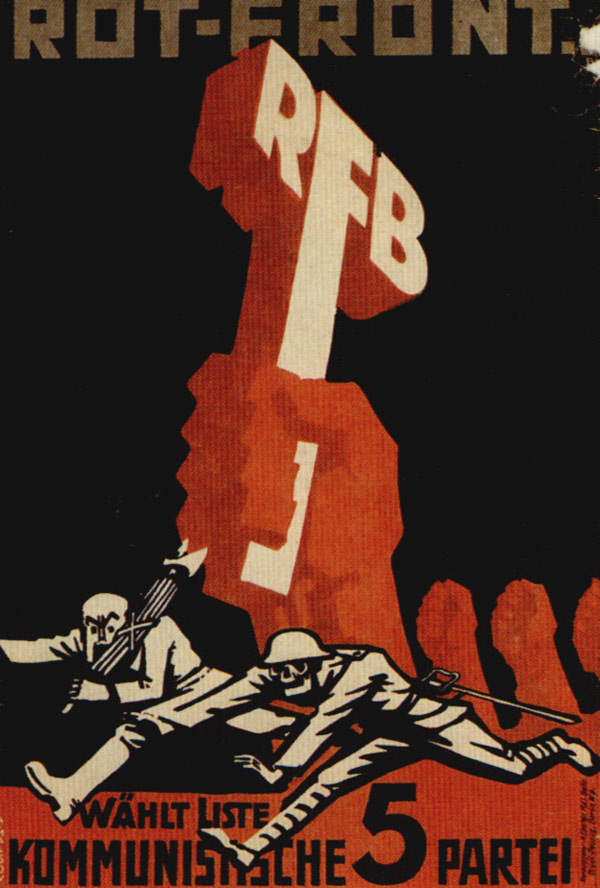
THIS movement was not built to order. It was not “made in Moscow” in the sense that our enemies charge, but its inspiration is certainly found in the sacrifices and struggles of the Russian proletariat. This is a spontaneous defensive movement of the working masses, and the Communists by carrying out their historic mission as the vanguard of the workers in their every struggle have won hegemony over it and now have the tremendous benefit. As soon as the Dawes plan stabilization resulted in partial employment and a subsiding of the revolutionary wave, the various fascist bands became more and more brazen in their attacks on the workers. The more militant elements were singled out for discrimination–Communists and other militants, precisely the elements that could fight back, tooth and nail. Right out of the shops and factories this defensive shock troop of the proletariat sprang forth, and the Communists gave it full support and encouragement, Thaelmann, Communist Party presidential candidate, became its honorary commander. From a few handfuls it grew into the thousands and tens of thousands, the cream of the working class and especially of the working youth.
Disarm Fascists.
The “strong-arm squads” of the fascists were disarmed, spanked and sent home when they came around to administer punishment to some local strike leader. The perfect discipline and martial bearing of these thousands of militant proletarians gave new courage to the workers and threw consternation into the camp of the enemy. And well they might. During the summer groups of from ten to a hundred hiked out into the country distributing literature to the farmers and villagers. About twenty of our boys came upon as many fascists secretly engaged in army rifle target practice, made a surprise attack, disarmed and marched them back to the village police station, to the great delight of the workers who had been terrorized for months by this band. And at the same time another 40 more armed fascists had been hiding in the woods only a short distance away but they did not dare to attempt a rescue.
Things do not always come off so easily, however. In Leipsig recently the monarchists of all Germany staged a tremendous militarist demonstration. The Communists called for a counter-demonstration but the social-democratic leaders refused and called upon their followers to “ignore” the reactionary hordes. There were many clashes between our young militants and the armed bravos of the monarchists, two of our boys on point of death from bullet wounds, and many others injured. Many arrests were made on both sides, but all the forbidden arms were found on the fascists. The R.F.B. in such cases as this makes tremendous propaganda by calling for a united front of all working class elements in shops and factories to fight back this anti-labor violence, and despite the crawfishing of the right wing labor leaders the working masses respond to the call to fight.
The United Front in Practice.
It is not easy for these Communist veterans of the barricades of 1918 and 1923 to stomach unity with the very elements which, duped by their traitorous leaders, made futile the sacrifice of the revolutionary vanguard. But a new ferment is working among these masses, no longer can they be so easily herded by their bosses in the interest of the plutes; more and more they are beginning, if not actually to get into this big proletarian mass Communist Party, at least to cooperate actively with its activity on the field of workers’ relief, Red Front, workers’ health, sport, youth protection, factory committees, trade union committees, etc. So the Communists are learning that alongside of an implacable hatred for the pink-clad bourgeois lieutenants of the social-democratic party they must maintain a very different attitude toward the masses of simple and honest proletarians who make up their following.
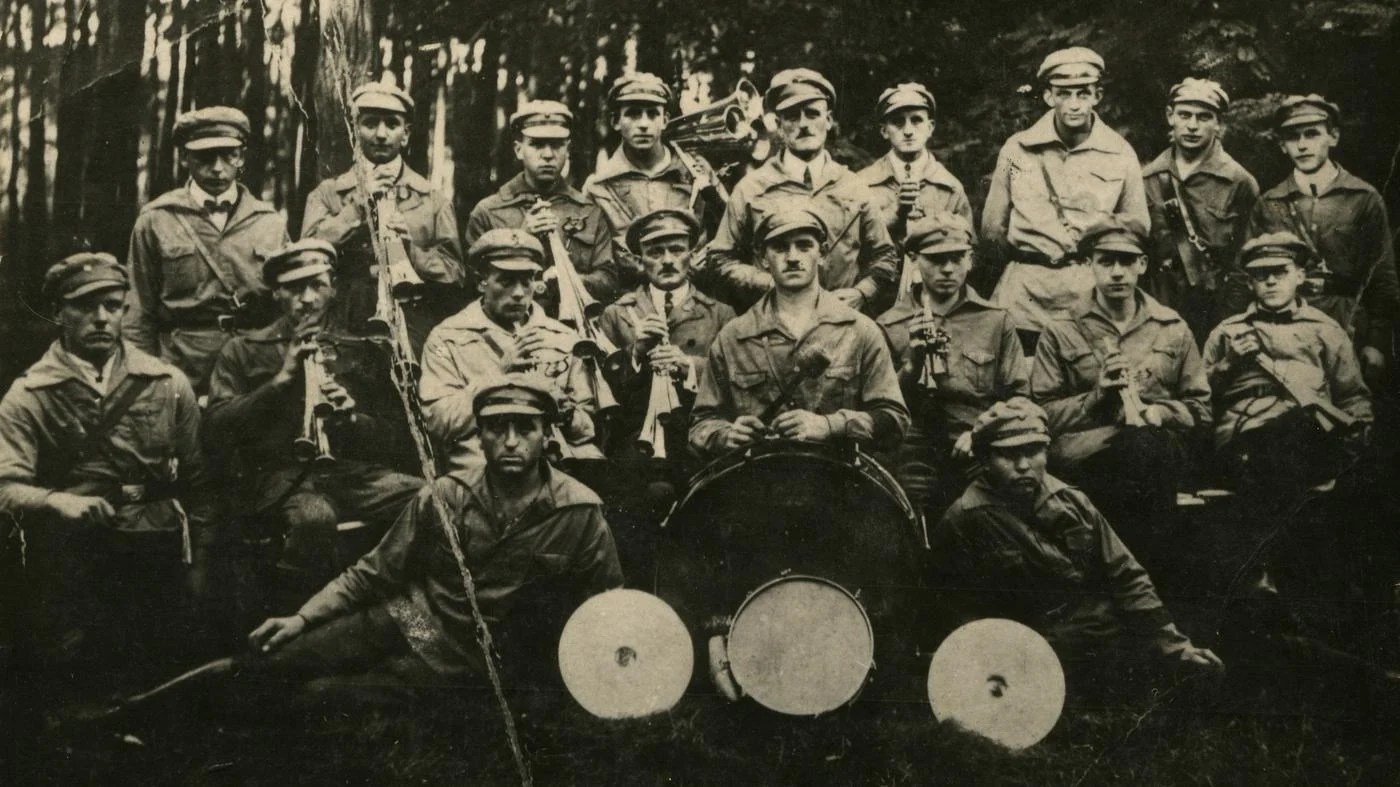
This attitude was graphically illustrated when, in the course of a Red Front homeward march, we encountered a band of perhaps sixty young republicans under strapping military leadership and with silken black-red-gold banners flapping over their heads. We, uninitiated, expected a clash, but the two groups contented themselves with singing the louder–with all the advantage on the side of the Communists. Very different is the attitude when a detachment of Stahlhelm, Jungdo, Werwolf or other black bands are encountered! It is this stand, in line with the new political policy of the party as illustrated in proposing a united front of all workers’ parties in the recent elections, that is making it constantly harder for the labor lieutenants of the bourgeoisie to keep the masses away from cooperating with the Communists for the realization of everyday working class needs.
The Critics Get Chills.
The masters are very much perturb- ed over this situation. The Madgeburger Zeitung writes:
“The whole organization is militaristically constituted. They have a ‘Manual at Arms’ with report, execution and saluting regulations. In the place of the greeting by touching the hand to the headpiece they substitute the threatening ‘proletarian greeting’ of the raised clenched fist. The divisions are set up on military pattern. A ‘Gau’ is equivalent to a division or army corps, a city section to a regiment.
And they charge that in addition to public marching and gymnastics the members receive secret instructions in the use of all manner of war weapons, which obviously presupposes secret stores of arms to be used at the decisive moment. The R.F.B. neither affirms or denies these conjectures, but adds to them a satiric tale of how, after legally registering their society in Germany and passing muster before General von Seckt, they chartered the Stinnes steamer Karl Legien and with 100,000 men went first to China and then to Morrocco to help Abdel-Krim whip the French.
IT should be mentioned that criticism of the R.F.B. is not altogether confined to the capitalists; pacifists and anarchist elements view with alarm the strict discipline and perfect organization–the very features which give such splendid promise of effectuating a coming proletarian dictatorship. And occasionally even a party member cocks a skeptical eyebrow at this “playing at soldiers,” disregarding entirely the effective immediate physical protection it affords to Communist Party activity, as well as the political value of its united front among the young factory workers, its organizational mobilizing of all militants, and its training of the manpower for coming open combat. That the responsible party leaders and the Comintern do not share this viewpoint has already been made clear.
As for their “Prussian cadaver discipline,” they answer very indignantly that their discipline is self-imposed, and as democratic as it is necessary. They challenge their critics to test this by personal observation. The reply is entirely proper; nowhere has there been so perfect an esprit-de-corps between leader and ranks. There is good reason for this because all leaders rise out of the ranks thru demonstrated fitness. Every member is a potential troop leader. Just before disbanding a parade a young leader wanted to show off his prowess by some special fancy marching. His second command was incorrect and a roar of laughter went up from the ranks, and he himself joined in it, admitted his mistake and stepped back into the ranks to make room for the next candidate leader. Here truly, as Napoleon promised, “every private carries a marshal’s baton in his knapsack.” (But in a different, a very different sense).

THERE is some little romantic exaggeration in demeanor of an occasional Red Front Fighter. Why worry! Heroics are ever a temptation, especially to young scrappers. Thus an R.F.B. courier enters an office and salutes, fist up, Red Front! He is answered in the same way and the following colloquy allegedly takes place:
Q. “Who are you?”
A. “Rote Front.”
Q. “What do you want?”
A. “Rote Front.”
Q. “Who sent you?”
A. “Rote Front.”
Q. “Where are you going?” A. “Rote Front.”
This is not impossible if the conversation took place in the printshop and the lad had come from his headquarters to get some papers and take them back there.
Hail, German Red Guard.
A FINE crowd. Kin to the Red Guards of the Russian revolution, to which they love to liken themselves, and whose songs they sing and traditions they keep. The struggle in Germany is already only slightly concealed open warfare, and these are labor’s own battalions. He who puts on this Red Guard uniform is a marked man ever after; he literally takes his life into his hands. Yet thousands of the very best elements of Germany’s proletariat–men and women on equal footing-are enrolling for the open fight. They march along the streets, proudly singing praise to the Russian revolution and death to capitalism and its servants. And they do not require a thousand or a hundred before they will march–two or three will do. A new code of honor-revolutionary honor. A new discipline–iron-revolutionary discipline. Thoroly prepared–always ready–waiting and working for a new day–the Red day.
Even now they prepare for their coming role. Out in a little manufacturing city of Furstenwald, two hours by train from Berlin, the local police had distinguished themselves by crass brutality against the workers. In reply the R.F.B. decided to institute in that city a Red day. Announced thru the press and the organization connections the night before found troop after troop of Red Front Fighters of the whole district bound for the marked town. The big Gesellschaftshaus with its four halls was converted into their barracks. All Sunday morning more and more arrived until when the parade assembled it numbered more than 8,000 and took twelve minutes to pass a given point. How proud the workers were to come out with red rosettes in buttonholes and to flying red flags from their windows.
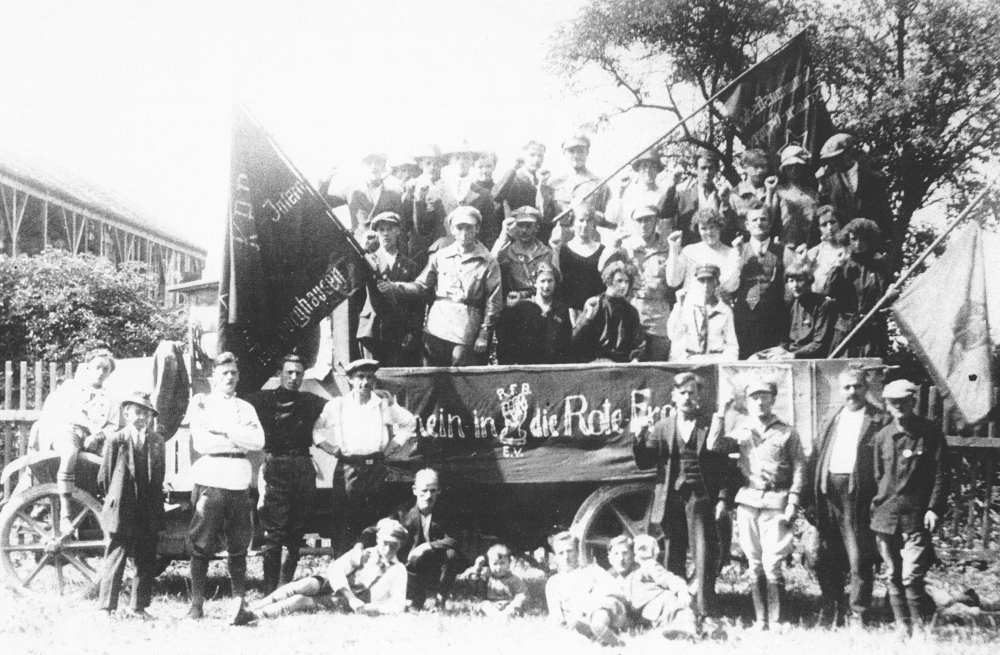
The Red Front of the workers held that town in its own hands. The bourgeois did not venture out of doors until after the ceremonies were over, until speeches were finished and banners were presented. Truly a Red day. And symbolic of the time that is coming when similar proletarian hosts will be similarly all-powerful everywhere in Germany.
The Saturday Supplement, later changed to a Sunday Supplement, of the Daily Worker was a place for longer articles with debate, international focus, literature, and documents presented. The Daily Worker began in 1924 and was published in New York City by the Communist Party US and its predecessor organizations. Among the most long-lasting and important left publications in US history, it had a circulation of 35,000 at its peak. The Daily Worker came from The Ohio Socialist, published by the Left Wing-dominated Socialist Party of Ohio in Cleveland from 1917 to November 1919, when it became became The Toiler, paper of the Communist Labor Party. In December 1921 the above-ground Workers Party of America merged the Toiler with the paper Workers Council to found The Worker, which became The Daily Worker beginning January 13, 1924.
PDF of full issue: https://www.marxists.org/history/usa/pubs/dailyworker/1925/1925-ny/v02b-n295-supplement-dec-26-1925-DW-LOC-fixed-p1-p2.pdf
 Revolution's Newsstand