
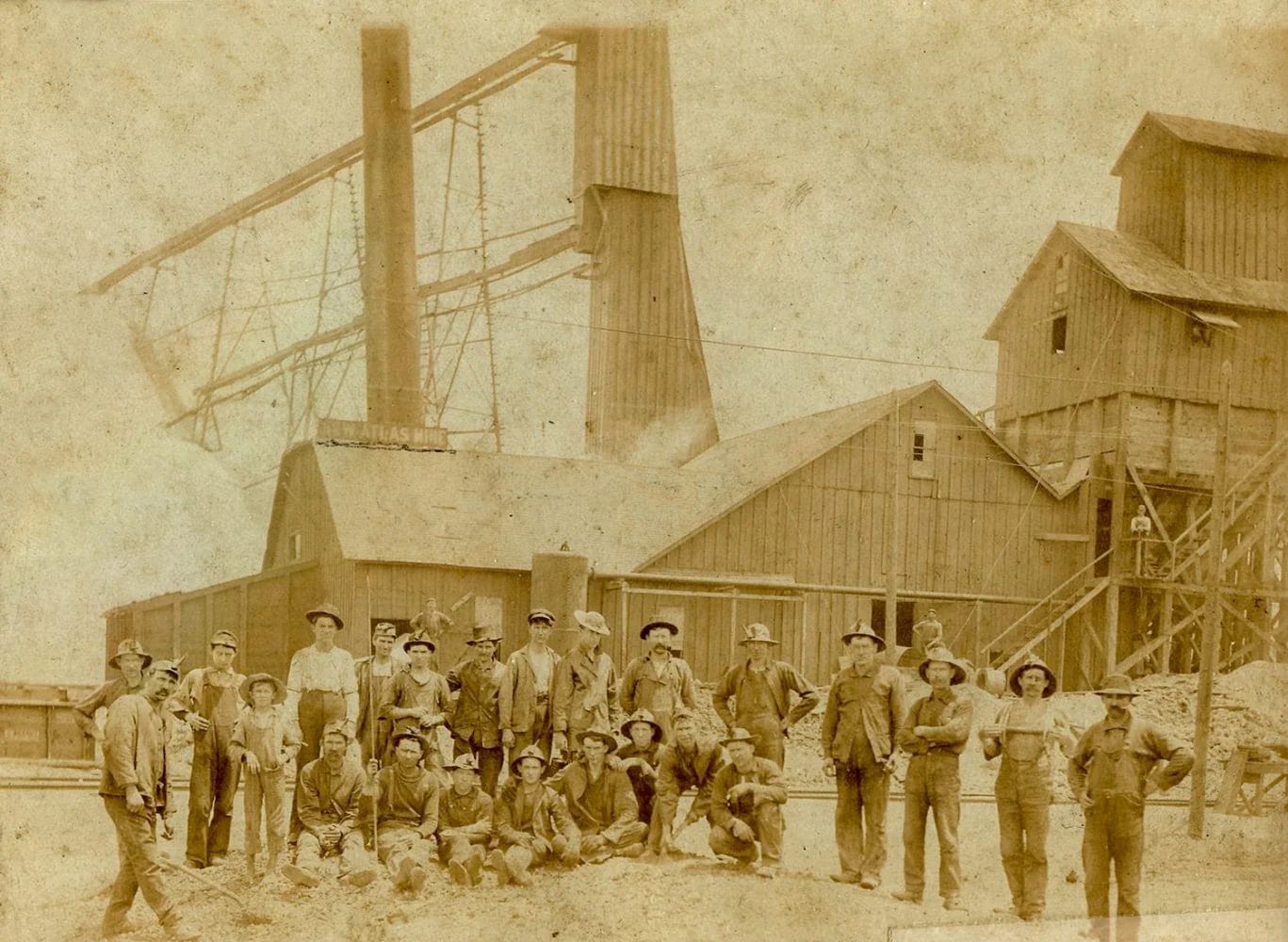
While the I.W.W. was never able to organize the large industries and found it hard going in the big cities, it was capable of reaching places no other union could. A few hearty wobblies set to work organizing Webb City, Missouri, a town in the southwestern lead and zinc mining region, as the U.S. prepared to enter World War One.
‘Webb City I.W.W.’ by Jack Nella from Solidarity. Vol. 7 No. 327. April 15, 1916.
(Special to Solidarity) Webb City, Mo., April 8. This city, like many others of its size, has at last been invaded by an unwelcome host. Unwelcome to the exploiters, at least. The “pesky go-about” the wobbly, the dynamic specimen of laboring manhood has at last firmly anchored himself in this so-called “scab infested” region. Glory be.
Sometime about January 5 a fellow appeared in Webb City. He came from somewhere in Northern Missouri, and was supposed to have brought hiss home with him, judging by the looks of expectancy on the jib of the folks hereabouts.
Stories to this effect were circulated among the “jack miners,” who turned out en masse to see this sight. Their curiosity simply had to be satisfied, even though they should be doomed to disappointment. They came, they saw, and the vision conquered. The monstrosity was only a man.
After three months of systematic agitation, conducted for the most part through individual contact with prospective members, a strong I.W.W. local has been established. Hall meetings have been a feature of the work, good crowds attending all those held to date. Educational subjects, such as pertain to the needs of our class, have been the only kind handled by any speaker, all others being taboo wholly.
The operators have learned to have a wholesome “fear (?)” of the metal miners and smeltermen. They seem determined to let us run our course, to see how far we will go. They seem to take the whole affair as a huge joke as yet. They are confident that the camps cannot be lined up. They have seen the independent union fail, as well as the W.F. of M., who recently sent in their charter. They have recourse, so they inform us, to the foreign laborer. They have harped upon this bugaboo until they are certain, in their own minds that the slaves in the zinc fields will not place their jobs in jeopardy by joining the most hated of all unions, the I.W.W. The slaves, meanwhile, are biding their time. Those who have lined up are not in the least dubious concerning the ultimate outcome of all this agitation. Optimism reigns supreme in the minds of the miners, who will not be content until a portion of the masters’ profits has been added to the slender-looking pocketbook of those who produce.
On the evening of April 6th, street agitation started. Fellow Worker Biley broke the ice, followed the next night by Fellow Worker Jack Allen. A good crowd responded to our efforts. Interest was everywhere manifest, and the announcement that the meetings were to be continued met with general approval.
A meeting was held in Johnstown, a suburb of Cartersville, on the evening of April 7th, Riley on the box. Someone, who is said to be an ex-bull, took exception to his remarks, and informed him of the fact that content was his (the ex-b.’s) long suit. Riley informed this specimen that the world was wide; he was under no obligation to remain, and that in the event of a fracas resulting, the I.W.W. would probably do as they had always done, police their own crowd. “John Yap” seemed to be suddenly stricken with a case of cold feet, for no trouble ensued. Riley put the matter up to a vote of the crowd, resulting in a unanimous “aye.” Diplomacy, in this case, won out.
All members are urged to pay the local a visit when passing through. Office is located at 110 Dougherty St., where the latest dope on revolutionary matters can be had. “Work is good, wage poco, conditions for the present are tolerable.”
JACK NELLA
The most widely read of I.W.W. newspapers, Solidarity was published by the Industrial Workers of the World from 1909 until 1917. First produced in New Castle, Pennsylvania, and born during the McKees Rocks strike, Solidarity later moved to Cleveland, Ohio until 1917 then spent its last months in Chicago. With a circulation of around 12,000 and a readership many times that, Solidarity was instrumental in defining the Wobbly world-view at the height of their influence in the working class. It was edited over its life by A.M. Stirton, H.A. Goff, Ben H. Williams, Ralph Chaplin who also provided much of the paper’s color, and others. Like nearly all the left press it fell victim to federal repression in 1917.
PDF of full issue: https://www.marxists.org/history/usa/pubs/solidarity-iww/1916/v7-w327-apr-15-1916-solidarity.pdf
 Revolution's Newsstand