
Of interest to anyone who has ever been a teacher….or a student. The then leader of the C.P.’s Junior Section with an explanation for the new methods employed by comrades leading preteens; playing games to learn about the class struggle, guiding without orders, and occasionally running riot. In 1924, a twenty-year-old Shacthman, himself a ‘red diaper baby’ who had been in the Y.P.S.L., was working full time for the Communist Party’s Young Workers League as head of its Juniors section, and editor of both ‘Young Worker’ and ‘Young Comrade.’
‘Leading the Junior Groups’ by Max Shachtman from the Daily Worker Saturday Supplement. Vol. 2 No. 210. November 22, 1924.
THE leader of the Communist children’s groups is not a teacher in the sense that one considers the instructor in the modern capitalist school. Far from it! His task and purpose is the organization of the working class children to an understanding of the struggle that is going on right in the midst of life, arousing the children to the necessity of being a participant in the great battle for proletarian freedom. And for this task it is not necessary to be equipped with an erudite knowledge of the educational theories and methods of the bourgeoisie. Quite the contrary–it is too often a positive hindrance. The purpose of all bourgeois education is the preparation of the child to be a part of social life, which today means the training of good, efficient, but none too intelligent wage workers. The Communist junior groups train the child to fight against bourgeois influence in education, and the system that it supports.
A Leader’s Requisites.
What is required of a leader of a junior group is a simple understanding of the aim of the Communist movement and the desire to enroll the children into the ranks of the revolutionary workers, accomplishing this task without resorting to any of that dish-watery sentimentality and christian humanitarianism from which the youth is relatively free, but the use of which has so effectively killed off any good that the socialist Sunday schools ever produced. The leader must be able so to obscure the fact of his “leadership” as to develop the initiative of the children, stimulate the spirit of freedom and solidarity and independence of external direction to the extent that the groups arrive at the point where the children are themselves the judges, the legislators and the executives.
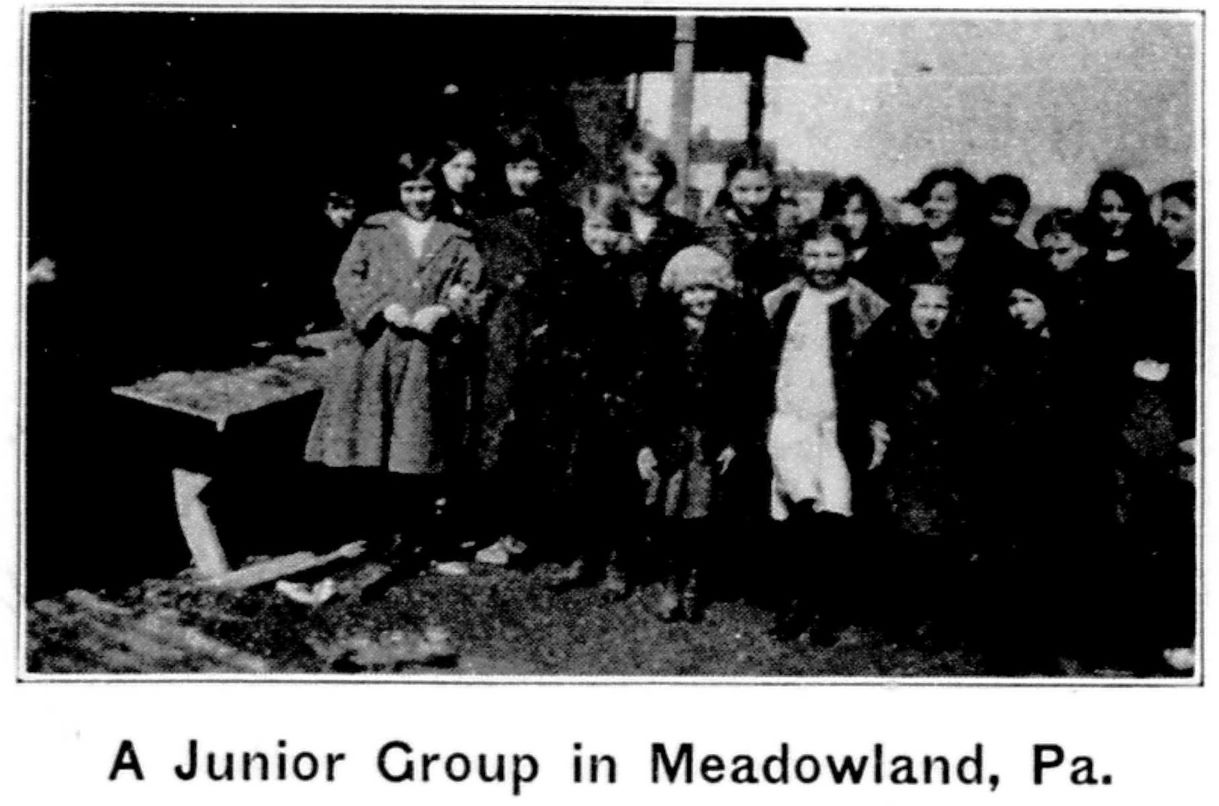
But here the cry is raised: What! Let a bunch of kids run loose? Permit them to run things to suit themselves? Why, that’s independence run riot!
And the cries of indignation are drowned in the angry spluttering of the protester.
But wait, dear adult. It is here that the leader of the groups enters, and in a most inobtrusive fashion. Let us admit that the children, when left to themselves, are inclined to conduct, themselves in a rather “riotous” manner, not according to Robert’s rules of order. It is the task of the group leader to direct this superabundance of energy into the channels of Communist activity or education. This must be done without leaving the impression upon the child that such a thing must be done because the group leader has said so.
Free Play to the Children.
Do the children want to play games? Very well, there are already a number of games that bring home to the child the message of the class struggle, games which are being played by large numbers of children with enjoyment and profit. Do they want to sing? Excellent! A singing proletariat is a marching proletariat. And instead of singing of the fact that it isn’t going to rain any more, the children soon learn and sing with enthusiasm the parody: “The capitalists ain’t going to reign no more” with at least a dozen verses of their own composition.
Would they like to hear a story, as absorbing as any fairy tale ever was? Let them gather around the group leader who has learned the value of studying and repeating the stories of the lives of working class heroes: Spartacus, Danton, John Ball, Lenin, Karl Liebknecht, Rosa Luxemburg, Wesley Everest, Joe Hill–their name is legion; or else he can relate some tale of heroism of revolutionaries in underground Russia, the armed march- es of the West Virginia miners, and the thousands of other incidents that abound in the pages of working class history thruout the centuries.
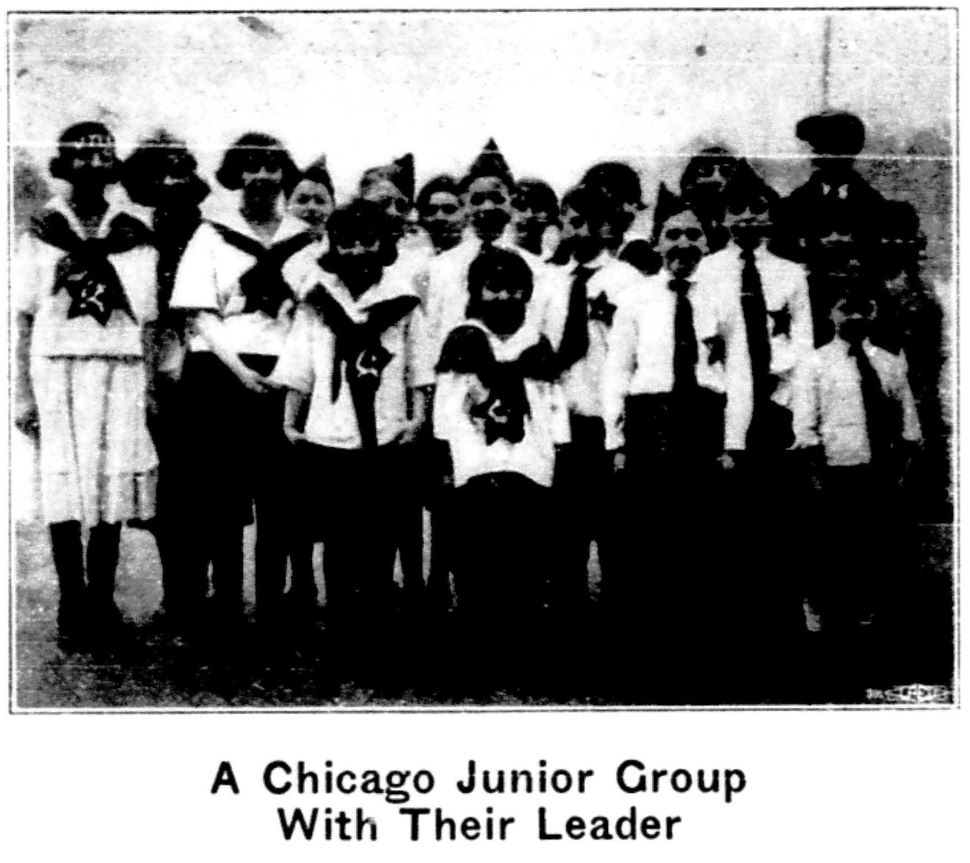
Occasionally the leader will take his group on a tour thru the rich residential district and then thru the section of the city where the workers live, and permit the child to draw his own conclusions from the contrast. A day spent in the woods, or in the country is of great value, not because it takes the child away from his sordid environment, but to develop the spirit of united work, to build their bodies, and skillfully to inculcate in their minds the difference between the boy and girl scouts whom they meet on the way, and ourselves. Games, sports, plays, socials, all can be made to serve as aids in the development of class consciousness, revolutionary solidarity, and the creative individuality of the child in the interests of the common weal.
Even in so small a matter as the wish of the children to chalk up sidewalks or buildings can be turned to good use. The leader will suggest that they chalk up announcements of their meeting, or slogans of any campaign in which the Communist Party, or the junior groups are engaged. And it is quite probable that questions will follow, giving the leader the opportunity to draw from the children the reply to the questions they themselves have asked.
No Orders.
The leader of the junior group, if he knows his real function, will never order anything to be done, not even if the order to the children is that they should do things themselves. The children will learn to organize themselves upon an independent basis. When they learn that there is something to be done, it will naturally develop that some division of labor is necessary in order that the task be accomplished.
If writing is necessary, the one or two or three children who are best fitted for the work will usually volunteer or be chosen. If it is required that a certain job be done in various parts of the city, directions will inevitably be issued assigning certain little comrades to particular places. Slowly but with certainty the functions of the group secretary, treasurer, organizer, literature agent, sports and social director are crystallized and apportioned among the members. The group leader has achieved his purpose without having laid down the law.

The members of the young Communist leagues have proved to be more capable group leaders than have the adults for the following three general reasons: First, they are more adapted to the special characteristics of the child’s psychology; second, they are not burdened with any “non-political and humanitarian” inclinations; and third, being members of the young Communist league, they know better than the adults the necessary preliminaries for the training of the child to become a member of the revolutionary youth movement. In the group leader of today, training the child for membership in the ranks of the revolutionary proletariat, can be found the seeds of the pedagog of the future. While his task is different from that which will be undertaken by the teacher of our youth in the Communist society–insofar as at present the question is a political one, of the class struggle still, the method of education and leadership is a symbol of the methods that will be followed in the classless society. stead of having our teachers as the willing or unwilling tools of capitalism, bound and gagged by the dead hand of the master class, imbuing the child with the ideas and ideals of a slave, the future brings the free teacher of free children. It brings the teacher and the child released from the prostitution of mind and body, freed from the mental cringing and servitude imposed by an unscrupulous ruling class. It presages the new society and the new education.
The Saturday Supplement, later changed to a Sunday Supplement, of the Daily Worker was a place for longer articles with debate, international focus, literature, and documents presented. The Daily Worker began in 1924 and was published in New York City by the Communist Party US and its predecessor organizations. Among the most long-lasting and important left publications in US history, it had a circulation of 35,000 at its peak. The Daily Worker came from The Ohio Socialist, published by the Left Wing-dominated Socialist Party of Ohio in Cleveland from 1917 to November 1919, when it became became The Toiler, paper of the Communist Labor Party. In December 1921 the above-ground Workers Party of America merged the Toiler with the paper Workers Council to found The Worker, which became The Daily Worker beginning January 13, 1924.
PDF of full issue: https://www.marxists.org/history/usa/pubs/dailyworker/1924/v02a-n210-supplement-nov-22-1924-DW-LOC.pdf
 Revolution's Newsstand