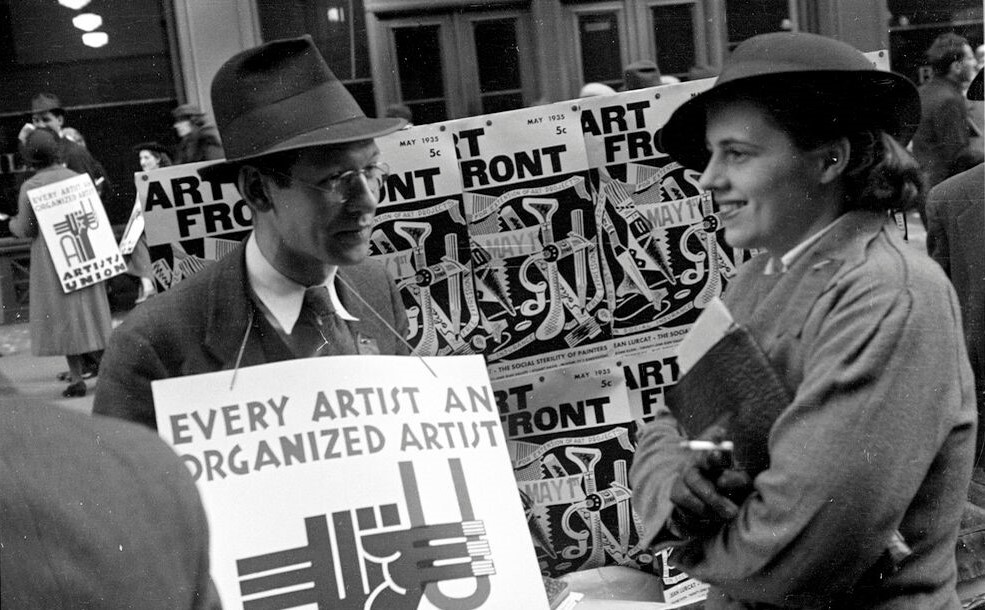
A full report of the convention including the agenda, decisions made, resolutions passed, and structure defined.
‘Eastern District Convention of the Artist’s Union’ from Art Front. Vol. 2 No. 7. June, 1936.
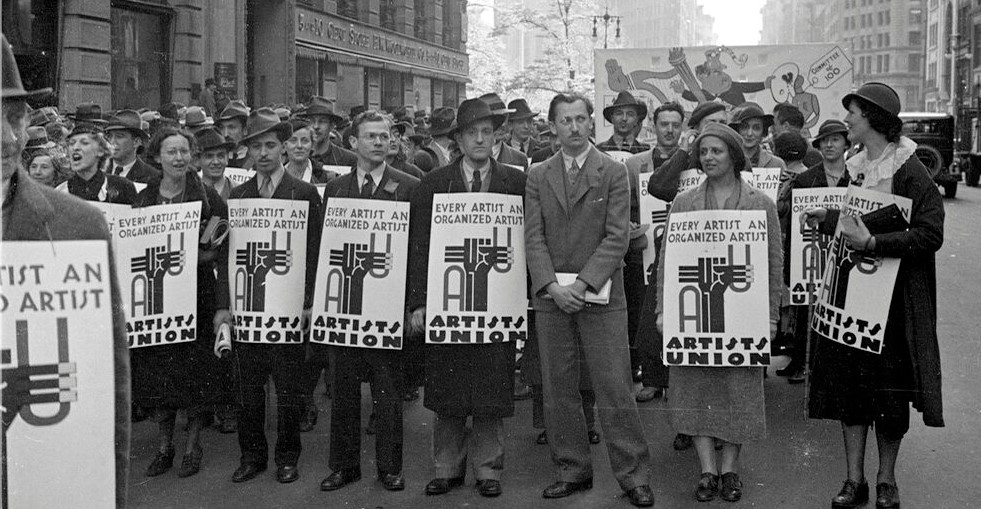
TWELVE hundred artists, delegates and friends met at the Hotel New Yorker in New York, May 7 in the first Artists’ Union Convention of the Eastern District of the United States. This is the first time in our history that large numbers of artists have come together to find a common ground on economic issues. The emergence of the artists as a group into the economic field is a recent phenomenon. Once started, however, they have tackled their problems with a firmness and clear-sightedness that is the envy of many older and more experienced groups. The Convention is a result of these activities and stands now as a landmark of achievement in this field. It also marks the beginning of another phase of activity–the local struggles have now been raised to a national struggle.
The inspiring work of the Convention has laid a solid foundation upon which the artists in all sections of the country may fight for security and cultural development. The work of the Convention will long be remembered by the delegates participating. With almost machine-like precision it took up in three days an appalling amount of work. Unfruitful issues were rejected and pertinent material was promptly and effectively acted upon. The delegates will carry back to their unions detailed reports of the Convention, but space forbids our taking up here anything but the major issues dealt with.
The open session was devoted to the presentation by outstanding speakers of many of the major problems facing the artists. The program of this session follows:
David Freed, Secretary of American Musicians’ Union, Local 802, “Contributions to Culture by the Trade Unions.” Elmer Rice, noted playwright, “Need of Professionals to Organize.” George Biddle, President of National Mural Painters Society, “A Realistic Approach to Organization.” Stuart Davis, Secretary of the American Artists Congress, “The Defense of Culture.” Samuel Putnam, “Experiences of Artists Abroad.” Francis G. Gorman, Vice-President of United Textile Workers Union, American Federation of Labor, “Farmer-Labor Party and the Professional.” Meyer Schapiro, Department of Fine Arts, Columbia University, “Art and Art Projects.” Willis Morgan, President of City Projects Council, “White-collar Professionals on Relief.” Phil Bard, executive member of the Artists’ Union, “A National Artists’ Union.”

Business of the Closed Sessions
The reports of the various delegates having been presented, the consideration of the problems before the Convention got speedily under way. Represented were the Artists Unions of Boston, Mass., Providence, R.I., Provincetown, Mass., Springfield, Mass., Baltimore, Philadelphia, Ulster County, West Maine and New York City. The major accomplishments of the three days’ sessions may be summarized as follows:
RECOMMENDATIONS
The Artists’ Unions support the expansion of projects:
1. They stand for the enlarging of existing projects.
2. They demand a uniform wage scale. Immediate campaign for N.Y. wage of 23.86 for 24 hour-week.
In view of the fact that project work is not used locally (Balto work used in Cleveland, National exhibitions, etc.), they oppose population stipulations which are no actual criterion of actual cost of living and demand equal pay for equal work. Ultimate struggle for the trade union minimum of $2 per hour, 15 hours per week.
3. They oppose the paupers oath and such restrictive clauses:
In opposition to all relief restrictions, alien clauses, etc., they demand the employment of all artists in need of work.
4. They support the establishment of federal art project galleries.
These are to be established by the administration in order to show project work at its best advantage.
In localities where pressure on the federal administration is inadequate, the Artists’ Unions should use every means possible to secure city, county, and state grants for educational work.
It is the recommendation of the Artists’ Unions that legislative committees be established:
1. In every locality.
2. In every state (when there is more than one union in a state).
3. By the national organization. There should be a bulletin issued periodically by this committee.
It is the purpose of the committees to utilize vote pressure on officials which has been generally ignored by the unions up to now. They are to gather information, and conduct letter writing campaigns of union members and others on all bills effecting the economic, cultural, interests and civil liberties of members.
The Artists’ Unions agree to initiate and cooperate in any campaign against reaction, war and fascism.
Local affiliation with the American League is recommended.
Protest of the removal of James Pfeufer, Executive Secretary of the Artists’ Union of Mass., and demand removal of Frank W. Sterner, State Supervisor of Art Projects. Send protests to Holger Cahill, Federal Art Director, Washington, D.C.; to Paul Edwards, State Director of all Projects, W.P.A., Park Square Building, Boston, Mass., to Richard C. Morrison, Regional Director of Art Projects, 85 Devonshire Street, Boston, Mass.
The Artists’ Unions should broaden their activities to include non-project activities:
1. Municipal art gallery and center. Expansion to include other groups in cultural center.
2. Establishment of art schools by the Artists’ Unions.
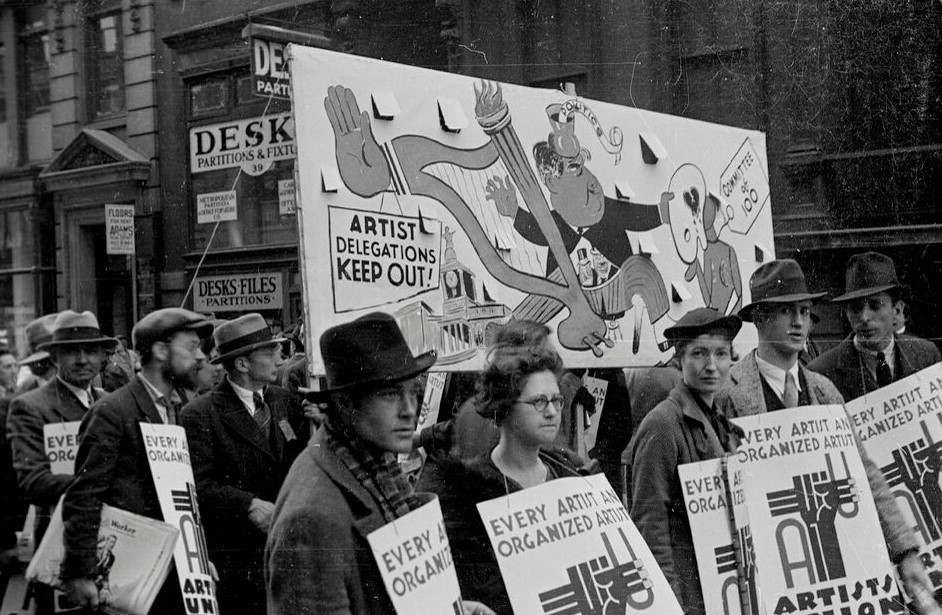
3. The holding of union exhibitions. These should not be allowed to compete with project shows. $1 to $10 shows, open air shows, etc., should be avoided if they are apt to destroy the commodity value of paintings, etc. In general the cheap side-show circus is to be avoided and activities confined to those channels which will raise art interest. Trade union shows, etc., are to be encouraged.
4. Headquarters. Attractive headquarters are very advantageous, especially in the larger cities to serve as club rooms, etc. Springfield has the advantage of being able to meet in the art museum there.
5. Bulletins. These should not be too pretentious as they may consume too much time and energy. Baltimore publishes a local page in the “Art Front.”
6. General cultural and social activities. These include forums.
The Artists’ Unions should work with other artists’ groups. Artists’ Coordination Committees should be established for the exchange of information on rental municipal centers, etc.
The Artists’ Unions should cooperate with other relief and white-collar groups. Set up a W.P.A. Council (not a loose tie-up but a close organization.)
The Artists’ Unions should work with the A. F. of L.
Artists’ Unions should cooperate locally with the A.F. of L. on all possible measures. Affiliation will have to depend on the formation of National Organization. As the building trades are opposed to the artists, while the other unions such as the musicians and teachers and bookkeepers, etc., favor us, it is probable our best opportunity is through the Committee for Industrial Organization (Lewis). We will only enter on the basis that we maintain our own jurisdiction.
The Artists’ Union should undertake to realize the maximum of publicity from their activities.
Letters of greeting to the Eastern Convention were received from many figures in the Art World. Warm letters of support were received from the following individuals: Peter Blume, Lynd Ward. Harry Sternberg, Lucian Bernhard, Max Weber, Walker Ufer, E.M. Benson, Yasno Kuniyoshi.
The Teachers’ Union and the Artists’ Congress sent telegrams supporting the aims of the convention.
RENTAL POLICY
A National Rental Policy Committee was set up to cope with the Rental Policy on a National Basis. Questions of conditions under which the rental fee will be requested and minimum fees to be asked will be undertaken by this committee. The committee will consist of delegates from each of the following groups.
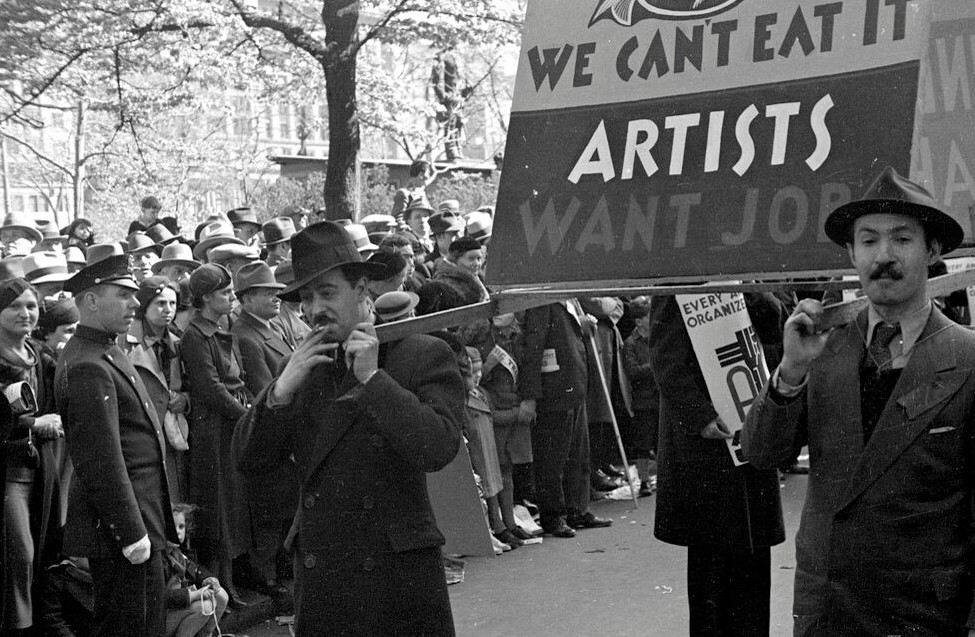
Mural Painters Society. American Group. Harlem Artists Guild. American Artists Congress. National Sculpture’s Society with one delegate from each Artist Union.
CONSTITUTION OF EASTERN DISTRICT UNION
PREAMBLE
Believing that united action can best improve the conditions of the artist professionally engaged in the practice of the plastic and graphic arts, that the production of painting, sculpture and all other forms of the plastic arts are dependent upon the economic well being of artists, and that the social and economic problems of the artists are not different from those of all labor;
Therefore, we the undersigned, have organized the Artists Union of the Eastern District of the U.S.A. and do voluntarily bind ourselves to support and carry out its purposes as set forth in the following program.
Article 1. Name.
The name shall be Artists Union, Eastern District, U.S.A.
Article 2. Aims and Purposes
Sec. 1. To unite in a single body all men and women who are profession engaged in the practice of the graphic and plastic arts.
Sec. 2. To improve and protect the economic conditions of the artists,
Sec. 3. To maintain and further cultural standards of this country by encouraging a wider distribution and understanding of art in the general public.
Sec. 4. To aid in securing such legislation as may contribute to the protection and advancement of the social and economic status of the artist.
Sec. 5. To protect our craft and the persons engaged therein from discriminatory and repressive legislation and actions, and to insure complete liberty of expression.
Sec. 6. To support and cooperate with any organized group engaged in actions of a progressive nature socially, economically and culturally.
Article 3. Executive Board
A. Powers:
Sec. 1. The Eastern District Executive Board shall have the authority to act in the name of all affiliated bodies, in all questions of national significance within the scope of the program above.
Sec. 2. The Executive Board may make recommendations to the local union on questions of local character.
Sec. 3. Executive power shall be determined by the majority vote of (a quorum of) the Executive Board.
Sec. 4. It shall have regular quarterly meetings. All actions outside of these meetings shall be by majority vote by written communications.
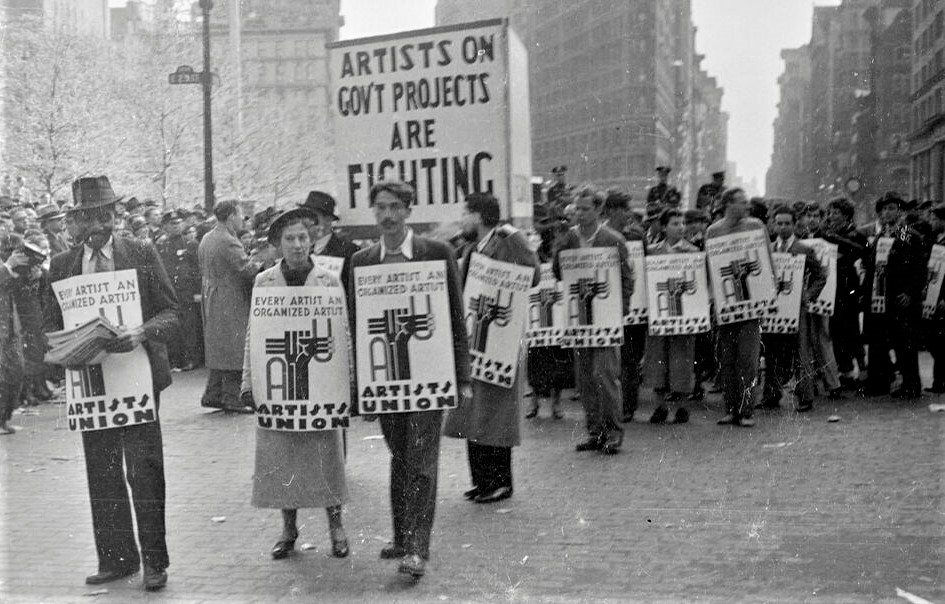
Sec. 5. In an emergency, the Central Committee shall have the power to act in the capacity of the Executive Board. This action to be subject to confirmation by majority vote of the Executive Board.
Sec. 6. The Central Executive Committee shall have the power to call emergency meetings of the Executive Board.
Sec. 7. The Central Executive Committee shall prepare and inform the members of the Executive Board of the issues that will be taken up at the regular and special meetings of that board.
Sec. 8. A majority of the Executive Board shall constitute a quorum.
B. Structure:
Sec. 1. The Executive Board shall consist of members elected on a numerical basis. There shall be one delegate from each Artists’ Union having a membership of fewer than 100; 100 to 300, 2 delegates; 300 to 500, 3 delegates, 500 to 700, 4 delegates; above 700, 5 delegates.
Sec. 2. There shall be a Central Executive Committee of five, elected from the convention. It shall consist of a chairman, secretary, and treasurer and two others.
Article 4. Local Powers
Sec. 1. The local Artists Union shall have the right to elect its representative or representatives to the Executive Board of the Artists Union, Eastern District, U.S.A.
Sec. 2. The local union shall have the power to initiate action only within the Scope of the program and aims of the Artists Union, Eastern District.
Sec. 3. The local union shall have power to make recommendations to the District Executive Board.
Sec. 4. Action which has been approved by majority vote of the Eastern District Executive Board shall be binding on all affiliated Artists Unions.
Sec. 5. Any group of 7 artists or over in the Eastern District, U.S.A., is eligible for application for membership in the Artists Union, Eastern District, providing they accept the program of the Artists Union as outlined above.
Article 5. Finances
Sec. 1. The dues from affiliated Artists Unions shall be $5 quarterly per delegate in the Executive Board.
Article 6. Art Front
Sec. 1. The Art Front shall be the official publication of the Artists Union, Eastern District, U.S.A.
Sec. 2. The local Artists Unions shall set up committees which shall have editorial and business responsibility.
RESOLUTIONS ADOPTED BY THE EASTERN DISTRICT CONVENTION
I. Be it resolved that we go on record as urging the establishment of a Permanent Federal Art Project to include all artists, and that we further favor the immediate introduction and passage by Congress of the Federal Art Bill as the only means of establishing the minimum demands of artists in the cultural and economic fields. We further urge all trade unions, economic, cultural organizations and individuals directly to contact their congressmen and representatives by means of letters, telegrams and petitions demanding the passage of the Federal Art Bill.
II. Be it resolved that this convention go on record as supporting the Frazier-Lundeen Bill for adequate social and unemployment insurance.
III. Be it resolved that this convention go on record as supporting the Marcantonio Relief Standards as one providing for the protection of our union and economic rights.
IV. As neither of the major existing political parties offers satisfaction of the minimum demands for permanent economic security in the form of adequate unemployment insurance, expansion of the W.P.A. to include all unemployed on a permanent basis and old age pensions and as we seek peace to protect and advance the cultural life of the people in preference to increased armaments destructive to these pursuits, we therefore urge the formation of a Farmer-Labor Party dedicated to these principles and recommend that each affiliated Artists’ Union initiate and support all efforts toward building this political party for professionals, farmers and workers.
V. Be it resolved that this convention of the Eastern District of the Artists Union pledges itself to fight all tendencies and forces of reaction, war and fascism.
(a) We endorse the boycott of all publications of William Randolph Hearst because of his manifestations of anti- union, anti-civil liberties and un-American policies.
(b) We endorse the boycott of the Olympic Art Exhibition to be held in the summer of 1936 in Berlin and urge all artists to support this stand.
(c) We recommend to all affiliated artist bodies that they co-operate with local chapters of the American League Against War and Fascism.
(d) We call upon all artists to refuse to make any posters that would foster war propaganda.
VI. Be it resolved that this convention of the Eastern District of the Artists Union go on record as endorsing and supporting the Federal Youth Act.
Art Front was published by the Artists Union in New York between November 1934 and December 1937. Its roots were with the Artists Committee of Action formed to defend Diego Rivera’s Man at the Crossroads mural soon to be destroyed by Nelson Rockefeller. Herman Baron, director of the American Contemporary Art gallery, was managing editor in collaboration with the Artists Union in a project largely politically aligned with the Communist Party USA.. An editorial committee of sixteen with eight from each group serving. Those from the Artists Committee of Action were Hugo Gellert, Stuart Davis, Zoltan Hecht, Lionel S. Reiss, Hilda Abel, Harold Baumbach, Abraham Harriton, Rosa Pringle and Jennings Tofel, while those from the Artists Union were Boris Gorelick, Katherine Gridley, Ethel Olenikov, Robert Jonas, Kruckman, Michael Loew, C. Mactarian and Max Spivak.
PDF of full issue: https://www.marxists.org/history/usa/parties/cpusa/art-front/v2n07-not-06-jun-1936-Art-Frontpdf.pdf
 Revolution's Newsstand