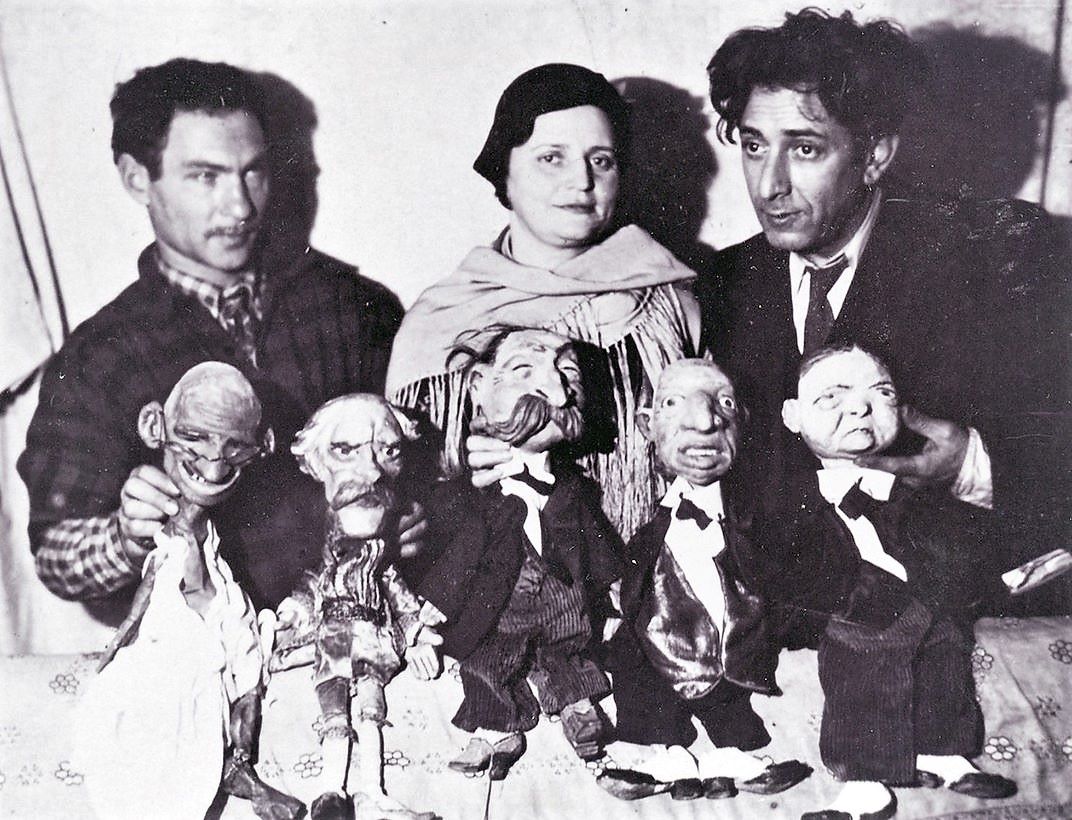
Yosl Cutler, founder of the Yiddish Puppet Theatre, multi-talented artist, and satirical columnist for the Yiddish-language Communist daily Morgen Freiheit, died tragically in a 1935 car accident. His New York funeral was attended by over 10,000 people.
‘The Death of Yosl Cutler’ by Nathaniel Buchwald from New Masses. Vol. 15 No. 13. June 25, 1935.
THE many thousands of his readers, comrades, admirers, friends had no other name for him than the chummy, affectionate Yosl. His colleagues loved him, children delighted in reciting his ditties, critics marveled at the disarming naivete and the rare felicity of his style, readers of The Jewish Morning Freiheit delighted in his humoresques and droll cartoons, theatre audiences clamored for encores when he presented his inimitable puppets. But a merchant from Omaha tried to hog the road, and Yosl Cutler is dead.
As a humorist and poet Yosl Cutler was unique among the Jewish writers. He wrote in a vein of charming unselfconsciousness and “primitivism,” made dazzlingly luminous by his shrewd satire, his fresh buoyant wit and his matchless use of the homely Yiddish idiom cunningly combined with the jargon of the East Side. With it all went a complete unity of the writer with his work. To those who knew Yosl, his spoofing verse, his beautifully simple ballads, his racy and grotesque puppets and his prankish cartoons were simply attributes of that ever gay, ever joshing and care-free boy who in his early manhood lost none of the impishness of an East Side gamin. The one volume of his stories and poems published in 1934 holds but an infinitesimal portion of that joyous and all-pervading something which was Yosl Cutler.
The son of a butcher, Yosl Cutler was born in the Ukraine in 1896, and at the age of fifteen came to New York in quest of those legendary fortunes and adventures of which he heard so much in his native Troyanov. He turned to account his love for “painting figures” and became a sign painter. Exploited by his employers and cheated by his clients, Yosl soon learned the real meaning of Amerikaner Glik’n and tried to laugh it off. He managed to receive some odd schooling in art and intended to become a painter. A chance meeting with Moishe Nadir turned Yosl into a writer. Before Cutler had published a single piece and while he was still puzzled by the mysteries of spelling, Nadir pronounced Yosl Cutler the most gifted and original of the young generation of writers.
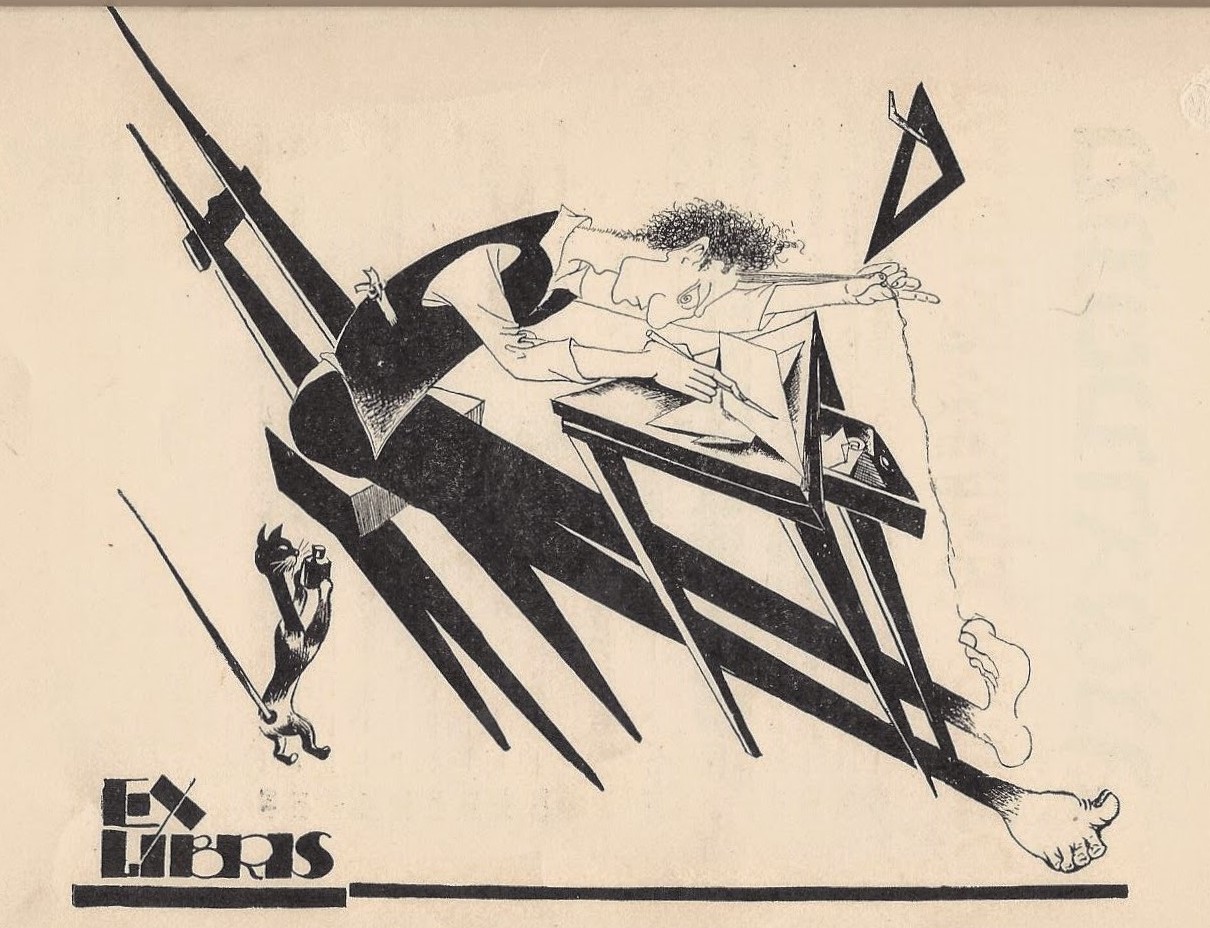
His literary career (if the word can at all be applied to Yosl Cutler) began in The Morning Freiheit some thirteen years ago. At first he was merely spoofing. With childish de- light he invented topsy-turvy worlds, peopled Heaven with the most absurd and grotesque beings and turned the traditional religious lore into droll and very irreverent nonsense. Though politically undeveloped at the time, he brought with him to the revolutionary movement an unfailing instinct for the good and wholesome things in life and a thorough contempt for the rich, the exploiters, the philistines. As he gained knowledge and experience in the revolutionary movement with which he was identified in many ways, Yosl began imparting more and more meaning and revolutionary purpose to his spoofing. He began drawing upon his environment for material, forsaking entirely the never-never land of his imagination. Rent strikes, evictions, unemployment and class struggle generally became his themes. But Yosl did not turn “dry” when he turned Communist. On the contrary, he found a new purpose for his fooling and began writing in prose and verse amazingly clever political satire, retaining at the same time all the sunny cheer and infectious impishness of his earlier writings. He became so completely at one with the revolutionary movement that when it was suggested to him, in 1934, to join the Communist Party, Yosl replied: “And I thought I’ve been in the Party all this time!” As a puppeteer Yosl Cutler quickly gained a unique position both because of his unusual puppets and the rare quality of his material. At his funeral, over fifteen thousand workers marched. And yet the news of Yosl Cutler’s death is somehow hard to believe. Yosl and death are mutually exclusive. And despite the great shock at the terrible news, one has the feeling that Yosl Cutler will live on forever.
The New Masses was the continuation of Workers Monthly which began publishing in 1924 as a merger of the ‘Liberator’, the Trade Union Educational League magazine ‘Labor Herald’, and Friends of Soviet Russia’s monthly ‘Soviet Russia Pictorial’ as an explicitly Communist Party publication, but drawing in a wide range of contributors and sympathizers. In 1927 Workers Monthly ceased and The New Masses began. A major left cultural magazine of the late 1920s to early 1940s, the early editors of The New Masses included Hugo Gellert, John F. Sloan, Max Eastman, Mike Gold, and Joseph Freeman. Writers included William Carlos Williams, Theodore Dreiser, John Dos Passos, Upton Sinclair, Richard Wright, Ralph Ellison, Dorothy Parker, Dorothy Day, John Breecher, Langston Hughes, Eugene O’Neill, Rex Stout and Ernest Hemingway, Artists included Hugo Gellert, Stuart Davis, Boardman Robinson, Wanda Gag, William Gropper and Otto Soglow. Over time, the New Masses became narrower politically and more journalistic in its tone.
PDF of full issue: https://www.marxists.org/history/usa/pubs/new-masses/1935/v15n13-jun-25-1935-NM.pdf
 Revolution's Newsstand