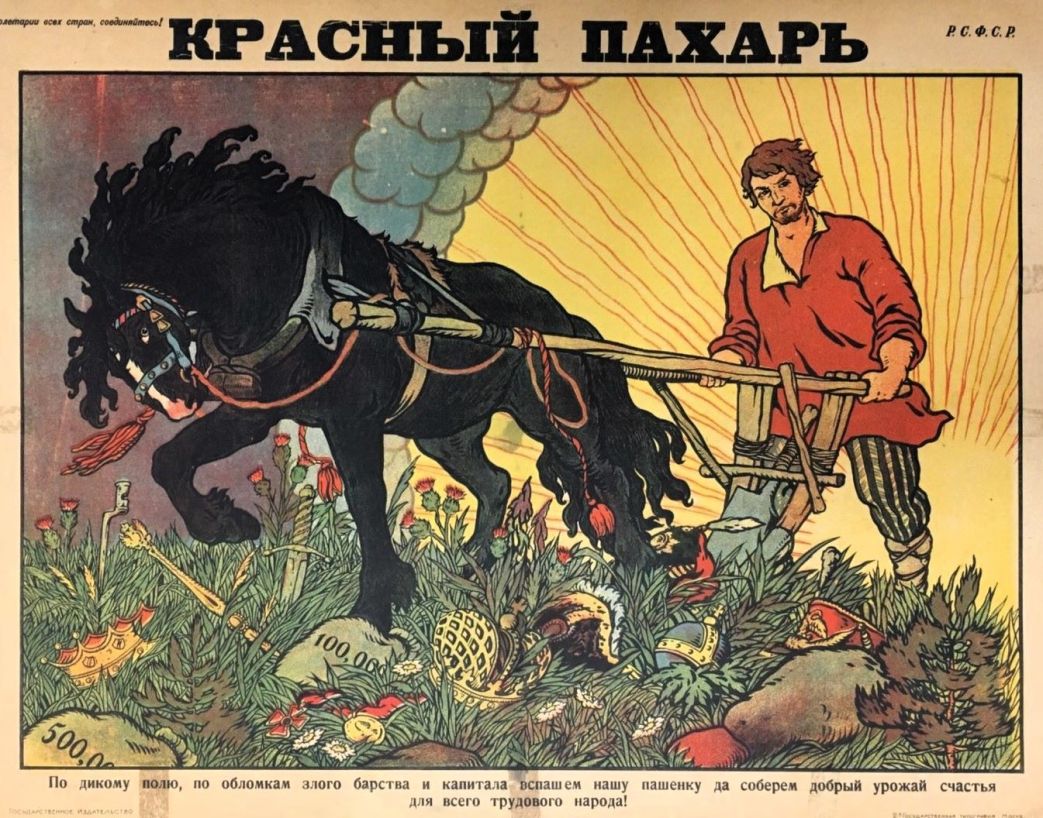
Reviewing a year of the New Economic Policy, the 11th Party Congress held in early Spring, 1922 passed this resolution on financial policy as the state sought to control and dominate capitalist economic relations reemerging in the country.
‘Financial Policy of the Soviet State: Resolution of the XIth Congress of the Communist Party of Russia’ from International Press Correspondence. Vol. 2 No. 44. June 2, 1922.
1. Under the conditions of the old economic policy the economic resources of the Soviet state were at the same time its immediate financial resources. The maintenance of the workers, the clerks and the army, the supply of the state industries with raw materials or semi-manufactured and other kinds of material was carried out by the direct shipment of goods. In consequence of this the financial policy was restricted to the question of distribution of paper money. The quite secondary importance of paper money was confined to the very limited field of market exchange.
2. Under the new conditions the Soviet State meets the expenditures in respect of the State administration and management only in part and that on a ever-decreasing scale, by the method of direct payment in kind (that is to say, the immediate despatching of goods). These expenditures are met on an ever-increasing scale by means of the market, i.e., by means of money.
3. The complete liquidation of the state economic system is only possible in the event of such a regulation of the relations of the state and of the market (small bourgeoisie and private capitalists) which guarantees the reliable and certain provision of the state industries (with raw materials and provisions), the army and the administration by the aid of the circulation of money. A preliminary condition to this is the stabilization of prices and a stopping of the depreciation of paper money.
The stabilizition of prices and the ceasing of the depreciation of paper money are only possible provided that the whole financial system of the state is put into order, that a genuine budget showing no deficit is drawn up and that the exchange of commodities is increased. The extension of the exchange of commodities must be brought about on the one hand by means of increased production and the greater efficiency of transport, and on the other hand by extending the sphere of money circulation, by the reduction of the share of the state in the budget and by means of the development of the commodity character of agricultural production and exchange.
4. A certain widening of the sphere of the circulation of money took place and to some extent is at present taking place as a result of the adoption of the new economic policy. This widening resulted in Autumn 1921 (at the time of the realization of the harvest) in a temporary stabilization of the rouble. The deficit in the budget of the Soviet State has destroyed this stabilization. The present deficit in the budget renders impossible any immediate currency reform having as its object the stabilization of the rouble. Immediate reform of the currency is on other hand impossible owing to the famine, whose influence is to be seen primarily in increased prices and increasing depreciation of money.
Without committing ourselves to the immediate return to gold currency, it is necessary to state that our economic and financial policy is set definitely towards the restoration of the gold money standard. This gold basis is necessary, inasmuch as gold remains the world currency and in so far as this importance of gold in the world market unavoidably influences the conditions of the home markets even in a country where a portion of the economic activity is carried out according to a regular plan. One of the practical means of realizing this is the maintenance of the inviolable gold reserve and the increase of the production of precious metals.

6. The principal measures of financial policy (including currency reform) at present are:
a) Increasing the circulation of commodities, principally through the development of state, cooperative and private domestic and foreign trade.
b)The reduction and later the elimination of the budget deficit, the balancing of the budget by means of the reduction of state expenditures and the increasing of state income both in money and in kind. (For this one must steadily keep in view the bringing of the collection of all taxes into one channel and the gradual rendering of money forms of taxation the chief means of revenue). On the other hand it is necessary that the flow of currency shall be regulated and not proceed according to chance, and that a stable financial practise be elaborated.
7. The development of the exchange of commodities can not be accomplished exclusively through the development of state trade. This last is by no means the chief method of developing the exchange of products. The state industry must chiefly develop itself with the help of those means which it obtains on the strength of its credit. The granting of this credit can and will be organized through the State Bank. The cooperative trade is to be receive considerable support but not so much as to be detrimental to the state. It is necessary that the exchange of checks for the conclusion of business and contracts be established between the state and private undertakings.
8.The necessity of allowing private capital to carry on trade implies in regard to interior trade the granting of home monopolies only for fiscal purposes, and in regard to foreign trade the permission of mixed companies, the granting of trade concessions, etc., with the maintenance of the State monopolies.
The spending up of the transition of agriculture from the condition of natural to exchange economy is to be the chief task of Communist policy. Only such a transition will ensure increased productive power in agriculture. This increase is the sole guarantee of the most rapid recovery from the economic and financial crisis.
9. The starting point in the fight against the budget deficit shall be the clear recognition that the Soviet State is not in possession of sufficient economic and in particular financial resources to enable it to maintain the whole of the vast administrative and economic apparatus that was set up in the period of “War Communism’
This apparatus was maintained at that time by means of methods which cannot be employed under the conditions of the new period which negates the expropriation of the small proprietor and in which the process of expropriation of the large property owners has been terminated. The Soviet State must thoroughly “disencumber” itself in the shortest possible time, and keep in the hands of the proletariat only the principal key industries and branches of national economy (transportation, banks, coal, oil, metals and natural products) while it either retains the most important undertakings in these branches or secures its real and undisputed control by appropriate methods in the event of the participation of private capital in state undertakings and their combinations.
10. In consideration of the tremendous importance of industry generally and of the state industries without whose development a serious clearing up of finance is impossible, in particular for the whole economic system of the R.S.F.S.R., it is necessary to take in hand a number of measures for the purpose of securing the existence of industry and its development.
11. It is also necessary along with the reduction of the state financing of industry and commerce considerably to reduce the administrative apparatus, to lessen the number of governing bodies at the centre and in the provinces, to hand over a number of expenditures and tasks to the local budgets and to exclude from the state budget all expenditures which do not serve the immediate maintenance of the existence of the proletarian state. Above all there must be a quantitative reduction and in its place there must be a qualitative increase. But there must be no question of separating the payment of wages from the management of production.
12. With regard to the workers and clerks in the state undertakings (factories, transport, etc.) and institutions which remain under state management, the Soviet State must hinder by every means the sinking of real wages. It is the duty of the party and the trade unions to see to it that the economic and administrative bodies do not use the funds intended for the payment of the workers and clerks to meet other requirements. It is necessary at the same time to oppose most energetically the irrational apportionment of resources on the part of the state institutions, to fight against their expending too much on the central administrative apparatus at the cost of the business undertakings and the subordinate institutions.
13. It is the special task of finance policy at first to reduce the output of paper money and later on to end it. This most important problem, to the solution of which a beginning must immediately be made, can be thoroughly solved only by means of raising the standard of production, the increasing of the state’s income arising from the nationalized industries and in particular the successful execution of the taxation policy.
14. The taxation policy must devote itself to the task of regulating the process of accumulation by direct taxes on fortunes and incomes, etc. Taxation policy is in this connection the chief instrument of the revolutionary policy of the proletariat in the transition period.
15. The taxation policy must at the same time pursue the purely fiscal immediate purpose of securing the greatest possible yield from taxes. The execution of the system of taxation, however, shall involve no reduction of the real wages of the workers; that is to say, it shall confer corresponding compensation in respect of remuneration of labor. In consequence of the present condition of the machinery of taxation, which was liquidated during the past period, and is now by great effort being restored, it is extremely difficult to carry out the system of direct taxation. At the same time the party is taking up the task, concurrently with the setting up of the machinery of taxation, of developing the system of direct taxation and of gradually abandoning indirect taxes. At present, however, the chief basis of the system of monetary taxation can only be in indirect taxes as they are easier to realize (duties on articles of general necessity) and which are to be complemented by direct real taxes on trade and commerce and by a per capita tax for definite purposes (famine relief and combating the epidemic).
The production and use of articles of luxury will be subject to particularly heavy taxation. In order to secure the successful payment of the monetary taxes, it is necessary that the Party and Soviet organs devote their special attention to that task and that many members of the partly be engaged in this work.
16. The importance of the taxes on imports and exports will increase with the development of foreign trade. The customs duties on exports and imports will not be used merely as a means of revenue. They are also to be used for securing the greatest possible development of the state industries. Without losing sight of financial interests the tariff on imports will allow specially favorable conditions for the importation of provisions and foodstuffs until the new harvest. Imports of industrial and agricultural means of production will be granted a rebate.

17. The increasing income from State industries, transport, trade, agricultural products, forests, mines, etc., the increasing number of concessionaires and lessees, all of these can and shall be employed towards clearing up the budget and wiping out the deficit. One must bear in mind in this respect that unrelenting struggle against waste, confusion and lack of all commercial knowledge is a prerequisite for the state undertakings, instead of as heretofore showing a deficit, showing a surplus. The members of the Party must learn to work and manage economically and profitably. We must gradually qualify a considerable number of workers for the management of industry and commerce.
18. The growth of the exchange of commodities between city and country, the circulation of goods within the town and country markets, and in a still greater degree the exchange of goods with foreign countries can be rapidly and successfully developed only by the powerful help of credit. Its regulation must be in the hands of the State Bank. Branches of credit institutions can be established under the control of the State Bank which are to serve to concentrate idle funds for the purpose of using them in production. A network of small local credit institutions (Cooperative Credit) can be established. But this can only take place in so far as the dominance of the State Bank is not interfered with. Branches of foreign banks can only be admitted provided they enter into treaty relations with the State Bank. Foreign banks may under no conditions acquire the right to issue bank notes.
19. All measures of financial policy tending to bring order into the budget, to increase income, to regulate the circulation of money and to organize credit are nothing more than palliative measures, as they cannot remove the economic crisis which is the basis of the financial crisis. The only remedy lies in the extension of the market in consequence of the increase of output of the large industries and the peasant and home industries.
20. The general economic policy and the financial policy must serve this purpose. After the conclusion of the period of “War Communism” the party of the working class is faced with the problem of consolidating captured political power in the shortest possible time, by giving the state apparatus created in the struggle a solid financial basis.
21. The capitalist world is confronted with new crises, wars and revolutions. The transition period between Capitalism and Socialism is approaching its end. Nothing can stop it. Soviet Russia, the first proletarian state, will more completely fulfil its historical task, the more quickly it overcomes the poverty, famine and ruin which weaken it and carries out the economic and financial mobilization for further struggles on behalf of Socialism.
International Press Correspondence, widely known as”Inprecor” was published by the Executive Committee of the Communist International (ECCI) regularly in German and English, occasionally in many other languages, beginning in 1921 and lasting in English until 1938. Inprecor’s role was to supply translated articles to the English-speaking press of the International from the Comintern’s different sections, as well as news and statements from the ECCI. Many ‘Daily Worker’ and ‘Communist’ articles originated in Inprecor, and it also published articles by American comrades for use in other countries. It was published at least weekly, and often thrice weekly.
PDF of full issue: https://www.marxists.org/history/international/comintern/inprecor/1922/v02n044-jun-02-1922-Inprecor-yivo.pdf
 Revolution's Newsstand