A valuable explanation of the organs of power in the Soviet state as established by the 1918 Constitution and developed in the first years of the Revolution. In six parts: I. The All-Russian Central Executive Committee, II. The Council of People’s Commissars, III. The Council of Labor and Defence, IV. The All-Russian Congress of Soviets, V. Local Soviet Congresses, VI. Town Soviets.
‘How the Soviet Government Works VI: Town Soviets’ from Soviet Russia (New York). Vol. 6 No. 9. May 15, 1922.
“WE find that if only fifteen to twenty men take part in administration, they must even against their own will become bureaucrats—however much they speak against bureaucracy. The wide participation in administration of the workers themselves is imperative.” In these sentences L. Kamenev, reporting at the Seventh All-Russian Congress of Soviets, in December, 1919, on the proposed amendments to the Constitution, summed up the fundamental principles upon which the Russian Soviet system is built, and which are most clearly to be seen at work in the lowest units or cells of the Soviet machinery—the local Soviets.
Of the distinguishing features which are associated with Soviet practice in Russia since the revolution, the following are the most important: In the first place, the Soviet system as such is in its origin a town system. It is the method of self-expression adopted by the masses of the Russian workers where their consciousness of solidarity was highest, and where the feeling that their interests were sharply antagonistic to those of all other classes was most acute. Soviets could not spring up spontaneously in the Russian countryside, where the primitive conditions of agriculture themselves rendered man an individualist, difficult to organize, and with little political consciousness. Similarly in the smaller provincial towns, where the population consists of small farmers, shopkeepers, and their assistants, office employees, and petty artisans, there was no strong coherent force amongst the mass of the workers to make their participation in the class struggle so advanced that it could produce an entirely new political organism like the Soviets. It was in large industrial centers—Moscow, Petrograd, Tula, Ivanovo Voznesensk—with their compact and politically intelligent masses of factory workers, that the need for an independent political working class organization first made itself felt, during the general strike of 1905 and at the moment of the March revolution in 1917. The example of the capitals was rapidly followed by the provincial and country towns, and these in their turn, during the summer of 1917, served to waken the countryside into political activity. We have already seen that this difference in time between. the organization of town and country Soviets gave rise to the existence of separate All-Russian organizations, and later to a difference in electoral methods when delegates to Soviet congresses were being selected.
Secondly, the Soviets — Councils of Workers’ Deputies—were in their origin fighting rather than political organizations, and consequently their composition, methods of election, regulations, methods of work, etc., are only gradually being elaborated, in proportion as the Russian working class passes from a state of perpetual siege conditions, in which work rather Tai form is demanded of public institutions, to a state of political calm and mastery in its own home, when it is able to find time for more elaborate rules of procedure. This original feature of the Soviets is brought out still more strongly when we recall that the Russian working class had no other form of combination at its disposal when Tsarism fell. Even the political parties were underground propagandist organizations, which at best could only for a time, at moments of a particularly intense crisis, assume the direct leadership of mass movements—as in the Petrograd strikes of 1895-6. No trade union movement existed in Russia, for all practical purposes, before the March revolution in 1917; and this fact was of enormous importance. Had it been otherwise, it is very possible that the workers would have asked for no better protection of their interests than a powerful all-embracing trade union congress. As it was, the political parties, both in 1905 and in 1917, were accustomed, owing to the illegal nature of their work, to carry it on primarily in the workshop and not in the trade union club or at the street corner; and they naturally urged the workers to elect a body for general political purposes which should be responsive to the tangible and ever-present workshop, rather than to the intangible electoral district or the still only rudimentary trade unions.
This brings us to the third important characteristic of the Russian Soviets—their form of election —which ensures their constant and intimate contact with the working classes. In every Soviet there are a few deputies from trade unions, political parties, the local garrison, etc., but the bulk are elected in the workshops, commercial or educational establishments, large depots or stores, etc. For every 500 employees one deputy is elected, workers in enterprises with less than a hundred employees uniting for electoral purposes with the workers of other small enterprises. Where the workers are scattered, as in the case of shop assistants, teachers in small schools, literary and art workers, they are assembled at special electoral meetings by their trade union; while assemblies of housewives, domestic workers, janitors, etc., convened ward by ward, take part in the elections on a similar basis. Thanks to this system, to take a concrete example, there participated in the Petrograd elections:
In July, 1919…330,000 workers
In January, 1920…501,000
In June, 1920…562,000
or practically the entire adult population (253.000 workers in factories, depots, hospitals etc. 142,000 Soviet employees, 114,000 Red soldiers and sailors, 47,000 housewives, and 5,000 students). A similar proportion of the classes participating is shown (selecting at random) by the statistics of the first elections to the Soviet of Rostov-on-Don, in February, 1921, after the liberation of the town from the yoke of Denikin: 94,000 workers and employees, 30,000 Red soldiers, 14,000 peasants, and 2,000 housewives.
Not only does the method of election of the Soviets retain and even extend the franchise for the widest circles of the population, but by drawing them into contact with the administrative apparatus at the place or in the building where they are employed for the greater part of their lives, it makes the Russian administrative apparatus, as has already been suggested, a much more popular and flexible system than any of its predecessors. The deputy from any given factory or workshop is constantly under the control of and liable to be recalled by his electorate, to whom he renders periodical reports (in Moscow, for example, out of a Soviet of 1,000 to 1.500. there were 423 such cases of recall in 1918, and 411 in 1919). Within the Soviet itself, the deputy is not allowed to confine himself to the hearing of reports by the Executive Committee, or the making of them to his constituents; he must participate in the daily work of the administrative apparatus, in some capacity or other, to prevent his transformation into a “legislator”, pure and simple, in just, the same way as his frequent contact with a definite mass of electorate is designed to prevent him from becoming transformed into a “departmental official”, pure and simple. So strongly was this felt, particularly during the period of the civil war, when above all it was essential to have in the districts public bodies with energy, resource, and contact with real life, that (the case was quoted by the People’s Commissariat for Home Affairs in a lecture at the Sverdlov University) the provincial executive committee of Vladimir in Tula. 1919 (the beginning of the Denikin offensive), found it necessary to dissolve all the town Soviets of the province. The electorate in these towns were for the most part composed of traders, peasants, and shopkeepers, and the Soviets had actually been elected by universal suffrage; with the result that they had fallen into a state of complete quiescence, leaving all administrative work to be carried on by the county executive committees In the larger towns, from 1920 onwards, the practice was adopted of appointing committees of the Soviet, into one of which every member must enter; and, although under civil war conditions only certain of the committees showed real vitality (the position may be compared to that of the People’s Commissariats on the national scale), there can be no doubt that the institution of these committees has also done a great deal towards making the Soviets a working and not a talking institution. This is shown indirectly by the fact that, in March, 1920, the regulations of the Moscow Soviet—which in many ways, as might be expected, is the prototype of thousands of similar bodies elsewhere—laid down that all members were ipso facto members of the Soviets of their wards. By February, 1922, the process of drawing each individual member into general municipal work, in addition to his sessional duties, had advanced so considerably that, at all of the several hundred electoral meetings which were reported in the press during last month’s Soviet elections, the assembled workers, having elected a deputy to the Moscow Soviet, proceeded to choose others of their number for the ward councils. This circumstance, in its turn, brings us to another interesting characteristic of the Soviet system, which we have already seen strongly marked in the case of the congresses—the constant influx of new blood into the administrative apparatus, with once again the result that little by little that apparatus becomes part of the everyday experience of the most average worker. Statistics, unfortunately, are not as readily available as in the case of the Soviet congresses. It is known, however, that at the Petrograd Soviet elections in July, 1919, 1,570 members out of 1,836 were elected for the first time; at the elections in July, 1920, out of a total of 2,214 elected one half were new members; and that in all over 20,000 workers and employees passed through what Zinoviev has called the “gigantic political laboratory” of the Petrograd Soviet in three years.

As a symbol of the cardinal feature of the Soviet system—its dependence upon and closeness to the masses of the Russian working people—we may cite the fact that, following the excellent example set by Petrograd in 1920, most of the principal industrial centres have adopted the practice of holding periodical sessions of the executive committees of their Soviets in one or another of the most important factories of the city, the workers being allowed to make their observations in the course of the discussion on the departmental reports submitted.
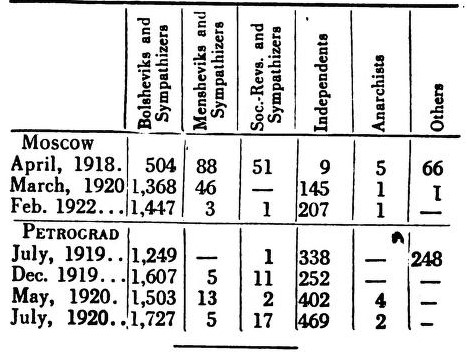
The following tables of election statistics at the two capitals during the last few years bring out two facts of importance: the ever-growing influence of the Communist Party with the Russian factory proletariat, and the increasing proportion of workers whom the Soviet system “draws out”, not as adherents of this or that party, but as adherents of the Soviet system itself, interested in making it an effort at governmental apparatus for the benefit of the Russian working class.
Soviet Russia began in the summer of 1919, published by the Bureau of Information of Soviet Russia and replaced The Weekly Bulletin of the Bureau of Information of Soviet Russia. In lieu of an Embassy the Russian Soviet Government Bureau was the official voice of the Soviets in the US. Soviet Russia was published as the official organ of the RSGB until February 1922 when Soviet Russia became to the official organ of The Friends of Soviet Russia, becoming Soviet Russia Pictorial in 1923. There is no better US-published source for information on the Soviet state at this time, and includes official statements, articles by prominent Bolsheviks, data on the Soviet economy, weekly reports on the wars for survival the Soviets were engaged in, as well as efforts to in the US to lift the blockade and begin trade with the emerging Soviet Union.
PDF of full issue: https://www.marxists.org/history/usa/pubs/srp/v6-7-soviet-russia%20Jan-Dec%201922.pdf
 Revolution's Newsstand