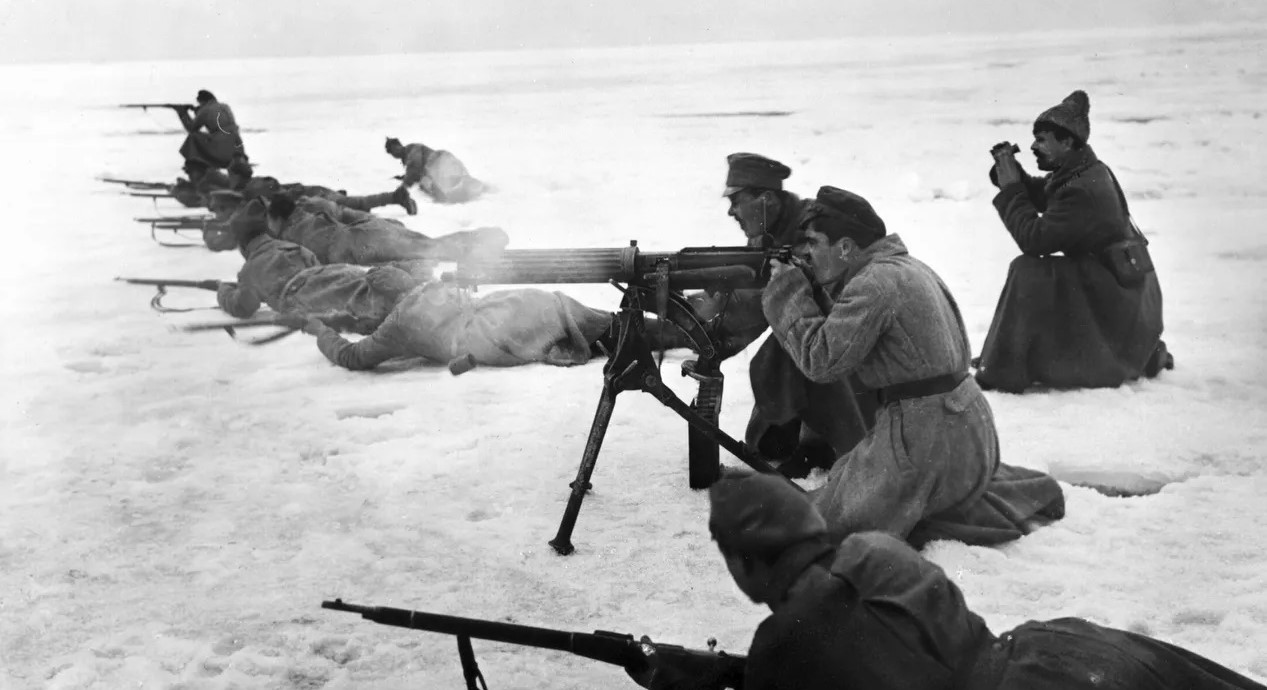
Karl Radek on the rebellion of the Kronstadt naval garrison in 1921.
‘The International Lesson of Kronstadt’ by Karl Radek from Workers Council. Vol. 1 No. 5. June 1, 1921.
When on March 2nd the tidings reached across the frontier that the sailors at Kronstadt rose in revolt against the Soviet government, the White Guard Press of the whole world raised a shout of great joy. “The Kronstadt sailors who had carried the revolution to every nook and corner of Russia, who had been the bitterest opponents of the bourgeoisie, these sailors have now broken away from Soviet Russia, who is there now to fall back upon?” So argued the various mouth-pieces of the Russian counter-revolution, some of which were already figuring out the number of days left for Soviet Russia to live.
The suppression of the sailors revolt in itself does not diminish the significance of this event. It is of great importance to gain a clear conception of the nature of the Kronstadt revolt in order to understand not only the present situation in Russia but also to get some light on one of the most important problems of the world revolution in general, namely, the problem of the relations between the Communist Party and the proletarian masses, in other words the problem of the dictatorship: party dictatorship or class dictatorship, as some erroneously state it.
The Uprising
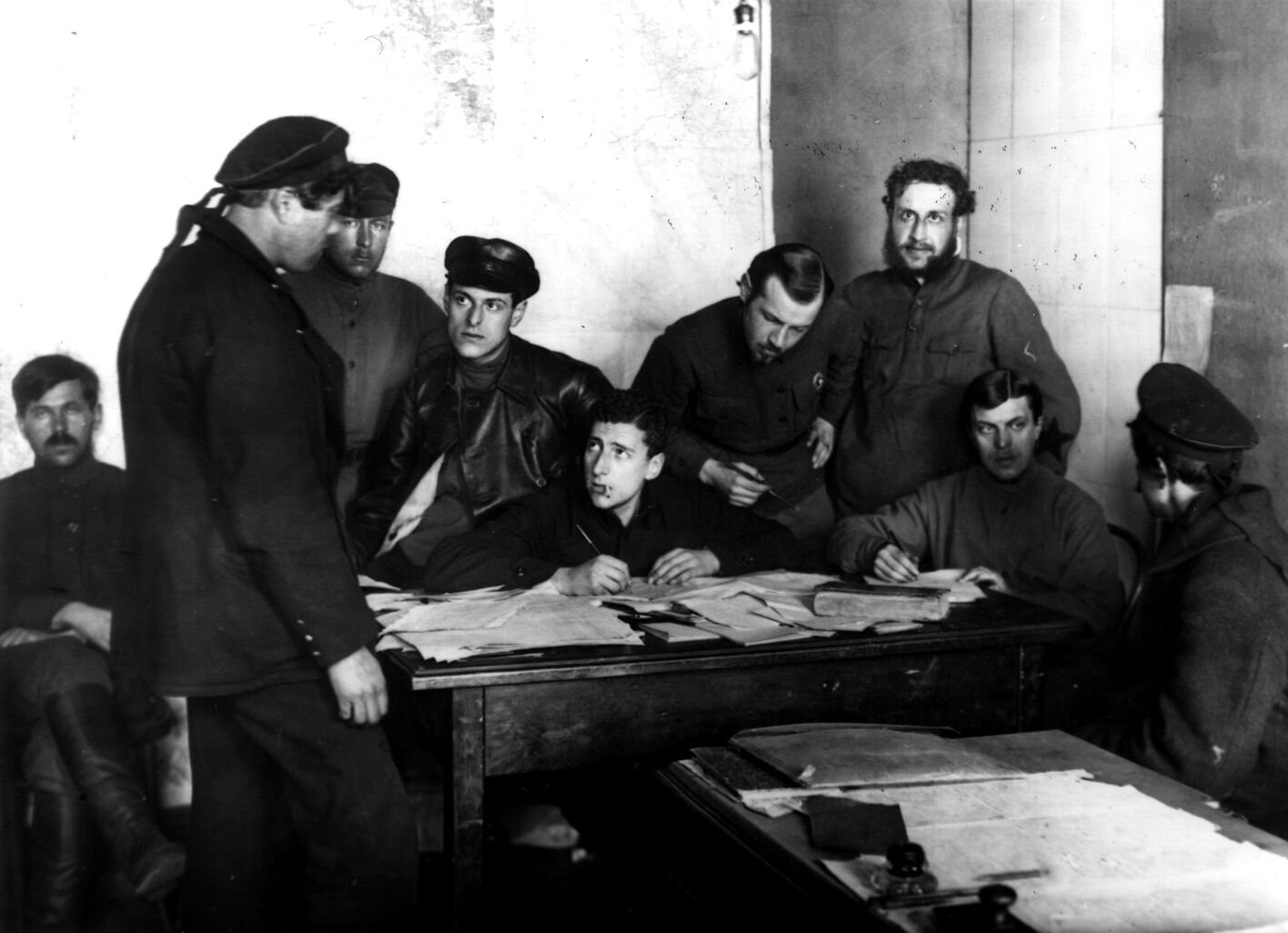
The Kronstadt revolt was undoubtedly more than a local event, although it naturally had its own local features. The disaffection of the sailors was due mainly to their opposition to the regime of discipline and order imposed upon them by the Soviet government.
The sailors of Kronstadt played an important part during the revolution of 1905 and 1917 in the work of destroying the government apparatus. Owing to the reckless nature of the sailor, and owing to the fact that there is a high percentage of skilled workers among them, they were enabled to become an important revolutionary factor. But during the last three years, the revolutionary proletarian elements in the fleet were extremely weakened. Thousands upon thousands of fighters in all army corps, in all the Soviet institutions on work of defense as well as of reconstruction, were recruited from the old Kronstadt sailors. The insignificant number of old comrades who had remained at Kronstadt, occupied commanding posts and formed the Communist apparatus of the fleet, and it was just against those that the new crew rebelled. From where were these new crews recruited? Finland and the Baltic provinces are no longer in the hands of Soviet Russia, and these new sailors could be recruited only from the South of Russia and from the Black Sea coast. Thus the majority of the sailors manning the fleet consists of peasants from the Ukraine.

On the whole it may be said that this revolt was in the first place the expression of the discontent of the Ukrainian peasant. Following the termination of the White Guard fronts, the sailors went home in great numbers on furlough. They learned that there was no direct danger threatening from the White Guards and at the same time they heard complaints coming from all sides about the Government requisitions of food products. In the Ukraine they learned about the relentless struggle carried on by the Soviet Government against Machnov and his band, who under the flag of anarchism were committing pillage and arson among the population, and disturbing railway traffic. Some of these sailors never returned from their furlough, others joined the Machnov crowd.
But the Kronstadt sailor is a revolutionist at heart. He does not stand for the return of the White Guard general, the landowner, or the capitalist. He did not regard his protest against the burdens imposed upon the peasantry by the revolution and against the discipline and order demanded by it, of a counter-revolutionary nature. On the contrary, he regarded his opposition in the light of furthering the October revolution. “We brought about the revolution,” “we proclaimed the motto of All the Power to the Soviets.” The Soviets therefore should exercise power, they should represent the masses as a whole, and not the Communist Party alone, as is the case to-day. We must create a real Soviet power. While this state of mind prevailed an extensive discussion within the Communist Party was started upon all the questions that had accumulated during the three years of the civil war and had stirred up the ranks of the party. In the Communist press and at Communist gatherings it was publicly stated that during the long period of struggle the organism of Soviet Russia had be- come affected with parasitic bureaucratic elements. The necessity of clearing the Communist Party from careerists and place-seekers, was brought to light. All this of course reached Kronstadt and the peasant psychology of the sailors somewhat transformed by the lies circulated in the navy, assimilated all this and formed a distorted conception of the situation in Soviet Russia. This conception comprised all the tendencies of anarchism which tends in opposition to every form of centralisation and bureaucracy; it also contains the Socialist Revolutionary which regards the peasantry as the foremost revolutionary force, and lastly also the syndicalist tendencies demanding that the worker like the peasants should be the absolute owner of the products produced by his labor.
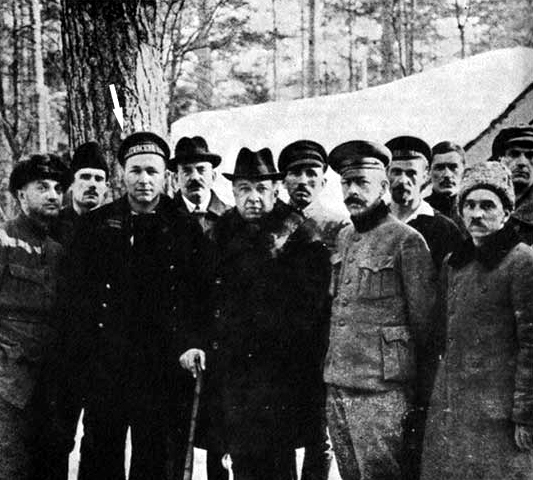
The Kronstadt rebels felt that they were not alone in this matter. They heard extremely exaggerated reports of peasant movements from the Russian White Guard papers published in Finland; they heard about the poverty prevailing in Petrograd and about strikes; they heard of the keen disappointment of the workers everywhere at the absence of an improvement in their conditions at the conclusion of the war. It was in this atmosphere that the organizations of the socialist revolutionists of the Right Wing as well as of the Left, of the Anarchist and individual Mensheviks were carrying on their activity. Above all in the back-ground, unseen by the sailors, were the avowed counter-revolutionists and the monarchistic conspiracy of the Artillery officer Koslovsky. Eventually the sailors having risen against the Soviet Government realized that they would have to pay dearly for it, and therefore, came out in open mutiny. The Soviet Government could not tolerate such a situation for long. Troops, under the leadership of the Storm Battalion of Red Cadets, sent to Kronstadt by the Party Conference, which was in session in Moscow at the time, marched at night across the already cracking ice of the Gulf of Finland. The resistance was very stubborn, but not so stubborn as it might have been in view of the weapons at the disposal of Kronstadt. Not only was the faith of the sailors in the possibilities of success shaken, but also their confidence in the justice of their cause. The latter became more obvious as the counter-revolution, hitherto concealed in the background became more and more exposed to the light of day.
Thus, Kronstadt was taken in one assault. As the fallen victims were being taken to their graves, White Guard newspapers arrived in Russia, from Paris, Berlin, and Prague, which proved how right was the Soviet Government in regarding the mutiny at Kronstadt, not as the beginning of a third revolution, but as an attempt of a new counter-revolution.
The New Plan of the Counter-Revolution When the Russian counter-revolutionaries heard of the mutiny in Kronstadt, they forgot the chasm that divided them from Kronstadt.
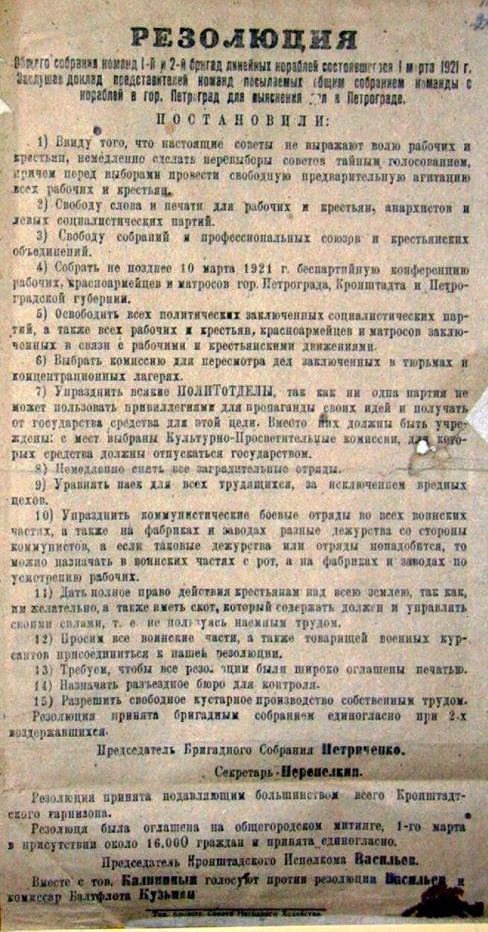
With unusual insight and clearness, they saw the significance of the Kronstadt events. Miliukov’s organ “Posledini Novosti,” and “Obtchee Delo,” the organ of Bourtzev, both declared their convictions and resolve to support. not only the Kronstadt sailors, but immediately to draw up a plan of tactics based on the acceptance of the Kronstadt slogans. The tactical plan developed in these papers consisted in the recognition that every counter-revolutionary attack, which openly operates with the forces of the Allies, or with representatives of the old regime, of the junkers and the capitalists, is doomed to failure. The masses, they say, do not believe in the honesty of the intentions of the Allies. They know perfectly well that when the Allies set their forces against Soviet Russia they do so in order to convert Russia into their colony. They, and particularly Miliukov, are convinced that the defeat of Denikin, and Koltchak and the others, were due to the fact, that as representatives of the Russian junkers, they repelled the peasants.
Miliukov’s first conclusion therefore, in which he is energetically supported by Savinkov, is that the counter-revolutionary movement in Russia can only be successful when it springs from within and appears to be free from feudal tendencies. Miliukov however, on the basis of the Kronstadt events draws yet another conclusion. He recognized that the demand for the Constituent Assembly has no attractions, either for the peasant, the workman, or the Red Armist. The sailors in Kronstadt rose with the slogan real Soviets, but this was accompanied with the slogan “Down with the Communists.” For this latter slogan Miliukov is prepared to pay the price of accepting the slogan for a real Soviet Government: for, in the event of the fall of the Communist Party, there falls also the only power in Soviet Russia, which has led the struggle against world capital, and the only power, which is capable now, providing it has peace, to carry out the economic reconstruction of the country, and the only power, as the greatest section of the revolutionary proletariat and peasant masses, to guide the ship through the rocks and secure the ultimate aim of the revolution.
Soviets without Communists will represent the wavering, disunited, and exhausted workers, and they will be compelled to allow the bourgeois forces, which the Communist Soviet Government bents to its service and over which it keeps a strong control, to operate without any control at all. The counter-revolutionary emigrés will return to Russia and will fill all the administrative departments of these non-Party-Soviets, and in fact, take complete power in their hand. Then, the time will come when this seizure of power will be clothed in the juridical forms that the counter-revolution will regard necessary. Miliukov’s organ in a dispute with a doctrinaire Socialist Revolutionary goes so far as to defend the Soviets, not only as organs of administrations, but also as organs of State power. “The Soviets are not merely consultative or legislative organs, but the organ of State power as a whole, only as such can they take the place of the State power of the Bolsheviks, only as such can they be the starting point for the building up of a regular organization in the provinces, which can maintain contact with the people. It is of course, understood that after they have performed this temporary function, they will be re-elected” (issue of March 18th). Miliukov, the founder and leader of the ideas of the liberal Cadet Party, this blind, doctrinaire, West European parliamentarian, understands that the defeat of the Communist Party of Russia will destroy the only power which enables Soviet Russia to be a great world factor for revolution, and that without the dictatorship of the Communist Party, Soviet Russia will fall a victim to the counter-revolution. He thus bases the counter-revolution on the one and certain point, i.e. the destruction of the Communist Party of Russia.
In peasant Russia, after the destruction of the Communist Party, the peasantry in the Soviets will consolidate itself, as a conservative bourgeois class, and all other things will be added later.
Lessons of Kronstadt Mutiny
The tactical plan of the Russian counter-revolution to overthrow the Soviet Government by rousing the petty bourgeois, peasant, and semi-proletarian masses against the Communist Party, under the cry of securing a “genuine Soviet government” by means of a “third revolution,” will fail. The Communist Party of Russia is sufficiently able, sufficiently elastic, and sufficiently bound with the masses to thwart this plan. The fact however, that the Russian counter-revolution, in its struggle for power, has had to employ the slogan of Soviets in order to get support against the Communist Party, is one of world historical importance. When the proletariat of Western Europe in their solidarity with Soviet Russia, as the hub of the world Revolution, say to themselves: “My country, right or wrong,” when it refuses to be influenced in its relation to the Communist Party of Russia by tales either of its “terrorism,” or its opportunism, it, in this way, expresses its great revolutionary instinct. It understands that here it is not a question of the extent to which communism is actually being carried out in Russia, whether communism can be rapidly introduced, or whether it can be introduced in an isolated agricultural country, but it is a question of Russia having been torn out of the hands of the European counter-revolution, and that hundreds of millions of peasants and the economic forces of the greatest country in Europe are not being employed in the military and economic service of capitalism which is now fighting for its very existence, but in the service of the world proletariat struggling for a new economic system. And the world proletariat understands that under these conditions the Communist Party is right when it retains power in its hands. Whatever the Communist Party does will be judged by history from the standpoint of the manner it has served this purpose; this may mean either the application of terroristic measures, at the moment when the enemy is attacking, for the purpose of gathering all the resources of the country to defeat the counter-revolution, or to make concessions to the petty bourgeois elements in order to sever them from the bearers of counter-revolution, the junkers and the capitalists. This is what the advanced guard of the proletariat whit its revolutionary instinct has grasped, and they see now how correct were those who said that you cannot support the Russian Revolution and at the same time combat the Russian Communist Party. The attempt of the Hilferdings, Dittmanns, Longuets, and Bauers, to distinguish between Soviet Russia, the Russian Revolution, and the Communist Party, in the light of the stand taken by the Russian counter-revolution during the Kronstadt affair, is a deception and at best a piece of self deception. “Long live the Russian Revolution,” “Long live Soviet Russia,” “Down with the Russian Communists and the Dictators of Moscow,” echo the Tzarist minister of Finance, Kokovtzev, Dardanelles Miliukov, the Paris Bourse, and General Wrangel; and they add: “If the Communist Party of Russia is beaten, the counter-revolution can afford for a little while to wrap itself in the mantle of the Soviets.” In the light of this, the Hilferdings, the Dittmanns, the Bauers, and the Longuets, and all the heroes of the Second and a Half International, prove themselves to be, not the Right Wing of the Revolutionary Working Class Movement, but the Left Wing of the capitalist counter-revolution. The future historian of this great struggle for the freedom of the world proletariat will record the fact that on the day, on which the Russian Communists filled the breaches in the defences of Petrograd with their bodies, caused by the Kronstadt mutiny, the “Freiheit” referred to Zinoviev as “the corrupter of the Russian Proletariat”, that Mons. Longuet, like Herr Bauer, expressed his sympathy, not with the Communists, who were forming a defence to Petrograd of their bodies on the ice in the Gulf of Finland, but with the misguided tools of world reaction in Kronstadt.
The Kronstadt events compel the West European proletariat to draw still further conclusions. They are weighing up our differences with the section of the Communist movement which believes that the Russian Dictatorship of the Communist Party must be opposed by the dictatorship of the mass; of the whole of the working class. The Laufenbergs and Wolfheims (former leaders of the German Communist Labor Party), who in 1919, believed they could oppose the idea of the Dictatorship of the Communist Party by the idea of the dictatorship of the masses, have now avowedly gone into the camp of the counter-revolution. In their last pamphlet “Moscow and the German Revolution” they frankly express themselves as opponents, not only of the Russian Communist Party, but also of Soviet Russia, by denouncing the Soviet Government to the German labor masses as a bad edition of Tzarism. They are now regarded by the Communist elements in Germany, with whom they have up till now maintained a spiritual bond, as counter-revolutionaries. This process can only be brought to a definite end when all the sections of the Communist International see not only the Russian aspect of the events of Kronstadt, and the tactics of the Russian counter-revolution, but also the international aspect. The peculiar Russian feature of these events lies in the fact that the proletarian stratum in Russian society is smaller than in Western Europe, that the petty bourgeois stratum in Russia is greater than in England or Germany, and for that reason, its influence upon the working class in Russia is greater than it is in Western Europe; for that reason the possibilities of petty bourgeois hesitation and wavering of the working class is greater in Russia than in the West of Europe. The struggle in Western Europe will be far more severe because the bourgeoisie there is far better organized than was the Russian bourgeoisie. The food difficulties will be ten times greater than they are in Russia and conditions will arise in which the broad labor masses will waver when they will begin to think of capitulating to the bourgeoisie, and when the dictatorship of the proletariat will only be able to maintain itself in the form of the steel hearted advanced vanguard, the Communist Party. Just as the declaration of the “Centre” that it is in favor of dictatorship, but against terror, is nothing else than a declaration to the effect that these elements are not prepared to use every means to secure the victory of the masses, and that they are prepared to betray it each time a difficult situation arises, so is the cry in favor of dictatorship of the whole working class as against the dictatorship of the Communist Party proof that these elements are only prepared to fight as long as the backward elements of the working class remain at their post, that is, as long as the struggle is easy, when there will be no need to starve, to freeze or to bleed. In our pamphlet “The Dictatorship of the Working class and the Communist Party,” written in the summer of 1919 against Laufenberg and Wolfheim, we wrote “under no circumstances will the Communist Party dissolve after the seizure of power. It will closely bind its members, the best representatives of the Dictatorship, and decide with them what measures have to be carried out in the organs of power of the proletariat. The Communist Party, as a concentrated power, will march in advance of the masses and its organs, in order to preserve the dictatorship. For the proletariat is not secured once and for all in one blow. Until ultimate victory it must be won anew every day. The labor masses, which to-day are divided into sections, varying stages of fighting fitness, must, in the process of the advancing proletarian revolution, be imbued with the determination to fight, in order that the existence of a proletarian dictatorship be at all possible. But this “unity” is only relative. There will always be a section of the proletariat, which during the establishment of the dictatorship, will be hostile, or will idly stand aside, and the masses, which on the day of victory, will celebrate, in the days of difficulty, in the days of setbacks,–will waver, will doubt the possibility of ultimate victory and will think of surrender. The proletarian revolution does not bring any immediate relief from poverty. Under certain circumstances it will bring a change for the worse in the position of the proletariat, and for this reason, it is necessary to have a strong, centralized Communist Party, which, as the strong arm of the proletariat, must be determined for a certain period, if the conditions of the struggle do not improve, and the temper of the masses does not rise, to retain power as a Party representing the revolutionary minority. Naturally, if the majority of the working class is imbued with the false hope that it will be able to live better in the chains of capitalist slavery, than by struggling for its freedom and will exhibit active hostility to the proletarian dictatorship, the Communist Party will not be able to maintain its position; but it must remain at its post and endeavour to hold it. The conditions will then improve. The working class will again rally round the Party, and it will be able to lead the struggle to ultimate victory. The emancipation of the working class can only be the task of the fighting majority of the proletariat. But in the struggle for emancipation, circumstances may arise in which the revolutionary minority of the working class must take the whole burden of the struggle upon its own shoulders, in which dictatorship of the proletariat must temporarily take the form of the dictatorship of the Communist Party. That was the position at one time in Russia.”
We are convinced that the Kronstadt events will teach those communist elements who have not sufficiently appreciated the role of the Party in the revolution, the real conclusions of the resolution of the Second Congress of the Communist International on this question. It is not sufficient however for the principle that the proletarian party must retain power in its own hand when the petty bourgeois counter-revolution in the form of the dissatisfaction of the workers, advances against it to be accepted. It must be understood that however much the Communist Party must rely upon the masses of the workers in order to secure victory, conditions may arise even in Western Europe, in which the vanguard will have to retain power in its own hands for some time. It must be understood that under all circumstances the Communist Party is the soul of the Revolution, and the backbone of the Proletarian Dictatorship.
The struggle which the Communist Party is at present conducting in order to strengthen its influence among the as yet non-Communist working masses, the struggle which it is conducting to awaken the initiative of these masses, is the culmination of its iron determination at all cost to maintain power. This determination should serve as an example for the Communists in other countries. The greatest lesson of the Kronstadt events is its international lesson.
The Worker’ Council purpose was to win the Socialist Party of America to the Third, Communist, International and later to win locals and individuals. Published (mostly) weekly by the International Education Association in New York City, Workers Council included important members of the SP, mainly from its Jewish Federation like. J. Louis Engdahl, Benjamin Glassberg, William Kruse, Moissaye J. Olgin, and J. B. Salutsky, editor of the radical Jewish weekly, Naye Welt. They constituted the Left Wing that remained in the Socialist Party after the splits of 1919 and were organized as The Committee for the Third International. Most would leave the SP after its1921 Convention, joining the Workers (Communist) Party after a short independent existence later that year.
PDF of full issue: https://www.marxists.org/history/usa/pubs/workers-council/05-workers-council-1921.pdf
 Revolution's Newsstand