
Divisions by nationality and between radicals and conservatives in the Western Federation of Miners are used by Arizona copper bosses incapacitate the union in a lockout. Those divisions would soon lead to a split and violence.
‘The Story of the Globe Lockout’ by Paul Lundgren from Industrial Union Bulletin. Vol. 2 No. 30. February 27, 1909.
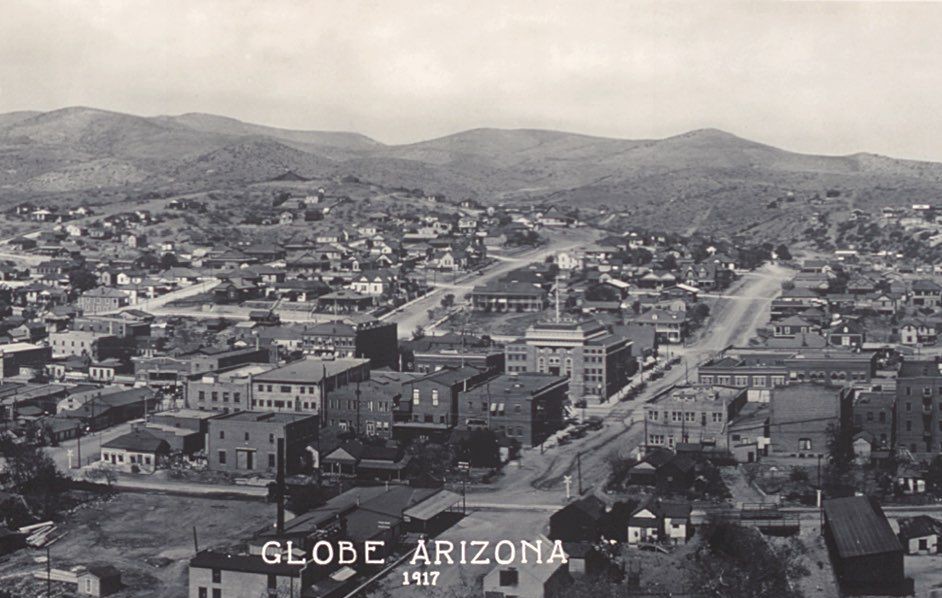
The following is a report of recent occurrences in Globe, Arizona, to the Arizona State Union of the Western Federation of Miners. It is written by an Executive Board member of the A.S.U., and gives a graphic picture of some of the latest events in the great struggle for supremacy between miner and mine-owner in the West.
From Idaho to Colorado; from Nevada to Arizona the drama is ever the same; and is but a part of the greater drama of the labor movement that can only end with, the triumph of the working class organized East and West into a class organization on the industrial field whose purpose is “to take possession of the earth and the machinery of production, and abolish the wage system”:
Globe, Ariz., Feb. 1, 1909.
To the Executive Board of the A.S.U.: Fellow Workers: The late trouble in Globe, as viewed in the retrospect, furnishes good material for thought for students of, and men interested in, the great struggle between the classes. It is with that idea in mind that I take the trouble of giving the matter a detailed write-up, adding comments and giving impressions as they stamped themselves upon my mind.
Immediately after the election of September last, which resulted in complete now blood being returned and, almost without exception, in the different positions in the union being filled by the so-called radicals (more specifically described by the name of Industrial Unionists), there was noticeable dissatisfaction with results shown in the ranks of the employers. At the second visit of Secretary Holohan and Special Delegate Albert Wills to the grounds of the Old Dominion, both were ordered off the premises by Mr. Kingdom, superintendent of that mine. Since then Albert Wills has repeatedly been invited to “keep off the grass,” but he took no notice further than to report matters in the union meetings, where he was repeatedly upheld in his course of ignoring the command of the company. Matters rushed along, the delegate insistent upon performing his duties, to the apparent chagrin of the company officials. Things, however, came to a head when in the second week of January Sheriff Thompson informed Secretary Holohan that he was ordered to arrest Delegate Wills if he ever again ventured on company grounds in his official capacity.
A special meeting of the union was immediately convened. Albert Wills was specifically instructed to ignore the threats, and fifty men volunteered to take his place if he was jailed. Several days elapsed, Wills visiting the grounds every day, backed up by the fifty well organized; nothing happened.

The company next erected a block-house, and with a full force of deputies at their back, forbade all but employes to enter the grounds. As per instructions of the union, Albert Wills and myself, as next in line of the volunteers, entered the grounds by another road, evading the block-house. The company tools, by bluff and threats, endeavored to eject us. We point blank refused to budge an inch. A deputy sheriff then approached and said we were under arrest, and requested that we go with him to jail. We, of course, complied, and as we passed the block-house others immediately took our places on the company’s grounds. The deputy, however, when we stepped off the premises, told us his duty was done, and let us go. We told him politely that he caused our withdrawal from the grounds by false pretenses, and we immediately went back, where we were again intimidated by the company tools, whose instructions, however, evidently did not include actual violence. The superintendent. Mr. Kingdom, then posted the following notice: employes are hereby notified that the mine is shut down, beginning tomorrow, for an indefinite time.” That settled it. We went back to the union hall and reported.
But here I must digress and relate another phase of the company’s capaign against the union. After the notification of Sheriff Thompson’s, but before the lockout occurred, one Trojanovich, partner of the notorious Clausen of Copper Queen infamy, Slavonian well versed in the English language, assisted by others, carried on a systematic propaganda among his countrymen, the purpose being to cause that nationality to form an independent union and divorce themselves from the. W.F.M. Another special meeting of the union was held for the purpose of ascertaining how much inroad, if any, the aforementioned machinations had caused. The Slavonians and Italians. were there to a man, and the vigorous and unanimous condemnation of Trojanovich’s actions attested beyond the shadow of a doubt the true blue makeup of those foreign fellow workers, and I will say right here that the subsequent understanding of the labor movement and the class-conscious solidarity shown by the Slavonians and Italians was a revelation that should cause the most confirmed pessimist to conclude that there was no ground for fear we Were completely secure in that direction.
The next move of the company was the lockout. It undoubtedly had for its purpose the cleavage of the union through another element, namely, the Cornishmen. I am sorry to say that in that quarter we were not so well intrenched. Consternation immediately set in, and, with honorable exceptions, one long howl, “Fire the delegate,” was the order of the day from that nationality, re-echoed in plaintive tune by other English-speaking workers. The “fire the delegate” bunch immediately called for a special meeting, which was so well attended that not more than half could crowd into the union hall. The meeting was, therefore, adjourned to meet at Dreamland, the largest hall in the city, the following day at 9 o’clock. Executive Board Member Clough of the Federation had then arrived and took part in the deliberations. The so-called radicals had been advocating a course of “passive resistance,” by leaving the company scope to make the next move. That method, however, had to be abandoned in face of the overwhelming clamor for immediate action. Clough advised that a committee of five be elected to look over the situation and report important matters to special meetings to be called whenever the committee deemed it necessary. This was too slow a way for the anxious and eager jobites, so the motion was amended to go into a committee of the whole. The argument for motion and amendment soon disclosed that there was absolutely nothing tangible to go on. It was alleged that the different companies promised to again start work if Delegate Wills was gotten rid of, but everything was hearsay, and, at best, alleged statements made by the superintendents to individual employes. After arguments for many hours, a substitute motion was made to elect a committee of five in conjunction with the Executive Board member to interview the managers of the different mining companies and ascertain officially the reason of the shut-down. The substitute motion carried, and the meeting adjourned.

The committee called a special meeting the next day and reported that with the exception of Carter, superintendent of the Boston & Superior, all had refused to see the committee. Much rag-chewing followed, which was only stopped by the announcement made to the president by Sheriff Thompson that Hegart was willing to grant an interview to the Executive Board member and Mike O’Connor of the committee. Great hilarity and applause followed the announcement. I, for one, could not see the grounds for such a demonstration unless it was that in the minds of the conservative element it promised a speedy return to the sweat-boxes. If that was the hope it inspired, the hope was doomed to disappointment.
At the reconvening of the meeting the same evening at 8 o’clock the committee reported that Hegart had refused to make a statement to Clough and O’Connor farther than to say that he would not explain to anyone but employes of his company, and stated further, on inquiry, that he had never agreed with Sheriff Thompson to interview the men as representatives of the union, but would be willing to interview his employes as such and furnish a written statement as to the cause of the shut-down. The committee and Clough deliberated and agreed to send John Harper and Pete Bugen (they both being Old Dominion employes), as a sub-committee to Hegart. The interview resulted in the following document by that gentleman:
“Messers. John Harper and Pete Bugen, Employes Old Dominion Mine, City:
“Gentlemen–In response to your request, as employes of this company, for the reasons why this mine is shut down, would advise as follows:
“We propose to conduct our operations without outside interference.
“We do not propose to have any intimidation of any of our employes.
“We do not propose to have any soliciting of any employe while at work.
“We will allow none but employee admittance to our company buildings.
“We propose to have none but employes admitted around our shafts.
“We propose on pay-days to allow no soliciting of employes of whatever nature around our general office.
“Walking Delegate Albert Wills has violated all of the above regulations; has been ordered off the premises for so doing; has been run off the premises for returning after being warned, and so long as you see fit to retain, him as your representative, or similar actions by other representatives prevail, we will main closed down as at present. Yours very truly,
“R B. HEGART, Supt.”
When I state that former delegates have had free access to any part of the company’s grounds, and further, that the rules as net forth by Mr. Hegart, had then become known for the fret time, you will understand how absurd was the position of blaming Wills for the shutdown. It was a direct, stab at the union, and an attempt to curtail its facilities for getting membership and, through that ability on the part of the union to approach the men, to fill the mine up with a scab element.
In addition to the documents procured from Mr. Hegart by the two of his employes mentioned, another, stating the same terms, was handed in by an employe of the Miami Copper Company, a member of the union who completely ignored the organization in his ignoble worship of the God Job. But such trifling irregularities and contempt for the organization did not bring upon his head the unanimous condemnation it deserved. Instead, a motion was made to adopt the document as official and thereby accepting the company’s terms. Motions, amendments, amendments to amendments, substitute motions, etc., were made, all with a view of throwing out the documents, but without avail. The original motion was put to a vote, and carried, 296 to 205. The show of hands was a revelation; it showed clearly by nationality the conception each had of an economic organization. In the affirmative up went the bands of the Cornishmen almost unanimously. The majority of the rest of the English-speaking membership also affirmed. In the negative up rose as one man the Italians and Slavonians and those of the English-speaking element known as the radicals in this camp. The vote was decisive; the union had lost through the spinelessness of its membership. The vote firmly established the fact that the majority was ready and willing to throw principle to the devil. It was willing to sacrifice an acknowledged efficient and competent organizer, shown by the books, the membership jumped from less than 1,000 to 1,300 in his four months of office.
The motion was made to declare the office of walking delegate vacant. The chair refused to entertain the motion until the by-laws of this union had been complied with. This necessitated that charges against the delegate must be made and sustained, and at least three weeks would be necessary to comply with the constitution. Consternation reigned in the camp of the anxious jobites. Amid great confusion the meeting adjourned until after dinner.
On reconvening, the situation was critical, the so-called conservatives desperate. Executive Board Member Clough then came to the rescue. He stated that he surely had the speedy solution to the problem, and each of the factions, he would guarantee, would be equally satisfied with the arrangement he was about to propose. He required, however, that the assembly have full confidence in him and his proposed measure, and wanted that assurance by a show of hands that his subsequent motion would be carried. The show of hands was satisfactory and he moved the following motion: “That this union sustain Albert Wills, the special delegate, in his actions and conduct up to date.”
The motion carried almost unanimously. Clough then handed in the resignation of Wills and moved that a vote of thanks be accorded him for diligent performance of his duties. This motion also carried almost unanimously. Next a motion was made to accept his resignation, which carried without much opposition. The meeting then adjourned.
The hilarity of the victors (?) was now much tempered by the hot shots repeatedly thrown into their ranks by those who prized principle higher than jobs. The unmanly position they had held throughout had not failed to come home to all but the least susceptible. The mines have again started to work, but to the observer it is not hard to predict the course that from now on will be followed by the companies. Already some of those that were prominent in their attitude of opposition to the emasculation of the union, have been duly fired, the rest will follow in due time, and with as much dispatch as half decency will permit.
It is useless to comment farther. The weeding out of the “undesirables” in camp can now take place systematically, and the “sane, safe and conservative,” not to say servile, wage slave will be left to graciously accept the conditions their masters and it profitable that they shall exist under. Yours fraternally PAUL LUNDGARD.
The Industrial Union Bulletin, and the Industrial Worker were newspapers published by the Industrial Workers of the World (IWW) from 1907 until 1913. First printed in Joliet, Illinois, IUB incorporated The Voice of Labor, the newspaper of the American Labor Union which had joined the IWW, and another IWW affiliate, International Metal Worker.The Trautmann-DeLeon faction issued its weekly from March 1907. Soon after, De Leon would be expelled and Trautmann would continue IUB until March 1909. It was edited by A. S. Edwards. 1909, production moved to Spokane, Washington and became The Industrial Worker, “the voice of revolutionary industrial unionism.”
PDF of full issue: https://www.marxists.org/history/usa/pubs/industrialworker/iub/v2n30-feb-27-1909-iub.pdf
 Revolution's Newsstand