
T.A. Jackson looks at the divisions in Ireland, created and fostered by British imperialism, and sees a plan for India.
‘Divide and Rule; The ‘Black Hundred Trick’ in India and in Ireland’ by T. A. Jackson from International Press Correspondence. 12 No. 35. August 11, 1932.
Outbreaks of rioting between Moslems and Hindus in India have occurred much more frequently of late, and they have in every case been so timed as to effect the maximum of damage to Indian Nationalism and being the maximum of relief to British Imperialism.
These facts of themselves have been significant enough; but now we learn observers sympathetic more to Imperialism than to Nationalism have become convinced that “the outbreaks are being directed by an organisation with plenty of money and active brains”.
These observers no doubt desire thus to provide “an alibi” for the Imperialist authorities. In fact they only complete the proof of their complicity.
The Imperialists in India are using with diabolic cunning an adaption of the methods used by the Tsar against the Revolutionaries of 1905-7–the method of the God-and- Vodka intoxicated “Black Hundreds”.
They take to this method with all the greater facility because it was first used with bloody effect by British Imperialisms in Ireland.
The Tsars did but copy the methods of the frenzied reactionaries who founded the “Orange Society” as a last desperate means of smashing the “United Irishmen” founded by the genius of Theobald Wolfe Tone–a Society which has been the tool of Imperialist reaction from its foundation in 1797 to this day.
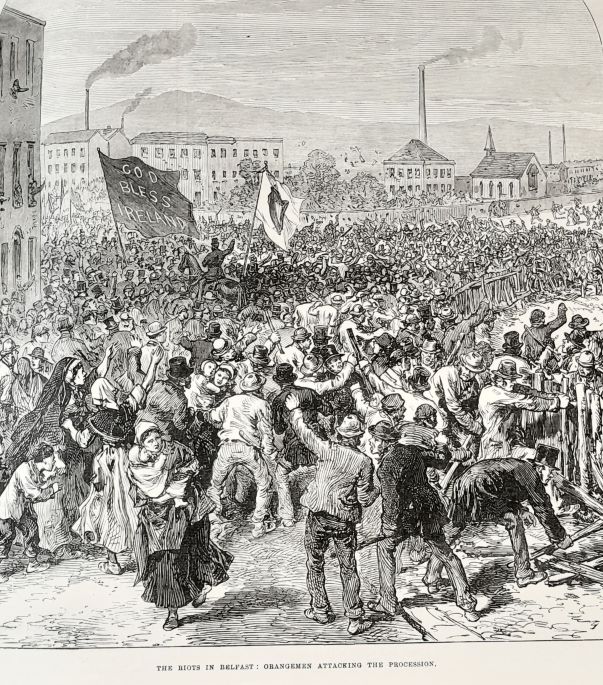
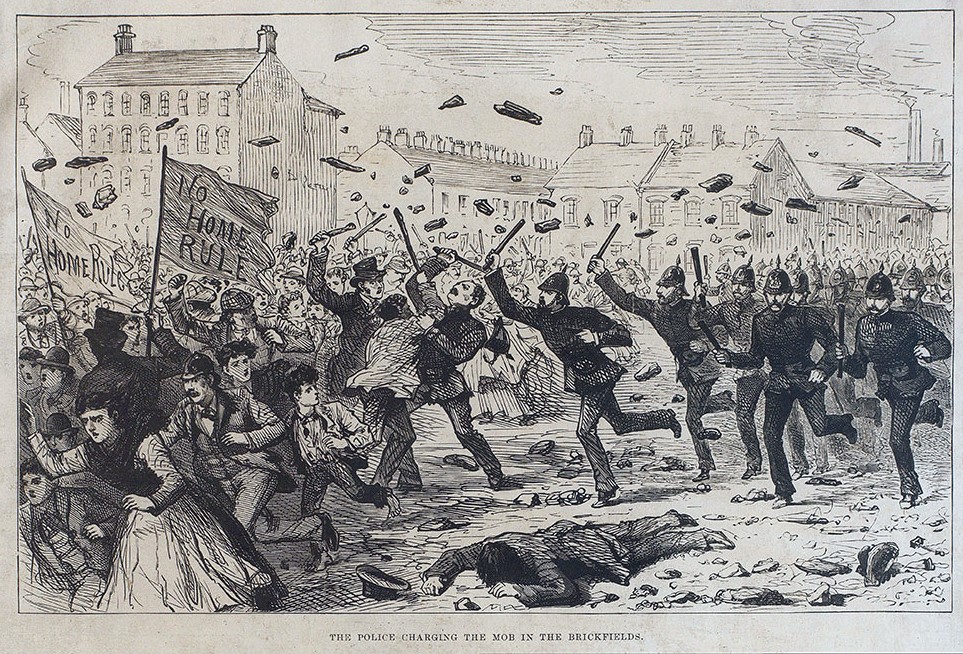
Evidence of the evil legacy of this “true-blue” British invention of the “communal question” appeared in the savage hooligan assaults in Ballymena (Antrim) and Belfast upon train-loads and coach-parties of Catholics on their way to the Eucharistic Congress final celebration on June 26.
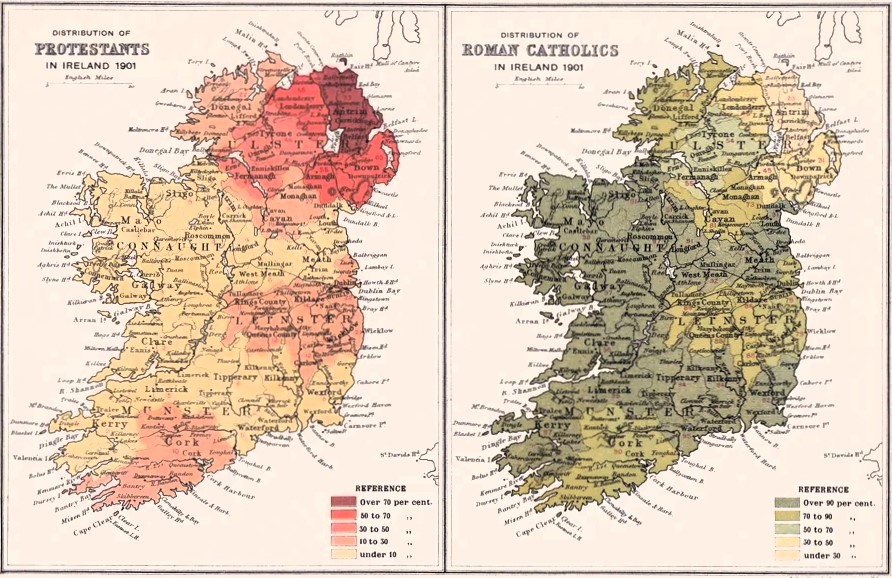
That the majority of the people of Ireland are Catholics is well known. That the Catholics are near to being a majority even in the six counties of “Northern Ireland” is not so well known; true though it is. Least known of all is the fact that not every Protestant in Northern Ireland is a “Protestant” and that not even every “Protestant” is an “Orangeman”.
The non-Catholic minority in Ireland has, in fact, never been in unity. They were divided firstly into adherents of the Established Church (the church of the landlords and the English “garrison”) and Nonconformists. The latter were and are divided yet again into Presbyterians, Baptists, Quakers, Unitarians and Wesleyans.
It is the former and the former alone who were in ’98 and are to-day known as “Protestants”. The latter were and are known generally as “Presbyterians”.
The distinction is of vast importance historically and politically. The Church of Ireland (disestablished in 1867 in an effort to placate the Fenians) was from the beginning the Church of English (“Protestant”) ascendancy in Ireland. It was the Church of the aristocratic landlord, of his toadies, and hangers-on; of the government officials and placemen, and their hangers-on. It was by the aristocrats, the squires, the squireens and their demoralised dupes that the Orange Society was formed.
The “Presbyterians” on the other hand were from the first as much the objects of the hatred of the English Ascendancy party and its church as were the Catholics, and only little less the victims of their oppression.
All the virtues commonly ascribed to “Ulster” as against the rest of Ireland find whatever basis they have in the enterprise, courage and steadfastness of the old Presbyterian stock. It was Presbyterians who defended Derry and Newton-Butler against the counter-revolution of Seamus-a-Cocker. The “Apprentice boys” who closed the gates of Derry and gave out the slogan “No surrender” were Presbyterians. As such they were hated by the aristocratic “Protestants”, and as such they were subjected, after the war was won and the counter- revolution defeated, to nearly all the limitations imposed upon the Catholics who had been drawn into the fight on the reactionary side.
The effects of the savage penal code in which the triumph. of this Whig Revolution of 1688/90 culminated in Ireland remain to this day.
It was the penal code of 1691 and the succeeding years which made possible the impressive-nay the amazing display at the Eucharistic Congress in Dublin on June 26. It was the Orange Society of 1797, and its bloody deeds in 1798 with the perpetuation of its spirit and its organisation as a tool of imperial ascendancy that made this display inevitable.
The penal code was designed deliberately to make the term Irish-Catholic so synonymous with poverty, ignorance, wretchedness and inhibition from all the enjoyments of a civilised existence that (it was hoped) both Irishry and Catholicism would be in time totally exterminated.
It was by long odds the most savage code of repression ever applied by a victorious revolutionary class.
By comparison the terror of Robespierre was compassion and the deeds of the inquisition were exercises in benevolence. It begot its inevitable reaction. It did make the Irish in bulk poor beyond all believing. But in making them too poor to patronise English schools and school masters, it left them to be instructed by the lineal descendants of the “scholars” of the old Gaelic civilisation which successive English invasions had destroyed.
This line of “scholars” has barely died out even in our own day, and there is no more heroic figure in history than the poor “hedge schoolmaster” teaching in the fields with scouts out to watch for the spies of the “English enemy”–and doing this for no reward beyond the love of learning itself, a share of porridge and potatoes and a warm seat by the fire. The same penal code which made it a crime for a Catholic to teach a school, also barred the Catholics from all the learned professions. Priests of the Catholic Church were allowed to practise (under insulting conditions of registration), but solely because (a) the “poor must have some religion to keep them in order” and (b) because the peasant Irish were too poor to be worth any Anglican parson’s plundering.
That from the ranks of Irishmen who after making their way overseas to gain the necessary ordination returned to take up parochial duties amid such conditions of heartbreaking poverty, as Swift describes, there should have been found enough to keep the Catholic chapels of Ireland steadily in use says much for the intensity of the Nationalism begotten by inevitable reaction from the brutalities of the penal code.
Thus it came to be that in every Irish country parish the only man to whom the people could look for advice, aid, comfort and assistance-for a champion against the rack- renting absentee landlord and his agent or his virtually absentee “Protestant” parson and his ferocious tithe-proctor— was either the Celtic-traditional Catholic hedge-schoolmaster (whose existence was a crime) or the Catholic priest.
Is it any wonder that loyalty to the Catholic Church became inextricably associated with loyalty to Gaelic tradition and Irish nationality?
Wolfe Tone, whose brilliant insight and revolutionary. genius is virtually unknown to English revolutionaries who though bred a Protestant, had the capacity to rise far above such trammels–saw clearly that the Irish “devotion” to Catholicism was the product of historic circumstances, and like to lapse with their passing.
Using all his powers to persuade the French Republic to send an army to Ireland to precipitate a revolution, he replied to a doubt whether the Catholic clergy might not influence the people against the French: “I assured him, as the fact is”, he says, “that it was much more likely that France would turn the people against the clergy”. And he went on to give instances showing how readily the people resisted the clergy when these sought to check their struggle against their English oppressors.
It was at that conjunction when, as a result of the organising genius of Tone, the Catholic “Defenders” and “White boys” had united with the “Presbyterian” Republicans of the North to form the “United Irish men”, that the reactionaries formed the “Orange” societies and commenced upon that series of pogroms and outrages against the Catholics which resulted in the insurrection in Wexford taking a predominantly Catholic form instead of a nationalist republican one.
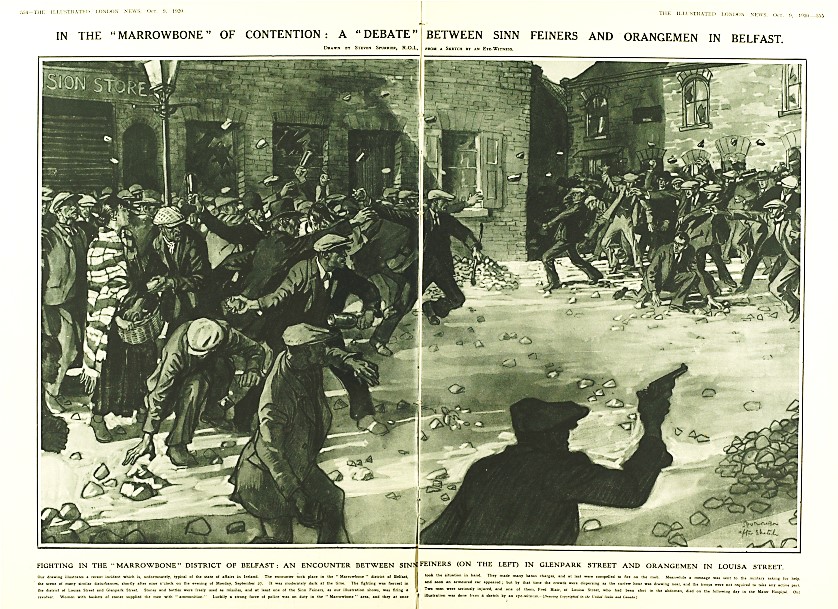
Since that day, aided by successive reactionary governments in Ireland, the Orange Society has developed into a “Free Masonry”–a combination of secret political caucus and job-trust, which on occasion can always be relied upon to produce a pogrom when such will be politically convenient to British imperialist reaction.
Unfortunately for Ireland the sectarian interests of the priests have been able to take advantage of Orange sectarianism to warp repeatedly Irish nationalism in a similar direction.
The Catholic hierarchy is as little desirous of a truly united Ireland as are the Grand Masters of the Orange lodges, and as a proof thereof they have quite cheerfully imitated their methods. The “Hibernians” (Board of Irin) form a Catholic counter-part to the Orange lodges-equally a combination of political caucus and job-trust, equally capable of producing pogrom for pogrom. The “foulest brood that ever came into Ireland” was Connolly’s description of the Board of Erin.
As a set-off against this the neo-Fenianism of the Patrick Pearce school, the Irish Republicanism embodied in, for example, the I.R.A., is in principle and practice diametrically hostile to “Hibernianism” and all its works, all the more so as the latter was the organisational basis for the old evil corrupt and cowardly Parliamentarian nationalism.
Thus a conclusion may be provisionally drawn: The size and the enthusiasm of the Eucharistic celebrations are not at all proof of any “incurable” addiction on the part of the Irish people to Catholicism, superstition and mental enslavement to the priests. In great measure they owed much of their success and their emotional force to the crisis in the relations between the British Empire and the Free State.
Neither, on the other hand, does the outbreak of hooliganism in Antrim and Belfast prove that “Ulster” and “Orange” pogrom-politics are convertible terms.
There is a big danger of reaction indicated in each of these phenomena. But their significance is heavily discounted by the magnificent parade of 15,000 men at Wolfe Tone’s grave on June 20 and in the signs of militant proletarian revival in the North.
Could we but bring to life another Tone who would unite the Republicans of the South and the Proletarian Militants of the North as Tone did, and as Connolly would have done had he lived-all the manufactured sectarian hatred of all the Mumbo-Jumbos, Orange and Green, would be unable to prevail against the united Irish workers and Farmers’ Republican Party.
International Press Correspondence, widely known as”Inprecor” was published by the Executive Committee of the Communist International (ECCI) regularly in German and English, occasionally in many other languages, beginning in 1921 and lasting in English until 1938. Inprecor’s role was to supply translated articles to the English-speaking press of the International from the Comintern’s different sections, as well as news and statements from the ECCI. Many ‘Daily Worker’ and ‘Communist’ articles originated in Inprecor, and it also published articles by American comrades for use in other countries. It was published at least weekly, and often thrice weekly
PDF of full issue: https://www.marxists.org/history/international/comintern/inprecor/1932/v12n35-aug-11-1932-Inprecor-op.pdf
 Revolution's Newsstand