
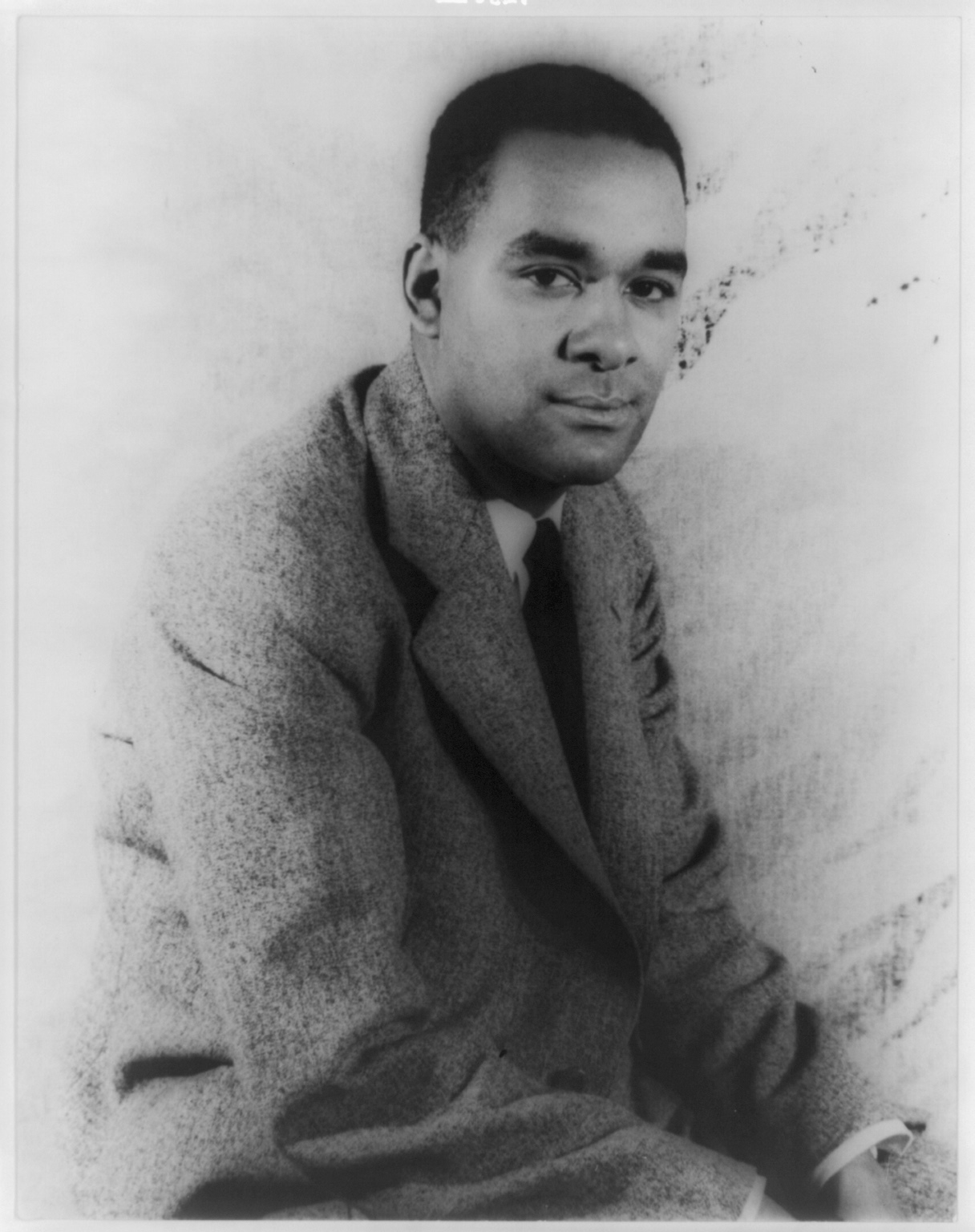
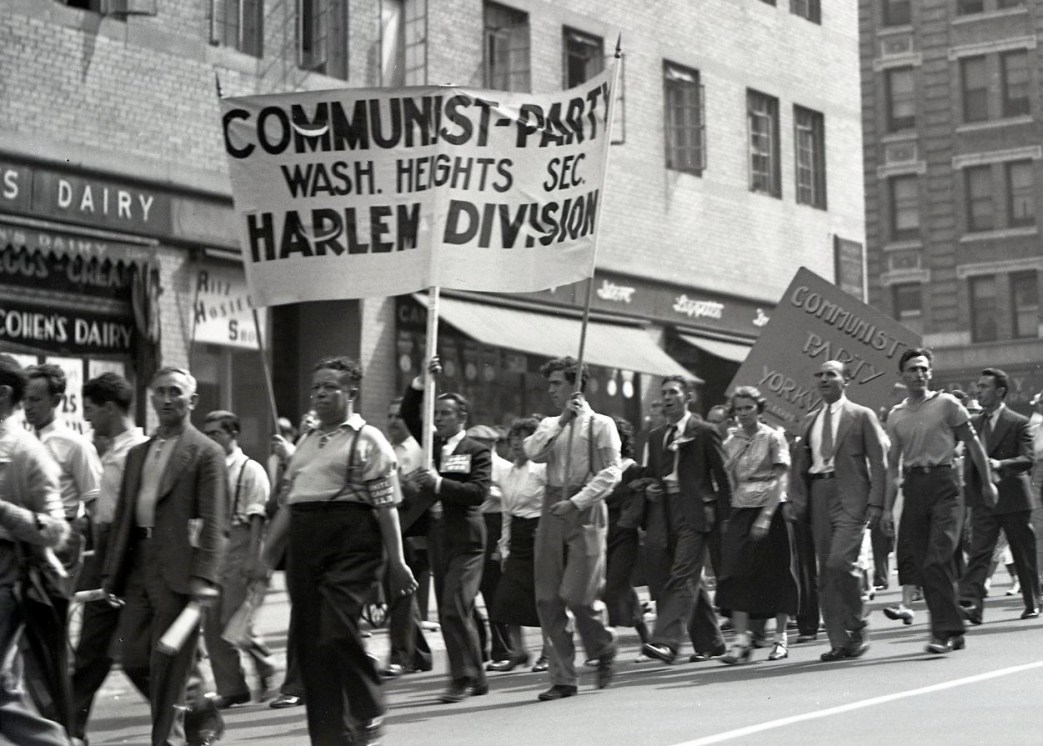
The novelist Richard Wright describes a meeting of the Nat Turner Branch of the Communist Party’s Harlem Division in the summer of 1937.
‘What Happens at a Communist Party Branch Meeting in the Harlem Section?’ by Richard Wright from the Daily Worker. Vol. 14 No. 195. August 16, 1937.
How does the Communist Party work? What do Communists do when alone and among themselves.
Let’s visit a meeting and see.
Leaving the blare and glare of Lenox Ave., you walk up one flight of stairs and enter an oblong room whose walls are covered with murals depicting the historical struggles of the Negro in America. This is the Nat Turner Branch of the Harlem Division of the Communist Party. It was so named in honor of a black slave who died struggling for freedom.
Before you have time to sit down your eyes are drawn to a huge black placard.
“IN MEMORY OF OUR BE LOVED BROTHER, ALONZO WATSON, WHO DIED FIGHTING POR DEMOCRACY IN SPAIN.”
GIVE LIVES
So you know, even before the meeting starts and you hear them talk, that there are people here who will give their lives for what they believe.
The Nat Turner Branch has a membership of about 20; of that 20 around 16 were present. The composition according to class and sex were as follows: 9 women and 7 men. Of the 7 men, 2 were white. The Negro men and women were of the working class in manner, accent, and deportment.
There is absolutely no difference between the Negro and white in the Communist Party. They participate on an equal footing in the carrying out of their tasks.
TO THE POINT
As the meeting gets under way you notice that there are no abstractions no splitting of intellectual hairs. Every word is simple and straight to the point. They are not concerned about whether the world exists or what reality is: they know the world exists and they know from their own harsh lives just what kind of a world it is. They meet here to devise ways and means of changing that world into a more human one.
The extent of the activities of these seemingly ordinary people is amazing. When Wilhemina Plummer, Negro woman organizer of the Nat Turner Branch, rises to read the agenda and announcements you learn that two delegates from this branch are to attend a conference on Harlem housing conditions; there are announcements urging members to attend classes to learn public speaking: and there is a call and response for two comrades to picket a department where a strike is in progress.
Then a startling discussion arises over the American Labor Party. There is no desire here to “grab” the ALP. Members are urged to join to help build that organization. The whole attitude is more of giving one’s self to something more important than a mere petty grappling for control. Suffused through every speaker’s words is the burning desire to see the A.L.P. become a popular political party. The women volunteered to join that party and give their services.
THIS IS COMMUNISM!
Education and the process of education is the keynote of everything said and done here by these black men and women. Next, they decide to give a lawn party to raise funds to send a comrade to the Workers’ School.
Then comrades are urged to buy and sell tickets to aid the National Hunger March to Washington to take place on Aug. 23. “We must support this,” says the organizer. “We in Harlem know what hunger is.”
SCOTTSBORO FIGHT
Petitions demanding of Congress and the state of Alabama the freedom of the five remaining innocent Scottsboro Boys are passed around. Comrades are urged to have them filled out as soon as possible. The meeting is going fast as now; they want to get through as soon as they can in order to listen to an educational report on the situation in China.
An open-air meeting is planned on neighborhood problems; comrades having difficulties of any kind are invited to attend the next buro meeting of the branch (three or four leading comrades in a branch who formulate policies for endorsement of the membership by whom they are elected constitute a buro).
The weakest spot in the entire meeting is the discussion regarding the Daily and Sunday Workers. The comrade who had been delegated to obtain the Daily and deliver it to the members of his branch had failed. He tried desperately to shunt his responsibilities onto the shoulders of someone else. Hot words flew to and fro. He was finally made to realize that it was his fault and that next time he had to get those papers and deliver them!
RECEPTION
A reception for the mothers of the Scottsboro Boys was planned next. From high political issues they went without a change the tone of the discussion down to ice cream, fried chicken, how to bake a cake, and how to make good punch, etc. A committee was elected to arrange this reception. A “man” comrade refused to serve on this committee on the grounds that it was a “woman’s affair”, and a “woman” comrade bawled him out with strong words.
“What’s good for one Communist is good for any Communist!” she said.
Party recruiting came next. One new member was introduced, a Negro woman worker. She was welcomed unanimously and voted in.
Business over, a white comrade, a student, rose to give a talk on the international scene with an emphasis upon China. Before he spoke many questions were asked, among which were: To what extent are American interests involved in China? What is the role of the Party in relation to Japan’s aggression? What is the relationship between China, Spain and Ethiopia? What of Japan’s boast of protecting the “darker races” and then making war on China? What of the Chinese Soviets and the Chinese Red Army? A concrete analysis of how these events and facta were interlinked proceeded. The entire room was dead quiet. There was applause when the speech ended. A comrade rose and demanded that hereafter business meetings should be made shorter so that more and longer educational discussions could be had.
This is the same Party that took power in Russia, that fulfilled the two Five-Year Plans, that built the Red Army; and that is now building Socialism.
These black people who meet here in Harlem are hungry more than in one sense. They love this Communist Party which is the only organization caring enough for them to give them this world-view of things. It is through such meetings as these that Bolsheviks are forged, men and women with guts and courage enough to take the world into their hands and mould it and in moulding it remake themselves.
And it is through such meetings as these that for the first time in American history the Negro is receiving his highest possible pitch of social consciousness. When you listen to them talk you know that the future is fraught with conflict but you feel that here are people capable of dealing with that conflict.
Denied university educations, they are receiving an education from the vanguard of the working class, the Communist Party. Farmers, intellectuals, and middies class people who drifting about in a shoreless sea, wondering what straw they can grasp, should look here, for this is a new pole of strength about which the life of the whole world can regroup itself. These working people may not have polished accents, graceful gestures, etc.; but they have what takes to build a new world–the ability to ACT and a singleness of VISION.
The Daily Worker began in 1924 and was published in New York City by the Communist Party US and its predecessor organizations. Among the most long-lasting and important left publications in US history, it had a circulation of 35,000 at its peak. The Daily Worker came from The Ohio Socialist, published by the Left Wing-dominated Socialist Party of Ohio in Cleveland from 1917 to November 1919, when it became became The Toiler, paper of the Communist Labor Party. In December 1921 the above-ground Workers Party of America merged the Toiler with the paper Workers Council to found The Worker, which became The Daily Worker beginning January 13, 1924.
PDF of full issue: https://archive.org/download/per_daily-worker_daily-worker_1937-08-16_14_195/per_daily-worker_daily-worker_1937-08-16_14_195.pdf
 Revolution's Newsstand