
In the effervescence of 1930s radical art, perhaps none was more dynamic and ‘new’ than dance.
‘The Dance For Those “Not Interested” in the Dance’ by Stanley Burnshaw from New Masses. Vol. 18 No. 2 January 7, 1936.
PEOPLE who were sensible or lucky enough to see the last two dance recitals will please turn the page. This review is not for them. It is for you, Mr. or Miss Follower-of-Social-Art who are interested in all examples of left-wing culture except the dance. You have been told, of course, that last year four thousand people packed the Center Theater to see a handful of young dancers in revolutionary solos. You may even have heard, with due skepticism, that hordes of otherwise sensible people stood in line in piercing cold rain to purchase the privilege of standing in Carnegie Hall for three hours during eight dances. Possibly you read that another capacity audience packed the Adelphi Theater a week later. Nevertheless, whenever the dance is mentioned you lift an eyebrow or turn on a patronizing smile in order to assure everybody in sight that you are still an untouchable.

It is about time for you to wonder if by some remote possibility you may be wrong. These masses of devoted spectators may be smitten with a mania–that has happened before; but you can be positive that they do not pound their hands to demand encores of works that are innocuous or incomprehensible. Nor do crowded revolutionary journals devote columns to analyzing faddist pastiches. The fact is: we are living in the midst of a genuine renascence, one of the most exciting that has fructified America. And there are no mysterious prerequisites for enjoyment, there is no mystical vocabulary. Fundamentally the dance is for anybody who has felt an emotional lift seeing splendid arc in the flight of birds or other piercing instants of plastic grace. But the new dance is not interested exclusively in the beauty of body motion; it appreciates that the configuration of movements communicates emotions and ideas. In the dance of social consciousness, particularly, these ideas and emotions are legible.
There was in fact much more ideology than dancing in the first left-wing dances; a necessary process but one which had to be outgrown if there was to be a fusion of form and content. Last year the New Dance League electrified New York with a group of compositions that proclaimed a vast leap toward artistic maturity. This year their recital has produced no such repercussions–how could it?–but the dancers themselves have achieved far more skill and scope, and at least two unforgettable compositions.
The consistently excellent technic throughout the recital (Dec. 22) was nothing less than astonishing. Naturally this was especially apparent in those works unsuccessful as compositions–Rose Crystal’s We Need Space (whose title bore no inherent kinship to the composition); Marie Marchowsky’s Conflict (too reminiscent of Graham’s Imperial Gesture); William Matons’ Mad Figure (a routine illustration of a poem). The warm audience-response proved that the dancers made the most of hampering material. It also implied the need for more penetrating choreographic creativeness.
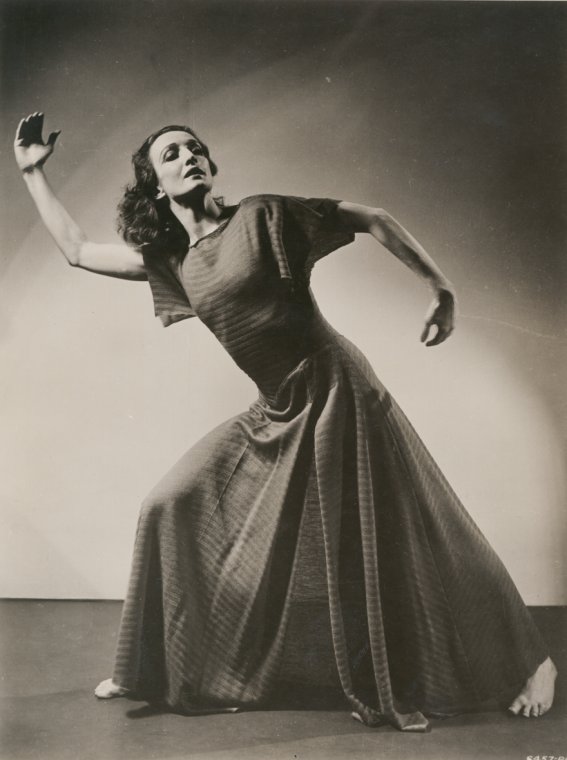
Two of the performers, on the other hand, gave brilliant demonstrations of the achievement of which our dancers are capable. Drawing her material from one of the Songs About Lenin, Sophie Maslow has created in dance form the contrasting moods of “In January he died,” “In April he was born.”
But the high point of the evening was Lily Mehlman’s Fatherland, a group of three dances: Heil, Defiance and Song of Affirmation. We have seen many attempts at utilizing fascist symbolism, but never such creative use of symbols and never such savage intensity. There are no obvious tricks here, no glib maneuvers of design. With driving lyricism Fatherland registers the shame and degradation of German fascism, the desperate defiance, and in another emotional key, the prophetic note of affirmation. In our opinion this work is the flower of all our efforts at anti-fascist, anti-Nazi art.
The program included several satires, a welcome emphasis but one which brings its own problems; for nothing is more exacting of precise invention and execution, and nothing is sadder than a satire that misses fire. Anna Sokolow’s Speaker began in apparently forthright terms but it suddenly emerged as travesty. Similar confusion thwarted the effect of her Impressions of a Dance Hall, whose mood was irony until it suddenly melted into pathos, blunting the emotion of the whole. Jane Dudley’s Liberal registered its witty point but her other three portraits blurred. Jose Limon and Letitia Ide made a dazzling thing of Nostalgic Moments- overlong but studded with passages of beautiful irony and splendidly performed. With disingenuous sureness Merle Hirsch turned Valse Sentimentale into a witty fragment.

The dances performed at the recital for the benefit of the International Labor Defense (Carnegie Hall, Dec. 15) have been reviewed before, but revisions have been made in three new dances and with interesting results. Martha Graham’s Imperial Gesture has been enriched by specific political symbolism. Although the new material has not been quite assimilated it is a much deeper and stronger work. Tamiris has considerably shortened her anti-militarist Maneuvers, but at the sacrifice of needed irony. She has strengthened her Middle Ground by discarding the color literalisms; but the whole conception of this work still remains inadequate. Doris Humphrey describes her New Dance as “the growth of an individual in relationship to his fellows within an imaginary state.” The superabundant energy of this work, its magnificent color and the driving music by Wallingford Rieger inspired the audience to a prolonged ovation. It is by no means an easy work to follow, but a second seeing clarifies the sequence and rewards one again with its gorgeous lyricism.
Charles Weidman’s Stock Exchange was the only new number. Like several of his new works, it proclaims his growing interest in social themes, but it is still a first draft. It moves with a fine gusto, broad comic strokes and sputtering iron ironics.
Anna Sokolow’s Strange American Funeral closed the program, and as those familiar with this interpretation of Michael Gold’s poem know, it is a work of large significance. By the use of an amplifier, the singer’s voice acquired a strange quality supremely attuned to the needs of the dance. Anna Sokolow has proved that the poem-dance can be incomparably more than the tiresome panto-mimic illustration if one has the necessary creativeness. That she has this is brilliantly apparent in the constant freshness and “inevitableness” with which the dancers flow from one design into another. Dance as well as poetry can “surprise by a fine excess.”
The New Masses was the continuation of Workers Monthly which began publishing in 1924 as a merger of the ‘Liberator’, the Trade Union Educational League magazine ‘Labor Herald’, and Friends of Soviet Russia’s monthly ‘Soviet Russia Pictorial’ as an explicitly Communist Party publication, but drawing in a wide range of contributors and sympathizers. In 1927 Workers Monthly ceased and The New Masses began. A major left cultural magazine of the late 1920s to early 1940s, the early editors of The New Masses included Hugo Gellert, John F. Sloan, Max Eastman, Mike Gold, and Joseph Freeman. Writers included William Carlos Williams, Theodore Dreiser, John Dos Passos, Upton Sinclair, Richard Wright, Ralph Ellison, Dorothy Parker, Dorothy Day, John Breecher, Langston Hughes, Eugene O’Neill, Rex Stout and Ernest Hemingway, Artists included Hugo Gellert, Stuart Davis, Boardman Robinson, Wanda Gag, William Gropper and Otto Soglow. Over time, the New Masses became narrower politically and more journalistic in its tone.
PDF of full issue: https://www.marxists.org/history/usa/pubs/new-masses/1936/v18n02-jan-07-1936-NM.pdf
 Revolution's Newsstand