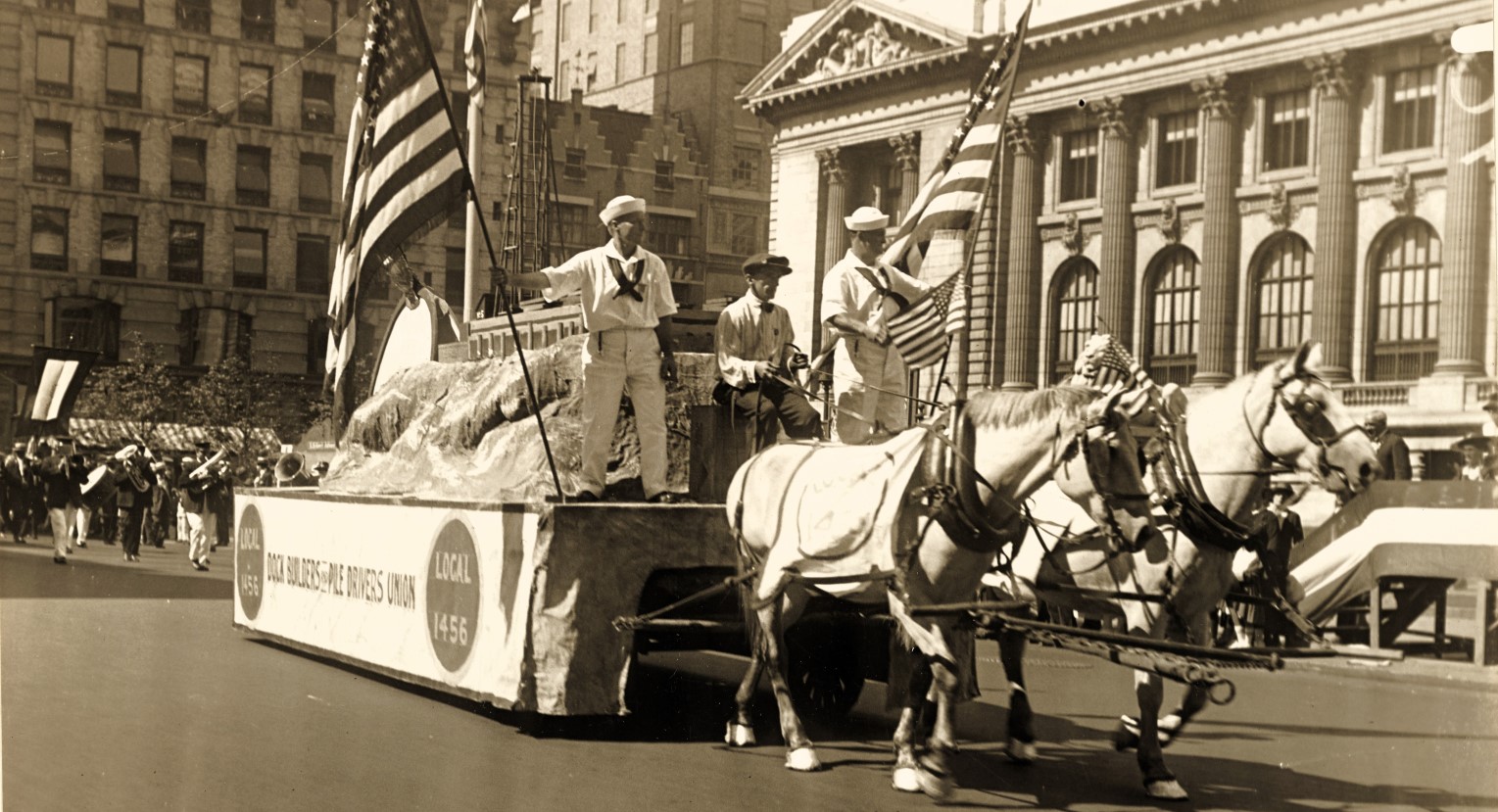
Though Labor Day didn’t start out as ‘Capital and Labor Day,’ it quickly became that. T.J. O’Flaherty with the story.
‘The Passing of Labor Day’ by Thomas J. O’Flaherty from the Daily Worker Saturday Supplement. Vol. 4 No. 199. September 3, 1927.
OF all the names in which there is no meaning Labor Day stands out as the most prominent.
The real Labor Day is the first of May when the class conscious, militant workers of all lands gather to demonstrate, to take stock of their defeats and victories in the past, and pledge themselves to prosecute the struggle for working class emancipation with greater vigor in the future.
The rallying day of international labor–the first of May–as well as the Labor Day of class collaboration, had its genesis in the United States, but the American labor bureaucracy have spurned the first like an unwanted child and left it on the political doorstep.
The first of May brings out the police with their clubs and their riot guns. The official Labor Day brings out the capitalist politicians, the labor fakers and the capitalists, who enjoy the day scratching each others’ backs.
Even a few years back, Labor Day had some proletarian character. It was customary for the union that was engaged in a strike or that was most recently on strike to be given the position of honor in the parade. There are no longer any parades. The labor leaders advise the rank and file to go to some shady glen for the day or take their families to the seaside. It is much easier on the labor fakers and less costly. Bringing great masses of workers together to demonstrate, gives them a consciousness of power. Here is danger for the minority that governs and oppresses the masses by the aid of guns, clubs and reactionary labor bureaucrats.
The idea of Labor Day was first proposed in the New York Central Labor Union, in May 1882. Two years later the first Monday of every September was declared Labor Day by the American Federation of Labor in convention assembled. The labor leaders of those days were not yet safely tucked away in the pockets of the capitalists. Those at the top were conservative and many of them reactionary, but they were obliged to fight the capitalists on the industrial field and the latter did not yet know how to pull their fangs. Of course the economic position of the American capitalists was far from being as sound as it is today. They could not afford to bribe the top strata of American labor as they have been in recent years.

In those days even Sam Gompers shook his fists at the capitalists. Indeed, Sam was always able to shake his fists and wag his tongue against the “bad” employers, but that is about as far as he ever went. He was a first-class trained ram of capitalism and nobody was better able to lead the sheep to the industrial shambles than the first president of the American Federation of Labor.
In 1886 we find Gompers speaking from the same platform with Henry George, the great single taxer who was candidate for mayor of New York. The huge parade that was held on Labor Day of that year had vitality in it. There were injunctions then as now and the labor leaders instructed their followers to violate the injunctions.
About this time the great eight-hour-day movement was launched and the A. F. of L. made preparations for the calling of a national strike on the first of May, 1886. The response to the strike was so enthusiastic that the employers decided drastic action must be taken to halt the movement. The Haymarket massacre and the bloody persecution and murder of the most militant of labor’s leaders was the answer.
Following the hanging of the Haymarket trade union leaders a period of apathy prevailed until 1889 when the workers again resumed the fight for the eight-hour-day. This time instead of a general strike of all unions, each organization was to strike separately. Some gains were made but after a few years the struggle was abandoned and when the United States congress in 1894 passed a law declaring Labor Day a holiday in the District of Columbia and the Territories, the officials of the A.F. of L. considered the battle won. Since then Labor Day has been gradually losing its labor character.
As the Labor Day blessed by the capitalists is losing its original vitality and has al- ready become a day of mutual back-scratching between the labor fakers and the employers, May Day–the real Labor Day–will gain in strength, prestige and significance to the workers of the United States.
The Saturday Supplement, later changed to a Sunday Supplement, of the Daily Worker was a place for longer articles with debate, international focus, literature, and documents presented. The Daily Worker began in 1924 and was published in New York City by the Communist Party US and its predecessor organizations. Among the most long-lasting and important left publications in US history, it had a circulation of 35,000 at its peak. The Daily Worker came from The Ohio Socialist, published by the Left Wing-dominated Socialist Party of Ohio in Cleveland from 1917 to November 1919, when it became became The Toiler, paper of the Communist Labor Party. In December 1921 the above-ground Workers Party of America merged the Toiler with the paper Workers Council to found The Worker, which became The Daily Worker beginning January 13, 1924.
PDF of full issue: https://www.marxists.org/history/usa/pubs/dailyworker/1927/1927-ny/v04-n199-new-magazine-sep-03-1927-DW-LOC.pdf
 Revolution's Newsstand