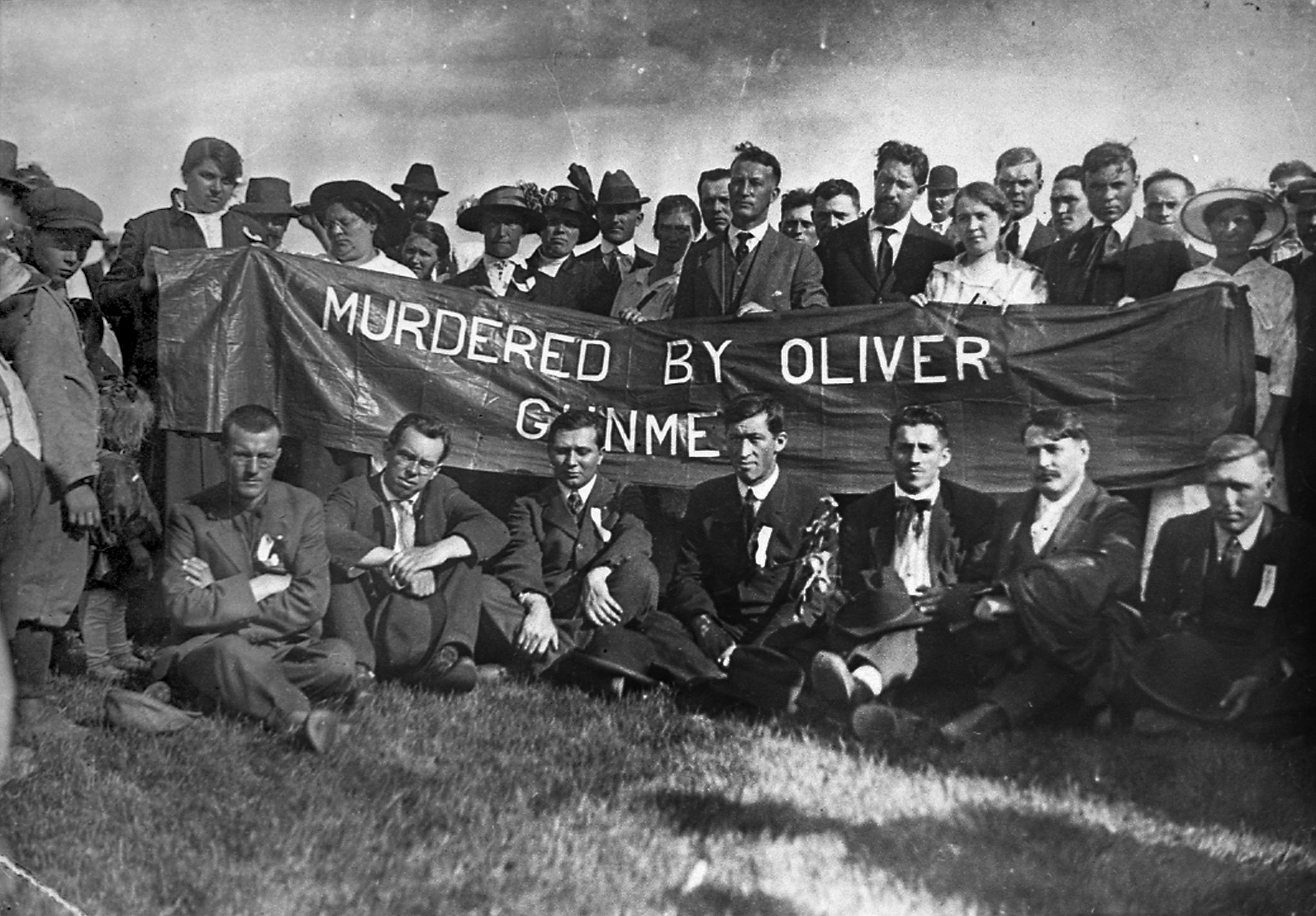
Haywood on the massive 1916 iron strike in Minnesota’s Mesaba Range.
‘Dollars And Steel Against Humanity’ by William D. Haywood from Solidarity. 7 Nos. 347 & 348. September 2 & 9, 1916.
The Iron Ore Miners Strike.
COMPARISONS
For the quarter ending June, 1916, the United States Steel Corporation reports earnings of $81,000,000.
On June 27, 1916, Mancini Atillo received for four days’ work digging iron ore, $3.80.
The Steel Trust for the year 1915 paid 800 per cent dividends. Martin Stark, for two days’ work digging iron ore received–8 cents.
At a recent dinner given by Mrs. Elbert H. Gary, whose husband is Chairman of the United States Steel Corporation, shares of steel stock were distributed as tokens among her guests.
In the proceedings of the committee of Range municipalities and the striking miners it was shown that miners’ wives were compelled to submit to the mine captains as a means of holding their husbands’ jobs.
READ THE FOLLOWING STORY.
If you want to see the iron ore miners win this strike, if you want to see the imprisoned woman, strikers, and organizers of the I.W.W. get a fair trial, send funds to Wm. D. Haywood, Gen. Secy-Treas., Room 307, 164 W. Washington St., Chicago, Illinois. FROM COMMITTEE ON INDUSTRIAL RELATIONS Southern Building, Washington, D.C.
For Release in afternoon papers of Thursday, Aug. 3
Washington, Aug. 3. The following report on the strike of iron miners now in progress on the Mesaba range of northern Minnesota has been submitted to the Committee on Industrial Relations by George P. West, author of the report of the United States Commission on Industrial Relations on the Colorado strike. It is based on a field investigation.
The City of Duluth, the County of St. Louis and the State of Minnesota, as represented by Governor Burnquist and other public officials, have joined hands in a relentless effort to crush out the strike of 15,000 iron miners now in progress on the Mesaba range, 70 miles north of Duluth.
With the support and good will of the United States Steel Corporation and affiliated interests as the stake, Governor Burnquist, Sheriff John R. Meiring, of Duluth, County Prosecutor Greene, and the Duluth Chief of Police are playing at ducks and drakes with the most sacred rights of the foreign workmen who mine the ore that goes down to the ships at Duluth for shipment to the Pittsburg mills.
More than one thousand men, according to the Sheriff’s own statement, have been deputized, and armed with carbines, revolvers and riot sticks. Clothed by the Sheriff with the state authority, they have been placed in brutal and tyrannical control of a district comprising at least 100 square miles and 75,000 population. The slums of Duluth and other cities have been combed to recruit this army of gunmen, and Sheriff John R. Meining, like eff Farr of Colorado, admitted to the writer that he had deputized the company guards without investigation of their records or character. In fact, he specifically stated that some of the men employed by the companies in this capacity, and deputized by him, “might possibly be” men of the character suggested when the writer told Sheriff Meining that they looked like thugs.
The part played by Governor Burnquist, County Prosecutor Greene and Chief of Police McKercher of Duluth will appear later.
Business Duluth is doing its bit. Responding to the Steel Corporation’s bidding, its leading wholesalers have served formal notice on the merchants of the iron range towns that all credit will be curtained pending the strike and weekly payments required. A copy of this notice is in my possession.

And while the miners of Minnesota and their families face want and suffering and endure the abuse and violence of a private army of gunmen, the United States Steel Corporation announces the largest earnings in the history of an American industrial corporation.
LIKE COLORADO
It is a story of public authority prostituted to private interests that is hardly equaled by Colorado, the same story of an industrial absolutism riveted on the workers through the ownership or control by a great corporation of the natural resources on which the economic life of the community depends.
One bright chapter can be written into strike records of Minnesota officials. The principal towns on the iron range, a narrow strip of the richest iron ore on the continent, running east and west on the high tree-covered plateau above Lake Superior-are Hibbing, with 15,000 population; Virginia, with 15,000, and Chisholm, with 9,000. And their Mayors, with a majority of their councilmen, stand squarely for the rights of the miners. Mayor Victor Power of Hibbing, Mayor Michael Boylan of Virginia, Mayor E.E. Webber of Chisholm, and officials of several lesser municipalities have done all within their power as officials or as men to protest against the outrageous lawlessness and cruelty of the companies and of their servants in public office. This protest even took the form of a resolution adopted at a conference of officials of the range municipalities denouncing the unfairness of Governor Burnquist’s personal agent.
Today, at the urging of the same municipal authorities, Mediators Davies and Fairley of the United States Department of Labor are on the range in an effort to break down the refusal of the companies to meet their men or even to consider their grievances. And the mayors of the range municipalities announce that if the Steel Corporation persists in its refusal to admit the possibility of grievances and in its blood and iron policy of crushing the strike with gunmen, they will put the strikers to work on needed improvements for the cities where they live.
The Mesaba range mining towns are beautifully situated on high ground, with vast stretches of open country and no serious congestion. The Oliver Iron Mining Company, an arm of the Steel Corporation under its direct control has made great strides in providing decent housing conditions. Compared with the steel towns of the same Corporation near Pittsburg, the mining towns of Minnesota are paradisial, but as far as civic improvement, the credit belongs with the Mayors who succeeded, after long and bitter controversy, in forcing the company to pay its taxes.
Yet in what should have been the happiest, most prosperous communities in the world, the Steel Corporation has precipitated one of the most bitter, as it was one of the most spontaneous and unorganized, industrial revolts of recent history. It has done this by its policy of treating the men like serfs denying them any voice, herding them with the aid of a permanent force of private police, and driving them at top speed by a vicious piece rate system of payment that leave the door wide open for favoritism, injustice and the extortion of bribes by the petty bosses who assign favorable or unfavorable working places.
The strike started without organization of any sort, and spread almost instantaneously through the iron range before any outside labor organization had participated. The men were un- organized and put of touch with the labor movement. By chance an appeal reached the I.W.W. and organizers for that organization made a tardy response. It is not an I.W.W. strike in the sense that it was fomented by agents of that organization. No I.W.W. agent or organizer was on the range prior to the beginning of the strike, I.W.W. agents have offered to withdraw from the district if their elimination would lead to settlement, and the strikers have specifically agreed in writing in a communication to the companies that they would not ask for the recognition of any union. Yet the companies refused a conference.
THE MINERS’ DEMANDS.
Thousands of the best miners have left the iron range never to return. The vast majority of those remaining are resisting all urgings to return to work, and if funds can be procured there is a likelihood that grievances will be adjusted.
These are the miners’ demands:
1. An eight-hour day.
2. A minimum wage of $3.00 in the underground mines, and $3.50 in the same, but in wet places, and $2.75 on the surface for eight hours of labor.
3. Abolishment of the contract labor system.
4. Pay day twice a month.
Laborers in the open-pit surface workings are now paid $2.60 for a ten-hour day. In the underground workings, where the majority of miners are employed, the miners work an eight-hour day and are paid on piece rate basis, designed to speed the men up. Rates per car of ore mined are changed every week, resulting in driving the men at top speed and placing them in competition with each other.
Miner after miner swears that pit bosses and foreman exact bribes for awarding favorable “ground” to the men, and that no miner can obtain a working place where $3 or more can be earned unless he has first won the good will of the shift boss or foreman, by whatever means appeals to that individual. Inasmuch as petty common bribery is in plants where this system prevails, and employers often admit the necessity of fighting it, these complaints undoubtedly are based on widespread abuses.

At a conference called a Virginia by officials of the municipalities in the range and presided over by Mayor Michael Boylan of Virginia, testimony was given by many miners from which the following are extracts:
M. Shusterich: “Those fellows who are making $3 and $4, what do they do? I can bring proofs from fellows at Chisholm that any miner who makes over $3 there, he had to tip the captain. I know certain captains there–if necessary I will name them and bring proofs where they are making tips of $5 and $10 from fellows making money there, and then going into saloons, they have to buy drinks and cigars, and I can prove that even if the mining captains like the woman of some of those miners in order to keep his job he has to shut his eyes to that. Any miner who is working ten or fifteen years, if he have hard work for fifteen years at contract, this speeding system, I tell you if à miner makes up to $3 he works like hell, and all his power and everything in him he can make $5 or so, and then if they see he make more money they cut him down, and they have to work harder, and I challenge anybody to say that any miner who works in these mines at contract for ten years is fit for any labor after he gets to be 35 to 40 years.”
BUSINESS MAN SAYS.
Rupert Swinnerton, business man and councilman at Hibbing:
“While I am a business man I want to agree with what this man just said. I have had several talks with mining officials and others and what he says is true. There was a good deal of dissatisfaction with conditions here in the mines long before the I.W.W. came onto the range. I am in the land business, and sometimes sell a piece of land to some of these men, and they would tell me their grievances–the hard time they had getting along–how it was impossible for them to pay their way. I am convinced that there are things that should be adjusted. I would like to see the time come when a great corporation like the United States Steel Corporation, could see these differences and make efforts to re- move them. And these things that this man mentioned about men having to tip the mining captains are true.”
Mike Stark of Chisholm: “I am a miner for 14 years. I have eight children, seven living and one died. I work now for last three years I get $59 check a month, $61, $62, $63, $67 up to $70 a month–but a couple of times over $70 in three years, and I send four kids to the school and the teacher would like to have the children dressed and clean and everything like that. I like to do that myself. And the children go to church, and the priest like to see that the wife is dressed nice like the American ladies, and the children dressed like the American children. I like that, too, but I can’t.”
Joe Thomas, miner: “Look at me. I have five children to support. I have to send them to school. If they go with dirty clothes the teacher send them back Say ‘Your father get better clothes. If our women go to church the priest they say ‘What the matter with Austrian women. They stink in church. People couldn’t sit by them because we didn’t buy stuff like they.”
Matt Mattson, Virginia: “I worked in the mine thirteen years around Virginia all the time, any mine here. Last I worked at the Alpena. I want to say something about the contract system. You get place to work on contract and make $2.00, and you make it run up to $3.00, he cut you in middle of month. A man can’t work through the month, he cut him. (Rates are changed and readjusted weekly.) You say something and then the captain says, ‘I can’t help it. You make too much. If you don’t like your job you quit. I worked three years steady. I made first year pretty nearly every month around $3.00. Some time I had a little over, sometime under. After another two years I make $2.22%, $2.22, $2.35 make around $49 a month, $50 a month, $55 a month. It work like that.”
HOW MINERS FEEL
Fulvio Pettinello: “I worked for the Oliver Iron Mining Co. at the Alpena, two years ago I struck a hard place, and I make $1.97, some other times I make over $8 and $3.50. What I should do then? Two years ago I got married and got American girl. I believe she has right to live as another American, so I believe further I got right to live. What should I say when I got $1.971 “I should tell her: This month don’t order meat or nothing.
“On February 4, a charter was granted to Metal Mine Workers, No. 490, with a temporary headquarters at Minneapolis, Minn. Previous to this, organizers for the I.W.W. had been at work among the miners on the iron range. When the strike was declared early in June, additional organizers were immediately sent to the scene of action. While it is possible that the organizers of the I.W.W. offered to withdraw if this would lead to a settlement, this does not mean that the organization would withdraw, as the Industrial Workers of the World is on the Iron Ranges of Minnesota to stay.
The most widely read of I.W.W. newspapers, Solidarity was published by the Industrial Workers of the World from 1909 until 1917. First produced in New Castle, Pennsylvania, and born during the McKees Rocks strike, Solidarity later moved to Cleveland, Ohio until 1917 then spent its last months in Chicago. With a circulation of around 12,000 and a readership many times that, Solidarity was instrumental in defining the Wobbly world-view at the height of their influence in the working class. It was edited over its life by A.M. Stirton, H.A. Goff, Ben H. Williams, Ralph Chaplin who also provided much of the paper’s color, and others. Like nearly all the left press it fell victim to federal repression in 1917.
PDF of full issue: https://www.marxists.org/history/usa/pubs/solidarity-iww/1916/v7-w347-sep-02-1916-solidarity.pdf
PDF of full issue 2: https://www.marxists.org/history/usa/pubs/solidarity-iww/1916/v7-w348-sep-09-1916-solidarity.pdf
 Revolution's Newsstand