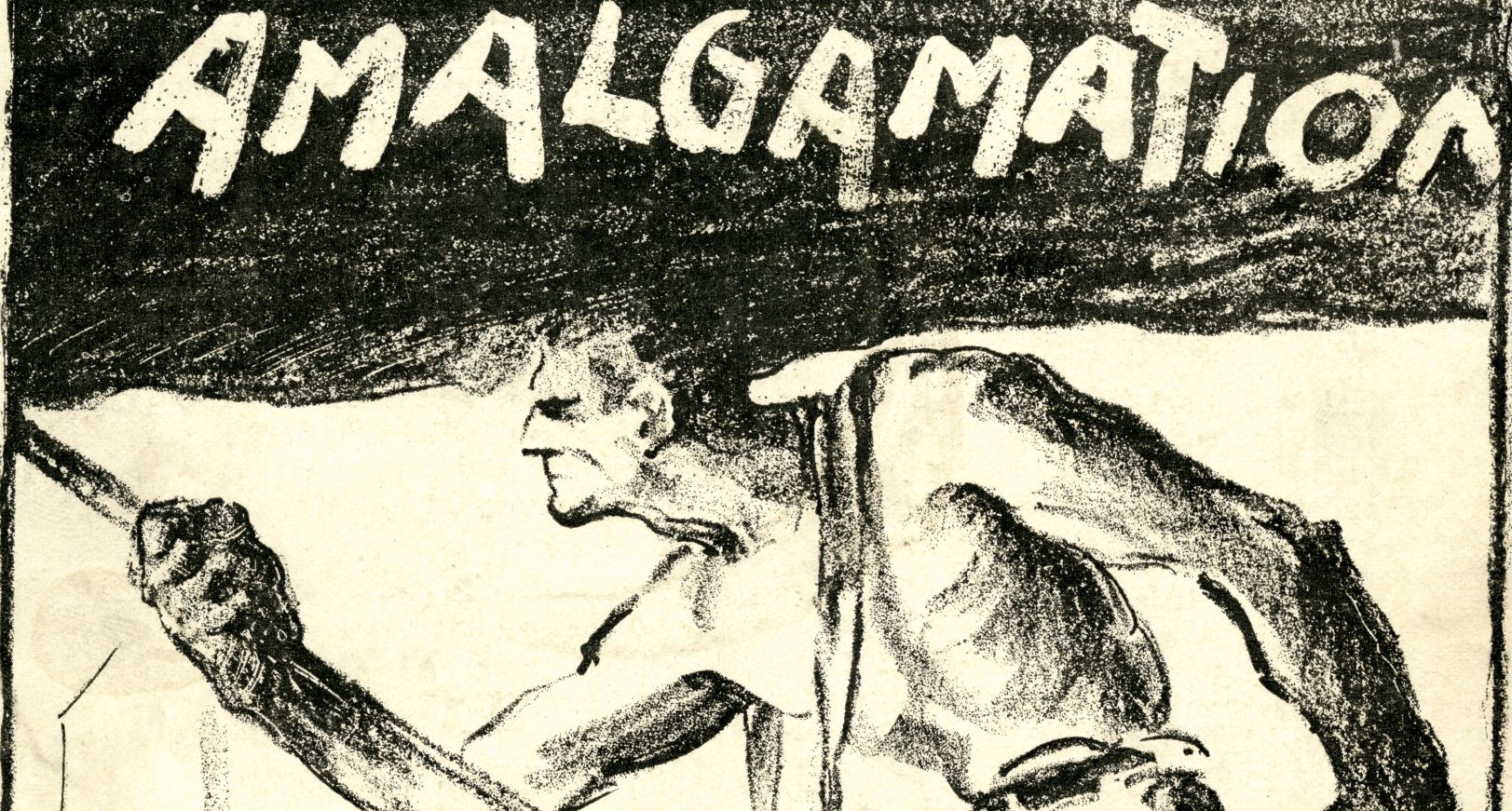
A central figure in the early T.U.E.L. gives a report for an international audience on its first year.
‘A Year of the Trade Union Educational League’ by Charles Krumbein from International Press Correspondence. Vol. 3 No. 16. February 15, 1923.
Although the Trade Union Educational League was organized in November, 1920, it is really only a year old, because previous to the launching of The Labor Herald in March, 1922, it consisted of little more than a few scattered groups throughout the country. But in the past year it has taken on a truly wonderful growth. Not for many years past, if ever, in this country has there been an organization operating upon the industrial field which has created such a stir in the labor movement and made so much genuine progress.
When the League began its operations a twelve-month ago, the situation was anything but promising. On the one hand there was the reactionary bureaucracy heading the trade unions, unprogressive and tyrannical, and having behind it a demoralized, discouraged, and defeated labor movement. And on the other hand there were the militants, confused and befogged by dual unionism, inexperienced in the trade union movement, and overwhelmed with contempt for the old mass unions.
Attacking the Problem.
But despite this double difficulty of a reactionary leadership to contend against, and a very inexperienced body of militants to draw upon for support, the Trade Union Educational League has nevertheless made most substantial progress in the twelve months of its activity. It has become a real force in the labor movement, and one which even the most powerfully situated reactionaries have to reckon with.
In its operations directly upon the mass organizations the League has real results to show. It has popularized various planks of its program among groups of workers hitherto untouched by radical propaganda. Its agitation for the formation of a Labor Party has struck home in many organizations and is bound to bear fruit in the near future. Likewise its advocacy of the Red International of Labor Unions. But the one brilliant success of the League’s work was in connection with its work for industrial unionism. It has gone to the masses of organized workers with its message of solidarity and got an overwhelming response, a response which has not only shocked and frightened the reactionaries but heartened the rebels more than anything else that has happened in the United States for decades How the innumerable local unions, central labor councils, state federations, and international organizations have been won over to declare for industrial unionism through amalgamation, in spite of the bitter opposition of the reactionaries in their ranks, is an old story now to all who follow the course of the labor movement. It is not too much to say that in the short period it has been in the field, the League has already got the majority of the organized masses to accept in principle, at least, the highly important proposition of industrial unionism. With this accomplished, the definite re-organization of the craft unions on an industrial basis will inevitably and unfailingly follow.
But far more important than the effective work done among the broad masses were the educational results secured among the militants themselves. The one thing that is needed to the American labor movement on its feet and to make a real fighting body of it is a clear-seeing, self-confident, and well-organized body of militants. Substantial headway has been made by the League in creating such an organization. By their experience of the past twelve months the militants are learning that the workers making up the trade unions are eager and willing to accept a militant program, once it is put up to them in a way that they can understand. And the way they are recovering from the infantile sickness of dual unionism constitutes one of the most remarkable phenomena in the whole history of the labor movement. The change that has taken place in this respect due to the League, is nothing short of an intellectual revolution.
The Opposition Defeated.
As few organizations in the labor movement have achieved so much success in so short a time as the Trade Union Educational League, likewise few have had such heavy opposition to contend with. Hardly was the announcement of the organization of the League made than a general rallying of the reactionary forces took place to withstand the onslaught of the threatening newcomer. Fulminations flared forth on all sides in an attempt to discredit the League in the eyes of the rank and file by painting it red and denouncing it as a Russian conspiracy against the labor movement. No less a person than Mr. Gompers himself took the lead in this virulent campaign of attack, and when he broke a few lances fruitlessly, he called upon his faithful lackeys, Matthew Woll, Chester Wright, etc.
But the opposition, reckless though it was, did not break up the advance of the League. This is primarily because of the soundness of the latter’s policies. When its militants went amalgamation, for example, they received such wide-spread to the masses with propaganda of industrial unionism through support that the old guard were unable to fight back successfully. A case in point was the National Railroad Amalgamation Conference. Despite the fact that that historic gathering was condemned in bitterest terms by Stone, Johnston, and many other high officials of the railroad trade unions, it was a glowing success. For once the rank and file, acting in intelligent opposition, took the bit between their teeth and made a determined move for progress. Grable, in the Detroit convention of his organization, tried to step in front of the amalgamation movement and to bring it to a halt, but what happened to him is now a classic in labor history. The League has demonstrated beyond all doubt that it is possible to organize progressive movements among the mass unions in spite of the most determined opposition of a reactionary bureaucracy. This in itself is an achievement of the first magnitude.
The Tasks Before Us.
Although the League has already made its influence felt in the labor movement it is only an infant in size and experience. There is still a world to do to give it the necessary volume and power to achieve the great task before it. This work is of a manifold nature. First we must see to it that all militant workers throughout the length and breadth of the country, become members of the trade unions and plunge deeply into the activities of these organizations. We must organize local general groups in every city and town in the United States and Canada. These in turn must be subdivided into industrial sections, which shall work ceaselessly to educate the members of their respective organizations locally. Then there must be National Committees set up to co-ordinate the work of the local industrial groups throughout the entire labor movement. Especially is this latter task very essential, because without national organization the work of the local groups is fruitless.
Besides building the structure of the League, we must also see to it that it has a powerful weapon wherewith to reach the minds of the masses. The Labor Herald must be developed. Its present circulation must be quadrupled in the coming year. This can readily be accomplished if all the individuals and groups in the League will do just a little towards developing its circle of readers. When The Labor Herald reaches a circulation of 50,000, and this should be in a year’s time if the militants realize their opportunity, it will have power and influence that will astound both reactionaries and revolutionaries.
The Year to Come.
The Trade Union Educational League looks forward with confidence to the oncoming year. The experience of the past twelve months shows it that its methods and policies are fundamentally correct and that the workers of America are ready for its message of solidarity and liberty. The old Gompers bureaucracy is bankrupt. It has absolutely nothing constructive to offer the workers. Industrial evolution proceeds with ever increasing speed, but the Gompers crowd, learning and forgetting nothing, cling desperately to their outworn and futile policies. Th. Trade Union Educational League, despite its youth, has a practical monopoly upon the advocacy of progressive policies in the mass organizations of the workers. It is the only organization, radical or otherwise, in the field today which has any message of real instruction and inspiration for the masses. Its policies of industrial unionism through amalgamation, organization of a Labor Party, affiliation of the trade unions to the Red International of Labor Unions, the Workers’ Republic, etc., correspond to the needs and aspirations of the American working class. The Trade Union Educational League is the key to the industrial situation in this country and Canada.
International Press Correspondence, widely known as”Inprecorr” was published by the Executive Committee of the Communist International (ECCI) regularly in German and English, occasionally in many other languages, beginning in 1921 and lasting in English until 1938. Inprecorr’s role was to supply translated articles to the English-speaking press of the International from the Comintern’s different sections, as well as news and statements from the ECCI. Many ‘Daily Worker’ and ‘Communist’ articles originated in Inprecorr, and it also published articles by American comrades for use in other countries. It was published at least weekly, and often thrice weekly. The ECCI also published the magazine ‘Communist International’ edited by Zinoviev and Karl Radek from 1919 until 1926 monthly in German, French, Russian, and English. Unlike, Inprecorr, CI contained long-form articles by the leading figures of the International as well as proceedings, statements, and notices of the Comintern. No complete run of Communist International is available in English. Both were largely published outside of Soviet territory, with Communist International printed in London, to facilitate distribution and both were major contributors to the Communist press in the U.S. Communist International and Inprecorr are an invaluable English-language source on the history of the Communist International and its sections.
PDF of full issue: https://www.marxists.org/history/international/comintern/inprecor/1923/v03n16-feb-15-1923-Inprecor-yxr.pdf
 Revolution's Newsstand