
Marcus Garvey led one of the most important, largest Black organizations in history. After Garvey was found guilty of mail fraud in and sent to federal prison 1925, the Universal Negro Improvement Association, so dominant in Black politics for a decade, came to an impasse. Robert Minor, a leading white Communist voice for a central orientation of the U.S. party to Black workers in the 1920s, with an essay on the moment.
‘After Garvey—What?’ by Robert Minor from Workers Monthly. Vol. 5 No. 8. June, 1926.
AT Carteret, New Jersey, a few days ago, a body of armed men drove the entire Negro population from the town, burned a Negro church and generally conducted an organized reign of terror of the sort which America calls a race riot and which the old Russia of the now-dead czar called a pogrom.
The Negro in America.
In the state of Kentucky there has been during the past few weeks a series of lynchings of new character—lynchings in which the state government participated, no longer as a “silent partner” merely permitting unofficial murder, but this time as an open, active leader in official murder without trial: In Kentucky courts of law Negroes accused of crime are being given “eighteen minute trials’—and the latest was a “ten-minute trial”—with a mob outside the court room, twelve actual members of the mob in the jury box, a virtual member of the mob as judge, usually a “confession” extorted by torture in a back room before the “trial,” no defense whatever for the Negro victim (with the lack of defense concealed behind the presence of so-called attorneys for the victim), and a verdict of hanging delivered to the cheering mob from ten to eighteen minutes after the ceremony began. A body of state troops, acting in fact as uniformed lynchers, is in these cases stationed between the rest of the mob and the victim until the farce can be completed, and a few days later the sheriff acts as the mob’s master of ceremonies in placing the noose and pulling the trap of the gallows. Then the ruling class of Kentucky leers into the faces of the Negro population and says: “The nigger got a trial didn’t he?”
The 12,000,000 Americans known to be wholly or partly of African decent occupy a position which can not much longer be tolerated by them. Enslaved as landless peasants or serfs in the agricultural southern states, working at odd jobs in extremest poverty in cities north and south, and just now breaking into big industrial plants as the workers at the heaviest labor, excluded from more attractive forms of labor, working for a wage much below that of other workers, often excluded from trade unions, living in miserable segregated slums, systematically degraded as a low caste by a rigid social code —the Negro masses have a score of issues which are worth life and death to them.
For a half-century these or similar issues have existed, but the forces which could deal with them did not emerge. At last the Negro has touched the transforming chemical—by entering into large industrial labor. By becoming a part of the modern industrial proletariat —a process through which many thousands of Negro former peasants are now going—the Negro masses are reaching the epoch in which their liberation is placed on the agenda of history. The flood of black population into the cities of the north has generated a culture which takes the form of a fever for organization. This culture has already gone through the stage of the exclusive devotion to the exaltation of favored individuals of the race. It has reached the stage where a serious mass movement for organization and mass emancipation has come into being. The American Negro Labor Congress.
The most modern of these movements—one which promises a mass character—is expressed in the American Negro Labor Congress. Simultaneously several particular movements, such as the successful organization of the Pullman porters, and the pressure upon the American Federation of Labor for the organization of other and more basic groups, show the trend of development.
The Role of the “Negro Question.”
At this time all promises and realizations of mass organization among Negroes are more or less recognized as being objectively movements against capitalism. In a formal “theoretical” way—in thought divorced from the concrete realities—it might be reasoned that the special burdens borne by the Negro are essentially relics of feudalism having no necessary place in capitalist society, and that therefore these burdens can be removed within capitalist society. It might be thought that the maintenance of a system of racial inequality within the borders of a highly developed capitalist country is not necessary to capitalist society, and that therefore when the forward pressure of an unfavored racial group begins to express a serious contradiction, capitalist society can accomplish the removal of the racial discrimination. But in concrete reality in a concrete world, it is not so. There is not and never was a purely capitalist society; by the term “capitalist society” is meant a society in which capitalist forms predominate. In all capitalist societies there are some remainders of feudal society which become interwoven with and interdependent with the capitalist economic and state systems. In no case has the complete removal of the feudal impurities taken place, and each proletarian revolution that we have experienced has overtaken a capitalist society still retaining much of the forms of feudalism. The mere existence of a peasant class is itself a relic of feudalism, and out of this comes the “alliance of the proletariat and peasantry” against capitalism.
In the case of America today, the existence of the “Negro question” is the existence in capitalist society of a remainder of a previous social system, and at the same time it is an integral part which cannot be separated from the capitalist system as it exists here and now. For the race question is interwoven with the class question; the special disabilities put upon the Negro toilers (real proletarians and peasants), are a built-in part of the concrete system of class exploitation. To any empty words about the ability of the capitalist society to abolish the special inferiority of the position of the Negro, we may answer that the capitalist system does not abolish this condition and that the struggle of the Negro as a racial group against the inferior racial caste status shows signs of beginning to merge with the proletarian movement against capitalism.
When the American Negro Labor Congress was founded in Chicago at the end of last year, the thing which caused a flurry among high capitalist and government circles was not the fact that some Communists were among its leaders, but the fact that the Congress represented the merging of cause of Negro equality with the cause of the labor movement. Some Communists had been among those who called together the Negro Sanhedrin Conference the year before; but the government did not send any of its agents to harass the Sanhedrin; it was the combination of “Negro” and “Labor’’ that caused fear. This is borne out further by the fact that when the Pullman porters (not a basically important element in the railroad industry, but an influential element in the Negro city populations) started to organize their trade union, the government supplied an assistant of the attorney general of the United States to act as an organizer of strike-breaking. There were other anxious counter-movements such as Coolidge’s recent appointment of a commission of several prominent Negroes of the job-seeking type, charged with the duty of finding “solutions” for questions of race friction—a commission which, of course, it is understood, must not meddle in such matters as segregation or murder or disfranchisement of Negroes.
It is seen that there are new developments among the masses of Negroes, developments which lead forward, and which are causing a shifting of landmarks.
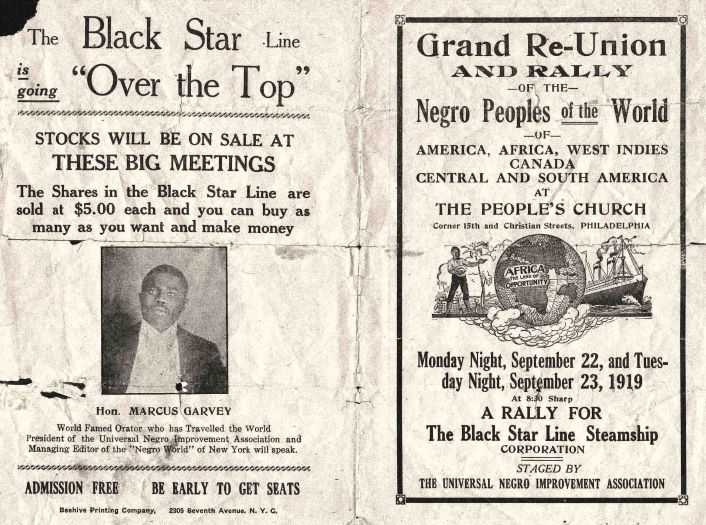
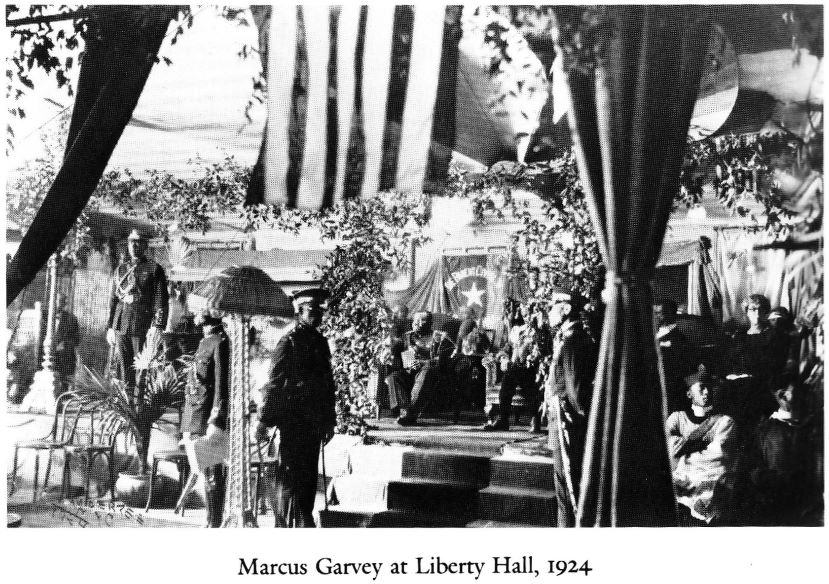
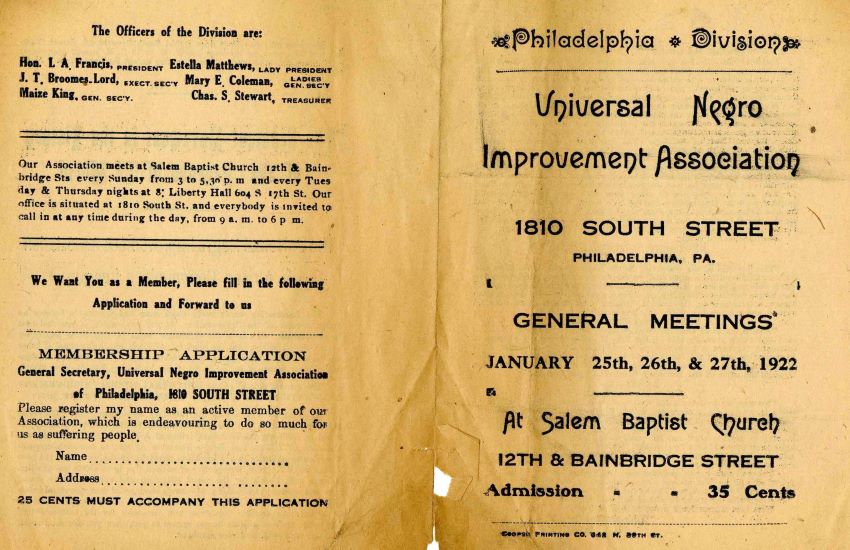
But we are concerned here chiefly with a movement which is not so new—with the first of the organized mass movements of Negroes, and which appears still to be the largest now in existence, the Universal Negro Improvement Association.
Universal Negro Improvement Association.
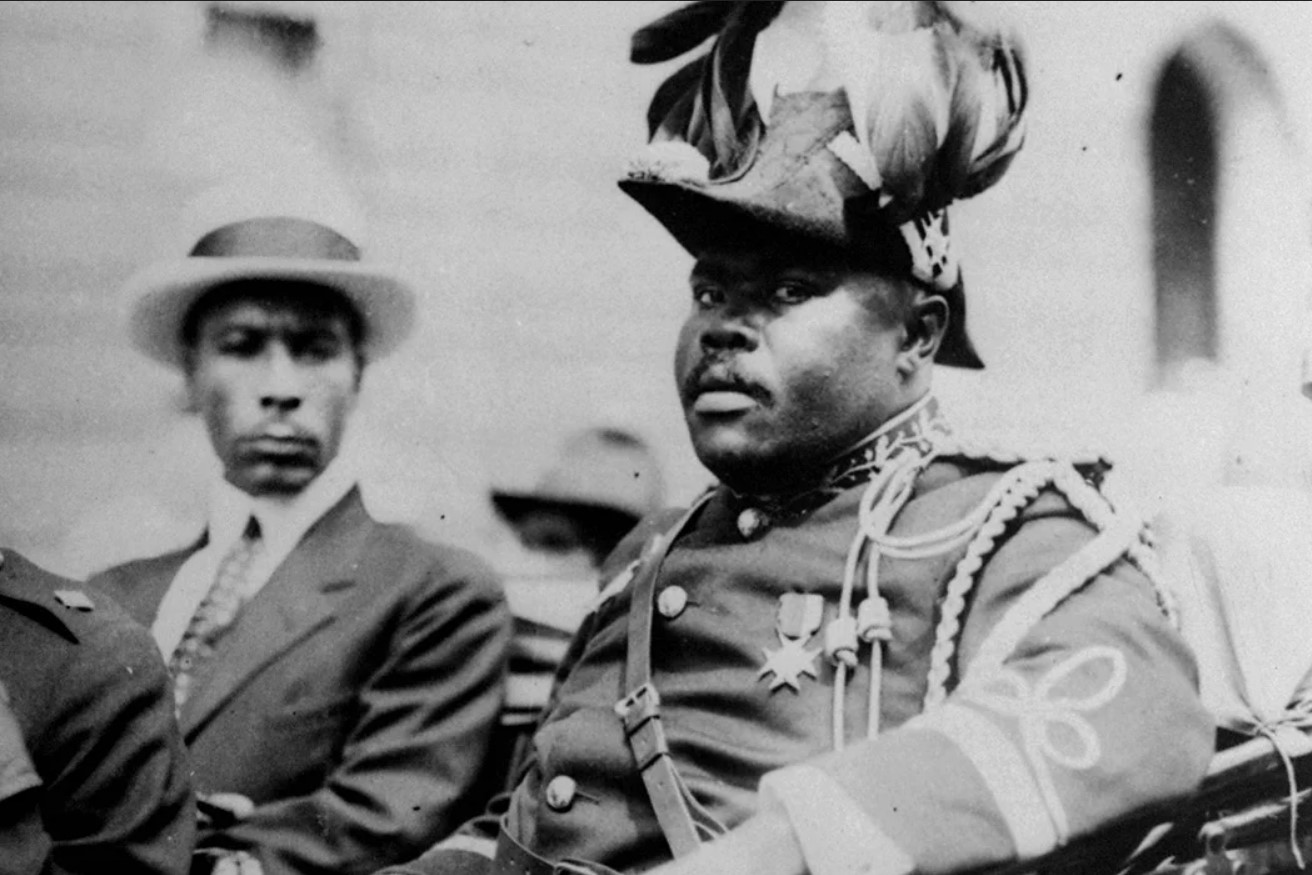
The Universal Negro Improvement Association, which seems at one time to have had about a half-million adherents, has been in a state of constant crisis during the past four years, and now appears to be in a process of rapid disintegration. When this movement first appeared about eight years ago, with something of a working-class character and even some traces of a working-class program mingled with utopian theories somewhat resembling that of Jewish zionism adapted to Africa and the Negro, the United States government assumed that its effect would be anti-capitalist and began an uninterrupted course of persecution. Under the leadership of Marcus Garvey the Association has retreated before every attack into a more and more fantastic opportunism.
The Decay of the Organization.
The decay of this first great experience of the Negro in mass organization is one of the tragedies of the struggle for emancipation— and it is a tragedy of the most disgracefully treacherous leadership ever known, a leadership which has never hesitated to desert its followers and which today has degenerated into the gutter of scramble for direct material gain for individuals.
Take up a copy of the “Negro World,” organ of the Universal Negro Improvement Association, and try to get from it a reflection of this great world-full of struggle of the Negro people—-or of the beginning crystallization of the forces of the Negro masses for the struggle. What do you find about these tremendous affairs in the organ of what still claims to be the mass organization of the exploited black people?
You find nothing whatever except a seething stew of controversy about the financial affairs —not precisely the financial affairs of the organization itself, but the financial affairs of various officers or ex-officers of the organization who have been or are now struggling for position for themselves in the effort to obtain financial gain for themselves out of the organization. For instance, the current number of the “Negro World” (May 8) shows that the sole present activities of the organization are devoted to a violent controversy over control of the remaining property of the organization in New York, the controversy over mortgages, etc., and, second, the effort to raise more money for—what?
For the organization and struggle against lynching of the Negro in the old or new form? No. For the struggle against segregation? No. For the struggle for the political rights of the Negro? No. For the struggle of the Negro working masses for equality in the labor movement, for equality of pay and equal access to _all kinds of jobs for organized Negro workers with organized workers in general? No. For the struggle against the ku klux klan? No. For any effort of any sort whatever to put the Negro upon a plane of equality? No. Is there even a consistent, aggressive fight for the release of the imprisoned president, Marcus Garvey himself, whom the United States government framed up and jailed on the mistaken idea that Garvey in some way represented an effort of liberation of the exploited Negro masses? No, not even that; Garvey’s political bankruptcy is nowhere better exemplified than by the fact he understands nothing of the possibilities of his case for mass organization in his defense; his only policy is to crawl and beg and bargain for his release. There is nothing in this organ in any way even suggesting a claim that the Negro has any rights whatever in this country.
Only the foulest scramble for money for the pockets of one or another officer or ex-officer of the organization—or at least for control of the financial resources.
Two Events.
Two events of the last convention of the Universal Negro Improvement Association correctly foreshadowed the present situation:
The first in importance relates to program. Since Mr. Marcus Garvey appeals in big type for the support of “the great program,” let us look again at the program that was adopted at the last convention in Detroit. The substance is:
“THE NATURE OF RACE PROBLEMS PRODUCED BY THE CONTACT OF RACES.”
“Race problems move on to solution and they cannot be solved except by separation or amalgamation.
“Thomas Jefferson proclaimed the nature of race problems and proposed separation.
“Bushrod Washington, James Madison, John Marshall, James Monroe, Henry Clay, John Randolph of Roanoke, Abraham Lincoln, and Ulysses S. Grant are among the eminent men and women who took part in the African colonization movement of the blacks.
“The Virginia General Assembly and others through resolutions and acts, supported the colonization of Liberia.
“The present resolution has high historical precedent, and, in effect, memorialized the Congress to assist an important group of Negroes who wish to continue the colonization of Liberia as an independent Negro nation.
“HOUSE JOINT RESOLUTION.”
“Memorializing the Congress of the United States to make provision for the colonization of persons of African descent, with their own consent, at any place or places without the United States where they may form a Nation and Government of their own.
“1. Whereas, race problems produced by the contact of races cannot be solved except by amalgamating the races or separating them; and
“2. Whereas, it is highly desirable that the American ‘Negro Problem’ should be solved in a manner that will preserve the white race and the black that each may make its contribution to the welfare of mankind; and
“3. Whereas, many of our Negroes evidence a desire to live in an independent nation of Negroes and strive to achieve a high and honorable race destiny; and
“4. Whereas, such desire on the part of our Negroes was encouraged by eminent white Americans who founded the colony of Liberia, and, later, by other eminent white Americans who sought to acquire San Domingo for a colony for the Negroes; and
“5. Whereas, there is much valuable land sparsely populated in the Negro republics of Hayti, San Domingo and Liberia; and
“6. Whereas, the ancestors of our Negroes were deprived of liberty and property, and forced into servitude to the white race; and
“7. Whereas, in servitude and in freedom the Negroes in America have served the white race in America in a manner morally to obligate the white man to recompense the Negroes by generously assisting them to establish themselves with bright prospects for the future in an independent nation ruled by men of their own race;
“8. Wherefore, be it resolved by the Legislature and the Senate concurring, that the Legislature memorializes the Congress of the United States to make provisions for the colonization of persons of African descent, with their own consent, at any place or places without the United States, particularly in Africa.”
The essence of this “program” is simply the deportation of the masses of American Negroes to the African colony of the Firestone company. Of course it is idiotic. The only reality it has is as a means of raising money.
The Salary Grab.
The only other important incident of the convention aside from the fight for control, was one which had to do with the method of employing officers of the organization. It had been a custom for several years, begun at the high point of prosperity of the organization, to fix handsome salaries for officers and the custom of the officers, acting as representatives of the organization, to make contracts with each individual officer for these large salaries which ranged up to many thousands of dollars a year. This was supposed to be necessary to the “dignity” of the fancy-titled men who obligingly took the position of leadership. The result was that during the past few years the U.N.I.A. has found that with every internal dispute there came an ousting of some officer and a consequent law suit of the officer for the enormous salaries stipulated in the contract of employment. Of course, the treasury was drained with constant court judgments in favor of the ousted officers. It can be said that with very few exceptions that the treasury was looted and gutted with every ousting of an officer—and these ousters were many. It was inevitable that after several years of this, at the last convention a naive delegate offered a motion to the effect that no more contracts be made of a sort that would enable discharged officers to sue the organization for salaries for unexpired terms. The proposal was a challenge to the sincerity of every newly elected officer present.
The test was effective, in a certain way. Immediately the proposal was made, the newly elected acting president, Fred A. Toote, jumped to his feet excitedly to declare that if the motion was not withdrawn he would resign. Toote explained that “You can’t obtain the services of competent men unless you give them some security of a means to support their families.” What he meant was, of course, that the officers of the organization placed a value upon the power to milk the treasury and upon their independence of control by the organization. The motion was withdrawn, not one delegate having the courage to speak plainly of the character of officers who would serve the Negro organization—the “great program’’—only on condition of a strangle hold on the often-looted treasury.
The Universal Negro Improvement Association became at its last convention, so far as its officers were concerned, an organization of private plunder for “leaders” and nothing else, excepting its character as a promoter in the ranks of the Negroes themselves, of the program of the ku klux klan for the submission of the Negroes to hopeless servitude.
The Disintegration of the Organization.
The inevitable result is found in the present situation in which a war of money-grabbing leaders is accompanied by the rapid break up and disintegration of what once was a magnificently promising mass organization.
A peculiar feature of the policy of Marcus Garvey is that it results in the destruction even of the machine itself. The organization for several years fixed its center of gravity in a scheme for a steamship line in connection with a utopian venture of “trade with Africa.” Now the salary-takers have lost the “steamship line” in the sheriff’s sale of the steamship “General Goethals” (re-named the “Booker T. Washington.”) Almost nothing of value is left to the contract-holding officers except a piece of property on 138th street in New York City, the headquarters of the organization, for the possession of which two sets of officers are fighting in the courts. The New York division of the organization has split away from the parent body and controls the mortgaged property, and the faction of Garvey is fighting for its recovery.
What Will Be the Fate of the U.N.I.A.?
What will be the fate of the Universal Negro Improvement Association? That an organization of masses of exploited Negroes should throw off the disintegrating influences, discard its Garvey-imposed opportunism, take on a clear program of struggle, and find new health and strength, must be the wish of any one who desires the emancipation of the Negro. Whether the saving of the Universal Negro Improvement Association is possible or not, cannot be said now. Every effort should be made to save it from destruction and perversion. The tendency of most observers is to regard the organization as inseparable from Garvey and Garveyism, and to consider that the two will disappear from the scene together.
But this is not a sound conclusion. The broken fragments of the U.N.I.A. contain some of the best rank and file material to be found—material which has not been corrupted by false leadership, as its resistance proves. If the organization cannot be saved, at least out of the best of the fragments something will grow that is more in line with the new tendencies.
But Garveyism has been the dominant note in Negro mass activity in America for nearly a decade.
After Garvey—What?
When Garveyism evaporates what will remain?
An article by Abram L, Harris in the April number of the “Crisis” contains the following interesting observation:
“The social unrest among the Negro race over which we waxed philosophical a few years back was not completely exhausted by the Garvey movement fiasco. Much of the ferment remains. Two years ago a friend of mine wrote this about the Garvey movement: ‘It is just another name for the psychology of the American Negro peasantry—for the surge of race consciousness felt by Negroes throughout the world, the intelligent as well as the ignorant. Though visionary and perhaps impossible of accomplishment, it afforded a mental relaxation for the long submerged Negro peasantry. Balked desire, repressed longings, must have an outlet.’ My friend then queried, ‘Ater Garvey—What?’ Had | known what | think I know today I would have answered, ‘Communism.’”
If what the writer means is the merging of the mass unrest of the Negro population with the advanced section of the labor movement, I believe the quoted prediction is correct.
The Workers Monthly began publishing in 1924 as a merger of the ‘Liberator’, the Trade Union Educational League magazine ‘Labor Herald’, and Friends of Soviet Russia’s monthly ‘Soviet Russia Pictorial’ as an explicitly Party publication. In 1927 Workers Monthly ceased and the Communist Party began publishing The Communist as its theoretical magazine. Editors included Earl Browder and Max Bedacht as the magazine continued the Liberator’s use of graphics and art.
PDF of full issue: https://www.marxists.org/history/usa/culture/pubs/wm/1926/v5n08-jun-1926-1B-WM.pdf
 Revolution's Newsstand